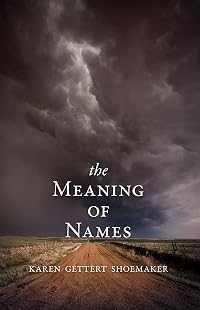
The Meaning of Names
by Karen Shoemaker
On This Page
Description
"Set in 1918 in the farm country at the heart of America, The Meaning of Names is the story of an ordinary woman trying to raise a family during extraordinary times. Estranged from her parents because she married against their will, confronted with violence and prejudice against her people, and caught up in the midst of the worst plague the world has ever seen, Gerda Vogel, an American of German descent, must find the strength to keep her family safe from the effects of a war that threatened show more to consume the whole world. The Meaning of Names re-creates a world gone by that speaks eloquently to modern day issues" -- show lessTags
Recommendations

















Member Reviews
One of the most beautiful books I've ever read. I took my time with it for the first 100 pages, mostly because Shoemaker's language is so gorgeous and dense that each chapter felt like a feast; I needed time to digest before moving on.
This was also a timely read--I put Nov. 4 as my start date, but I think I started reading it at the end of October. The anti-German, hyper-patriotic, xenophobic sentiment of 1917-1918 reminded me much of the toxic election season that coincided with my reading of this book. On one hand, I was comforted because I know we came out on the other side of such awful treatment of others. On the other hand, I was devastated because we simply refuse to learn from history.
I do not seek out fiction, and had this show more book not been on Nebraska's reading challenge, and had I not heard Shoemaker read her work on two separate occasions, I'm not sure I would have picked this one up. And that would have made my life much poorer than it is now that I've finished it. Read, read, read this book. show less
This was also a timely read--I put Nov. 4 as my start date, but I think I started reading it at the end of October. The anti-German, hyper-patriotic, xenophobic sentiment of 1917-1918 reminded me much of the toxic election season that coincided with my reading of this book. On one hand, I was comforted because I know we came out on the other side of such awful treatment of others. On the other hand, I was devastated because we simply refuse to learn from history.
I do not seek out fiction, and had this show more book not been on Nebraska's reading challenge, and had I not heard Shoemaker read her work on two separate occasions, I'm not sure I would have picked this one up. And that would have made my life much poorer than it is now that I've finished it. Read, read, read this book. show less
Reading this book, makes me wish I’d asked my German grandmother more questions. She, too, was a homesteader in Nebraska. It’s just lately, that I’ve come to realize that anyone who was German was looked on as a traitor during the First World War. Told from the perspective of a first-generation German-American woman who was disowned by her father because she refused to obey his directive to marry the man he approved of, the reader sees not only the impact of the war on German Americans, but how families can become divided as well by personal issues. Add the threat of a husband being drafted leaving a woman with four children, and the influenza epidemic, there’s a lot of history in this fictional account. I wish I’d ask my show more Grandma so many more questions. show less
Historical fiction is my favorite genre. This one was captivating mainly due to the setting - Nebraska during WWI and an influenza epidemic. The prejudice against German-Americans was very personal and wrote with prose that read like poetry. I loved the wording the author used to describe the plains - the palm of your hand. Many times throughout the novel I would ponder on her details and smile. I felt a connection to Gerda and her internal struggles as well as her love for her family. There are scenes written in such a way that I'll keep the images with me for a while - under Elizabeth's bed, the train to West Point, the letters from the postal carrier, the big storm, Owen's store, and the Vogel's home. Shoemaker crafted a tender and show more unforgettable novel. show less
Smaller presses are great. They put out tons of wonderful material every year. But the most captivating and well-worked stories often end up with the larger presses. It's as simple as survival of the fittest (or influence of the richest). There are always exceptions, of course. One notable exception in 2014 is Karen Gettert Shoemaker's The Meaning of Names. This little novel can go head to head with the big boys. It's eloquent, passionate, and entertaining. If you're wanting to get a head start on the year's best fiction, especially if you're in the market for historical fiction, check this one out.
The Meaning of Names is the story of Stuart, Nebraska in 1918. Anti-German sentiments are sweeping the country, as is a deadly strain of show more influenza. The first chapter pulled me right in. After that, it took a little time for the story to build up, but once it did, it was well worth the wait. The characters are believable. The storyline is interesting. The setting is vivid. The tension is great. But the element that stood out the most to me was the language. Shoemaker weaves some beautiful sentences that come together to create fabulous scenes. Despite the grit of the plains and the spread of a pandemic, I enjoyed being wrapped up in the world Shoemaker molded. show less
The Meaning of Names is the story of Stuart, Nebraska in 1918. Anti-German sentiments are sweeping the country, as is a deadly strain of show more influenza. The first chapter pulled me right in. After that, it took a little time for the story to build up, but once it did, it was well worth the wait. The characters are believable. The storyline is interesting. The setting is vivid. The tension is great. But the element that stood out the most to me was the language. Shoemaker weaves some beautiful sentences that come together to create fabulous scenes. Despite the grit of the plains and the spread of a pandemic, I enjoyed being wrapped up in the world Shoemaker molded. show less
Gerta suffers a tragedy when she is young, one that will haunt her throughout her life. Leaving West Point, against the wishes of her father, she marries Fritz and they buy a farm, settling in Stuart, Nebraska.
The year is 1918 and the farming life is a hard one. With four young children Greta is constantly busy, inside and outside the house. Yet their family is strong, but is it strong enough to withstand the draft when Fritz's name come up and when anti-German sentiment rears its ugly head in their small town? Soon German families are leaving but Fritz and Greta stay, not wanting to give up something for which they have worked so hard.
The characters in this novel are so very real, from the hardworking doctor to the young fervent show more priest taking over the parish church. This is a novel of a small town, all its characters, its prejudices, families helping families often at great risk to themselves. It is the best and worst of small towns and the prejudices of its people. Hard work and the joys and sorrows of families. Soon however, they will be confronted with something that will enact a higher toll than war and prejudice, one they will have few weapons against.
A beautifully written novel, emotionally stirring and greatly representative of a time and place. So happy I found and read this wonderful book. show less
The year is 1918 and the farming life is a hard one. With four young children Greta is constantly busy, inside and outside the house. Yet their family is strong, but is it strong enough to withstand the draft when Fritz's name come up and when anti-German sentiment rears its ugly head in their small town? Soon German families are leaving but Fritz and Greta stay, not wanting to give up something for which they have worked so hard.
The characters in this novel are so very real, from the hardworking doctor to the young fervent show more priest taking over the parish church. This is a novel of a small town, all its characters, its prejudices, families helping families often at great risk to themselves. It is the best and worst of small towns and the prejudices of its people. Hard work and the joys and sorrows of families. Soon however, they will be confronted with something that will enact a higher toll than war and prejudice, one they will have few weapons against.
A beautifully written novel, emotionally stirring and greatly representative of a time and place. So happy I found and read this wonderful book. show less
The Nebraska Library Commission encourages all Nebraskans to read a particular book each year to encourage a shared dialogue throughout the state. This year they chose The Meaning of Names [2014] by Karen Gettert Shoemaker. The author loosely tells the story of her grandmother’s family who homesteaded near Stuart, Nebraska. Gerda and Fritz Vogel contend with everything 1918 has to offer, including anti-German prejudices and the dread that surrounds World War I as well as the horrors of the flu pandemic.
Tensions against people of German descent build in Stuart until the community finds itself battling an unexpected enemy, the flu. About the flu in the fall of 1918 Shoemaker writes, “Around the world millions would die of it in less show more than three months. While the world focused on a war in which Man killed Man with horrific abandon, Death slipped behind the battle lines and entered their homes, took their families.” By the end of the pandemic, in the US one person in every five had caught the flu.
Shoemaker writes fully developed characters and has clearly done a lot of research about the time period. She writes in today’s language which makes the book stand apart from some of the older books about the German community’s arrival in the plains states. In all, it is an engaging book I was anxious to finish.
I confess I was naughty. I peeked at the last chapter early on. I almost never peek, but I had to have some idea what was going to happen. The ending. No spoilers here, but I wanted to let you know a couple of things, first you might need a hankie (I found it very touching), second the author ended the book the way it played out in her family.
I would recommend this book for Nebraska history buffs and also for anyone who likes a good novel or who wants to read the book Nebraskans are talking about this year. show less
Tensions against people of German descent build in Stuart until the community finds itself battling an unexpected enemy, the flu. About the flu in the fall of 1918 Shoemaker writes, “Around the world millions would die of it in less show more than three months. While the world focused on a war in which Man killed Man with horrific abandon, Death slipped behind the battle lines and entered their homes, took their families.” By the end of the pandemic, in the US one person in every five had caught the flu.
Shoemaker writes fully developed characters and has clearly done a lot of research about the time period. She writes in today’s language which makes the book stand apart from some of the older books about the German community’s arrival in the plains states. In all, it is an engaging book I was anxious to finish.
I confess I was naughty. I peeked at the last chapter early on. I almost never peek, but I had to have some idea what was going to happen. The ending. No spoilers here, but I wanted to let you know a couple of things, first you might need a hankie (I found it very touching), second the author ended the book the way it played out in her family.
I would recommend this book for Nebraska history buffs and also for anyone who likes a good novel or who wants to read the book Nebraskans are talking about this year. show less
This is a fictional book set in 1918 Nebraska. It tells the story about a German farm family and the struggles they faced with anti German attitudes, a flu epidemic and a World War. It is very well written.
Members
- Recently Added By
Author Information
1 Work 69 Members
Awards and Honors
Awards
Common Knowledge
- Original publication date
- 2014
- People/Characters
- Gerda Vogel
- Important places
- Nebraska, USA
- Important events
- World War I
- Epigraph
- In embryonic life, a baby girl's ovaries are endowed with a fixed number of ova and at birth they will contain all the eggs her body will ever produce, In organs no bigger than the very tip of her mother's little finger are... (show all) nestled the seeds of the next generation.
"We are nesting boxes," our mother told us, "the future always within us." - Dedication
- Dedicated to my mother
Christina Margaretha Vogel Gettert
October 14, 1918 - May 8, 2011 - First words
- When Gerda was five, her older sister came home to die.
- Last words
- (Click to show. Warning: May contain spoilers.)Of what, of what, of what, they all ask, of what had she been so afraid?
Classifications
Statistics
- Members
- 69
- Popularity
- 452,451
- Reviews
- 9
- Rating
- (4.30)
- Languages
- English
- Media
- Paper, Ebook
- ISBNs
- 1
- ASINs
- 1