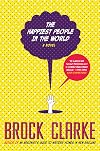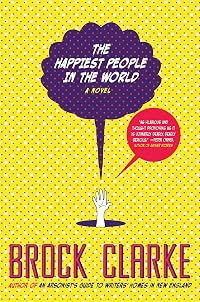
The Happiest People in the World
by Brock Clarke
On This Page
Description
"[A] dark and funny satire . . . Infidelities, secret identities and double-crosses . . . Reflects the absurdity of any country obsessed with spying on its own people." —The Wall Street JournalTake the format of a spy thriller, shape it around real-life incidents involving international terrorism, leaven it with dark, dry humor, toss in a love rectangle, give everybody a gun, and let everything play out in the outer reaches of upstate New York—there you have an idea of Brock Clarke's show more new novel. Filled with wonder and anger in almost equal parts,The Happiest People in the World is a ripped-from-the-headlines tale of paranoia and the all-American obsession with security and the conspiracies that threaten it.
"A literary first: a book that feels like the love child of Saul Bellow and Hogan's Heroes, full of authorial cartwheels of comedy and profundity." —GQ
"The Happiest People in the World begins with a raucous bar scene featuring party streamers, smoke, prone bodies, spilled fluids and a stuffed moose with a surveillance camera in its left eye . . . [Clarke has] success in dreaming up oddball originals that have instant appeal." —Janet Maslin, The New York Times
"[Clarke] creates books that taste like delicious cuts of absurdity marbled with erudition." —The Washington Post
"A whiz-bang spy satire bundled in an edgy tale of redemption . . . His comedy of errors is impossible to put down." —Publishers Weekly, starred review
"A darkly hilarious novel . . . The writing is clever, the dialogue snappy and understated, and the effect is as pleasantly unsettling as anything Kurt Vonnegut Jr. ever wrote." —The Portland Sun
"A zany and fast-paced book that explores the myriad ways people of all nations make themselves and others unhappy." —Chicago Tribune, Printer's Row
"Ranks among the funniest and most relevant social satires I've read . . . It might just make you the happiest reader in the world." —The Dallas Morning News
. show less
Tags
Recommendations


Member Reviews
Humor or satire are the wrong words to describe Brock Clarke's newest work. I might call it a Vonnegut-esque tragedy instead. It's characters were deeply human in their inability to connect with one another, and their many foibles wound the novel up like a clock. Like a Shakespearean tragedy, we begin at the end, then see how we got there. The book's final act left me uninspired, with none of the joy that keeps Vonnegut's best novels driving forward.
 This review was written for LibraryThing Early Reviewers.
Somehow Brock Clarke has flown under my radar until now. It's hard to believe that I have missed a title as delicious as An Arsonist's Guide to Writers' Homes in New England, but I did. However, thanks to a book giveaway by Algonquin Press, I ended up with a copy of Clark's next novel, The Happiest People in the World. That this refers to Danes, and that we'd just had a long discussion with a Danish friend about the virtues of her country, I was eager to read the book.
Remember back in 2005, when a Danish newspaper published a series of cartoons which depicted the prophet Muhammad, and the resulting objection caused protests, riots, and a boycott of Danish goods in some countries? I think there were even death threats made against the show more artist, but haven't looked that up to verify. Clarke has loosely based this novel around those events. In this case, a somewhat hapless Skagen newspaper artist creates a response cartoon, which results in his home and the newspaper office being firebombed. The end result is that he goes into hiding, ending up in upstate New York (actually Boonville, which actually bills itself as the snow mobile capitol of the world, though not in this book -- the things you learn about upstate NY when you are a reader.) There, he becomes the guidance counselor at the local school, which should have worked out well, except a) the town actually has a recruiting presence for the CIA, b) a hit man is on his way to find him, and c) everyone in the books is a bit off-kilter in how they view life. Oh, and there's a moose head in it. With a camera. And a microphone that doesn't work. Brilliant
This really was a well written, attention getting book, very funny in some parts, but I read it with the feeling of a train going downhill, without brakes. From the beginning of the book, you know true disaster is coming. It's just a matter of who will escape and how they'll survive after. But I read on, waiting for the train wreck, amazed at all that gathered and scattered as it came to the inevitable crash.
I will look for more by this author. Thank you Algonquin Press for sending this book my way. To date, I've never read a publication from Algonquin which didn't get me thinking, and tickle some aspect of my reader fancy. This was no exception. show less
Remember back in 2005, when a Danish newspaper published a series of cartoons which depicted the prophet Muhammad, and the resulting objection caused protests, riots, and a boycott of Danish goods in some countries? I think there were even death threats made against the show more artist, but haven't looked that up to verify. Clarke has loosely based this novel around those events. In this case, a somewhat hapless Skagen newspaper artist creates a response cartoon, which results in his home and the newspaper office being firebombed. The end result is that he goes into hiding, ending up in upstate New York (actually Boonville, which actually bills itself as the snow mobile capitol of the world, though not in this book -- the things you learn about upstate NY when you are a reader.) There, he becomes the guidance counselor at the local school, which should have worked out well, except a) the town actually has a recruiting presence for the CIA, b) a hit man is on his way to find him, and c) everyone in the books is a bit off-kilter in how they view life. Oh, and there's a moose head in it. With a camera. And a microphone that doesn't work. Brilliant
This really was a well written, attention getting book, very funny in some parts, but I read it with the feeling of a train going downhill, without brakes. From the beginning of the book, you know true disaster is coming. It's just a matter of who will escape and how they'll survive after. But I read on, waiting for the train wreck, amazed at all that gathered and scattered as it came to the inevitable crash.
I will look for more by this author. Thank you Algonquin Press for sending this book my way. To date, I've never read a publication from Algonquin which didn't get me thinking, and tickle some aspect of my reader fancy. This was no exception. show less
For the record: I received this book (an actual hardcover book!) for review from Algonquin Books, through LibraryThing’s Early Reviewers program. This does not affect the content of my review, but since I truly did love the book, I’m incredibly thankful to have a “real” copy and not just an ARC.
I’ve delayed this review so long, I hardly know where to begin. So, I will begin at the beginning. The novel contains eight parts, with a total of 67 chapters. The lengths of the parts are wildly uneven: Part one contains chapter 1, which is only four pages long. It doesn’t quite function as a prologue, exactly, but sort of as a smoky glimpse of things to come. I use the word “smoky” to mean the scene is literally smoky. The first show more page of the book contains the sentence, “The smoke was so thick the moose head was barely able to see the people it was intended to spy on.” From the book’s jacket, the reader learns that the novel will include a cartoonist from Denmark -- home of “the happiest people in the world” (except for that guy Hamlet, who I seem to recall was super unhappy) -- and some CIA agents, and a high school principal in a small town in upstate New York, plus the principal’s wife. We know there are CIA agents, so the mention of spying right on the first page isn’t wholly unexpected.
Part two begins with chapter 2, in which we meet the aforementioned Danish cartoonist. The timing of my reading of this book was very strange. I got the book in October, but didn’t actually read it until early January. Only a few days after the attacks on the satirical newspaper Charlie Hebdo in Paris, I found myself reading about a similar kind of situation in a fictitious newspaper in Denmark. I had waited too long to start reading the book, but ended up reading it almost simultaneously with current real-world events. In the novel, the reason the cartoonist draws a controversial cartoon depicting the prophet Muhammad is quite mundane: his boss tells him to draw one. The reason the boss tells him to draw the cartoon is really a slap in the face for anyone who believes in freedom of expression: the editor hates his job, but the newspaper had been “owned and run by his family for almost two centuries. Quitting the paper would be like quitting his family” (p. 14). He realizes that if the paper prints a controversial cartoon, the backlash will require him to close up shop, and he’ll no longer be stuck in this job that he hates. (Selfish bastard.)
The newspaper offices are attacked, and the cartoonist’s house is burned down. The cartoonist is declared dead, but in reality, he’s alive and being protected by the CIA. After a couple few years of being shuttled here and there, the Danish cartoonist is given a new identity, Henry Larsen of Sweden. His CIA handler, a woman nicknamed Locs, travels with him to the US, then puts him on a bus to a little town in upstate New York called Broomeville. We learn that Locs used to live in Broomeville, and had an affair with the junior-senior high school principal, Matty. Although he had loved Locs, he’d broken it off with her and remained with his wife, Ellen, and their son, Kurt. Before bringing Henry to America, Locs got in contact with Matty, told him that she’d joined the CIA after their affair ended, and asked him if he had a job available for the man under her protection. Matty agrees to hire Henry Larsen as the school’s guidance counselor.
The novel’s plot is fairly complicated, and there are a number of quirky characters, but I felt most of the central characters were fleshed out and interesting. Although the details of the plot were far-fetched and improbable, the characters’ actions and emotions rang true. Locs still misses Matty, still loves him, although their affair ended seven years before. Ellen is still hurt by Matty’s betrayal, and when she hears someone else refer to him as “Matthew,” the name only Locs called him, she’s instantly suspicious. Their son Kurt, now a teenager, is intrigued by Henry, and curious about his sudden appearance in Broomeville, but also tells him impulsively when they first meet, “‘I’m definitely going to be needing your guidance counseling’” (p.77).
I found Brock Clarke’s writing to be propulsive. The book I read right before this one was a novella -- I think it was less than 100 pages -- and it took me about ten days to finish it. Then I started The Happiest People in the World, and I tore through it in three days. I thought the premise was interesting, and the first couple of chapters pulled me in quickly. In chapter 5, when Locs calls Matty to tell him she’s with the CIA and ask if he can give Henry a job, this paragraph appears:
“Fair enough,” Matty said, and immediately he wished he hadn’t. She had once accused him of saying that -- “fair enough” -- way too often and in response to things that weren’t fair enough at all, and then they’d gotten into a fight about it, his gist being, did she have to be such a bitch, and her gist being, she wouldn’t have to be such a bitch if he didn’t say “fair enough” all the time. (pp. 26-27)
I read that, laughed out loud, then walked to the other room and read the paragraph to my husband. From that point, I was all in on this novel. I liked the main characters, the secondary characters were pretty entertaining, the plot kept me guessing, but the thing I enjoyed most about the book was that tone, that voice, which could be funny, or serious, or sometimes both at the same time. The all-over-the-place feeling reminded me of my response to the novel A Fraction of the Whole by Steve Toltz, which I read in 2011 and love love loved; this is the first time another novel reminded me of Toltz's book. (That title links to my post about the book, in case wacky happenings are your thing.)
Here’s an extreme example, in which Ellen is driving Henry to the school in the snow, a ride that takes approximately one minute. If you like this, then you should definitely give this book a try.
In this way, Henry learned several things.That once Americans were out of the cold and in their trucks, they did not like to get back out into the cold, even if it meant making the inside of their trucks as cold as the outside; that American weathermen liked to refer to snow as “the white stuff”; that American sports talk radio announcers liked to say about something, “There’s no doubt about it,” before then expressing their many doubts about it; that American political commentators liked to preface their comments by saying, “No offense,” before then saying something offensive (the political commentator on the radio had said to whomever he was talking to, “No offense, but you have to be the stupidest human being on the planet”); that Americans were very impatient people with very short attention spans; that Americans believed as long as they were inside their trucks they were invisible, and that as long as they smoked cigarettes inside their trucks they would not then smell like cigarettes once they exited their trucks, and that in general Americans thought their trucks were magic; that while Europeans tended to think of Americans as people who liked to drive incredibly long distances in their pickup trucks, in fact Americans liked to drive incredibly short distances in their pickup trucks as well. These were the lessons Henry learned about Americans during his first minute in Ellen’s truck, and not once was he forced to reconsider them during all his days in Broomeville. (p. 92)
These are over-generalizations, of course, but there’s some amount of truth to them, in that everything in the paragraph sounds familiar to me. I’ve never driven a pickup truck, but I really do like my car, and most Americans seem to be quite fond of their motor vehicles. Meteorologists really do use the term “the white stuff” in areas of the country that get snowfall. Talk radio … well, no offense, but I think Clarke’s got the gist of it. If you can’t stand this paragraph, the book is probably not for you, although as I said, this is one of the more extreme examples. But, if you read it and thought, “Yes, I want more!” then you’ve come to the right place.
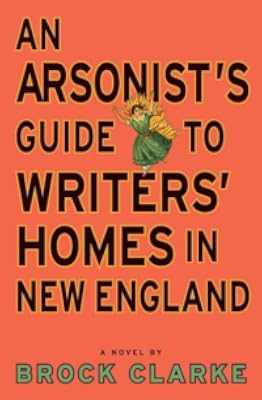
I loved taking the crazy journeys Clarke maps out in this novel. I was interested in his previous novel because of its unusual title, An Arsonist’s Guide to Writers’ Homes in New England, but hadn’t actually read it. Now that I’ve read The Happiest People twice, I decided to purchase that earlier book for my ereader. I don’t think I’ll be disappointed. show less
I’ve delayed this review so long, I hardly know where to begin. So, I will begin at the beginning. The novel contains eight parts, with a total of 67 chapters. The lengths of the parts are wildly uneven: Part one contains chapter 1, which is only four pages long. It doesn’t quite function as a prologue, exactly, but sort of as a smoky glimpse of things to come. I use the word “smoky” to mean the scene is literally smoky. The first show more page of the book contains the sentence, “The smoke was so thick the moose head was barely able to see the people it was intended to spy on.” From the book’s jacket, the reader learns that the novel will include a cartoonist from Denmark -- home of “the happiest people in the world” (except for that guy Hamlet, who I seem to recall was super unhappy) -- and some CIA agents, and a high school principal in a small town in upstate New York, plus the principal’s wife. We know there are CIA agents, so the mention of spying right on the first page isn’t wholly unexpected.
Part two begins with chapter 2, in which we meet the aforementioned Danish cartoonist. The timing of my reading of this book was very strange. I got the book in October, but didn’t actually read it until early January. Only a few days after the attacks on the satirical newspaper Charlie Hebdo in Paris, I found myself reading about a similar kind of situation in a fictitious newspaper in Denmark. I had waited too long to start reading the book, but ended up reading it almost simultaneously with current real-world events. In the novel, the reason the cartoonist draws a controversial cartoon depicting the prophet Muhammad is quite mundane: his boss tells him to draw one. The reason the boss tells him to draw the cartoon is really a slap in the face for anyone who believes in freedom of expression: the editor hates his job, but the newspaper had been “owned and run by his family for almost two centuries. Quitting the paper would be like quitting his family” (p. 14). He realizes that if the paper prints a controversial cartoon, the backlash will require him to close up shop, and he’ll no longer be stuck in this job that he hates. (Selfish bastard.)
The newspaper offices are attacked, and the cartoonist’s house is burned down. The cartoonist is declared dead, but in reality, he’s alive and being protected by the CIA. After a couple few years of being shuttled here and there, the Danish cartoonist is given a new identity, Henry Larsen of Sweden. His CIA handler, a woman nicknamed Locs, travels with him to the US, then puts him on a bus to a little town in upstate New York called Broomeville. We learn that Locs used to live in Broomeville, and had an affair with the junior-senior high school principal, Matty. Although he had loved Locs, he’d broken it off with her and remained with his wife, Ellen, and their son, Kurt. Before bringing Henry to America, Locs got in contact with Matty, told him that she’d joined the CIA after their affair ended, and asked him if he had a job available for the man under her protection. Matty agrees to hire Henry Larsen as the school’s guidance counselor.
The novel’s plot is fairly complicated, and there are a number of quirky characters, but I felt most of the central characters were fleshed out and interesting. Although the details of the plot were far-fetched and improbable, the characters’ actions and emotions rang true. Locs still misses Matty, still loves him, although their affair ended seven years before. Ellen is still hurt by Matty’s betrayal, and when she hears someone else refer to him as “Matthew,” the name only Locs called him, she’s instantly suspicious. Their son Kurt, now a teenager, is intrigued by Henry, and curious about his sudden appearance in Broomeville, but also tells him impulsively when they first meet, “‘I’m definitely going to be needing your guidance counseling’” (p.77).
I found Brock Clarke’s writing to be propulsive. The book I read right before this one was a novella -- I think it was less than 100 pages -- and it took me about ten days to finish it. Then I started The Happiest People in the World, and I tore through it in three days. I thought the premise was interesting, and the first couple of chapters pulled me in quickly. In chapter 5, when Locs calls Matty to tell him she’s with the CIA and ask if he can give Henry a job, this paragraph appears:
“Fair enough,” Matty said, and immediately he wished he hadn’t. She had once accused him of saying that -- “fair enough” -- way too often and in response to things that weren’t fair enough at all, and then they’d gotten into a fight about it, his gist being, did she have to be such a bitch, and her gist being, she wouldn’t have to be such a bitch if he didn’t say “fair enough” all the time. (pp. 26-27)
I read that, laughed out loud, then walked to the other room and read the paragraph to my husband. From that point, I was all in on this novel. I liked the main characters, the secondary characters were pretty entertaining, the plot kept me guessing, but the thing I enjoyed most about the book was that tone, that voice, which could be funny, or serious, or sometimes both at the same time. The all-over-the-place feeling reminded me of my response to the novel A Fraction of the Whole by Steve Toltz, which I read in 2011 and love love loved; this is the first time another novel reminded me of Toltz's book. (That title links to my post about the book, in case wacky happenings are your thing.)
Here’s an extreme example, in which Ellen is driving Henry to the school in the snow, a ride that takes approximately one minute. If you like this, then you should definitely give this book a try.
In this way, Henry learned several things.That once Americans were out of the cold and in their trucks, they did not like to get back out into the cold, even if it meant making the inside of their trucks as cold as the outside; that American weathermen liked to refer to snow as “the white stuff”; that American sports talk radio announcers liked to say about something, “There’s no doubt about it,” before then expressing their many doubts about it; that American political commentators liked to preface their comments by saying, “No offense,” before then saying something offensive (the political commentator on the radio had said to whomever he was talking to, “No offense, but you have to be the stupidest human being on the planet”); that Americans were very impatient people with very short attention spans; that Americans believed as long as they were inside their trucks they were invisible, and that as long as they smoked cigarettes inside their trucks they would not then smell like cigarettes once they exited their trucks, and that in general Americans thought their trucks were magic; that while Europeans tended to think of Americans as people who liked to drive incredibly long distances in their pickup trucks, in fact Americans liked to drive incredibly short distances in their pickup trucks as well. These were the lessons Henry learned about Americans during his first minute in Ellen’s truck, and not once was he forced to reconsider them during all his days in Broomeville. (p. 92)
These are over-generalizations, of course, but there’s some amount of truth to them, in that everything in the paragraph sounds familiar to me. I’ve never driven a pickup truck, but I really do like my car, and most Americans seem to be quite fond of their motor vehicles. Meteorologists really do use the term “the white stuff” in areas of the country that get snowfall. Talk radio … well, no offense, but I think Clarke’s got the gist of it. If you can’t stand this paragraph, the book is probably not for you, although as I said, this is one of the more extreme examples. But, if you read it and thought, “Yes, I want more!” then you’ve come to the right place.
I loved taking the crazy journeys Clarke maps out in this novel. I was interested in his previous novel because of its unusual title, An Arsonist’s Guide to Writers’ Homes in New England, but hadn’t actually read it. Now that I’ve read The Happiest People twice, I decided to purchase that earlier book for my ereader. I don’t think I’ll be disappointed. show less
This review was written for LibraryThing Early Reviewers.As is often the case I received this book free in exchange for a review. This time it was through LibraryThing. Despite that kindness I give my absolutely candid thoughts below.
Boiling down the plot to its most essential internals, the story revolves around a Danish cartoonist who pokes fun at the wrong religious figure and is forced to flee his life and family to take refuge in America. Once he gets there he finds that all is not as it seems.
To the positive side, the book certainly doesn't fall into any cliche tendencies and always keeps you guessing as to what exactly might be next. Even when you think you've seen what's next the what next you finally end up with is nothing like what you thought you had just a couple of pages ago. The show more back of the jacket describes the book as funny and I don't see funny so much as I do odd. The book's very first chapter, written from the perspective of a mounted moose head, is worth a glare at the least. Our estimable dust jacket also calls the book "smart" and I'd agree with that at least in part. It's not afraid to be bubblingly complex.
To the negative, there are bits of this book that glide along quite nicely but for the majority of it I felt it hard to follow. Most main characters go by at least two names and the primary one goes by three that are used somewhat interchangeably. After a hundred pages I had to go back to the start and take some notes to figure out who was who. Combine that with the tendency of one's mind to wander during much of the text and you end up with a frightful combination fraught with "Who the heck is THAT now?!" moments. Lastly, the story itself starts out bizarrely interesting and ends in an almost frustratingly drawn out manner. By the final 10 pages I was violently apathetic about what was going to happen next and almost threw the book in annoyance. I've never had this exact reaction to a book before and it makes me doubt my sanity in some ways.
In summary, not a book I'd recommend to anyone. It has some clever bits but they're so hard to dig out that I don't think the whole thing was really worth it by the end. That's a pity; it was my hope that the book would make me one of the Happiest People in the World. show less
Boiling down the plot to its most essential internals, the story revolves around a Danish cartoonist who pokes fun at the wrong religious figure and is forced to flee his life and family to take refuge in America. Once he gets there he finds that all is not as it seems.
To the positive side, the book certainly doesn't fall into any cliche tendencies and always keeps you guessing as to what exactly might be next. Even when you think you've seen what's next the what next you finally end up with is nothing like what you thought you had just a couple of pages ago. The show more back of the jacket describes the book as funny and I don't see funny so much as I do odd. The book's very first chapter, written from the perspective of a mounted moose head, is worth a glare at the least. Our estimable dust jacket also calls the book "smart" and I'd agree with that at least in part. It's not afraid to be bubblingly complex.
To the negative, there are bits of this book that glide along quite nicely but for the majority of it I felt it hard to follow. Most main characters go by at least two names and the primary one goes by three that are used somewhat interchangeably. After a hundred pages I had to go back to the start and take some notes to figure out who was who. Combine that with the tendency of one's mind to wander during much of the text and you end up with a frightful combination fraught with "Who the heck is THAT now?!" moments. Lastly, the story itself starts out bizarrely interesting and ends in an almost frustratingly drawn out manner. By the final 10 pages I was violently apathetic about what was going to happen next and almost threw the book in annoyance. I've never had this exact reaction to a book before and it makes me doubt my sanity in some ways.
In summary, not a book I'd recommend to anyone. It has some clever bits but they're so hard to dig out that I don't think the whole thing was really worth it by the end. That's a pity; it was my hope that the book would make me one of the Happiest People in the World. show less
This review was written for LibraryThing Early Reviewers.Review based on ARC.
I have been meaning to read anything by Brock Clarke for years! I'm so glad I won this ARC and was "forced" to read it now (sooner, rather than later). He IS funny and smart and dry and witty and thoughtful and enjoyable to read!
This book.... how to describe it. Jens is a newspaper-political cartoonist in Denmark. When an assignment goes horribly awry, an assassin tries to kill him, and the CIA must step in. He heads to the American northeast, to a small town in New York and poses as a high school guidance counselor. And.... that tells you kind of nothing about the book, but serves as a skeleton. And it's not worth anything because what is great about this story has nothing to do with its plot. Rather, it's the show more characterization and descriptions and humor and observations of an outsider looking in... and of insiders looking at an outsider that make this book so wonderful to read.
It's a quick read, it's funny, it's though-provoking... It presents political and social commentary without being preachy, and it's a story about chances and second chances. One of my favorite things about the book.... I couldn't possibly tell you because it's a spoiler. But I will say (and I really don't think you should read this unless you've already read the book),I finished the book, laid my head down to sleep, then had a Eureka! moment, where I had to re-read the first chapter. Love what he did there.
Highly recommend for people who are looking for a funny, dark, thoughtful commentary, or just an amusing tale about a Dane in New York.... show less
I have been meaning to read anything by Brock Clarke for years! I'm so glad I won this ARC and was "forced" to read it now (sooner, rather than later). He IS funny and smart and dry and witty and thoughtful and enjoyable to read!
This book.... how to describe it. Jens is a newspaper-political cartoonist in Denmark. When an assignment goes horribly awry, an assassin tries to kill him, and the CIA must step in. He heads to the American northeast, to a small town in New York and poses as a high school guidance counselor. And.... that tells you kind of nothing about the book, but serves as a skeleton. And it's not worth anything because what is great about this story has nothing to do with its plot. Rather, it's the show more characterization and descriptions and humor and observations of an outsider looking in... and of insiders looking at an outsider that make this book so wonderful to read.
It's a quick read, it's funny, it's though-provoking... It presents political and social commentary without being preachy, and it's a story about chances and second chances. One of my favorite things about the book.... I couldn't possibly tell you because it's a spoiler. But I will say (and I really don't think you should read this unless you've already read the book),
Highly recommend for people who are looking for a funny, dark, thoughtful commentary, or just an amusing tale about a Dane in New York.... show less
This review was written for LibraryThing Early Reviewers.This probably gets an extra star from me because of the Cornell references—we have that hat. Usually I find books that open with a puzzling preview of mayhem that you won’t understand until later overly formulaic, but this prologue got me thinking and I referenced it several times as I read to be sure I was decoding things correctly. It was well written, but mostly not overwritten (some of the stream of consciousness interior monologues were a bit long) and was a fast and enjoyable read. The characters were well done, you couldn’t predict what was going to happen, and, while events were unbelievable, they were all too believable as well because humans really do mess up, obsess, confess and regress in these ways. The parent-child show more relationships were particularly well done—“because everyone knows that there’s nothing more antagonizing to a son than a father who tries.” I’ll go out of my way to read more by this author. show less
This review was written for LibraryThing Early Reviewers.I received an early review copy of Brock Clarke's The Happiest People in the World.
First of all: Wow. The first little chapter in this book is great. What a grabber. What a great way to both draw in the reader and set a certain tone for the novel. Well done, Brock Clarke. Well done.
I think if I had to put what's going on in this book down to one thing, I'd say it's holding up a mirror to contemporary western society (and especially America) and pointing out its complete absurdity. There's a cartoonist whose life is turned upside down because of his portrayal of Muslims. There are naive teenage terrorists. A person goes into a superstore looking to buy a knife, and a salesperson tries to convince him to buy a gun instead. Huge show more misunderstandings and miscommunications (or complete lack of communication) are rampant and have life-altering repercussions. The explanations people come up with for things are often completely removed from anything real, but people run with them anyway. There's something self-centered about that. In one particularly amusing and disturbing (and that's kind of the book in a nutshell--amusing and disturbing) irony, one character's job is to protect the cartoonist from people who want to kill him because of their misunderstanding of his cartoon, and in short order SHE ends up wanting to kill him because of her misunderstanding of him. How much does the following quote sound like something you encounter on a probably daily basis? "No one responded to that information immediately, though Kurt could sense how much everyone resented him for using this basic point of fact to destroy their fantastic hypothesis." And then there's "The thought solidified in Matty's mind [...] became a fact." Actual facts carry less weight.
For the most part, I enjoyed this book. I wouldn't say I found it funny, exactly, because it's just too true. While the two don't really compare, it's sort of "funny" in the way that Slaughterhouse Five is "funny". You just have to shake your head. It's absurd and sad.
Clarke does have a few writing habits that can be a little annoying. In particular, he sometimes chooses to convey the rush of a person's inner thoughts using big run-on sentences. I can understand wanting to convey the idea that a person's thoughts simply aren't rational--that they're barreling ahead without pausing for analysis, but somehow using this technique over and over doesn't work 100% for me.
I'm a little torn on the rating for this book. If I felt more deeply connected to the characters--if they were a little more fleshed out, a little more real--it would be easy to give this book a full four stars. If there were such a thing as a 3.75, that's what I'd give this book. show less
First of all: Wow. The first little chapter in this book is great. What a grabber. What a great way to both draw in the reader and set a certain tone for the novel. Well done, Brock Clarke. Well done.
I think if I had to put what's going on in this book down to one thing, I'd say it's holding up a mirror to contemporary western society (and especially America) and pointing out its complete absurdity. There's a cartoonist whose life is turned upside down because of his portrayal of Muslims. There are naive teenage terrorists. A person goes into a superstore looking to buy a knife, and a salesperson tries to convince him to buy a gun instead. Huge show more misunderstandings and miscommunications (or complete lack of communication) are rampant and have life-altering repercussions. The explanations people come up with for things are often completely removed from anything real, but people run with them anyway. There's something self-centered about that. In one particularly amusing and disturbing (and that's kind of the book in a nutshell--amusing and disturbing) irony, one character's job is to protect the cartoonist from people who want to kill him because of their misunderstanding of his cartoon, and in short order SHE ends up wanting to kill him because of her misunderstanding of him. How much does the following quote sound like something you encounter on a probably daily basis? "No one responded to that information immediately, though Kurt could sense how much everyone resented him for using this basic point of fact to destroy their fantastic hypothesis." And then there's "The thought solidified in Matty's mind [...] became a fact." Actual facts carry less weight.
For the most part, I enjoyed this book. I wouldn't say I found it funny, exactly, because it's just too true. While the two don't really compare, it's sort of "funny" in the way that Slaughterhouse Five is "funny". You just have to shake your head. It's absurd and sad.
Clarke does have a few writing habits that can be a little annoying. In particular, he sometimes chooses to convey the rush of a person's inner thoughts using big run-on sentences. I can understand wanting to convey the idea that a person's thoughts simply aren't rational--that they're barreling ahead without pausing for analysis, but somehow using this technique over and over doesn't work 100% for me.
I'm a little torn on the rating for this book. If I felt more deeply connected to the characters--if they were a little more fleshed out, a little more real--it would be easy to give this book a full four stars. If there were such a thing as a 3.75, that's what I'd give this book. show less
This review was written for LibraryThing Early Reviewers.Members
- Recently Added By
Lists

Books Set in New York State
65 works; 11 members

Books Read in 2014
2,344 works; 89 members

Books Set in Small Towns and Villages
278 works; 16 members
Author Information

12+ Works 2,357 Members
Brock Clarke teaches creative writing at the University of Cincinnati.
Awards and Honors
Distinctions
Common Knowledge
- Canonical title
- The Happiest People in the World
- Original publication date
- 2014
- Important places
- Broomeville, New York, USA; Skagen, Denmark
Classifications
Statistics
- Members
- 166
- Popularity
- 197,693
- Reviews
- 57
- Rating
- (3.21)
- Languages
- English
- Media
- Paper, Audiobook, Ebook
- ISBNs
- 5
- ASINs
- 1