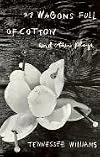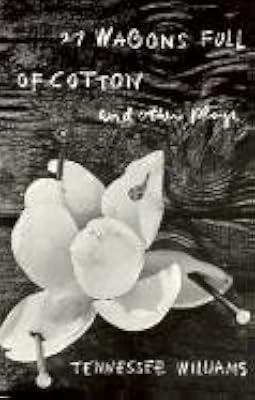
27 Wagons Full of Cotton and Other One-Act Plays
by Tennessee Williams
On This Page
Description
27 WAGONS FULL OF COTTON. Swift and passionate scene. (2 men, 1 woman.) THE PURIFICATION. Poetic drama in New Mexico. (9 men, 6 women.) THE LADY OF LARKSPUR LOTION. Powerful sketch about derelicts. (1 man, 2 women.) THE LAST OF MY SOLID GOLD WATCHES. A character sketch about a salesman. (3 men.) PORTRAIT OF A MADONNA. A sketch of a demented spinster. (4 men, 2 women.) AUTO-DA-F{226}E. Tragic Study of fanaticism. (1 man, 3 women.) LORD BYRON'S LOVE LETTER. A romantic story involving the poet. show more (1 man, 3 women.) THE STRANGEST KIND OF ROMANCE. Sketch of a lonely worker's devotion to his cat. (3 men, 1 woman.) THE LONG GOODBYE. A short study of family life. (2 men, 2 women.) HELLO FROM BERTHA. A tour-de-force sketch set in St. Louis. (4 women.) THIS PROPERTY IS CONDEMNED. A dramatic dialogue. (1 boy, 1 girl.) TALK TO ME LIKE THE RAIN AND LET ME LISTEN{21203d} "Morning-After" scene of moving drama wherein a wife decides to leave her husband under tragic circumstances. (1 man, 1 woman.) SOMETHING UNSPOKEN. Character sketch in which two characters are developed with remarkable insight. A play with an underlying current of irony and horror. (2 women.). show lessTags
Recommendations






















Member Reviews
Very good and very chilling. The husband is so self involved that he is clueless as to the reality of his wife's situation. She pays for being a weak, silly woman. A misogynistic viewpoint, to say the least, but still very effective.
Collection, One-act plays, "This Property is Condemned",
27 Wagons Full of Cotton
The Purification
The Lady of Larkspur Lotion
The Last of My Solid Gold Watches
Portrait of a Madonna
Auto-Da-Fe
Lord Byron's Love Letter
The Strangest Kind of Romance
The Long Goodbye
Hello from Bertha
This Porperty Is Condemned
Talk to Me Like the Rain...
Something Unspoken
The Purification
The Lady of Larkspur Lotion
The Last of My Solid Gold Watches
Portrait of a Madonna
Auto-Da-Fe
Lord Byron's Love Letter
The Strangest Kind of Romance
The Long Goodbye
Hello from Bertha
This Porperty Is Condemned
Talk to Me Like the Rain...
Something Unspoken
Baby Doll failed because it was stigmatized as dirty. Reading or watching it now, it seems fresh and witty, knowing but not lewd. A near-classic, balanced evenly between camp and carnality. It doesn't go as deep as A Streetcar Named Desire, but it's a seamless melding of Williams' abilities as a writer and a scandal-addict.
Aug 11, 2025English (UK)
Ratings
Members
- Recently Added By
Author Information

337+ Works 32,046 Members
After O'Neill, Williams is perhaps the best dramatist the United States has yet produced. Born in his grandfather's rectory in Columbus, Mississippi, Williams and his family later moved to St. Louis. There Williams endured many bad years caused by the abuse of his father and his own anguish over his introverted sister, who was later permanently show more institutionalized. Williams attended the University of Missouri, and, after time out to clerk for a shoe company and for his own mental breakdown, also attended Washington University of St. Louis and the University of Iowa, from which he graduated in 1938. Williams began to write plays in 1935. During 1943 he spent six months as a contract screenwriter for MGM but produced only one script, The Gentleman Caller. When MGM rejected it, Williams turned it into his first major success, The Glass Menagerie (1945). In this intensely autobiographical play, Williams dramatizes the story of Amanda, who dreams of restoring her lost past by finding a gentleman caller for her crippled daughter, and of Amanda's son Tom, who longs to escape from the responsibility of supporting his mother and sister. After The Glass Menagerie,Williams wrote his masterpiece, A Streetcar Named Desire, (1947), along with a steady stream of other plays, among them such major works as Summer and Smoke(1948), Cat on a Hot Tin Roof (1954), and Suddenly Last Summer (1958). His plays celebrate the "fugitive kind," the sensitive outcasts whose outsider status allows them to perceive the horror of the world and who often give additional witness to that horror by becoming its victims. Stephen S. Stanton has summed up Williams's "virtues and strengths" as "a genius for portraiture, particularly of women, a sensitive ear for dialogue and the rhythms of natural speech, a comic talent often manifesting itself in "black comedy,' and a genuine theatrical flair exhibited in telling stage effects attained through lighting, costume, music, and movements." After The Night of the Iguana (1961), Williams continued to write profusely---and constantly to revise his work---but it became more difficult to get productions of his plays and, if they were produced, to win critical or popular acclaim for them. Williams won the Pulitzer Prize for drama for A Streetcar Named Desire and Cat on a Hot Tin Roof. He won the New York Drama Critics Circle Award for these two and for The Glass Menagerie and The Night of the Iguana. (Bowker Author Biography) show less
Some Editions
Series
Belongs to Publisher Series
The Theatre of Tennessee Williams (Volume 6)
Common Knowledge
- Canonical title
- 27 Wagons Full of Cotton and Other One-Act Plays
- Original title
- 27 Wagons Full of Cotton and Other One-Act Plays
- Original publication date
- 1953, expanded edition
- Disambiguation notice
- This book, with the cover as shown here, contains 13 plays. Do not combine with the 1946 edition containing 11 plays, or Volume 6 of Williams' plays, which is called 27 Wagons Full of Cotton and Other Short Plays and co... (show all)ntains 16 plays.
Classifications
Statistics
- Members
- 292
- Popularity
- 110,411
- Reviews
- 4
- Rating
- (3.83)
- Languages
- English, Portuguese
- Media
- Paper, Ebook
- ISBNs
- 7
- ASINs
- 13