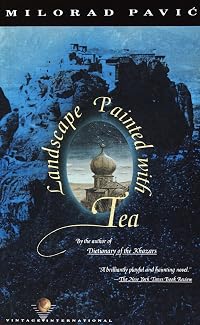
Landscape Painted with Tea
by Milorad Pavić
On This Page
Description
By the author of the highly acclaimed literary bestseller "Dictionary of the Khazars, " "Landscape Painted with Tea, " Milorad Pavic's second novel, is a tale of mysterious quest that is part modern Odyssey and part crossword puzzle. It begins with the story of a brilliant but failed architect in Belgrade and his search for his father, an officer who vanished in Greece during World War II. The truth about his fate--some of it set in motion 2,000 years ago and some of it by the Nazis-- is show more raveled in the history and secrets of Mount Athos, the most ancient of all monasteries, perched atop its inaccessible mountain on the Aegean. show lessTags
Recommendations






Member Reviews
At risk of sounding trite and pretentious, I would say this book is more of an experience than a novel. As with his earlier work, "Dictionary of the Khazars", Pavic uses his unique style to bewitch readers. Pavic is the consummate story-teller. In fact, at times, his "telling" overshadows his story. One can never be sure where Pavic's "story" is going next but one can be sure the ride will be wondrous.
"Landscape" is full of both wisdom and foolishness. It also abounds in complex and, for lack of a better word, bizarre characters. If you are insistent on a well-formed plot, consistent characters, and transcendent meaning, this is NOT your book. If you enjoy unremitting surprises, unpredictable twists, and a somewhat disjointed reality, show more this is your book.
Undoubtedly a unique author with unique talent. show less
"Landscape" is full of both wisdom and foolishness. It also abounds in complex and, for lack of a better word, bizarre characters. If you are insistent on a well-formed plot, consistent characters, and transcendent meaning, this is NOT your book. If you enjoy unremitting surprises, unpredictable twists, and a somewhat disjointed reality, show more this is your book.
Undoubtedly a unique author with unique talent. show less
Every Pavic I pick up seems more inventive than the last. This is a much more straightforward story than the extremely experimental Dictionary of the Khazars, but it still has some playfulness in its second half which is arranged as a crossword and invites the reader to choose to read "down" or "across". Of course the exact explanation for how to do this doesn't come until 80-odd pages later, but the challenge of interpreting a solution will likely be a fun challenge for some readers.
With works like these I tend to let the language and imagery just wash over me and Pavic does not disappoint in that regard either: there is a lot of clever wordplay, fairy and folktales which seem too delightfully playful to be real (or are maybe just show more presented that way expertly by Pavic), wise women making hauntingly mysterious speeches to the men in their life, and anything else you might want in a surrealist novel by an accomplished poet. show less
With works like these I tend to let the language and imagery just wash over me and Pavic does not disappoint in that regard either: there is a lot of clever wordplay, fairy and folktales which seem too delightfully playful to be real (or are maybe just show more presented that way expertly by Pavic), wise women making hauntingly mysterious speeches to the men in their life, and anything else you might want in a surrealist novel by an accomplished poet. show less
Milorad Pavić was a masterful weaver of stories. This novel is a surreal patchwork of allusions, history, religion, conflicts between generations, magical realism... Diving into any of his books is a literary adventure unlike any other.
I wanted to like this book, but ultimately I couldn't bear it. Every single sentence is a metaphor or simile, every single word means something different than it says. Nothing happens, yet at the same time _everything_ is happening--there's no critical engagement of a story, just a sort of hazy and selfish verbal hedonism. It read like the work of a student who's been taught that using concrete phrases--that saying, "he was, he said, he did"--is the mark of an unimaginative and immature writer. Some of these metaphors are, to be true, quite beautiful (the man whose "smile closed his eyes," for example) and some, I imagine, suffer in cultural translation (I thought there was a weird preoccupation with facial hair), but instead of giving show more us a handful of gemstones, we're given a ton of them to carry, and they broke my back (if you'll excuse my own metaphor). show less
This is the first time I have abandoned a book since 1961 when I gave up on Finnegan's Wake. It is too clever by half for me. In my quest for the perfect quirky dreamy novel, this one exceeds even my patience.
It is ironic. I bought this book because I was taken in by the title and the cover. Has the lesson been learned? Let us hope.
Don't judge a book by its cover! Alone. It needs to have additional known redeeming qualities.
This is so sad. I have been hauling this book around since 1990 when it was shiny and new. It should have been read (and abandoned) long ago, and now I have given up at page 18. Not a happy day. Alas.
A moment of silence, please.
It is ironic. I bought this book because I was taken in by the title and the cover. Has the lesson been learned? Let us hope.
Don't judge a book by its cover! Alone. It needs to have additional known redeeming qualities.
This is so sad. I have been hauling this book around since 1990 when it was shiny and new. It should have been read (and abandoned) long ago, and now I have given up at page 18. Not a happy day. Alas.
A moment of silence, please.
Only made it about 20 pages into this.
If you like reading, just to read words on a page, then I would suggest this book. I mean it does have some value, if you like words these are some pretty neat words and phrases and sentences you probably have never heard before. Each line seems to be mystery, or maybe every other line. You read it and then think, "I wonder what that means?" or "Wow, that is a very strange thing to say." It almost seems like some kind of Buddhist exercise. You could read this book for months, analyzing each line and maybe coming up with a couple of theories about what it means and then move on to the next line. It's a different kind of reading experience.
Basically, when I was in college in the early 90's I went show more through a post modern phase and this book was on a list of post modern books, so I picked it up. It's been sitting on my shelf for more than 20 years and I finally picked it up. show less
If you like reading, just to read words on a page, then I would suggest this book. I mean it does have some value, if you like words these are some pretty neat words and phrases and sentences you probably have never heard before. Each line seems to be mystery, or maybe every other line. You read it and then think, "I wonder what that means?" or "Wow, that is a very strange thing to say." It almost seems like some kind of Buddhist exercise. You could read this book for months, analyzing each line and maybe coming up with a couple of theories about what it means and then move on to the next line. It's a different kind of reading experience.
Basically, when I was in college in the early 90's I went show more through a post modern phase and this book was on a list of post modern books, so I picked it up. It's been sitting on my shelf for more than 20 years and I finally picked it up. show less
I'm not sure how to understand this book-- but I'm thoroughly enjoying it all the same. Some really creative use of language here.
Later: still not sure how I feel about this one. The presence of pseudo-folklore/folkloric practices got to be old pretty quickly.
Later: still not sure how I feel about this one. The presence of pseudo-folklore/folkloric practices got to be old pretty quickly.
Members
- Recently Added By
Published Reviews
This was first published in Yugoslavia, translated into French, then translated and published in the USA by Knopf in 1990, and in the UK by Hamilton in 1991. The table of contents shows six numbered chapters in Book One, ‘A Little Night Novel’. Each chapter ‘title’ is a transcription in italics of the opening 15 or so words of the chapter. Book One is followed on page 99 by Book Two, show more ‘A Novel for Crossword Fans’ – not mentioned in the table of contents, and with no table of contents of its own. show less
added by KayCliff
Lists

Speculative Fiction: Slipstream Literature
166 works; 16 members

Shaking a Leg
111 works; 3 members

Ergodic Literature
11 works; 1 member
Author Information

71+ Works 3,558 Members
Milorad Pavic was born in Belgrade on October 15, 1929. After receiving a doctorate from the University of Zagreb, he taught philosophy at the University of Novi Sad followed by the University of Belgrade. During his lifetime, he wrote several novels including Dictionary of the Khazars, Landscape Painted with Tea, The Inner Side of the Wind, and show more Last Love in Constantinople. He also wrote short stories, nonfiction and poetry. He died due to complications of a heart attack on November 30, 2009 at the age of 80. (Bowker Author Biography) show less
Some Editions
Awards and Honors
Distinctions
Work Relationships
Has as a commentary on the text
Common Knowledge
- Canonical title
- Landscape Painted with Tea
- Original title
- Предео сликан чајем; Predeo slikan čajem : roman za ljubitelje ukrštenih reči
- Alternate titles*
- Paysage peint avec du thé : roman
- Original publication date
- 1988
- People/Characters
- Atanas Svilar
- Important places
- Serbia; Yugoslavia
- First words
- They wore the tips of their mustaches braided like whips.
- Last words
- (Click to show. Warning: May contain spoilers.)The reader cannot be so stupid as not to remember what happened next to Atanas Svilar, who, for a time, was called Razin.
- Original language
- Serbian; Serbo-Croatian
*Some information comes from Common Knowledge in other languages. Click "Edit" for more information.
Classifications
- Genres
- Fiction and Literature, General Fiction
- DDC/MDS
- 891.8235 — Literature & rhetoric Literatures of other languages East Indo-European and Celtic literatures West and South Slavic languages (Bulgarian, Slovene, Polish, Czech, Slovak, Serbo-Croatian, and Macedonian) Serbo-Croatian Fiction 1900–1991
- LCC
- PG1419.26 .A78 .P713 — Language and Literature Slavic languages and literatures. Baltic languages. Albanian language Slavic. Baltic. Albanian Serbo-Croatian
- BISAC
Statistics
- Members
- 573
- Popularity
- 51,386
- Reviews
- 10
- Rating
- (3.70)
- Languages
- 10 — Bulgarian, Dutch, English, French, German, Italian, Portuguese, Russian, Serbian, Spanish
- Media
- Paper
- ISBNs
- 24
- ASINs
- 4