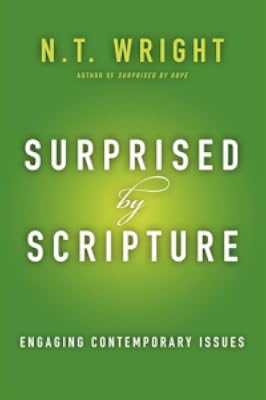
Surprised by Scripture: Engaging Contemporary Issues
by N. T. Wright
On This Page
Description
In this challenging and stimulating collection of popular essays, sermons, and talks, Wright provide a series of case studies which explore how the Bible can be applied to some of the most pressing contemporary issues facing us, including: Why it is possible to love the Bible and affirm evolution Why women should be allowed to be ordained Where Christians today have lost focus, and why it is important for them to engage in politics-and why that involvement benefits everyone Why the Christian show more belief in heaven means we should be at the forefront of the environmental movement And much more. Helpful, practical, and wise, Surprised by Scripture invites readers to examine their own hearts and minds and presents new models for understanding how to affirm the Bible in today's world-as well as new ideas and renewed energy for deepening our faith and engaging with the world around us. show lessTags
Recommendations


Member Reviews
Lots of good stuff here, but some (many) of the ideas would have benefited from a fuller (book length) development. I suppose that is to be expected from a collection of essays on large topics. Not surprisingly, then, the pieces I enjoyed most were those on topics Wright has addressed in books. “Jesus is Coming – Plant a Tree!,”one of my favorites, expands on ideas from Surprised by Hope and For All God's Worth, and “How the Bible Reads the Modern World” on ideas from The Last Word. Conversely, the essays I enjoyed least, the first four, were on topics on which Wright hasn't written books or, at least, I haven't read them. I had been particularly interested in what he would say in “The Biblical Case for Ordinating Women,” show more and there were plenty of good insights there, but his speculations on 1 Timothy 2:8-15, particularly on what prompted the writing of the letter, seemed to me to be... quite speculative. Also, in several essays he gives Lucretius, who seems to pop up everywhere recently, more credit than I am convinced he merits for almost singlehandedly instigating the Enlightenment. A minor quibble though, and his repeated reminders that the way most modern westerners see the world is not historically typical are well taken. While the science/religion essays were not the best, I was interested to see Wright bringing in material from John Walton's The Lost World of Genesis One, which I enjoyed, and Jonathan Sacks's The Great Partnership, which is in my “to read” stack. Overall, I would say this is a nice review and updating of Wright's ideas in a number of areas, which will be most enjoyed by readers who are familiar with his arguments from more in-depth treatments. show less
I wish this work was more complete and scholarly, but still an excellent and sound work. In particular, he puts the Enlightenment, Modernism and Post-Modernism in their proper perspectives. Particularly from the last few chapters, I had the following thought: It seems being Jesus to the community around you requires actions (not debate, arguments, doctrine, etc.), love (of the all-out self-giving sort) and sacrifice. If we can do this, then the rest (doctrine, etc.) matters. If we do not, then the rest is irrelevant.
Chap. 3- Can a Scientist Believe the Resurrection- If you don't force God upstairs someplace faraway where he cannot interfere, then sure you can (If you are a modern Epicurist, then this is a problem). The historical show more evidence can force the question, but it cannot force you to believe in the resurrection.
Chap. 4- The Case for Ordaining Women- Not as complete as I would like, but he makes a strong initial case for this point.
Chap. 5- Jesus is Coming--Plant a Tree- Three points: 1) God's creation is good. 2) God will renew it, and we are called to start that process now. 3) Climate change has social implications, particularly for the poor and vulnerable. show less
Chap. 3- Can a Scientist Believe the Resurrection- If you don't force God upstairs someplace faraway where he cannot interfere, then sure you can (If you are a modern Epicurist, then this is a problem). The historical show more evidence can force the question, but it cannot force you to believe in the resurrection.
Chap. 4- The Case for Ordaining Women- Not as complete as I would like, but he makes a strong initial case for this point.
Chap. 5- Jesus is Coming--Plant a Tree- Three points: 1) God's creation is good. 2) God will renew it, and we are called to start that process now. 3) Climate change has social implications, particularly for the poor and vulnerable. show less
Library - 2016. Didn't finish, ran out of time - p. 123 FINISHED JULY 2017
Ratings
Members
- Recently Added By
Published Reviews
ThingScore 100
It’s a challenging read, a scholarly work that, if carefully studied, could dramatically change how we view our Christianity and our places in the world.
added by aevaughn
Author Information

295+ Works 56,256 Members
N. T. Wright serves as Senior Research Fellow at Wycliffe Hall, Oxford University, as well professor emeritus of New Testament and Early Christianity at the School of Divinity at the University of St. Andrews. He is the award-winning author of many books, including Broken Signposts, Paul: A Biography, Surprised by Hope, and many more.
Common Knowledge
- Original title
- Surprised by Scripture: Engaging Contemporary Issues
- Original publication date
- 2014 by HarperCollins Pub., New York.
Classifications
- Genres
- Religion & Spirituality, Nonfiction, General Nonfiction
- DDC/MDS
- 261 — Religion Christian organization, social work & worship Social theology and interreligious relations and attitudes
- LCC
- BR115 .C8 .W755 — Philosophy, Psychology and Religion Christianity Christianity Christianity in relation to special subjects
- BISAC
Statistics
- Members
- 432
- Popularity
- 71,180
- Reviews
- 3
- Rating
- (4.15)
- Languages
- English
- Media
- Paper, Audiobook, Ebook
- ISBNs
- 9
- ASINs
- 3