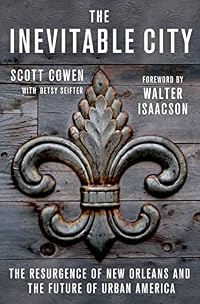
The Inevitable City: The Resurgence of New Orleans and the Future of Urban America
by Scott Cowen
On This Page
Description
"After seven years of service as the president of Tulane University, Scott Cowen watched the devastation of his beloved New Orleans at the hands of Hurricane Katrina. When federal, state, and city officials couldn't find their way to decisive action, Cowen, known for his gutsy leadership, quickly partnered with a coalition of civic, business, and nonprofit leaders looking to work around the old institutions to revitalize and transform New Orleans. This team led the charge to restore show more equilibrium and eventually to rebuild. For the past nine years, Cowen has continued this work, helping to bring the city of New Orleans back from the brink. The Inevitable City presents 10 principles that changed the game for this city, and, if adopted, can alter the curve for any business, endeavor, community--and perhaps even a nation.This is the story of the resurgence and reinvention of one of America's greatest cities. Ordinary citizens, empowered to actively rescue their own city after politicians and government officials failed them, have succeeded in rebuilding their world. Cowen was at the leading edge of those who articulated, shaped, and implemented a vision of transformative change that has yielded surprising social progress and economic growth: a drowned city identified with the shocking images of devastation and breakdown has transformed itself into a mecca of growth, opportunity, and hope"-- show lessTags
Recommendations






















Member Reviews
A combination memoir, urban planning and culture study of New Orleans in the aftermath of Hurricane Katrina.
Scott Cowen has a unique perspective on the city of New Orleans. While not a native Southerner, he is required to be estremely aware of what drives this city and region due to his job as president of Tulane University. But his true trial by fire, as university and city leader, came with Hurricane Katrina and the destruction left in its wake. He tells his story with insight and honesty - no punches pulled but without political hysteria. What he writes is a story of hope and renewal that can be a lesson plan for other urban areas looking to move forward and thrive.
Obviously well written (would anyone expect anything less of a show more university president?) but also well nuanced and thoughtful. I enjoyed his portrayal of the culture of New Orleans and how incredibly diverse it is (and how it deals with this diversity) without resorting to the usual cliches of tourist mecca. In the 'pull no punches' area, he plainly lays out how the 'help' and charity that New Orleans received after the hurricane was frequently anything but - ignoring what was truly needed in favor of what 'should' be done. The tightrope walk of rebuilding required a balance of honoring history while also keeping in sight a moving forward in order to bring about positive and lasting change. It is easy to see that this city has charmed Cowan as it has so many others. An enjoyable read recommended to anyone with interests in Hurricane Katrina history, Tulane University, or New Orleans itself. Urban planners and activists would also find much of interest in this book. show less
Scott Cowen has a unique perspective on the city of New Orleans. While not a native Southerner, he is required to be estremely aware of what drives this city and region due to his job as president of Tulane University. But his true trial by fire, as university and city leader, came with Hurricane Katrina and the destruction left in its wake. He tells his story with insight and honesty - no punches pulled but without political hysteria. What he writes is a story of hope and renewal that can be a lesson plan for other urban areas looking to move forward and thrive.
Obviously well written (would anyone expect anything less of a show more university president?) but also well nuanced and thoughtful. I enjoyed his portrayal of the culture of New Orleans and how incredibly diverse it is (and how it deals with this diversity) without resorting to the usual cliches of tourist mecca. In the 'pull no punches' area, he plainly lays out how the 'help' and charity that New Orleans received after the hurricane was frequently anything but - ignoring what was truly needed in favor of what 'should' be done. The tightrope walk of rebuilding required a balance of honoring history while also keeping in sight a moving forward in order to bring about positive and lasting change. It is easy to see that this city has charmed Cowan as it has so many others. An enjoyable read recommended to anyone with interests in Hurricane Katrina history, Tulane University, or New Orleans itself. Urban planners and activists would also find much of interest in this book. show less
 This review was written for LibraryThing Early Reviewers.
Everyone who was in New Orleans when Hurricane Katrina struck in 2005 has a story. The Inevitable City is Scott Cowan’s story—part recovery from the storm and its aftermath, part a set of guiding principles for aspiring leaders.
Cowan’s memoir is not a tale of rooftops and airlifts, but nevertheless it chronicles a rescue—that of Tulane University, of which Cowan (now retired) was president, and, to a degree, of the city of New Orleans. Like all memoirs, this one presents itself from the subjective perspective of an individual whose “take” on a situation may be incomplete or skewed. As an account of Katrina recovery, it is perhaps neither the most comprehensive nor the most objective. For this reader, its greater value rests show more in the ten principles that steered him as a leader in that recovery.
Each of the book’s ten chapters illustrates one of these principles, which appear in italics near the end of the chapters. “A first principle of leadership,” Cowan writes, for example, “is ‘Do the right thing,’ despite opposition. Leaders have the realism to face the facts, the wisdom to weigh the options, the will to make a decision, and the audacity to act. Which is another way of saying, Stand up and do what you think is best” (p. 23). Another principle, applied to the problem of inner-city crime, has the potential for broad application: “Leaders begin by facing the facts: gathering information in an inclusive way that takes into account different, sometimes conflicting, sets of data. But they go beyond the raw data to search out root causes, interpreting statistics in order to develop innovative approaches that are based both on the evidence and on a sense of a problem’s deep origins. They use these evidence-based approaches to propose reasonable possibilities for the larger community to evaluate and debate” (p. 65-66).
The Inevitable City is well organized and well written. It is not adequate as an introduction to the effects of Hurricane Katrina or the recent history of New Orleans, but will be read most profitably by those who already have some knowledge of those events. show less
Cowan’s memoir is not a tale of rooftops and airlifts, but nevertheless it chronicles a rescue—that of Tulane University, of which Cowan (now retired) was president, and, to a degree, of the city of New Orleans. Like all memoirs, this one presents itself from the subjective perspective of an individual whose “take” on a situation may be incomplete or skewed. As an account of Katrina recovery, it is perhaps neither the most comprehensive nor the most objective. For this reader, its greater value rests show more in the ten principles that steered him as a leader in that recovery.
Each of the book’s ten chapters illustrates one of these principles, which appear in italics near the end of the chapters. “A first principle of leadership,” Cowan writes, for example, “is ‘Do the right thing,’ despite opposition. Leaders have the realism to face the facts, the wisdom to weigh the options, the will to make a decision, and the audacity to act. Which is another way of saying, Stand up and do what you think is best” (p. 23). Another principle, applied to the problem of inner-city crime, has the potential for broad application: “Leaders begin by facing the facts: gathering information in an inclusive way that takes into account different, sometimes conflicting, sets of data. But they go beyond the raw data to search out root causes, interpreting statistics in order to develop innovative approaches that are based both on the evidence and on a sense of a problem’s deep origins. They use these evidence-based approaches to propose reasonable possibilities for the larger community to evaluate and debate” (p. 65-66).
The Inevitable City is well organized and well written. It is not adequate as an introduction to the effects of Hurricane Katrina or the recent history of New Orleans, but will be read most profitably by those who already have some knowledge of those events. show less
This review was written for LibraryThing Early Reviewers.I received this book through LibraryThing Early Reviewers. I had a very hard time convincing myself to pick it up, each time I put it down. The leadership principles evoked were banal and normative, not ground-breaking or surprising. Cowen acknowledges the privileged position that he occupied, so I'm not criticizing him for this, but -- I found that the stories that weren't about privileged people doing leadership-type-things to be somewhat superficial. Since the real tragedy of New Orleans was about the experiences of silenced populations, I found this to be -- not wrong, because Cowen was writing about his own experiences, and that's fine -- but basically just missing the point that I'd want to hear about.
This review was written for LibraryThing Early Reviewers.History says the spoils go to the victors. In NOLA's case, the victor was Hurricane Katrina, who disappeared. So it was up to those remaining to come together to see the city brought back from the literal and real cliff of destruction. Cowen presents a real picture of what happened, where leadership failed, leading to greater destruction, and how the sense of working together toward the same goal, has allowed NOLA to let go of some pre-ordained norms, to try different avenues (like charter schools) and achieve greater success, through rebuilding infra-structure and business alike. This is not a pick it up and hurry read, nor a diary of Cowen's life after Katrina, but a sharing of the good, the bad and the ugly, and the new, and how any show more city at the same brink, can be turned around, if the people there CARE to see their city brought back. That is the key that Cowan's book ultimately honors- how caring about others has allowed the resurgence of NOLA to come about. The book makes for interesting reading and I highly recommend it! show less
This review was written for LibraryThing Early Reviewers.Scott Cowen had been president of Tulane University for seven years when Hurricane Katrina hit. Within days, he and his staff were in a hotel in Houston and his students were scattered throughout the country, with no guarantee when they would return or even whether they would have a university—or a city—to return to. Cowen soon gained a reputation, not only in New Orleans but also nationally, as someone who could get miraculous things done in a crisis. This book looks at the changes that Katrina brought to New Orleans—to the schools, to healthcare, to neighborhoods, even to the newspaper—and assesses the leadership qualities—some Cowen's but many from people in all levels of authority and walks of life—needed to bring about show more positive changes. While Cowen is certainly a New Orleans booster, he doesn't sugar-coat the problems facing the city, including those that result from otherwise benign or positive developments (not for nothing does he repeat the mantra, "No benefit without cost"). Some of the lessons on leadership ("Be inclusive in your fact finding, consider contrarian views, and understand both the root causes of problems and the range of possible solutions," "The first, necessary step in solving problems and implementing change is an accurate and complete articulation of the situation"), set off in italicized paragraphs, will not be new to readers of management literature; rather, it's the human stories of hope, struggle, and determination surrounding them that will stick with readers. Recommended for anyone with an interest in Hurricane Katrina, New Orleans, crisis management, leadership, or urban planning and renewal. show less
This review was written for LibraryThing Early Reviewers.There have been many, many books written about the effect of Hurricane Katrina on New Orleans. Scott Cowen, President of Tulane University, adds his to the list with The Inevitable City, a book that seems to be part memoir, part urban blue print, and part inspirational tale of the city's revival. Though his aim seems noble, and it's clear he loves the New Orleans, I don't really think he brings anything new to the table here, beyond perhaps recounting some of the more long-term consequences of the post-storm population decrease. As I lived in the New Orleans area at the time of the storm I found this book interesting, but I was nonetheless left wondering why Cowen felt the world needed his take on the story as well.
This review was written for LibraryThing Early Reviewers.This is a good book for a very narrow audience. The subject is the recovery of the city of New Orleans after Katrina. Although there are some human interest stories the book was written by the former President of Tulane University so it definitely has an administrative bent to it. So, I see the book as more beneficial to some who care about leadership from a governmental perspective. Essentially the author tries to figure out what worked and what didn't in New Orleans post Karina.
This review was written for LibraryThing Early Reviewers.Members
- Recently Added By
Author Information
2 Works 45 Members
Scott Cowen is president emeritus of Tulane University and was one of the key players in the rebuilding of New Orleans after Hurricane Katrina. His work has been widely covered by the media, including in Fast Company, Newark-based The Star-Ledger, The New York Times, and The Chronicle of Higher Education. He is also a guest panelist on the Sirius show more talk show Doctor Radio. TIME magazine has named President Cowen one of the nation's Top 10 Best College Presidents and flew Orleans City Business called him one of the 30 driving forces in New Orleans in the last 30 years. show less
Classifications
- Genres
- Nonfiction, Business, General Nonfiction
- DDC/MDS
- 307.3 — Society, Government, and Culture Social sciences, sociology & anthropology Communities Structure
- LCC
- HT177 .N49 .C69 — Social sciences Communities. Classes. Races Communities. Classes. Races Urban groups. The city. Urban sociology Urban renewal. Urban redevelopment
- BISAC
Statistics
- Members
- 39
- Popularity
- 744,521
- Reviews
- 8
- Rating
- (3.67)
- Languages
- English
- Media
- Paper, Ebook
- ISBNs
- 2
- ASINs
- 1