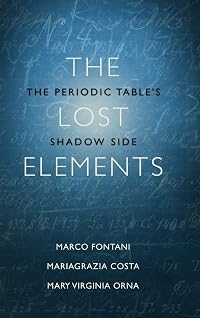
The Lost Elements: The Periodic Table's Shadow Side
by Marco Fontani
On This Page
Description
Throughout its formation, the periodic table has seen false entries, good-faith errors, retractions, and dead ends; in fact, there have been more elemental 'discoveries' that have proven false than there are current elements on the table. This book collects the most notable of these instances, stretching from the nineteenth century to the present. The book tells the story of how scientists have come to understand elements, by discussing the failed theories and false discoveries that shaped show more the path of scientific progress. show lessTags
Recommendations










Member Reviews
Most of this book rates between four and five stars with respect to the amazing amount of information in it. It did take me more than a year to read it because I would read a few pages, put it down, pick it up, and read some more. Wash, rinse, repeat. It's not the type of book I can read from cover-to-cover but that's not intended to be a criticism of the writing style. I found it to be clear and entertaining. A wonderful set of citations, also.
And the amount of information in it. WOW! Almost everything I had read about the elements and their organization into the periodic table was primarily about what had been discovered and little about what had not been discovered.
Hmm... that reads weird.
Anyway, I had read little about discoveries show more of elements that were mistaken. If you stop and think about it for a moment, surely there must have been many of these false discoveries over the years and this book puts so many of them in context. Overall a very enjoyable read.
So why did I give it only one star? In reading a review about it on Amazon I came across something unfortunate. The last part on alchemy appears to be from Robert A. Nelson's Adept Alchemy. I was shocked and went to the page and it appears to be true. You can match chapter titles along with the text with some additions along with some alterations (see Part II).
Damn shame. show less
And the amount of information in it. WOW! Almost everything I had read about the elements and their organization into the periodic table was primarily about what had been discovered and little about what had not been discovered.
Hmm... that reads weird.
Anyway, I had read little about discoveries show more of elements that were mistaken. If you stop and think about it for a moment, surely there must have been many of these false discoveries over the years and this book puts so many of them in context. Overall a very enjoyable read.
So why did I give it only one star? In reading a review about it on Amazon I came across something unfortunate. The last part on alchemy appears to be from Robert A. Nelson's Adept Alchemy. I was shocked and went to the page and it appears to be true. You can match chapter titles along with the text with some additions along with some alterations (see Part II).
Damn shame. show less
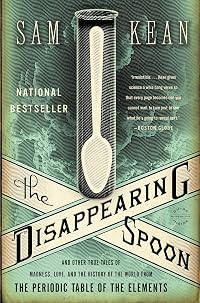
I was expecting something like The Disappearing Spoon, expect with discoveries that turned out to be false. Unfortunately, The Lost Elements is not quite as interesting and isn't written as much for a lay audience as The Disappearing Spoon. I found The Lost Elements to spend a lot of time explaining complicated chemical processes that anybody without a degree in the field will likely not understand or appreciate.
Additionally, many of the stories wound up repeating themselves. By writing the book in chronological order, this meant that some element discoveries were repeated several times as multiple attempts had been made to discover them.
Probably the only thing of merit I really got from this book was the need for integrity in show more scientific research. In fact, it made me wonder what would happen if the merits of discovering something went not to the first scientists to do so, but the ones to successfully reproduce the work. It would certainly have cut a lot of charlatans out of the scientific field. show less
Additionally, many of the stories wound up repeating themselves. By writing the book in chronological order, this meant that some element discoveries were repeated several times as multiple attempts had been made to discover them.
Probably the only thing of merit I really got from this book was the need for integrity in show more scientific research. In fact, it made me wonder what would happen if the merits of discovering something went not to the first scientists to do so, but the ones to successfully reproduce the work. It would certainly have cut a lot of charlatans out of the scientific field. show less
I had heard of only a few of these incorrect discoveries. It is amazing how many elements were falsely believed to exist, and how difficult the process of finding the truth has been.
more a reference than a book most would read
Members
- Recently Added By
Lists

University Presses
155 works; 1 member
Author Information
2 Works 37 Members
Classifications
Statistics
- Members
- 35
- Popularity
- 820,529
- Reviews
- 4
- Rating
- (2.63)
- Languages
- English, Italian
- Media
- Paper, Ebook
- ISBNs
- 5