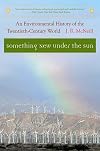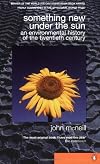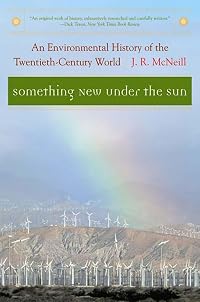
Something New Under the Sun: An Environmental History of the Twentieth-Century World
by J. R. McNeill
On This Page
Description
"In the course of the twentieth century the human race, without intending anything of the sort, has undertaken a giant, uncontrolled experiment on the earth. In time, according to J.R. McNeill in his startling new book, the environmental dimension of twentieth-century history will overshadow the importance of events like the world wars, the rise and fall of communism, and the spread of mass literacy. Contrary to the wisdom of Ecclesiastes that "there is nothing new under the sun," McNeill show more sets out to show that the massive change we have wrought in our physical world has indeed created something new. To a degree unprecedented in human history, we have refashioned the earth's air, water, and soil, and the biosphere of which we are a part." "McNeill's work is a fruitful compound of history and science. McNeill infuses a substrate of ecology with a lively historical sensibility to the significance of politics, international relations, technological change, and great events. He charts and explores the breathtaking ways in which we have changed the natural world with a keen eye for character and a refreshing respect for the unforeseen in history."--Jacket. show lessTags
Recommendations










Member Reviews
This is a first attempt at an inventory of what the 20th century exactly meant in terms of the impact of man on the environment. John R. McNeill (°1954) in detail goes through what human development in the past 100 years has meant for the different biospheres of our planet: starting from the earth's crust, via the atmosphere, the rivers and oceans, to the living beings with whom we share our planet, he paints a particularly negative picture of human intervention and the resulting pollution and biological extinction. For each aspect he explores a few striking examples. This does not provide a very pretty picture, and McNeill clearly warns of the potentially dramatic consequences in the long term.
He also analyses what the driving force show more behind so much human intervention is. For him, this comes down to the growth imperative fetish: Western modernity is obsessed with 'always more', in all domains. This also is the greatest obstacle to taking the environmental crisis seriously. And so his message is that we must eventually get rid of that.
If you read this book carefully, you will notice that McNeill actually still is rather cautious. And that has everything to do with the publication date: 1999. It is clear that a quarter century later we can no longer afford to be so optimistic. More about that in my History account on Goodreads: https://www.goodreads.com/review/show/1986543394. show less
He also analyses what the driving force show more behind so much human intervention is. For him, this comes down to the growth imperative fetish: Western modernity is obsessed with 'always more', in all domains. This also is the greatest obstacle to taking the environmental crisis seriously. And so his message is that we must eventually get rid of that.
If you read this book carefully, you will notice that McNeill actually still is rather cautious. And that has everything to do with the publication date: 1999. It is clear that a quarter century later we can no longer afford to be so optimistic. More about that in my History account on Goodreads: https://www.goodreads.com/review/show/1986543394. show less
Sub-titled "An Environmental History of the 20th Century", this is a sober and objective survey of environmental changes over the past 100 years. I was concerned this would be an emotional appeal or judgmental polemic from the left - but not the case, it is academic and professional history from an environmental perspective (the environment, not "environmental movement"). It's encyclopedic in scope and style.
I would not call this an "entertaining" read (although some of the facts really fire the synapses), but it is deeply rewarding as a broad survey of a very large and complex problem. The chapters and sub-sections are arranged in a logical outline making it possible to read the chapters in any order.
The main idea of the title show more "something new under the sun" is that humans have so fundamentally changed the environment that things really are very different now than they have ever been historically. To regard our current conditions of energy availability, access to water, unending economic growth - as enduring and normal appears to be an interesting gamble given the facts.
Some interesting trivia: humans did not become the dominate primate until about 8,000 BC with the rise of agriculture (baboons outnumbered humans before then). About one-fifth of all humans that ever lived did so in the 20th century. In sheer energy terms, if all modern technology and energy sources were not available, the average American would need about 70 human slaves to maintain the current standard of living (each American "directs" 70 energy-slave equivalents). Each year, humans move more earth and soil than glaciers, wind erosion, mountain building (plate tectonic uplift), and volcanoes combined. Probably the single most damaging biological organism in earths history was the human primate Thomas Midgley Jr from Beaver Falls, Pennsylvania born in 1889. He invented Freon (which destroys the Ozone layer), and also leaded gasoline, which has polluted most of the worlds soil lasting thousands of years (all of us carry elevated lead levels because of it and will continue to do so for centuries to come, leading to birth defects, lowered IQs, etc..). Midgley contracted Polio at age 51 and invented a system or ropes and pulleys to move his crippled body off the bed - he became tangled and was strangled to death in 1944 by his own invention, before learning how damaging his inventions were. show less
I would not call this an "entertaining" read (although some of the facts really fire the synapses), but it is deeply rewarding as a broad survey of a very large and complex problem. The chapters and sub-sections are arranged in a logical outline making it possible to read the chapters in any order.
The main idea of the title show more "something new under the sun" is that humans have so fundamentally changed the environment that things really are very different now than they have ever been historically. To regard our current conditions of energy availability, access to water, unending economic growth - as enduring and normal appears to be an interesting gamble given the facts.
Some interesting trivia: humans did not become the dominate primate until about 8,000 BC with the rise of agriculture (baboons outnumbered humans before then). About one-fifth of all humans that ever lived did so in the 20th century. In sheer energy terms, if all modern technology and energy sources were not available, the average American would need about 70 human slaves to maintain the current standard of living (each American "directs" 70 energy-slave equivalents). Each year, humans move more earth and soil than glaciers, wind erosion, mountain building (plate tectonic uplift), and volcanoes combined. Probably the single most damaging biological organism in earths history was the human primate Thomas Midgley Jr from Beaver Falls, Pennsylvania born in 1889. He invented Freon (which destroys the Ozone layer), and also leaded gasoline, which has polluted most of the worlds soil lasting thousands of years (all of us carry elevated lead levels because of it and will continue to do so for centuries to come, leading to birth defects, lowered IQs, etc..). Midgley contracted Polio at age 51 and invented a system or ropes and pulleys to move his crippled body off the bed - he became tangled and was strangled to death in 1944 by his own invention, before learning how damaging his inventions were. show less
What I learned from this book is that the 20th century is not just "business as usual," much as that term is used in a derogatory way today among environmentalists. Humans really had a very profound and disturbing effect on the environment. The 20th century really was totally, totally different from anything that had happened before. It's the "hockey-stick" graph phenomenon, multiplied over and over again. He talks about cities, biodiversity, the atmosphere, the land, the oceans, everything. He has a firm grasp of the underlying technology that's operating. Obviously this can't continue forever, or even for more than just a few more years, but if there's any doubt on this point in your mind, this would be a good book to start with.
Ratings
Members
- Recently Added By
Lists

Environmental History
46 works; 8 members
Author Information
19+ Works 1,290 Members
Awards and Honors
Series
Belongs to Publisher Series
Common Knowledge
- Canonical title
- Something New Under the Sun: An Environmental History of the Twentieth-Century World
- Original publication date
- 2000
Classifications
- Genres
- Science & Nature, Nonfiction, History, General Nonfiction
- DDC/MDS
- 304.2 — Society, government, & culture Social sciences, sociology & anthropology Factors affecting social behavior Human ecology
- LCC
- GF13 .M39 — Geography, Anthropology and Recreation Human ecology. Anthropogeography Human ecology. Anthropogeography
- BISAC
Statistics
- Members
- 440
- Popularity
- 69,967
- Reviews
- 3
- Rating
- (4.00)
- Languages
- 6 — English, German, Hungarian, Italian, Spanish, Swedish
- Media
- Paper, Ebook
- ISBNs
- 12
- ASINs
- 2