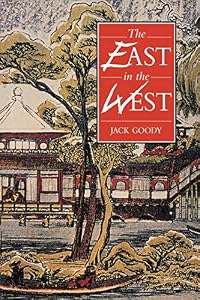
The East in the West
by Jack Goody
On This Page
Description
The East in the West reassesses Western views of Asia. Traditionally many European historians and theorists have seen the societies of the East as 'static' or 'backward'. Jack Goody challenges these assumptions, beginning with the notion of a special Western rationality which enabled 'us' and not 'them' to modernise. He then turns to book-keeping, which several social and economic historians have seen as intrinsic to capitalism, arguing that there was in fact little difference between East show more and West in terms of mercantile activity. Other factors said to inhibit the East's development, such as the family and forms of labour, have also been greatly exaggerated. This Eurocentrism both fails to explain the current achievements of the East, and misunderstands Western history. The East in the West starts to redress the balance, and so marks a fundamental shift in our view of Western and Eastern history and society. show lessTags
Recommendations




















Member Reviews
In a trio of books written during the last decade (this one, plus The Theft of History and The Eurasian Miracle), the cultural anthropologist Jack Goody has put forth a critique of the occidentalist bias in European historical writing. Like any good global historiography, Goody’s critique draws attention to problems in periodization, transregional analysis and the assumed distinctions between societies, and the relative merits of diffusion or evolution as explanations for change over time. This volume proposes several hypotheses towards a reconsideration of the social and cultural practices frequently taken to explain the development of industrial capitalism in the West. For those interested in global history, The East in the West is show more a fine example of the explanatory power accorded to economic culture since the publication of Fernand Braudel’s The Mediterranean in 1949.
Goody’s approach to the problematique of East v. West is to recognize that the major societies of the East are heirs to the same Bronze Age urban revolutions as the West. The differences among the major societies of Eurasia must be seen as diverging from a common base, writes Goody, and so their literate, mercantile sectors acquired much the same potential for commercial and cultural development. Recognizing the common heritage of the Bronze Age means that neither deep, continuing cultural features nor any ‘necessary’ sequence of events support the perception of a permanent pre-eminence for the West. Indeed, since the Bronze Age, there has been an oscillation between periods of Eastern advantage and triumph and periods of Western advantage and triumph. According to Goody, “we need to ask on a much more specific level what factors enabled the East to advance at one period and in one sphere and the West at others.”
Through a succinct, suggestive analysis of some of these specific factors (mercantile bookkeeping, kinship and capital, forms of labor, etc.), Goody develops his argument that neither rationality, individualism, nor a propensity to entrepreneurial risk-taking were characteristics unique to European culture. The belief that rationality as a method began with the classical Greeks has been undermined by the work of Jean Bottéro and others on empiricism, deduction, and logic in ancient Mesopotamia—and Goody provides sources on the forms of instrumental rationality in China, India and the Middle East (at Baghdad’s House of Wisdom, for instance) before the so-called Age of Reason in the West. It is also good to remember that the conquests of Alexander spread Greek syllogistic methods to the East before they arrived in Europe.
"The West has tended to misunderstand even itself in drawing too sharp a contrast between our individualism, our rationality, our nuclear family, and their collectivism, their extended families." These differences are matters of degree rather than of kind, writes Goody, and if we are to absorb the lessons of the East, they do not appear to have much to do with the onset of modernization.
The historiography of the West frequently locates the birthplace of capitalism at Venice, with mercantile activity around the Mediterranean as the necessary predecessor to the industrial revolution of the late 18th century. But, notes Goody, there were equivalent forms of economic activity in India, China, and Japan, equally open to the take-off provided by the investment of fixed capital in the factory system. European historians long misunderstood the scale and scope of the Indian Ocean trade that linked China, the Philippines and Moluccas, India, Persia, Arabia and Africa, much of it carried out by independent merchants organized in guilds. The network of external trade connected to a lively internal market, which required commercial institutions as well as ties to the political and administrative establishments. The presence of contract law and banking in Muslim territories and joint-stock companies and commercial insurance in Mughal India signaled the advent of increasingly complex mercantile economies throughout the region. Upon arrival in India, the British saw active merchant capital (in the processing and distribution of food products and textiles), a money economy, production for the market, and a range of thriving craft industries, which served as a link between the village and long-distance trade. Largely through her own efforts, says Goody, India was approaching the manufacturing stage in the development of capitalism, but the coming of the industrial revolution in England set back the Indian economy and prevented it from developing.
To speak of the birth of commercial activities in the West during the Middle Ages represents a misunderstanding deriving in part from the relative backwardness of Europe after the end of Roman hegemony. What we witness in the later Middle Ages is not so much a birth but a rebirth, or recovery, according to Goody. (What was new was the range of action, especially after Columbus.) Western historians have tended to underplay the achievements of the East during the Middle Ages at a time when it was often Europe that could be considered backward, and to attribute advances in the West to permanent, deep-seated, structural factors.
Ultimately, the holistic notion of culture or social structure (so attractive to social scientists, at least since Max Weber) has failed to account for the earlier imbalance or the swings of the pendulum. “To speak of mentalities or outlooks is to place cognitive processes at the level of abilities rather than capacities,” writes Jack Goody, “and therefore to underestimate the rapidity or even the possibilities of change.” What should be most sobering for the inhabitants of western societies is Goody’s point that the comparative advantage for either East or West has always been temporary. That goes for the lead held by the West in our present, which will one day be the past. show less
Goody’s approach to the problematique of East v. West is to recognize that the major societies of the East are heirs to the same Bronze Age urban revolutions as the West. The differences among the major societies of Eurasia must be seen as diverging from a common base, writes Goody, and so their literate, mercantile sectors acquired much the same potential for commercial and cultural development. Recognizing the common heritage of the Bronze Age means that neither deep, continuing cultural features nor any ‘necessary’ sequence of events support the perception of a permanent pre-eminence for the West. Indeed, since the Bronze Age, there has been an oscillation between periods of Eastern advantage and triumph and periods of Western advantage and triumph. According to Goody, “we need to ask on a much more specific level what factors enabled the East to advance at one period and in one sphere and the West at others.”
Through a succinct, suggestive analysis of some of these specific factors (mercantile bookkeeping, kinship and capital, forms of labor, etc.), Goody develops his argument that neither rationality, individualism, nor a propensity to entrepreneurial risk-taking were characteristics unique to European culture. The belief that rationality as a method began with the classical Greeks has been undermined by the work of Jean Bottéro and others on empiricism, deduction, and logic in ancient Mesopotamia—and Goody provides sources on the forms of instrumental rationality in China, India and the Middle East (at Baghdad’s House of Wisdom, for instance) before the so-called Age of Reason in the West. It is also good to remember that the conquests of Alexander spread Greek syllogistic methods to the East before they arrived in Europe.
"The West has tended to misunderstand even itself in drawing too sharp a contrast between our individualism, our rationality, our nuclear family, and their collectivism, their extended families." These differences are matters of degree rather than of kind, writes Goody, and if we are to absorb the lessons of the East, they do not appear to have much to do with the onset of modernization.
The historiography of the West frequently locates the birthplace of capitalism at Venice, with mercantile activity around the Mediterranean as the necessary predecessor to the industrial revolution of the late 18th century. But, notes Goody, there were equivalent forms of economic activity in India, China, and Japan, equally open to the take-off provided by the investment of fixed capital in the factory system. European historians long misunderstood the scale and scope of the Indian Ocean trade that linked China, the Philippines and Moluccas, India, Persia, Arabia and Africa, much of it carried out by independent merchants organized in guilds. The network of external trade connected to a lively internal market, which required commercial institutions as well as ties to the political and administrative establishments. The presence of contract law and banking in Muslim territories and joint-stock companies and commercial insurance in Mughal India signaled the advent of increasingly complex mercantile economies throughout the region. Upon arrival in India, the British saw active merchant capital (in the processing and distribution of food products and textiles), a money economy, production for the market, and a range of thriving craft industries, which served as a link between the village and long-distance trade. Largely through her own efforts, says Goody, India was approaching the manufacturing stage in the development of capitalism, but the coming of the industrial revolution in England set back the Indian economy and prevented it from developing.
To speak of the birth of commercial activities in the West during the Middle Ages represents a misunderstanding deriving in part from the relative backwardness of Europe after the end of Roman hegemony. What we witness in the later Middle Ages is not so much a birth but a rebirth, or recovery, according to Goody. (What was new was the range of action, especially after Columbus.) Western historians have tended to underplay the achievements of the East during the Middle Ages at a time when it was often Europe that could be considered backward, and to attribute advances in the West to permanent, deep-seated, structural factors.
Ultimately, the holistic notion of culture or social structure (so attractive to social scientists, at least since Max Weber) has failed to account for the earlier imbalance or the swings of the pendulum. “To speak of mentalities or outlooks is to place cognitive processes at the level of abilities rather than capacities,” writes Jack Goody, “and therefore to underestimate the rapidity or even the possibilities of change.” What should be most sobering for the inhabitants of western societies is Goody’s point that the comparative advantage for either East or West has always been temporary. That goes for the lead held by the West in our present, which will one day be the past. show less
Ratings
Members
- Recently Added By
Lists

Books recommended in the history category on FiveBooks.com
329 works; 4 members
Author Information

52 Works 1,440 Members
Jack Goody is Emeritus Professor of Social Anthropology in the University of Cambridge and a Fellow of St John's College
Classifications
Statistics
- Members
- 37
- Popularity
- 778,189
- Reviews
- 1
- Rating
- (3.38)
- Languages
- 5 — Chinese, English, French, Portuguese, Slovenian
- Media
- Paper, Ebook
- ISBNs
- 6