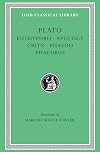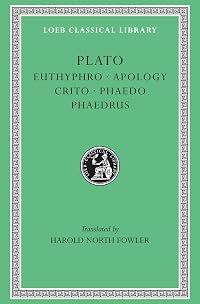
Euthyphro / Apology / Crito / Phaedo / Phaedrus
by Plato
On This Page
Description
For someone whose influence has been so profound on Western thinking remarkably little is known of the Greek philosopher and thinker Plato. Due to the means and social status of his family Plato was most probably educated by some of Athens' finest teachers. The curriculum would have been rich and varied and include the doctrines of Cratylus and Pythagoras as well as Parmenides. Two major events shaped Plato's life whilst he was a young man. The first was a meeting with the great philosopher show more Socrates. Socrates's methods of debate impressed Plato and he soon became a devoted follower. From here would flow Plato's career as one of the finest minds civilization has produced. Major event number two was the on-going rivalry between Athens and Sparta which erupted into the Peloponnesian War. This was, in fact, several 'stop-start' wars fought during the period 431-404 BCE. Plato served in the cause of Athens and its Allies between 409 and 404 B.C.E. The comprehensive defeat of Athens by Sparta ended the Athenian democracy, although after a brief oligarchy it was restored. Plato traveled for a dozen years throughout the Mediterranean, studying mathematics with the Pythagoreans in Italy, as well as geometry, geology, astronomy and religion in Egypt. It was during this time that Plato began his writings, a remarkable number of which survive to this day. The writings themselves are usually classified into three distinct periods although there is some uncertainty as to the exact order in which they were written. Having now returned to Athens Plato embarked upon an extraordinary undertaking. In around 385 B.C.E., he established a school of learning, known as the Academy. The extensive curriculum included astronomy, biology, mathematics, political theory and philosophy. Plato hoped that those who studied there would be future leaders who would be better equipped thorough its teachings to understand how to build a better government. Plato would preside over its teachings until his death in Athens around 348 B.C.E. show lessTags
Recommendations




Member Reviews
What is piety? In this dialogue entitled Euthyphro we find Socrates under indictment and on his way to the trial. He meets a prophet, Euthyphro, who claims to know the nature of piety and plans to prosecute his father for murder of a slave.
The lines are drawn and we are presented with several definitions of piety as Euthyphro attempts to deal with Socrates' questioning. Do we get a definition that works? No, but we find the struggle itself is one that defines the dilemma of the limits of our knowledge, Humility and respect for these limits are the gifts bestowed to the attentive reader - Euthyphro leaves unbowed.
The lines are drawn and we are presented with several definitions of piety as Euthyphro attempts to deal with Socrates' questioning. Do we get a definition that works? No, but we find the struggle itself is one that defines the dilemma of the limits of our knowledge, Humility and respect for these limits are the gifts bestowed to the attentive reader - Euthyphro leaves unbowed.
One of the very best Loeb editions, in my opinion.
Ratings
Members
- Recently Added By
Lists

100 World Classics
99 works; 15 members
Author Information

2,739+ Works 100,769 Members
Plato was born c. 427 B.C. in Athens, Greece, to an aristocratic family very much involved in political government. Pericles, famous ruler of Athens during its golden age, was Plato's stepfather. Plato was well educated and studied under Socrates, with whom he developed a close friendship. When Socrates was publically executed in 399 B.C., Plato show more finally distanced himself from a career in Athenian politics, instead becoming one of the greatest philosophers of Western civilization. Plato extended Socrates's inquiries to his students, one of the most famous being Aristotle. Plato's The Republic is an enduring work, discussing justice, the importance of education, and the qualities needed for rulers to succeed. Plato felt governors must be philosophers so they may govern wisely and effectively. Plato founded the Academy, an educational institution dedicated to pursuing philosophic truth. The Academy lasted well into the 6th century A.D., and is the model for all western universities. Its formation is along the lines Plato laid out in The Republic. Many of Plato's essays and writings survive to this day. Plato died in 347 B.C. at the age of 80. (Bowker Author Biography) show less
Some Editions
Series
Belongs to Publisher Series
Work Relationships
Common Knowledge
- Canonical title
- Euthyphro / Apology / Crito / Phaedo / Phaedrus
- First words
- Euthyphro: Euthyphro: What strange thing has happened, Socrates, that you have left your accustomed haunts in the lyceum and are now haunting the Portico where the king archon sits?
- Quotations
- "This invention [letters], O king," said Theuth, "will make the Egyptians wiser and will improve their memories; for it is an elixir of memory and wisdom that I have discovered." But Thamus replied, "Most ingeniou... (show all)s Theuth, one man has the ability to beget arts, but the ability to judge of their usefulness or harmfulness to their users belongs to another; and now you, who are the father of letters, have been led by your affection to ascribe to them a power the opposite of that which they really possess. For this invention will produce forgetfulnness in the minds of those who learn to use it, because they will not practice their memory..." [tr. Fowler, p. 563]
- Last words
- (Click to show. Warning: May contain spoilers.)Phaedrus:
Phaedrus: Let me also share in this prayer; for friends have all things in common.
Socrates: Let us go. - Original language
- Greek
Classifications
Statistics
- Members
- 448
- Popularity
- 68,319
- Reviews
- 2
- Rating
- (4.38)
- Languages
- 5 — Chinese, English, Finnish, Greek (Ancient), Russian
- Media
- Paper, Ebook
- ISBNs
- 23
- ASINs
- 10