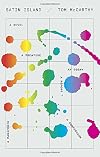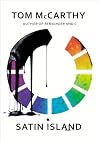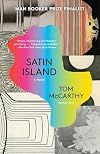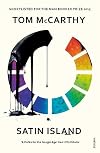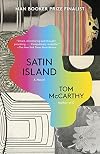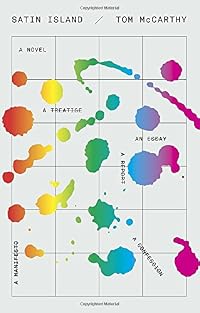
Satin Island
by Tom McCarthy
On This Page
Description
"When we first meet U., the narrator of SATIN ISLAND, he is sitting in the airport at Turin, caught in a delay caused by a rogue airplane. Like everyone else in the waiting area, he is sifting through airport pages on his laptop, and then through news sites, social pages, corridors of trivia...until he happens to stumble on information about an image on a famous shroud in Turin. The image itself isn't even visible on the shroud; it only emerged when some amateur photographer looked at the show more negative of a shot he'd taken and saw the figure--Christ's body supine after crucifixion. Only in the negative: the negative became a positive. A few decades later when the shroud was radiocarbon dated, it turned out to come from no later than the mid-thirteenth century. But that didn't trouble the believers. Things like that never do. A "corporate ethnographer," U. is tasked with writing the Great Report. Yet at every turn, U. finds himself overwhelmed by the ubiquity of data, lost in a buffer zone and wandering through a crowd of apparitions. Meanwhile, Madison, the woman he is seeing, becomes increasingly elusive, much like the particulars in the case of the recent, highly-publicized parachutist's death, with which U. is obsessed. He also develops a perverse interest in oil spills, spending great amounts of time watching loops of clean up videos. As U. begins to wonder if perhaps the Great Report will remain a shapeless, oozing plasma, his senses are reawakened by an ominous dream of an apocalyptic cityscape. SATIN ISLAND is a novel that captures the way we experience the world today, our efforts to find meaning, to stay awake, and discern the narratives we think of as our lives"-- show lessTags
Recommendations





Member Reviews
If W.G. Sebald had written Remainder instead of Tom McCarthy, it would have turned out to be a book exactly like Satin Island.
The novel requires concentration. Events occur in repeating patterns and you get the feeling that these patterns matter, but you're not sure why. To my way of reading, the patterns feel like a refined and far more subtle expression of Remainder's "reenactments." The novel presents a way of looking at the world that is more rational than the world of Remainder, but no less disorienting. When I put the book down to go do something else, the feelings I had while reading the novel affected my lived experience. I saw things differently. It's as if the novel made me feel a little stoned. Quite an accomplishment for show more words on a page. show less
The novel requires concentration. Events occur in repeating patterns and you get the feeling that these patterns matter, but you're not sure why. To my way of reading, the patterns feel like a refined and far more subtle expression of Remainder's "reenactments." The novel presents a way of looking at the world that is more rational than the world of Remainder, but no less disorienting. When I put the book down to go do something else, the feelings I had while reading the novel affected my lived experience. I saw things differently. It's as if the novel made me feel a little stoned. Quite an accomplishment for show more words on a page. show less
I give this book one star as a desperate cry for attention, which I figure is okay, since the book's blurb describes SI as "an unnerving novel that promises to give us the first and last word on the world" and suggests that in this book McCarthy "captures--as only he can--the way we experience our world." Take that, entire rest of the world!
Of course, the blurb is in part a joke, because the book's main character, U., is meant to write a report that is about everything--that will "name the world we live in"--for a rich business tycoon. And my one star is in part a joke, because it might also be a five star book.
How is this possible, you ask? Well, I have two readings of this book. In the first (one star), this is just another show more self-indulgent piece of flatulence, only yet more cliched than the self-indulgent flatulence that preceded it. I had repeated flashbacks to the '90s--here we have an anthropologist who apparently got his PhD without ever reading anything other than Levi-Strauss (compare: a biologist who still believes in genetic determinism); we have a lot of stuff about masks and performativity; he quotes Deleuze and Badiou as if they were fresh meat; he doesn't quote, but uses concepts from, Lacan; the novel draws false analogies between constructedness and fictiveness; IT BRINGS UP AND MISUES SCHRODINGER'S POOR ABUSED CAT [at this point my notes consist of the all-caps exclamation REALLY DUDE?!]; it quotes sous les paves la plage; like '90s theory it mistakes easily dissolved fallacies to produce apparent paradoxes (if a skydiver dies because the cords to his parachute were cut, when was he murdered? Incipit pages of guff); it acts as if writing was an act of oppression against the material world (words pollute us just like oil pollutes oceans!); it frets about the way media and the internet have changed everything (please ignore actually existing suffering and injustice); it somehow manages to imply that Mallarme was a totalitarian; it is a paeon in praise of trash and excrescence.
It does all this in what appears to be our new normal form: juxtapositions of random images that are meant to produce meaning. You may have experienced this as "modernism." But now, for some reason, it's freighted with all kinds of revolutionary freshness. McCarthy's images, fyi, are Staten Island, anthropology, material culture, oil-spills, the dead parachutist, media images of crowds, the Mallaremean 'book,' sex with a woman called Madison, Leibniz, pomo theory, corporate speak, Vanuatu, the Shroud of Turin, the internet, and cancer. It ends, of course, in New York. Thank you Teju Cole, Ben Lerner, et al.
Now, note "sex with a woman called Madison," because this where the book *might* get interesting, though no reviewers have picked up on this. The above list of cliches might have been produced by a random literary novelist who didn't bother to read anything and thinks he's being original. But introducing a woman who, for three quarters of the novel, does literally nothing other than be inseminated is simply not done any more, and McCarthy knows this. True, at the end of the book Madison confronts U. with the fairly trite observation that ideas aren't as important as, you know, actual suffering.
It is impossible to believe that McCarthy would willingly write a book so cliche-ridden as to include the girl who's up for anything sexually, and doesn't bother to, you know, talk or anything. And this leads me to think that the book's best scene is also the key to unlocking its secret. U. imagines giving a speech at a conference, where someone accuses him of aestheticizing of pollution. U. shouts down this dissenter, and it's quite funny.
But imagine for a second a writer so brave, so reckless, that he would actually write a spot-on parody of almost all of his time's most tiresome literary tropes. That he would do so with almost no sign whatsoever that he intended the book to be taken as a parody, except for this lone dissenting voice and the curious absence of one particular literary trope, viz., the excellent insistence that female characters be something other than sex toys. Why, I wonder, did McCarthy miss this one, even as he produced so much uncertainty, media fluff, internetism, and definitively boring theoretical goop? Could it be that McCarthy intentionally wrote a *terrible* novel, including a reckless act of immorality (i.e., objectifying the only woman in the novel) as a sign that he *knew* it was a terrible novel? Could it be that this is the best worst book ever written, a marvelous literary polemic taking aim at everything horrible in 'high-brow' literary writing, including the "now our hero comes into contact with other people and doesn't have to think about them anymore" conclusion?
I hope so, because otherwise this is just an even worse version of what everyone else is doing. show less
Of course, the blurb is in part a joke, because the book's main character, U., is meant to write a report that is about everything--that will "name the world we live in"--for a rich business tycoon. And my one star is in part a joke, because it might also be a five star book.
How is this possible, you ask? Well, I have two readings of this book. In the first (one star), this is just another show more self-indulgent piece of flatulence, only yet more cliched than the self-indulgent flatulence that preceded it. I had repeated flashbacks to the '90s--here we have an anthropologist who apparently got his PhD without ever reading anything other than Levi-Strauss (compare: a biologist who still believes in genetic determinism); we have a lot of stuff about masks and performativity; he quotes Deleuze and Badiou as if they were fresh meat; he doesn't quote, but uses concepts from, Lacan; the novel draws false analogies between constructedness and fictiveness; IT BRINGS UP AND MISUES SCHRODINGER'S POOR ABUSED CAT [at this point my notes consist of the all-caps exclamation REALLY DUDE?!]; it quotes sous les paves la plage; like '90s theory it mistakes easily dissolved fallacies to produce apparent paradoxes (if a skydiver dies because the cords to his parachute were cut, when was he murdered? Incipit pages of guff); it acts as if writing was an act of oppression against the material world (words pollute us just like oil pollutes oceans!); it frets about the way media and the internet have changed everything (please ignore actually existing suffering and injustice); it somehow manages to imply that Mallarme was a totalitarian; it is a paeon in praise of trash and excrescence.
It does all this in what appears to be our new normal form: juxtapositions of random images that are meant to produce meaning. You may have experienced this as "modernism." But now, for some reason, it's freighted with all kinds of revolutionary freshness. McCarthy's images, fyi, are Staten Island, anthropology, material culture, oil-spills, the dead parachutist, media images of crowds, the Mallaremean 'book,' sex with a woman called Madison, Leibniz, pomo theory, corporate speak, Vanuatu, the Shroud of Turin, the internet, and cancer. It ends, of course, in New York. Thank you Teju Cole, Ben Lerner, et al.
Now, note "sex with a woman called Madison," because this where the book *might* get interesting, though no reviewers have picked up on this. The above list of cliches might have been produced by a random literary novelist who didn't bother to read anything and thinks he's being original. But introducing a woman who, for three quarters of the novel, does literally nothing other than be inseminated is simply not done any more, and McCarthy knows this. True, at the end of the book Madison confronts U. with the fairly trite observation that ideas aren't as important as, you know, actual suffering.
It is impossible to believe that McCarthy would willingly write a book so cliche-ridden as to include the girl who's up for anything sexually, and doesn't bother to, you know, talk or anything. And this leads me to think that the book's best scene is also the key to unlocking its secret. U. imagines giving a speech at a conference, where someone accuses him of aestheticizing of pollution. U. shouts down this dissenter, and it's quite funny.
But imagine for a second a writer so brave, so reckless, that he would actually write a spot-on parody of almost all of his time's most tiresome literary tropes. That he would do so with almost no sign whatsoever that he intended the book to be taken as a parody, except for this lone dissenting voice and the curious absence of one particular literary trope, viz., the excellent insistence that female characters be something other than sex toys. Why, I wonder, did McCarthy miss this one, even as he produced so much uncertainty, media fluff, internetism, and definitively boring theoretical goop? Could it be that McCarthy intentionally wrote a *terrible* novel, including a reckless act of immorality (i.e., objectifying the only woman in the novel) as a sign that he *knew* it was a terrible novel? Could it be that this is the best worst book ever written, a marvelous literary polemic taking aim at everything horrible in 'high-brow' literary writing, including the "now our hero comes into contact with other people and doesn't have to think about them anymore" conclusion?
I hope so, because otherwise this is just an even worse version of what everyone else is doing. show less
{I}ncomprehensible is no better than banal -- it’s just its flip-side. But maybe, just maybe, {...} in between understanding so completely that an object’s robbed of its allure (on the one hand), and (on the other one) not understanding anything at all -- there might be some “ambiguous instances” in which the balance is just right.
That’s the narrator, U (“Call me U”), an anthropologist at a contemporary London consulting firm, comparing how well (or not) observers and those observed understand one another. But I also wonder if it’s the writer, McCarthy, commenting on how well (or not) readers understand novels? For me, the allure of postmodern fiction is that it’s never banal. I enjoy the struggle to get myself toward show more some center of comprehension, and even then be left with a resonance that “there’s still more to this” that tempts a re-read.
So it is with my experience of Satin Island. Here, U is tasked by the firm to document the contemporary zeitgeist into a “Great Report.” The task is huge and ambiguous, and U takes inspiration from the work and processes of other anthropologists, for example his hero, Claude Levi-Strauss, and Bronislaw Malinowski who advised, “Write everything down” (because the importance of something often is known only later). And so he does, creating dossiers of his ruminations on technology, oil spills, the company, his office, his colleagues, his lover, his dying friend, the murder of a parachutist. And in the process of presenting these vignettes, he reveals the zeitgeist.
I'm so glad to have finally sampled McCarthy, his intellect and originality. But a lot of what carried me through this book is my interest in workplace premises, and I'm undecided about reading more by him unless there's another good-fit premise.
I learned of {Petr’s} death by text. {His estranged wife must} have been handed his mobile phone, and sent the announcement out to everybody in the contacts file {...} To almost all intents and purposes, the sender was Petr. His existence, at that moment, was impressing itself on me, and on hundreds of others, with as much force as -- if not more than -- at any other time. All we need to do to guarantee indefinite existence for ourselves is to keep our network contracts running, and make sure a missive goes out every now and then.
{A}lthough {the parachutist} hadn’t actually been killed until the moment of his impact, to all intents and purposes, he had {from the moment someone cut his parachute cords}. For the last hours -- days, perhaps -- of his life, he had (this is how Schrodinger would formulate it) been murdered without realizing it.
{I cleared and cleaned my desk} to transform it into a tabula rasa upon which I might compose a great, momentous work. {...} Sitting at it, I looked out of the window at the sky. This was blue too -- clear blue with the odd wisp of cloud. I angled myself so as to face the largest uninterrupted stretch of sky, then turned so as to align myself exactly with the desktop, so that the borders and perimeters of this ran parallel and perpendicular to those of my gaze. I sat there for a long time, luxuriating in the emptiness of first one space then the other: desktop, sky, desktop.
(Review based on an advance reading copy provided by the publisher.) show less
That’s the narrator, U (“Call me U”), an anthropologist at a contemporary London consulting firm, comparing how well (or not) observers and those observed understand one another. But I also wonder if it’s the writer, McCarthy, commenting on how well (or not) readers understand novels? For me, the allure of postmodern fiction is that it’s never banal. I enjoy the struggle to get myself toward show more some center of comprehension, and even then be left with a resonance that “there’s still more to this” that tempts a re-read.
So it is with my experience of Satin Island. Here, U is tasked by the firm to document the contemporary zeitgeist into a “Great Report.” The task is huge and ambiguous, and U takes inspiration from the work and processes of other anthropologists, for example his hero, Claude Levi-Strauss, and Bronislaw Malinowski who advised, “Write everything down” (because the importance of something often is known only later). And so he does, creating dossiers of his ruminations on technology, oil spills, the company, his office, his colleagues, his lover, his dying friend, the murder of a parachutist. And in the process of presenting these vignettes, he reveals the zeitgeist.
I'm so glad to have finally sampled McCarthy, his intellect and originality. But a lot of what carried me through this book is my interest in workplace premises, and I'm undecided about reading more by him unless there's another good-fit premise.
I learned of {Petr’s} death by text. {His estranged wife must} have been handed his mobile phone, and sent the announcement out to everybody in the contacts file {...} To almost all intents and purposes, the sender was Petr. His existence, at that moment, was impressing itself on me, and on hundreds of others, with as much force as -- if not more than -- at any other time. All we need to do to guarantee indefinite existence for ourselves is to keep our network contracts running, and make sure a missive goes out every now and then.
{A}lthough {the parachutist} hadn’t actually been killed until the moment of his impact, to all intents and purposes, he had {from the moment someone cut his parachute cords}. For the last hours -- days, perhaps -- of his life, he had (this is how Schrodinger would formulate it) been murdered without realizing it.
{I cleared and cleaned my desk} to transform it into a tabula rasa upon which I might compose a great, momentous work. {...} Sitting at it, I looked out of the window at the sky. This was blue too -- clear blue with the odd wisp of cloud. I angled myself so as to face the largest uninterrupted stretch of sky, then turned so as to align myself exactly with the desktop, so that the borders and perimeters of this ran parallel and perpendicular to those of my gaze. I sat there for a long time, luxuriating in the emptiness of first one space then the other: desktop, sky, desktop.
(Review based on an advance reading copy provided by the publisher.) show less
I came across ‘Satin Island’ while browsing in the library; the cover caught my eye then the blurb intrigued me. I liked the notion of a ‘corporate anthropologist’ trying to distill some meaning from contemporary life. Subsequently I realised I’d already read a book by the same author: [b:Tintin and the Secret of Literature|146163|Tintin and the Secret of Literature|Tom McCarthy|https://images.gr-assets.com/books/1172178213s/146163.jpg|1408682]. That has the distinction of being one of the most incomprehensible, obscurantist things I’ve ever read. Seriously, it includes some Žižek-level nonsense. Nonetheless, I liked the idea of analysing the cultural significances of Tintin and I also like the theme of this novel. Rather show more than actually applying dense critical theory to popular comics, ‘Satin Island’ points out that such radical left wing theory is swallowed into the corporate maw, like everything else:
The cover of edition I read had a quote calling McCarthy, ‘a Kafka for the Google Age’. I disagree. Kafka's novels, for me, are defined by generalised narratives stripped of historical and specific meaning. They can be taken as allegories for a myriad of situations and events. ‘Satin Island’ is about the search for meaning and truth in the very details of life, at a specific point in time, that Kafka totally strips from his writing. I was reminded instead of [b:White Noise|11762|White Noise|Don DeLillo|https://images.gr-assets.com/books/1327934706s/11762.jpg|327422] by Don DeLillo and [b:Present Shock: When Everything Happens Now|15811513|Present Shock When Everything Happens Now|Douglas Rushkoff|https://images.gr-assets.com/books/1355084098s/15811513.jpg|21536777] by Douglas Rushkoff. The latter is a non-fiction book about the problems of living in the eternal present, unmoored by an endless barrage of new information. I thought U, the narrator, articulated quite neatly the difficulty of dredging understanding from the dynamic complexity of 21st century life:
U eventually concludes that this mythical report has already been written, but by software, and that only software could ever read it. The world has accelerated beyond human understanding and we yearn for a moment of pause in which to gather our thoughts. It’s fair to say that nothing much happens in ‘Satin Island’, but it definitely has interesting things to say about both formal research and daily attempts at comprehension in contemporary life. I wondered whether U would come to the same conclusion that I did (he did not): the only place to begin his Report would have to be the end, at death. That’s the only experience common to all of humanity still, the only certainty, the only thing that brings the constant present to a halt. Given the presence of a dying friend in U’s life, I presume the author intended the reader to notice this and wonder at U’s oversight. He is looking for meaning in little details, where only limited and transitory insight is to be found.
The other element of the novel I enjoyed was U’s consciousness of being part of a corporate edifice. He fantasises about being able to wreck the grand project he works on, without articulating how. When he confides his grandiose daydreams of destruction to his sort-of girlfriend, she squashes them like so:
‘Satin Island’ isn’t a novel to read for plot, characterisation, or even writing quality, rather it presents thought-provoking ideas and reflections. In fact, it could quite easily have been re-written as non-fiction. I mean that as a complement. show less
I did the same thing with another French philosopher, Badiou: I recycled his notion of a rip, a sudden temporal rupture, and applied it, naturally, to tears worn in jeans, which I presented as the birth-scars of their wearer’s singularity, testaments to the individual’s break with general history, to the successful institution of a personal time. I dropped the radical baggage from that, too (Badiou is virtually Maoist). This pretty much set up the protocol or MO I’d deploy in my work for the Company from then on in: feeding vanguard theory, almost always from the left side of spectrum, back into the corporate machine. The machine could swallow everything, incorporate it seamlessly, like a giant loom that re-weaves all fabric, no matter how recalcitrant and jarring its raw form, into what my hero would have called a master-pattern - or, if not that, then maybe just the pattern of the master.
The cover of edition I read had a quote calling McCarthy, ‘a Kafka for the Google Age’. I disagree. Kafka's novels, for me, are defined by generalised narratives stripped of historical and specific meaning. They can be taken as allegories for a myriad of situations and events. ‘Satin Island’ is about the search for meaning and truth in the very details of life, at a specific point in time, that Kafka totally strips from his writing. I was reminded instead of [b:White Noise|11762|White Noise|Don DeLillo|https://images.gr-assets.com/books/1327934706s/11762.jpg|327422] by Don DeLillo and [b:Present Shock: When Everything Happens Now|15811513|Present Shock When Everything Happens Now|Douglas Rushkoff|https://images.gr-assets.com/books/1355084098s/15811513.jpg|21536777] by Douglas Rushkoff. The latter is a non-fiction book about the problems of living in the eternal present, unmoored by an endless barrage of new information. I thought U, the narrator, articulated quite neatly the difficulty of dredging understanding from the dynamic complexity of 21st century life:
I’d begun to suspect - in fact, I’d become convinced - that this Great Report was unplottable, unframeable, unrealisable: in short, and in whatever crossbred form, whatever medium or media, unwriteable. Not just by me, with my limited (if once celebrated) capabilities, but fundamentally, essentially, inherently unwriteable. It wasn’t just that there could no more be a Lévi-Strauss 2.0 than a second Leibniz; beyond this, I grew exasperated every time I tried to picture, even in the most abstract of ways, a mechanism capable of managing and arresting, let alone pinning down and mapping the dynamics, process, and patterns - social, anthropological, historical, micro- and macro, what-you-will - that the Report would have to somehow turn into its content, these entities that kept proliferating every which way, from every which turn and juncture, at every which moment.
U eventually concludes that this mythical report has already been written, but by software, and that only software could ever read it. The world has accelerated beyond human understanding and we yearn for a moment of pause in which to gather our thoughts. It’s fair to say that nothing much happens in ‘Satin Island’, but it definitely has interesting things to say about both formal research and daily attempts at comprehension in contemporary life. I wondered whether U would come to the same conclusion that I did (he did not): the only place to begin his Report would have to be the end, at death. That’s the only experience common to all of humanity still, the only certainty, the only thing that brings the constant present to a halt. Given the presence of a dying friend in U’s life, I presume the author intended the reader to notice this and wonder at U’s oversight. He is looking for meaning in little details, where only limited and transitory insight is to be found.
The other element of the novel I enjoyed was U’s consciousness of being part of a corporate edifice. He fantasises about being able to wreck the grand project he works on, without articulating how. When he confides his grandiose daydreams of destruction to his sort-of girlfriend, she squashes them like so:
You boys, she said, as once again I felt a double-pang of complement and slight, are sweet. You all want to be the hero in the film who runs away in slo-mo from the villain’s factory that he’s just mined, throwing himself to the ground when it explodes. But the explosion’s taking place already - it’s always been taking place. You just didn’t notice…
‘Satin Island’ isn’t a novel to read for plot, characterisation, or even writing quality, rather it presents thought-provoking ideas and reflections. In fact, it could quite easily have been re-written as non-fiction. I mean that as a complement. show less
"When these events (events! If you want those, you'd best stop reading now) took place, I found myself deployed not to some remote jungle, steppe or tundra, there to study hunter-gatherers and shamans, but to a business."
"Everything, as Peyman said, may be a fiction -- but the Future is the biggest shaggy-dog story of all."
This may be the weirdest novel I've ever loved. In the first couple of pages I thought "oh no, this is not my cup of tea," but I hung in there and I'm glad I did. The protagonist, U, is a "cultural anthropologist" working for a company that is implementing The Project, which will presumably change the world with such incredible scope that the world will not know it has been so changed. While working on this show more implementation in his own very small way from his own very small basement office, U has also been charged with writing the Great Report, a treatise (?) which will also change the world and with similar subtlety. Satin Island is, perhaps (or is it?), U's Great Report but it's also a jumble of tales and speculations which illustrate the interconnectedness of everything. Or something like that. Heavier on word-play and musings about alternative meanings of various world events (an oil spill, the death of a parachutist) than on plot, per se, I most enjoyed reading this novel when I was alert. That is, I don't recommend this as bedtime reading, not because it's disturbing or activating, but because the wry, humorous thread, is just loose enough to be vulnerable. The novel's author/narrator is quite present and he acknowledges the presence of the reader a couple of times, adding to the postmodern fun.
Honestly, I still prefer novels with richly wrought characters and poignant emotional impact but this is such an original voice -- without being inaccessible -- that I have to give it 4.5 stars. I don't know if it will win the Booker prize but I totally get its presence on the short list. show less
"Everything, as Peyman said, may be a fiction -- but the Future is the biggest shaggy-dog story of all."
This may be the weirdest novel I've ever loved. In the first couple of pages I thought "oh no, this is not my cup of tea," but I hung in there and I'm glad I did. The protagonist, U, is a "cultural anthropologist" working for a company that is implementing The Project, which will presumably change the world with such incredible scope that the world will not know it has been so changed. While working on this show more implementation in his own very small way from his own very small basement office, U has also been charged with writing the Great Report, a treatise (?) which will also change the world and with similar subtlety. Satin Island is, perhaps (or is it?), U's Great Report but it's also a jumble of tales and speculations which illustrate the interconnectedness of everything. Or something like that. Heavier on word-play and musings about alternative meanings of various world events (an oil spill, the death of a parachutist) than on plot, per se, I most enjoyed reading this novel when I was alert. That is, I don't recommend this as bedtime reading, not because it's disturbing or activating, but because the wry, humorous thread, is just loose enough to be vulnerable. The novel's author/narrator is quite present and he acknowledges the presence of the reader a couple of times, adding to the postmodern fun.
Honestly, I still prefer novels with richly wrought characters and poignant emotional impact but this is such an original voice -- without being inaccessible -- that I have to give it 4.5 stars. I don't know if it will win the Booker prize but I totally get its presence on the short list. show less
Satin Island is written in the style of a corporate report, complete with numbered paragraphs. It tells the story of an anthropologist working for an international company that trades in abstractions. He’s lending weight to a project by spinning ideas (although he, and perhaps no one, knows what the project is).
The writing is stylish and captures the protagonist’s state of alienation. His mind roves restlessly through contemporary culture – the otherness of airports, the impossibility of minimalism, the hiddenness of museum archives. He picks up motifs and then discards them.
Then it ends. Except I didn’t realise it was an end. I turned the page and found myself staring blankly at ‘Acknowledgements’. And I thought, what was show more the point of that? The author would no doubt claim that was what he meant me to think, the get-out-of-jail-free card of the postmodern author. But I still feel cheated.
I want an ending. It doesn’t have to be a wedding or a gunfight or the solving of a crime, but I want to know that the world of the book has changed (and if it's really good, my world). If that’s not part of your creed (or if, as I suspect, you just can’t do plot), then don’t call it a novel. Call it a prose-poem or a meditation or a thing. If I open an umbrella, I expect it to keep out the rain.
*
I received a free copy of this novel from the publisher via Netgalley. show less
The writing is stylish and captures the protagonist’s state of alienation. His mind roves restlessly through contemporary culture – the otherness of airports, the impossibility of minimalism, the hiddenness of museum archives. He picks up motifs and then discards them.
Then it ends. Except I didn’t realise it was an end. I turned the page and found myself staring blankly at ‘Acknowledgements’. And I thought, what was show more the point of that? The author would no doubt claim that was what he meant me to think, the get-out-of-jail-free card of the postmodern author. But I still feel cheated.
I want an ending. It doesn’t have to be a wedding or a gunfight or the solving of a crime, but I want to know that the world of the book has changed (and if it's really good, my world). If that’s not part of your creed (or if, as I suspect, you just can’t do plot), then don’t call it a novel. Call it a prose-poem or a meditation or a thing. If I open an umbrella, I expect it to keep out the rain.
*
I received a free copy of this novel from the publisher via Netgalley. show less
This experimental novel will change how you interact with the world. Or, change how the world interacts with you. The main character "U" is a Corporate Ethnographer/Anthropologist for "The Company". He is given the assignment of creating The Great Report, whose aim is to ethnographically catalog all of modern society.
In the process of working on this seemingly-impossible task, and unsure where to begin, U is confronted with a few specific events: A massive oil spill in open water (Deep-Water Horizon spill in the Gulf of Mexico), the death of a veteran sky diver whose parachute didn't open, the cancer diagnosis of a close friend, and the hub-and-spoke pattern. In his role as an ethnographer, he fixates on each of these and explores them show more in depth - their history, their significance to the world, their relationship to other things. Through this exploration, he begins to ask philosophical questions about the divisions of existence (life/death, truth/fiction, work/leisure, etc.) and how transitory their definitions are.
It's worth discussing the structure and style of this book. There are numbered chapters, but they do not read in a cohesive or narrative style, like chapters would. Each chapter is broken down into decimal sections which explore a single idea or event in depth. It's almost as if they are long-form prompts...there are no narrative connections between the sub-sections or the chapters - the reader is left to make those connections him/herself. What those connections are will be different for each person, because of his/her unique history and life experiences. By reading the novel and making those connections, are we helping U create The Great Report? Or, is the book itself "U"'s draft of The Great Report? Has The Great Report already been written from the metadata available from our digital/global/oversharing world?
This is what makes the novel so experimental. People reading it bring a unique set of experiences and history with them. It will be a different book to each person, because he/she will derive a distinct meaning from it. It truly will influence how you and the world interact from now on. show less
In the process of working on this seemingly-impossible task, and unsure where to begin, U is confronted with a few specific events: A massive oil spill in open water (Deep-Water Horizon spill in the Gulf of Mexico), the death of a veteran sky diver whose parachute didn't open, the cancer diagnosis of a close friend, and the hub-and-spoke pattern. In his role as an ethnographer, he fixates on each of these and explores them show more in depth - their history, their significance to the world, their relationship to other things. Through this exploration, he begins to ask philosophical questions about the divisions of existence (life/death, truth/fiction, work/leisure, etc.) and how transitory their definitions are.
It's worth discussing the structure and style of this book. There are numbered chapters, but they do not read in a cohesive or narrative style, like chapters would. Each chapter is broken down into decimal sections which explore a single idea or event in depth. It's almost as if they are long-form prompts...there are no narrative connections between the sub-sections or the chapters - the reader is left to make those connections him/herself. What those connections are will be different for each person, because of his/her unique history and life experiences. By reading the novel and making those connections, are we helping U create The Great Report? Or, is the book itself "U"'s draft of The Great Report? Has The Great Report already been written from the metadata available from our digital/global/oversharing world?
This is what makes the novel so experimental. People reading it bring a unique set of experiences and history with them. It will be a different book to each person, because he/she will derive a distinct meaning from it. It truly will influence how you and the world interact from now on. show less
Members
- Recently Added By
Lists

Man Booker Prize Longlist 2015
13 works; 9 members

Booker Prize
491 works; 62 members
Author Information

12+ Works 3,887 Members
Tom McCarthy is the author of Satin Island, and made the Man Booker Prize for Fiction 2015 shortlist. This same title also made the shortlist for the Goldsmiths Prize 2015. (Bowker Author Biography)
Some Editions
Awards and Honors
Awards
Distinctions
Common Knowledge
- Canonical title
- Satin Island
- Original publication date
- 2015
- People/Characters
- U; Madison; Petr
- Epigraph
- Outside, like the cry of space, the traveler percieves the whistles distress. "Probably," he persuades himself, "we are going going through a tunnel--the epoch--the last long one, snaking under the city to the all powerful tr... (show all)ain station of the virginal central palace, like a charm. -Mallarme
- Dedication
- For Matt Parker
- First words
- Turin is where the famous shroud is from. the one showing Christ's body supine after crucifixion: hands folded over genitals, eyes closed. head crowned with thorns.
- Quotations
- To the anthropologist, there's no such thing as a singular episode, a singular phenomenon--only a set of variations on generic ones; the more more generic, therefore, the more pure, the closer to an unvariegated or unscramble... (show all)d archetype.
- Last words
- (Click to show. Warning: May contain spoilers.)I stared at him; our eyes met for a while; then I, uncomfortable, broke off the contact and started walking, past the growing stream of people, out of the terminal and back into the city.
- Publisher's editor
- Bowler, Alex; Frank, Dan
Classifications
Statistics
- Members
- 701
- Popularity
- 40,462
- Reviews
- 34
- Rating
- (3.14)
- Languages
- 6 — Dutch, English, French, German, Italian, Spanish
- Media
- Paper, Audiobook, Ebook
- ISBNs
- 24
- ASINs
- 8