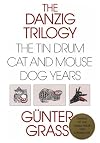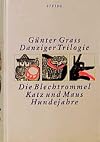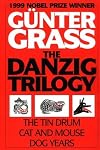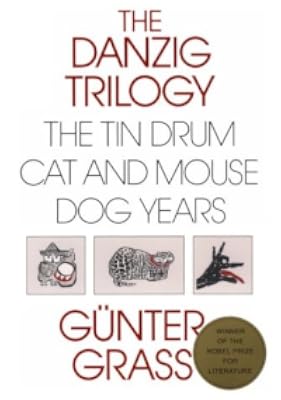
Danzig Trilogy: The Tin Drum, Cat and Mouse, Dog Years
by Günter Grass
Danzig Trilogy (Collections and Selections — Omnibus)
On This Page
Description
A critical examination of Grass's work offers overwhelming evidence that Cat and Mouse and Dog Years are part of a unified structure begun by The Tin Drum and that they continue to explore the same key figures, themes, and symbols. A Helen and Kurt Wolff Book.Tags
Recommendations
















Member Reviews
"The Danzig Trilogy" consists of 2 lengthy novels and one short novella- "The Tin Drum", "Cat and Mouse", and "Dog Years". Though not a continuing story, all three books take place during the same time frame covering the years of World War II and approximately ten-year span pre and post war periods. While all three adventures involve totally different characters the one thread that bonds them together is the location- the Free City of Danzig which is sandwiched between East Germany and Poland on the Baltic Sea. During the war Danzig becomes part of the Nazi empire. The ongoing theme is the effect war has on ordinary people. It is not necessary to read all three books or to read them in sequence, though I recommend starting with "The Tin show more Drum". And, if you intend to read the entire trilogy, purchasing it in one complete volume would be advantageous.
What makes this trilogy unique is that it is not focused on war combat, or military stories. It is a tale of ordinary people, of rural villages with multi-generation families all living in a common household with old grandparents, parents, and young school age children going about their daily lives as best they can under the negative economic, political, and cultural circumstances.
"The Tin Drum" is a quirky story about a thirty-year-old dwarf who is mental patient accused of murder. He may appear to be mentally unstable, but he is very intelligent and continually contemplates philosophy, religion, mythology, and the supernatural. During World War II he travels through France and Belgium with a troupe of dwarfs entertaining the military. I first read "The Tin Drum" in 2011 and the full review can be found in my archives. I must say, it was the most unusual narrative I ever read and worthy of an individual rating of 4.5 Stars.
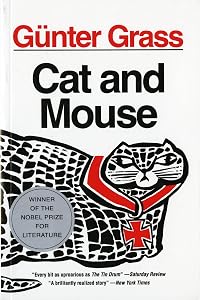
"Cat and Mouse" is a captivating character study of a young teen-aged boy- Joachim Mahlke. He is the envy of all his classmates: a leader, strong, independent thinker, a trend setter, always one step ahead of his peers. He never boasts and doesn’t seek approval, making his own rules and defying authority whenever it suits his purposes. While the war rages on, Joachim and his closest friends spend the summer diving off the coast of Brosen Beach to explore a sunken Polish mine sweeper for coveted battle souvenirs. Joachim and his classmates are required to enter the Hitler Youth Corps and eventually Joachim is drafted into the German army. This novella exemplifies the harsh reality of war and Gunter Grass offers the reader a stunning finale to this short tale. (individually rated 5 Stars)
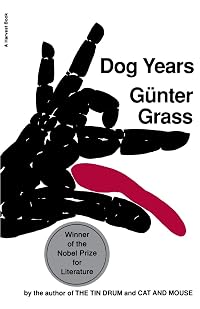
"Dog Years" is the story of various young adolescents coming of age just in time to witness and participate in World War II. In German mythological superstition ‘Dog Years’ signifies a season of disasters and madness. And indeed, it was. This complex story explores the themes of anti-Semitism, the effect of political propaganda, and the dramatic changes in social and cultural behavior as the war progressed as told from the perspective of the young teens who are going about their mundane lives: school, sports, social events, rationing, watching adult males going off to war… most of them never to return. A concentration camp lies on the edge of town that local citizens do their best to ignore. The few soldiers who do return home are idolized and labeled as heroes. Of course, everything changes as the youth become teens and are forced to join Hitler’s Youth Group, and many enlist or are drafted by the time they become 17 years old.
Told in three parts, the final section of "Dog Years" takes place in post-war Germany. A new generation of children are questioning their parents about their moral values and personal involvement in the war – the guilt, the anger, the shame (in children and parents alike). The parents come to the realization that they were deluded, lied to, collaged into the most horrendous barbaric behavior ever witnessed on earth. Even if they were just at home minding their own business during the war, they were technically guilty by association. One of the primary characters becomes a manic vigilante trying to bring evil Nazi’s to justice.
"Dog Years" also includes themes of German mythology which alluded me, but did not detract from the overall plot. A side story involves Hitler’s favorite dog – which ties into the myths of German lore. Gunter Grass offers a little bit of everything; satire, humor, philosophy, and a disturbing ending with dire warnings that history always repeats itself. Dog Years may actually top "The Tin Drum"" in originality. (individually rated 4.5 Stars)
Gunter Grass won the Nobel Prize in Literature in 1999. He grew up in Danzig and was drafted into the German army in 1944 at the age of 17 serving in the SS Panzer Division. He served one year before he was injured and captured by the Allies. The Danzig Trilogy" was completed in 1963.
Rated 4.5 Stars July 2019
All contents © 2019 Lois Weisberg. All rights reserved show less
What makes this trilogy unique is that it is not focused on war combat, or military stories. It is a tale of ordinary people, of rural villages with multi-generation families all living in a common household with old grandparents, parents, and young school age children going about their daily lives as best they can under the negative economic, political, and cultural circumstances.
"The Tin Drum" is a quirky story about a thirty-year-old dwarf who is mental patient accused of murder. He may appear to be mentally unstable, but he is very intelligent and continually contemplates philosophy, religion, mythology, and the supernatural. During World War II he travels through France and Belgium with a troupe of dwarfs entertaining the military. I first read "The Tin Drum" in 2011 and the full review can be found in my archives. I must say, it was the most unusual narrative I ever read and worthy of an individual rating of 4.5 Stars.
"Cat and Mouse" is a captivating character study of a young teen-aged boy- Joachim Mahlke. He is the envy of all his classmates: a leader, strong, independent thinker, a trend setter, always one step ahead of his peers. He never boasts and doesn’t seek approval, making his own rules and defying authority whenever it suits his purposes. While the war rages on, Joachim and his closest friends spend the summer diving off the coast of Brosen Beach to explore a sunken Polish mine sweeper for coveted battle souvenirs. Joachim and his classmates are required to enter the Hitler Youth Corps and eventually Joachim is drafted into the German army. This novella exemplifies the harsh reality of war and Gunter Grass offers the reader a stunning finale to this short tale. (individually rated 5 Stars)
"Dog Years" is the story of various young adolescents coming of age just in time to witness and participate in World War II. In German mythological superstition ‘Dog Years’ signifies a season of disasters and madness. And indeed, it was. This complex story explores the themes of anti-Semitism, the effect of political propaganda, and the dramatic changes in social and cultural behavior as the war progressed as told from the perspective of the young teens who are going about their mundane lives: school, sports, social events, rationing, watching adult males going off to war… most of them never to return. A concentration camp lies on the edge of town that local citizens do their best to ignore. The few soldiers who do return home are idolized and labeled as heroes. Of course, everything changes as the youth become teens and are forced to join Hitler’s Youth Group, and many enlist or are drafted by the time they become 17 years old.
Told in three parts, the final section of "Dog Years" takes place in post-war Germany. A new generation of children are questioning their parents about their moral values and personal involvement in the war – the guilt, the anger, the shame (in children and parents alike). The parents come to the realization that they were deluded, lied to, collaged into the most horrendous barbaric behavior ever witnessed on earth. Even if they were just at home minding their own business during the war, they were technically guilty by association. One of the primary characters becomes a manic vigilante trying to bring evil Nazi’s to justice.
"Dog Years" also includes themes of German mythology which alluded me, but did not detract from the overall plot. A side story involves Hitler’s favorite dog – which ties into the myths of German lore. Gunter Grass offers a little bit of everything; satire, humor, philosophy, and a disturbing ending with dire warnings that history always repeats itself. Dog Years may actually top "The Tin Drum"" in originality. (individually rated 4.5 Stars)
Gunter Grass won the Nobel Prize in Literature in 1999. He grew up in Danzig and was drafted into the German army in 1944 at the age of 17 serving in the SS Panzer Division. He served one year before he was injured and captured by the Allies. The Danzig Trilogy" was completed in 1963.
Rated 4.5 Stars July 2019
All contents © 2019 Lois Weisberg. All rights reserved show less
Ratings
Members
- Recently Added By
Lists

German Literature
518 works; 56 members
Author Information

213+ Works 22,872 Members
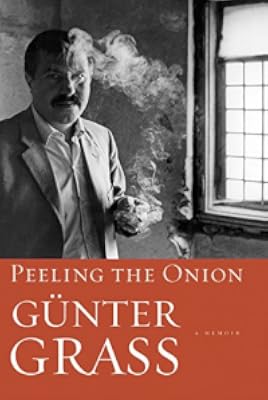
Günter Wilhelm Grass was born on October 16, 1927 in the Free City of Danzig, which is now Gdansk, Poland. He was a member of the Hitler Youth and at the age of 17, he was drafted into the German army. Near the end of the war, he served as a tank gunner in the 10th SS Panzer Division. He was captured by the Americans and forced to visit the newly show more liberated Dachau concentration camp. After his release from a POW camp in 1946, he worked in a potash mine and as a stonemason's apprentice and studied painting and sculpture in Düsseldorf. His first novel, The Tin Drum, was published in 1959. It was adapted into a film and won the Academy Award for Best Foreign Film in 1979. His other works included Cat and Mouse, Dog Years, From the Diary of a Snail, The Flounder, The Rat, and Crabwalk. He also wrote a memoir entitled Peeling the Onion. He received the Nobel Prize for Literature in 1999. He was also a political activist and liberal provocateur. He advocated for environmental conservation, debt relief for poor countries, and generous policies regarding political asylum. He died on April 13, 2015 at the age of 87. (Bowker Author Biography) show less
Series

Work Relationships
Common Knowledge
- Canonical title
- Danzig Trilogy: The Tin Drum, Cat and Mouse, Dog Years
- Original title
- Danziger Trilogie: Die Blechtrommel / Katz Und Maus / Hundejahre
- Original publication date
- 1987
- Important places
- Danzig; Danzig, Prussia; Danzig, Prussia, German Empire; Danzig (Free City); Gdańsk, Pomeranian Voivodeship, Poland
Classifications
- Genres
- Fiction and Literature, General Fiction
- DDC/MDS
- 833.914 — Literature & rhetoric German & related literatures German fiction 1900- 1900-1990 1945-1990
- LCC
- PT2613 .R338 .D2713 — Language and Literature German, Dutch and Scandinavian literatures German literature Individual authors or works 1860/70-1960
- BISAC
Statistics
- Members
- 296
- Popularity
- 108,755
- Reviews
- 1
- Rating
- (4.33)
- Languages
- Dutch, English, German
- Media
- Paper
- ISBNs
- 12
- ASINs
- 5