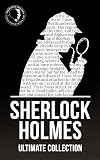
Sherlock Holmes: The Ultimate Collection (unspecified)
by Arthur Conan Doyle 
On This Page
Tags
Recommendations





























Member Reviews
I've read a good number of Sherlock Holmes' stories in my life but never, until now, have I read the entirety of Conan Doyle's works about the most famous of fictional detectives (4 novels and 56 stories). I found each story superbly crafted, and there's probably not much to be said in this review that hasn't been said better (and by someone with authority to make literary declamations) elsewhere. So I will dispense with the idea of a literary review of these works and content myself with some comments on what I found to be the most compelling features of these stories.
First, Conan Doyle used the affable Dr. Watson to great effect to "hide" the solution to each puzzle and create a dramatic reveal at the story's end. What was perhaps show more most interesting to me is that, I progressed through the stories, I found myself more and more following the clues and beginning to guess what turned out to be the mystery's solution. Now, in most detective stories, that is a terrible flaw in the story's design. However, it works to an interesting effect in the Holmes' canon because the reader who begins to follow Holmes' deductive reasoning ends up with an advantage over the story's narrator, Dr. Watson! Thus, the reader still feels satisfied even when the solution is guessed early on. I find that an exceedingly clever play on the narrator-reader relationship.
The character of Holmes' himself to me has always been an icon of the "ideal modern man"...the one whose cool rationality, much like Spock's in an entirely different genre altogether, always asserts itself at the last minute to save the day. Here is a man who is "pure mind" and thus indomitable to his foes...even the great Professor Moriarty. Except Holmes is NOT that simple of a figure. Even if that is what he claims for himself, the Holmes that Watson paints for us is a more a man of IMAGINATION than intellect. The genius of Holmes is his ability to "embody" the criminals he pursues, imagine their motives, and thereby guess their essential moves. I would say Holmes is more ARTIST than SCIENTIST in these stories, especially given the lengths to which he goes to make each solution appear in as dramatic a way as possible. I'd never noticed the tremendous influence of these core Romantic ideals in the figure of Holmes until I took the time to work my way through the corpus.
Conan Doyle is an enviable talent because of the evenness of the collection (both in quality and tone). His preface to "The Return of Sherlock Holmes" indicated to me an author who had grown tired of the character; so often, when that happens, the quality of craftsmanship begins to noticeably slip. Admirably, Conan Doyle added an additional 32 stories as well as the finest of the Holmes' novels (in my opinion), "The Hound of the Baskervilles," after reaching that point. For me, there was no discovery of "hidden gems" within the larger collection because each story is so like the most famous pieces (think here of the "Adventure of Silver Blaze" or "The Red-Headed League").
I suppose there's nothing particularly admirable or noteworthy about completing a feat such as this. Calling it a "feat" is also an overstatement of the case. But I can say this: it was a very satisfying venture. in Sherlock Holmes and John Watson, Conan Doyle has gifted to the literary world two wonderfully-drawn characters that have raised these works to the level of classic literature. And deservedly so. show less
First, Conan Doyle used the affable Dr. Watson to great effect to "hide" the solution to each puzzle and create a dramatic reveal at the story's end. What was perhaps show more most interesting to me is that, I progressed through the stories, I found myself more and more following the clues and beginning to guess what turned out to be the mystery's solution. Now, in most detective stories, that is a terrible flaw in the story's design. However, it works to an interesting effect in the Holmes' canon because the reader who begins to follow Holmes' deductive reasoning ends up with an advantage over the story's narrator, Dr. Watson! Thus, the reader still feels satisfied even when the solution is guessed early on. I find that an exceedingly clever play on the narrator-reader relationship.
The character of Holmes' himself to me has always been an icon of the "ideal modern man"...the one whose cool rationality, much like Spock's in an entirely different genre altogether, always asserts itself at the last minute to save the day. Here is a man who is "pure mind" and thus indomitable to his foes...even the great Professor Moriarty. Except Holmes is NOT that simple of a figure. Even if that is what he claims for himself, the Holmes that Watson paints for us is a more a man of IMAGINATION than intellect. The genius of Holmes is his ability to "embody" the criminals he pursues, imagine their motives, and thereby guess their essential moves. I would say Holmes is more ARTIST than SCIENTIST in these stories, especially given the lengths to which he goes to make each solution appear in as dramatic a way as possible. I'd never noticed the tremendous influence of these core Romantic ideals in the figure of Holmes until I took the time to work my way through the corpus.
Conan Doyle is an enviable talent because of the evenness of the collection (both in quality and tone). His preface to "The Return of Sherlock Holmes" indicated to me an author who had grown tired of the character; so often, when that happens, the quality of craftsmanship begins to noticeably slip. Admirably, Conan Doyle added an additional 32 stories as well as the finest of the Holmes' novels (in my opinion), "The Hound of the Baskervilles," after reaching that point. For me, there was no discovery of "hidden gems" within the larger collection because each story is so like the most famous pieces (think here of the "Adventure of Silver Blaze" or "The Red-Headed League").
I suppose there's nothing particularly admirable or noteworthy about completing a feat such as this. Calling it a "feat" is also an overstatement of the case. But I can say this: it was a very satisfying venture. in Sherlock Holmes and John Watson, Conan Doyle has gifted to the literary world two wonderfully-drawn characters that have raised these works to the level of classic literature. And deservedly so. show less
Arthur Conan Doyle was certainly an excellent storyteller. The atmosphere of Victorian England is wonderfully evoked through his tales. Despite the fact that the solutions to some of the cases may sometimes be a little unsatisfying, the initial mysteries keep the reader fully engaged, and it is hard to abandon the reading of any story once you start. Holmes is an intriguing character in that he possesses uncommon insights into human nature while almost completely eschewing every form of social contact. He rarely goes out except on professional business, and is usually immersed in old books or scientific experiments in his bachelor flat. Perhaps for this reason, Watson, while in awe of his friend's powerful intellect, seems quite show more protective of him at times. (Today, psychologists would probably assign Holmes a place on the autism spectrum).
Something I found interesting is that in Arthur Conan Doyle's stories Holmes' ideas are not always correct. Although his reasoning is always solidly based on the known facts, occasionally his theories prove to be wrong, or he is unable to assist the police to apprehend criminals (examples are the cases of The Yellow Face and The Engineer's Thumb). I actually welcomed this as making the character more realistic and human. The story of The Three Students, on the other hand, is a good instance of where Holmes possesses enough of the facts to arrive at wholly correct conclusions using his deductive method. Other cases, such as The Stock-Broker's Clerk, require that Holmes actually be present while events unfold and the truth is gradually revealed. Thus, while on the surface the stories may seem to progress in a similar manner to each other, in fact the details and the processes involved in bringing the cases to their conclusions can be very different.
I would definitely recommend that people who are only familiar with the TV or film versions of Sherlock Holmes read at least some of the original stories for themselves, since these allow the reader to discern more clearly how the author intended this rich and complex character to be understood. show less
Something I found interesting is that in Arthur Conan Doyle's stories Holmes' ideas are not always correct. Although his reasoning is always solidly based on the known facts, occasionally his theories prove to be wrong, or he is unable to assist the police to apprehend criminals (examples are the cases of The Yellow Face and The Engineer's Thumb). I actually welcomed this as making the character more realistic and human. The story of The Three Students, on the other hand, is a good instance of where Holmes possesses enough of the facts to arrive at wholly correct conclusions using his deductive method. Other cases, such as The Stock-Broker's Clerk, require that Holmes actually be present while events unfold and the truth is gradually revealed. Thus, while on the surface the stories may seem to progress in a similar manner to each other, in fact the details and the processes involved in bringing the cases to their conclusions can be very different.
I would definitely recommend that people who are only familiar with the TV or film versions of Sherlock Holmes read at least some of the original stories for themselves, since these allow the reader to discern more clearly how the author intended this rich and complex character to be understood. show less
There is a reason these are classics - they're wonderful. The best are taut, tight and terrific; even the weaker ones are very enjoyable reading. There are a lot of them, too, and they'll repay re-reading. A nice edition too; only a few typos, and a good table of contents.
Ratings
Members
- Recently Added By
Author Information

3,998+ Works 169,674 Members
The most famous fictional detective in the world is Arthur Conan Doyle's Sherlock Holmes. However, Doyle was, at best, ambivalent about his immensely successful literary creation and, at worst, resentful that his more "serious" fiction was relatively ignored. Born in Edinburgh, Doyle studied medicine from 1876 to 1881 and received his M.D. in show more 1885. He worked as a military physician in South Africa during the Boer War and was knighted in 1902 for his exceptional service. Doyle was drawn to writing at an early age. Although he attempted to enter private practice in Southsea, Portsmouth, in 1882, he soon turned to writing in his spare time; it eventually became his profession. As a Liberal Unionist, Doyle ran, unsuccessfully, for Parliament in 1903. During his later years, Doyle became an avowed spiritualist. Doyle sold his first story, "The Mystery of the Sasassa Valley," to Chambers' Journal in 1879. When Doyle published the novel, A Study in Scarlet in 1887, Sherlock Holmes was introduced to an avid public. Doyle is reputed to have used one of his medical professors, Dr. Joseph Bell, as a model for Holmes's character. Eventually, Doyle wrote three additional Holmes novels and five collections of Holmes short stories. A brilliant, though somewhat eccentric, detective, Holmes employs scientific methods of observation and deduction to solve the mysteries that he investigates. Although an "amateur" private detective, he is frequently called upon by Scotland Yard for assistance. Holmes's assistant, the faithful Dr. Watson, provides a striking contrast to Holmes's brilliant intellect and, in Doyle's day at least, serves as a character with whom the reader can readily identify. Having tired of Holmes's popularity, Doyle even tried to kill the great detective in "The Final Problem" but was forced by an outraged public to resurrect him in 1903. Although Holmes remained Doyle's most popular literary creation, Doyle wrote prolifically in other genres, including historical adventure, science fiction, and supernatural fiction. Despite Doyle's sometimes careless writing, he was a superb storyteller. His great skill as a popular author lay in his technique of involving readers in his highly entertaining adventures. (Bowker Author Biography) show less
Arthur Conan Doyle has a Legacy Library. Legacy libraries are the personal libraries of famous readers, entered by LibraryThing members from the Legacy Libraries group.
Common Knowledge
- Canonical title
- Sherlock Holmes: The Ultimate Collection (unspecified) (unspecified)
Classifications
Statistics
- Members
- 193
- Popularity
- 169,574
- Reviews
- 3
- Rating
- (4.61)
- Languages
- English
- Media
- Audiobook, Ebook
- ASINs
- 7