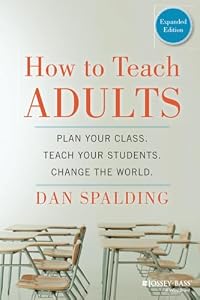
How to Teach Adults: Plan Your Class, Teach Your Students, Change the World, Expanded Edition
by Dan Spalding
On This Page
Description
"Your hands-on guide to teaching adults. no matter what the subject In this expanded edition of How to Teach Adults, Dan Spalding offers practical teaching and classroom management suggestions that are designed for anyone who works with adult learners, particularly new faculty, adjuncts, those in community colleges, ESL teachers, and graduate students. This reader-friendly resource covers all phases of the teaching process from planning what to teach, to managing a classroom, to growing as a show more professional in the field.How to Teach Adults can guide new instructors who are trying to get up to speed on their own or can help teacher trainers cover what their students need to know before they get in front of a class. It is filled with down-to-earth tips and checklists on such topics as connecting with adult students, facilitating discussions, and writing tests, plus everything you need to remember to put into your syllabus and how to choose the right textbook. Dan Spalding reveals what it takes to teach all students the skills they need to learn, no matter what the topic or subject matter.Full of vivid examples from real-world classrooms, this edition: Shows how to get started and tips for designing your course Includes information for creating a solid lesson plan Gives suggestions for developing your teacher persona How to Teach Adults offers the framework, ideas, and tools needed to conduct your class or workshop with confidence"-- show lessTags
Recommendations


Member Reviews
To understand this book properly, the reader must grasp that Spalding has taught English as a Second Language (ESL) classes to adults for several years. He is engaged in self-education and in innovation of education for other groups. In the final chapter of this book, he lays out an ambitious vision for what public education has to offer America in our time.
He addresses learning for adults primarily in a classroom environment (such as with his ESL classes), not in graduate school nor informally in a workplace. As such, he misses the mark in terms of what adult education is about. Much of adult education happens in unstructured (or even pseudo-structured) environments like churches. People learn from each other in an ad hoc manner. Or show more they read something (say, on the Internet) that teaches them about something else and discuss it with friends, family, or colleagues. In my experience, adult education – even in more formal graduate schools – is focused on efficient learning but not as much on the formalities of a teacher/student dichotomy.
I personally aim to teach and to learn in every environment I’m engaged with. I keep a book blog; I coordinate a Sunday School class for adults; I develop software with co-workers and discuss learnings; I lead discussions about that software with computer users; I talk over life with my daughter at the dinner table; etc. I’m interested in how to make those relationships adhere to efficient two-way knowledge exchange. This book frankly did not hit that sweet spot. It did point me to some resources that might, however.
This book’s audience is those engaged with teaching adults in formal (classroom) environments. It goes into detail about the issues educators might face and pushes the envelope about how to adapt those environments to contemporary needs. It adapts how schools of education teach teachers to adult learning contexts. This is a very necessary task; it just doesn’t fit my personal situation. It would have been nice to have a chapter (or even a series of chapters) on how to teach adults in non-classroom environments, where most adults spend most of their time. This could include in informal relationships, through group presentations, in meetings, or by technology and media.
The book did close strong by dwelling on two important issues for every American teacher: how to grow personally and where American education ought to go corporately. Clearly, Spalding cares about his profession and about his own and his students’ places in the world. His pedagogy is informed by his life, and vice versa. Professional teachers in particular will benefit from his approach. show less
He addresses learning for adults primarily in a classroom environment (such as with his ESL classes), not in graduate school nor informally in a workplace. As such, he misses the mark in terms of what adult education is about. Much of adult education happens in unstructured (or even pseudo-structured) environments like churches. People learn from each other in an ad hoc manner. Or show more they read something (say, on the Internet) that teaches them about something else and discuss it with friends, family, or colleagues. In my experience, adult education – even in more formal graduate schools – is focused on efficient learning but not as much on the formalities of a teacher/student dichotomy.
I personally aim to teach and to learn in every environment I’m engaged with. I keep a book blog; I coordinate a Sunday School class for adults; I develop software with co-workers and discuss learnings; I lead discussions about that software with computer users; I talk over life with my daughter at the dinner table; etc. I’m interested in how to make those relationships adhere to efficient two-way knowledge exchange. This book frankly did not hit that sweet spot. It did point me to some resources that might, however.
This book’s audience is those engaged with teaching adults in formal (classroom) environments. It goes into detail about the issues educators might face and pushes the envelope about how to adapt those environments to contemporary needs. It adapts how schools of education teach teachers to adult learning contexts. This is a very necessary task; it just doesn’t fit my personal situation. It would have been nice to have a chapter (or even a series of chapters) on how to teach adults in non-classroom environments, where most adults spend most of their time. This could include in informal relationships, through group presentations, in meetings, or by technology and media.
The book did close strong by dwelling on two important issues for every American teacher: how to grow personally and where American education ought to go corporately. Clearly, Spalding cares about his profession and about his own and his students’ places in the world. His pedagogy is informed by his life, and vice versa. Professional teachers in particular will benefit from his approach. show less
A great introduction to teaching methods and techniques for people who find themselves in the position of teaching adults and have no idea what they're doing.
Ratings
Members
- Recently Added By
Lists

Books for Educators
164 works; 6 members
Author Information

2+ Works 36 Members
Dan Spalding has more than ten years' experience teaching adults in both academic and nonacademic settings. He has developed curriculum for nonprofits, consulted with online learning startups, and is currently building a web platform to help people discuss and learn about the Antarctic.
Series
Belongs to Publisher Series
Common Knowledge
- Canonical title
- How to Teach Adults: Plan Your Class, Teach Your Students, Change the World, Expanded Edition
Classifications
Statistics
- Members
- 35
- Popularity
- 814,459
- Reviews
- 2
- Rating
- (4.00)
- Languages
- English
- Media
- Paper, Ebook
- ISBNs
- 3