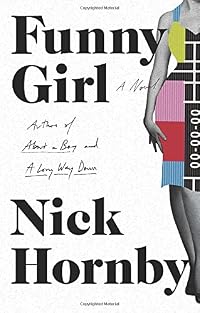
Funny Girl
by Nick Hornby
On This Page
Description
"From the bestselling author of High Fidelity, About a Boy, and A Long Way Down comes a highly anticipated new novel. Set in 1960's London, Funny Girl is a lively account of the adventures of the intrepid young Sophie Straw as she navigates her transformation from provincial ingenue to television starlet amid a constellation of delightful characters. Insightful and humorous, Nick Hornby's latest does what he does best: endears us to a cast of characters who are funny if flawed, and forces us show more to examine ourselves in the process. "-- show lessTags
Recommendations




Member Recommendations

Member Reviews
Reading "Funny Girl" was like meeting an old friend and being reminded all over again why you liked them so much in the first place. With wit, optimism and gentle compassion, Nick Hornby summons up the zeitgeist of Britain in the 1960s and 70s through the medium of TV comedy on the BBC.
Like Hornby himself, I was a child in the 1960s, so I missed some of then nuances of BBC comedy, failing to see what was daring and subversive but still understanding what was truly funny.
Hornby helped me to remember what it was like at the start of the 60s when we had only two TV channels in England,the BBC and ITV. EVERYBODY watched the same programs and discussed them the next day because those were the only programs available. I was seven when BBC 2 show more went on air in 1964 but I couldn't watch it because we didn't have a telly that could cope with the fancy 625 line UHF transmission. We were still watching a small box with a big tube that used the much lower definition 405 line VHF transmission. Of course, back then, everything was in glorious black and white. Even so, programs like the BBC's Comedy Playhouse attracted huge audiences and launched series that EVERYONE watched (Steptoe and Son, launched by the Comedy Playhouse, attracted audiences of up to 28 million - about half of the population of the UK at the time).
"Funny Girl" tells the story of Barbara, a young woman from "up North" who declines to accept the title of Miss Blackpool and moves south to London to follow in the footsteps of her idol, Lucille Ball and become a comedian. She clicks with the writers of a new show for the BBC, they re-write the show as showcase for her and her career takes off.
As we follow Barbara's career from ingénue through comic star to redoubtable Dame of British Television, Nick Hornby helped me understand the transitions that Britain was going through and the role comedy played in helping audiences to understand themselves.
I was deeply impressed by Nick Hornby's ability to write a novel that often made me laugh but which is centred around very believable, very human characters, with strengths and flaws and personality quirks, who he describes with a compassion that comes very close to love and which generates a possibility of hope that I found very affecting.
This well written book was made even better in audio by a superb performance by Emma Fielding who got every voice and every accent absolutely right and amplified the value of every page. show less
Like Hornby himself, I was a child in the 1960s, so I missed some of then nuances of BBC comedy, failing to see what was daring and subversive but still understanding what was truly funny.
Hornby helped me to remember what it was like at the start of the 60s when we had only two TV channels in England,the BBC and ITV. EVERYBODY watched the same programs and discussed them the next day because those were the only programs available. I was seven when BBC 2 show more went on air in 1964 but I couldn't watch it because we didn't have a telly that could cope with the fancy 625 line UHF transmission. We were still watching a small box with a big tube that used the much lower definition 405 line VHF transmission. Of course, back then, everything was in glorious black and white. Even so, programs like the BBC's Comedy Playhouse attracted huge audiences and launched series that EVERYONE watched (Steptoe and Son, launched by the Comedy Playhouse, attracted audiences of up to 28 million - about half of the population of the UK at the time).
"Funny Girl" tells the story of Barbara, a young woman from "up North" who declines to accept the title of Miss Blackpool and moves south to London to follow in the footsteps of her idol, Lucille Ball and become a comedian. She clicks with the writers of a new show for the BBC, they re-write the show as showcase for her and her career takes off.
As we follow Barbara's career from ingénue through comic star to redoubtable Dame of British Television, Nick Hornby helped me understand the transitions that Britain was going through and the role comedy played in helping audiences to understand themselves.
I was deeply impressed by Nick Hornby's ability to write a novel that often made me laugh but which is centred around very believable, very human characters, with strengths and flaws and personality quirks, who he describes with a compassion that comes very close to love and which generates a possibility of hope that I found very affecting.
This well written book was made even better in audio by a superb performance by Emma Fielding who got every voice and every accent absolutely right and amplified the value of every page. show less
I never particularly wanted to go back to the 1960's, but did so, happily and willingly, through Nick Hornby's latest book Funny Girl. Don't be confused by the title -- it has nothing to do with Fanny Brice, but everything to do with Barbara, a young woman from Blackpool, who wants to be the next Lucille Ball. Through a series of somewhat improbable events, which start with a beauty pageant in Blackpool, and a name change to Sophie Straw (a last name that her agent chooses, because she's so pretty every man really wants to roll in the hay with her), Barbara gets a starring role in a BBC series. The cast of characters of the novel, most of whom are involved in the series production, writing, or acting, have Hornby's typical depth and show more interest. Though the book covers a span of 50 years, the characters, their insights, and actions, remain fresh. It also provided a nice glimpse into the BBC of the past, and a contrast to today's entertainment industry. Hornby also did a nice job of interweaving fiction with reality, making me wish I could see Sophie in action, in person.
I received a copy of this book via Penguin's First to Read program. Though I had some difficulty getting this to load on my e-reader, and had to read on the laptop, it still was worth it! Thank you very much. show less
I received a copy of this book via Penguin's First to Read program. Though I had some difficulty getting this to load on my e-reader, and had to read on the laptop, it still was worth it! Thank you very much. show less
Nick Hornby has always been what I would call a reliable author, by which I mean that I might not have loved everything he has written, but I have found some enjoyment in everything of his that I have ever read. But actually I did love this book, and think it is his best yet.
Set in the 1960s, it tells of Barbara Parker from Blackpool, who wins the title of Miss Blackpool, promptly decides she doesn’t want it, and heads off to London to realise her dream of becoming a comedienne like her heroine, Lucille Ball.
Before long, Barbara has become Sophie Straw, landed a lead role in a new, successful tv sitcom, and the world – or the UK at least – is at her feet. She becomes part of a close-knit team, with her co-star, writers and show more director and life is wonderful for a while. But as they grow older and wiser and real life starts to get in the way, they have to rethink just how long the show can continue.
As I mentioned above, I really enjoyed this book. I liked Sophie so much – she was quick-witted, intelligent and full of fun – and I also liked the team she worked with. The writers, Tony and Bill, both gay men at a time when homosexuality was illegal and both dealing with it in very different ways; the director Dennis, gentle, kind, cuckolded by his awful wife Edith; and co-star Clive, who should have been easy to dislike with his womanising, his unfaithfulness and his professional jealousy, but who nonetheless was charismatic and made me laugh.
Hornby weaves real people in and out of the narrative, and I liked this; the prime minister and Lucille Ball both make an appearance amongst others. The tone is light and humorous, but never superficial. I felt as though 1960s London was brought to life.
Definitely a thumbs up from me for this one – I highly recommend. show less
Set in the 1960s, it tells of Barbara Parker from Blackpool, who wins the title of Miss Blackpool, promptly decides she doesn’t want it, and heads off to London to realise her dream of becoming a comedienne like her heroine, Lucille Ball.
Before long, Barbara has become Sophie Straw, landed a lead role in a new, successful tv sitcom, and the world – or the UK at least – is at her feet. She becomes part of a close-knit team, with her co-star, writers and show more director and life is wonderful for a while. But as they grow older and wiser and real life starts to get in the way, they have to rethink just how long the show can continue.
As I mentioned above, I really enjoyed this book. I liked Sophie so much – she was quick-witted, intelligent and full of fun – and I also liked the team she worked with. The writers, Tony and Bill, both gay men at a time when homosexuality was illegal and both dealing with it in very different ways; the director Dennis, gentle, kind, cuckolded by his awful wife Edith; and co-star Clive, who should have been easy to dislike with his womanising, his unfaithfulness and his professional jealousy, but who nonetheless was charismatic and made me laugh.
Hornby weaves real people in and out of the narrative, and I liked this; the prime minister and Lucille Ball both make an appearance amongst others. The tone is light and humorous, but never superficial. I felt as though 1960s London was brought to life.
Definitely a thumbs up from me for this one – I highly recommend. show less
Nick Hornby is at his best when he's writing about music (High Fidelity; Juliet, Naked), but he's very, very good on pop culture in general; with Funny Girl, he turns to the world of light entertainment in 1960s London.
Hornby takes Barbara from Blackpool and turns her into Sophie Straw, star of the new BBC sitcom Barbara (and Jim). In London, Barbara/Sophie finds the life she's always dreamed of, making people laugh on TV; her combination of looks, luck, charm, and humor win her a starring role on a show she loves, and she's able to help the show evolve with the times (to a point). Writers Tony and Bill, co-star Clive, and producer Dennis are well-rounded characters with their own lives; female characters other than Sophie take a back show more seat (magazine reporter Diane, Tony's wife June).
In his fiction, as in his essays, Hornby insists on the value of light entertainment, particularly comedy, defending it against its would-be attackers: the humorless Oxbridge types. ("What a terrible thing an education was, [Dennis] thought, if it produced the kind of mind that despised entertainment and the people who valued it.")
Funny Girl itself is a perfect example of light entertainment: Sophie struggles a little at the beginning but mostly skates through life, devoted to her work (she does find love as well). This book is about a handful of characters, but mostly, it's about the TV show they create together, their love of the work and each other. show less
Hornby takes Barbara from Blackpool and turns her into Sophie Straw, star of the new BBC sitcom Barbara (and Jim). In London, Barbara/Sophie finds the life she's always dreamed of, making people laugh on TV; her combination of looks, luck, charm, and humor win her a starring role on a show she loves, and she's able to help the show evolve with the times (to a point). Writers Tony and Bill, co-star Clive, and producer Dennis are well-rounded characters with their own lives; female characters other than Sophie take a back show more seat (magazine reporter Diane, Tony's wife June).
In his fiction, as in his essays, Hornby insists on the value of light entertainment, particularly comedy, defending it against its would-be attackers: the humorless Oxbridge types. ("What a terrible thing an education was, [Dennis] thought, if it produced the kind of mind that despised entertainment and the people who valued it.")
Funny Girl itself is a perfect example of light entertainment: Sophie struggles a little at the beginning but mostly skates through life, devoted to her work (she does find love as well). This book is about a handful of characters, but mostly, it's about the TV show they create together, their love of the work and each other. show less
I had low expectations for this one. I'm not sure why. I've always loved Hornby's writing, but the plot summary or something just didn't sound great to me. I was more than pleasantly surprised by the book. A young woman named Barbara from Blackpool moves to London during the 1960s to try to follow in the footsteps of her comedic icon, Lucille Ball. She soon renames herself Sophie Straw and gets a role starring on a BBC comedy series. I loved that the book didn't just focus on her struggle to succeed and end there. We get to see her life, along with the lives of the writers and directors connected with the show, unfold over the years.
Well, I did buy this novel for half price from Tesco's, so I can't really complain, but I'm not sure where the punchy cover reviews like 'Simply unputdownable' and 'Hilarious' came from. For a story about a comedy actress from the 1960s, I didn't find any of the dialogue very funny, and I could indeed put the book down (mostly after falling asleep and hitting myself in the face with it).
The first few chapters, introducing Barbara Parker, Miss Blackpool 1964 (for all of five minutes), were promising. But when Barbara changed her name to Sophie Straw, walked into her dream job of a starring role in a new Comedy Playhouse episode called Wedded Bliss and set about rewriting the thing because everybody instantly fell in love with her, then show more the rot started to set in. Male authors who can write convincing female characters are few and far between, and I think Nick Hornby is far too much of a 'lad lit' writer to even try. Sophie is a pneumatic blonde, superficially attractive to every man she meets, but also supposedly hilarious and confident to make female readers fall for her too - well, sorry, but she just got on my wick. This line sums the character up perfectly: 'She hasn't got any problems. That's what's so great about her. Everyone loves Sophie'.
Plus, the old 'provincial lass makes good in Swinging London' is so weathered from constant overuse in family sagas that the gimmick should now only be employed in parodies. I would love to believe that Nick Hornby was being ironic throughout - referring to reality TV and lavatory humour, having his politically correct characters talk about political correctness - but I suspect not. Barbara dumps her beauty queen crown and her dad in Blackpool, sets off for the capital, becomes the new Lucille Ball after two weeks working on a cosmetics counter, achieves overnight success in a show that does not sound remotely funny, has flings with various actors before discovering Mr Right - then cut to the modern day, after a cutesy series of 'biographies'. Nothing happens and nothing is believable. Perhaps those who work in the media - or used to work in 'light entertainment' - will find Sophie's story 'highly entertaining', but I just wanted one character I could care about in and amongst all the clever insider humour. Bill and Tony, the writers based on Galton and Simpson who wrote Steptoe and Son, came close, but Sophie was still hogging too much of the limelight for them to gain equal billing.
And oh, the 'humour'. Readers who go for the rambling irrelevancies of Hitchhiker's Guide might have to put down this unputdownable book to compose themselves, but otherwise the witticisms are mostly along the lines of: 'Tony and Bill used to be two different shades of chalk. Now Tony was turning into a variety of cheese. It wasn't a strong cheese, admittedly - he was probably closer in flavour to a cheese spread than to a seeping blue French thing riddled with maggots'. Huh, yeah. Era authentic, perhaps, but I'm just glad that comedy has moved on.
A great sense of the sixties, bar the 'political correctness', but a less than 'hilarious' attempt at comic writing. And the illustrations of Sabrina, Galton and Simpson, Tom Sloan, Till Death Us Do Part, Harold Wilson and various mocked-up scripts and book covers took up space that would otherwise have required further dialogue, but really served no other useful purpose (bar saving me from Wiki'ing Sabrina). Not my bag. show less
The first few chapters, introducing Barbara Parker, Miss Blackpool 1964 (for all of five minutes), were promising. But when Barbara changed her name to Sophie Straw, walked into her dream job of a starring role in a new Comedy Playhouse episode called Wedded Bliss and set about rewriting the thing because everybody instantly fell in love with her, then show more the rot started to set in. Male authors who can write convincing female characters are few and far between, and I think Nick Hornby is far too much of a 'lad lit' writer to even try. Sophie is a pneumatic blonde, superficially attractive to every man she meets, but also supposedly hilarious and confident to make female readers fall for her too - well, sorry, but she just got on my wick. This line sums the character up perfectly: 'She hasn't got any problems. That's what's so great about her. Everyone loves Sophie'.
Plus, the old 'provincial lass makes good in Swinging London' is so weathered from constant overuse in family sagas that the gimmick should now only be employed in parodies. I would love to believe that Nick Hornby was being ironic throughout - referring to reality TV and lavatory humour, having his politically correct characters talk about political correctness - but I suspect not. Barbara dumps her beauty queen crown and her dad in Blackpool, sets off for the capital, becomes the new Lucille Ball after two weeks working on a cosmetics counter, achieves overnight success in a show that does not sound remotely funny, has flings with various actors before discovering Mr Right - then cut to the modern day, after a cutesy series of 'biographies'. Nothing happens and nothing is believable. Perhaps those who work in the media - or used to work in 'light entertainment' - will find Sophie's story 'highly entertaining', but I just wanted one character I could care about in and amongst all the clever insider humour. Bill and Tony, the writers based on Galton and Simpson who wrote Steptoe and Son, came close, but Sophie was still hogging too much of the limelight for them to gain equal billing.
And oh, the 'humour'. Readers who go for the rambling irrelevancies of Hitchhiker's Guide might have to put down this unputdownable book to compose themselves, but otherwise the witticisms are mostly along the lines of: 'Tony and Bill used to be two different shades of chalk. Now Tony was turning into a variety of cheese. It wasn't a strong cheese, admittedly - he was probably closer in flavour to a cheese spread than to a seeping blue French thing riddled with maggots'. Huh, yeah. Era authentic, perhaps, but I'm just glad that comedy has moved on.
A great sense of the sixties, bar the 'political correctness', but a less than 'hilarious' attempt at comic writing. And the illustrations of Sabrina, Galton and Simpson, Tom Sloan, Till Death Us Do Part, Harold Wilson and various mocked-up scripts and book covers took up space that would otherwise have required further dialogue, but really served no other useful purpose (bar saving me from Wiki'ing Sabrina). Not my bag. show less
In 1964, Barbara Parker is crowned Miss Blackpool, and immediately resigns her post to head to London and make it big as a TV comedian, which she does in fairly short order. The book tells the story of her TV career, along with her colleagues in producing her hit show ("Barbara (and Jim)"), their various affairs, successes, and failures. It's an enjoyable book, though for me the story didn't really amount to much; I kept reading to find if there was going to be much of a theme, or even a story beyond the story of her life. It fees like it captures the reality of British TV production in the mid 60s, but to me that wasn't really enough to drive it. Also, Hornby never really shows Barbara (later Sophie) being funny. Hornby keeps you show more reading, though through most of his characterizations. show less
Members
- Recently Added By
Lists

Books Read in 2017
4,249 works; 129 members

Kirkus Starred Fiction Reviews of Books Published in 2015
310 works; 6 members
Books Read in 2016
4,666 works; 197 members

Most Frequently Tagged "Read in 2015"
70 works; 1 member

Actors
65 works; 5 members
Author Information

61+ Works 68,718 Members
Nick Hornby was born in Redhill, Surrey, England on April 17, 1957. He graduated from Cambridge University where he studied English. His books High Fidelity; Fever Pitch, which won the William Hill Sports Book of the Year Award in 1992; About a Boy and An Education were all made into movies. His other books include Slam; A Long Way Down; How to Be show more Good; Songbook; Shakespeare Wrote for Money; and The Polysyllabic Spree. He has received numerous awards including the American Academy of Arts and Letters' E. M. Forster Award in 1999 and the Orange Word International Writers' London Award in 2003. In addition to his books, his works have appeared in Esquire, Elle, GQ, Time, and Cosmopolitan. In 2015 his title, Funny Girl made The New York Times Bestseller List. (Publisher Provided) show less
Some Editions
Awards and Honors
Distinctions
Series
Belongs to Publisher Series
Llibres Anagrama (27)
Common Knowledge
- Canonical title
- Funny Girl
- Original publication date
- 2015
- People/Characters
- Barbara Parker / Sophie Straw; Clive Richardson; Bill Gardiner; Tony Holmes; Brian Debenham; Vernon Whitfield
- Important places
- London, England, UK; Blackpool, Lancashire, England, UK
- Related movies
- Funny Woman (2023 | IMDb)
- Dedication
- For Amanda, with love and gratitude, as ever. And for Roger Gillett and Georgia Garrett.
- First words
- She didn't want to be a beauty queen, but as luck would have it, she was about to become one.
- Quotations
- Bill was extremely careful. He always made sure that he knew the Test score, and that he dressed badly, and sometimes he made careful reference to girls. But then, he was afraid, like a lot of men in his position. He was alwa... (show all)ys one mistake away from prison.
- Last words
- (Click to show. Warning: May contain spoilers.)She could get a laugh that nobody was expecting, and they'd be off and running.
Classifications
Statistics
- Members
- 1,487
- Popularity
- 15,539
- Reviews
- 73
- Rating
- (3.49)
- Languages
- 11 — Danish, Dutch, English, French, German, Italian, Korean, Polish, Portuguese, Spanish, Swedish
- Media
- Paper, Audiobook, Ebook
- ISBNs
- 43
- ASINs
- 15