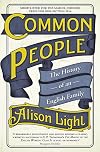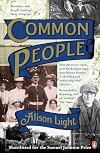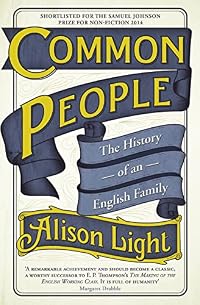
Common People: In Pursuit of My Ancestors
by Alison Light
On This Page
Description
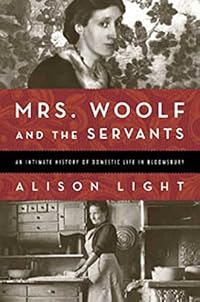
́Family history begins with missing persons, ́ Alison Light writes in Common People. We wonder about those we ́ve lost, and those we never knew, about the long skein that led to us, and to here, and to now. So we start exploring. Most of us, however, give up a few generations back. We run into a gap, get embarrassed by a ne ́er-do-well, or simply find our ancestors are less glamorous than we ́d hoped. That didn ́t stop Alison Light: in the last weeks of her father ́s life, she show more embarked on an attempt to trace the history of her family as far back as she could reasonably go. The result is a clear-eyed, fascinating, frequently moving account of the lives of everyday people, of the tough decisions and hard work, the good luck and bad breaks, that chart the course of a life. Light ́s forebears ́servants, sailors, farm workers ́were among the poorest, traveling the country looking for work; they left few lasting marks on the world. But through her painstaking work in archives, and her ability to make the people and struggles of the past come alive, Light reminds us that ́every life, even glimpsed through the chinks of the census, has its surprises and secrets. ́ What she did for the servants of Bloomsbury in her celebrated Mrs. Woolf and the Servants Light does here for her own ancestors, and, by extension, everyone ́s: draws their experiences from the shadows of the past and helps us understand their lives, estranged from us by time yet inextricably interwoven with our own. Family history, in her hands, becomes a new kind of public history. show lessTags
Recommendations













Member Reviews
Professional historians have generally given family history short shrift. It's 'history lite' or 'comfort-zone history'; solipsistic and myopic. Its practitioners, critics say, are only interested in themselves. The family history we choose to write, the past we believe in, is always a selection of stories from the many at our disposal in the past. Family history individualizes but it can also privatize, make us feel more singular. I have wanted to resist that way of 'finding my past'; to pay my respects but to look for wider perspectives on what too easily is seen as a chapter of accidents, hapless human tragedy in the lives of those struggling to find decent housing and steady work. I have no doubt that some of my ancestors were show more vicious, stupid and cruel. I wouldn't have liked them much if I had met them. But why were their lives so hard and what were their 'options', if they had them? Family history worth its salt asks these big questions about economic forces, political decisions, local government, urban history, social policy, as well as the character of individuals and the fate of their families. It moves us from a sense of the past to an idea of history, where we are no longer its centre, and where arguments must be had. It entails loss too, not least in seeing ourselves as representative, rather than simply unique.
Common People lives up to its author's expressed goal. Light organizes the book around the ancestry of her four grandparents. This ancestry is unique to Light and her siblings, yet her ancestors seem representative of the working class in 19th century southern England. Light's ancestors were “servants, sailors, watermen, farm carters...and artisans in the building trade”. Light's readers will get a feel for what it meant to be a servant or a sailor in the 19th century, how precarious life was for the working poor, and just how easy it was to run out of options and land in the workhouse. This should be near the top of the reading list for anyone with an interest in the social history of 19th century Great Britain. It's a shame that most of the photographs and facsimile reproductions are so dark that many of the details are lost. A book of this caliber deserved illustrative plates on higher-quality paper. show less
Common People lives up to its author's expressed goal. Light organizes the book around the ancestry of her four grandparents. This ancestry is unique to Light and her siblings, yet her ancestors seem representative of the working class in 19th century southern England. Light's ancestors were “servants, sailors, watermen, farm carters...and artisans in the building trade”. Light's readers will get a feel for what it meant to be a servant or a sailor in the 19th century, how precarious life was for the working poor, and just how easy it was to run out of options and land in the workhouse. This should be near the top of the reading list for anyone with an interest in the social history of 19th century Great Britain. It's a shame that most of the photographs and facsimile reproductions are so dark that many of the details are lost. A book of this caliber deserved illustrative plates on higher-quality paper. show less
https://nwhyte.livejournal.com/2882781.html
This is a great work of social and personal history. Light has taken her four grandparents and traced the genealogy of each as far back as she can go. None of them were from the well-chronicled upper or middle classes; she remarks that if anywhere can claim to be her ancestral home, it is the workhouse, as someone from every generation ended up there. She gradually zooms in on Portsmouth as the focal point of the story, but not before travelling around the middle and south of England in general. Where there may be personal data lacking, she diverges into intense history of the disruptive effect of the Industrial Revolution on society, the precise details of needle-making, the life prospects of show more the building labourer, the reality of the Navy in the tweentieth century; and she humanises these sweeping sources of data with moving empathy for her own ancestors and their fellow citizens. It's a tremendous piece of work, both sad and uplifting, demonstrating that historical writing can almost completely avoid the great and the good and still be really memorable. Strongly recommended. show less
This is a great work of social and personal history. Light has taken her four grandparents and traced the genealogy of each as far back as she can go. None of them were from the well-chronicled upper or middle classes; she remarks that if anywhere can claim to be her ancestral home, it is the workhouse, as someone from every generation ended up there. She gradually zooms in on Portsmouth as the focal point of the story, but not before travelling around the middle and south of England in general. Where there may be personal data lacking, she diverges into intense history of the disruptive effect of the Industrial Revolution on society, the precise details of needle-making, the life prospects of show more the building labourer, the reality of the Navy in the tweentieth century; and she humanises these sweeping sources of data with moving empathy for her own ancestors and their fellow citizens. It's a tremendous piece of work, both sad and uplifting, demonstrating that historical writing can almost completely avoid the great and the good and still be really memorable. Strongly recommended. show less
Light brings the insight and self-awareness I enjoyed in Mrs Woolf and the Servants to a look at her own family's history going back to her (I think) g-g-g-g-grandparents in the 19th century to her grandparents in the early - mid twentieth century. Going back through the generations Light discovers a family history that covers needle making, the Navy, time spent in various workhouses and asylums, time spent in service, the Baptist movement, bricklayers and builders. One branch of the family manages to work their way up to middle-class prosperity but otherwise they were just scraping by or not getting by and in the workhouse. One ancestor was born in a workhouse and then died in a lunatic asylum; another was buried in a shared grave. show more Light really brings home the poverty of the vast majority of English people in previous centuries whether living in the country or in slums and tenements in a city or town. Brilliant.
'If anywhere can claim to be my ancestral home it is the workhouse. Somebody in every generation fetched up there' show less
'If anywhere can claim to be my ancestral home it is the workhouse. Somebody in every generation fetched up there' show less
This starts as her family history, which might be of interest to her and her immediate family, but is not necessarily going to be of great interest to may other people. However it takes a slightly broader sweep through history, using her family's movements, jobs, religions and so on to tell a more general story of the country as a whole. So the family from the midlands that moved from the land to the town to the suburbs of Birmingham is a story of the industrial revolution and how it provided an incentive to move people about. She grew up in Portsmouth, a few miles from my hometown, so there was local interest for me as well and the more general interest. Although no-one I know has ever described a resident of Portsmouth as a show more "Portsmuthian". Just never!
At the end she tries to sum up where she comes from, and that's almost impossible. There is no ancestral place, we're all far too much a patchwork for that. In her case, her roots are in the poor and the just coping. They worked at all the different jobs of the centuries, moving as trade and work drove them. We come form all over.
I should say that my mother was working on our family tree and I can see in this some of the drivers to investigate that mean I have all her work in a box under the spare bed. It's one of those things that I think I'll save for my retirement to keep the brain busy. On a personal level, it's about wanting to "meet" the people who are currently names on a piece of paper. My greatgrandad who made it through all 4 years on the western front and the one on the other side of the family that ended up a POW. I want to know more about the names in the front of the family bible, given as a wedding present in 1856. I want to know what was going on around Sarah Ann Skelton when she stitched a sampler, aged 7 in 1829. I want to know where the chest of drawers (with the cheap wood on the sides, design to fit an alcove, and the posh stuff saved for the front) was made to fit in ~1800. All these things come down to us and they can tell us, at one level, nothing of who we are. But at another level, they do say something about how we came to be. And that's a story all of itself. show less
At the end she tries to sum up where she comes from, and that's almost impossible. There is no ancestral place, we're all far too much a patchwork for that. In her case, her roots are in the poor and the just coping. They worked at all the different jobs of the centuries, moving as trade and work drove them. We come form all over.
I should say that my mother was working on our family tree and I can see in this some of the drivers to investigate that mean I have all her work in a box under the spare bed. It's one of those things that I think I'll save for my retirement to keep the brain busy. On a personal level, it's about wanting to "meet" the people who are currently names on a piece of paper. My greatgrandad who made it through all 4 years on the western front and the one on the other side of the family that ended up a POW. I want to know more about the names in the front of the family bible, given as a wedding present in 1856. I want to know what was going on around Sarah Ann Skelton when she stitched a sampler, aged 7 in 1829. I want to know where the chest of drawers (with the cheap wood on the sides, design to fit an alcove, and the posh stuff saved for the front) was made to fit in ~1800. All these things come down to us and they can tell us, at one level, nothing of who we are. But at another level, they do say something about how we came to be. And that's a story all of itself. show less
Writing family histories has become such an industry over recent years that it's easy to become cynical about them. However, I tend to like them, along with TV programmes like'Who do you think you are?'. Alison Light's history of her family is one of the best mainly because it does what it says on the tin and celebrates and values the lives of 'common people'- the poor migrant working class living from hand to mouth often spending periods in workhouses and ending up in lunatic asylums. This is a fascinating picture of a range of working class trades, ranging from farm labourers, needle-makers, builders, servants, shoe makers, sailors etc. It shows the struggle and nobility of so many lives from birth to death as well as celebrating the show more strength and solidarity of slum communities and, in particular, the contribution of non-conformist churches and chapels in the 19th century. show less
I nearly discarded this until I realised that it focussed its genealogical lens on those at the lower end of the social spectrum, those who don't make the headlines, who live in poverty and strive to make ends meet against all odds. Also a large part of the book is set in Portsmouth and provides an excellent analysis of the town's history, in its time the most densely populated town in the UK. Page 207 points to the conditions in which people lived in the late 1840s: 'The island of Portsea 'was one huge cesspool', daily permitting 30,000 gallons of urine to penetrate the soil, making its way 'with a host of other abominations' into the well water'.
Historian Alison Light provides an excellent and readable venture into her own family's history, deftly demonstrating how one incorporates social history, local history, religious history, and more, to make ancestors come alive. She provides several very quotable phrases scattered thoughout the volume, certain to resonate with researchers adhering to the genealogical proof standard. My biggest complaint pertains to the "invisible endnotes" system employed by the editors. Readers deserve to know when something is being cited. The acceptable way of doing this is to provide a numbered footnote or endnote. I find the method employed by the editors lacking. In some places the author's aversion to religion manifested itself through show more condescending remarks. In other places where the opportunity presented itself, she refrained from such comments. This restraint maintained a bias-free environment in those portions of the narrative. Overall the book provided a commendable example in family history writing. Highly recommended. show less
Members
- Recently Added By
Lists

Best Biographies, Autobiographies and Memoirs
464 works; 156 members

Non-Fiction Worth Reading
1,015 works; 253 members

Top Five Books of 2014
1,064 works; 398 members

Morphy Pick!
24 works; 1 member

Favorite Books Published in 2014
27 works; 7 members
Author Information

9+ Works 665 Members
Alison Light is the author of the acclaimed Mrs. Woolf and the Servants. She is Honorary Professor in the Department of English at University College, London, and on the hoard of the Raphael Samuel History Centre in London.
Awards and Honors
Common Knowledge
- Canonical title
- Common People: In Pursuit of My Ancestors
- Alternate titles
- Common People: An English Family History without Roots; Common People: The History of an English Family
- Original publication date
- 2014
- People/Characters
- Alison Light
- Dedication
- For my mother, Barbara Light, with love and gratitude, and in memory of my father, Rob (Sid) Light, who first taught me that
'No man is an island' - First words
- I began this book because I realised I had no idea where my family came from.
- Quotations
- If anywhere can claim to be my ancestral home it is the workhouse. Somebody in every generation fetched up there.
- Blurbers
- Drabble, Margaret
Classifications
Statistics
- Members
- 178
- Popularity
- 179,093
- Reviews
- 9
- Rating
- (4.11)
- Languages
- English
- Media
- Paper, Ebook
- ISBNs
- 7
- ASINs
- 2