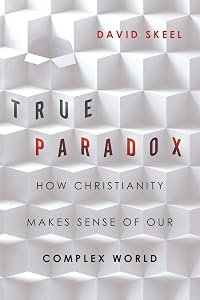
True Paradox: How Christianity Makes Sense of Our Complex World
by David Skeel
On This Page
Description
Foreword Review's 17th Annual INDIEFAB Book of the Year Finalist (Religion)! How do we explain human consciousness? Where do we get our sense of beauty? Why do we recoil at suffering? Why do we have moral codes that none of us can meet? Why do we yearn for justice, yet seem incapable of establishing it? Any philosophy or worldview must make sense of the world as we actually experience it. We need to explain how we can discern qualities such as beauty and evil and account for our practices of show more morality and law. The complexity of the contemporary world is sometimes seen as an embarrassment for Christianity. But law professor David Skeel makes a fresh case for the plausibility and explanatory power of Christianity. The Christian faith offers plausible explanations for the central puzzles of our existence, such as our capacity for idea-making, our experience of beauty and suffering, and our inability to create a just social order. When compared with materialism or other sets of beliefs, Christianity provides a more comprehensive framework for understanding human life as we actually live it. We need not deny the complexities of life as we experience it. But the paradoxes of our existence can lead us to the possibility that the existence of God could make sense of it all. show lessTags
Recommendations








Member Reviews
This one is different, but fun. When I think of apologetics, I generally think of logical arguments to prove the existence of God. Skeel is a lawyer, so he doesn’t think in straight lines. He dances around unexpected topics, letting us build a feeling about the truth of Christianity rather than bludgeoning us with hokey evidence.
It’s apologetics with a twist. Soft arguments in contrast to hard science or logic. I like it.
The two topics which most intrigued me were (1) the mystery of beauty and (2) the paradox of justice. The discussion of both was interesting and engaging, if not fully convincing. His goal is not only to defeat materialism but to lift Christianity above other religions as the best fit, and I didn’t quite get show more there. Yes, Christianity matches our observations of the world, but the fact that Christianity built its belief systems around observations should hardly surprise us. (The universe is beautiful, so a good God must have made it. The world’s justice systems are lacking, so a good God will one day swoop in and make everything right.) Nevertheless, Skeel’s approach leaves us feeling hopeful that something magnificent is behind life on earth, even if we haven’t figured it all out yet.
Skeel is a different kind of Christian than I am; I felt that immediately. He writes often of what “Christians believe” (not this Christian, David) and seems to use the word “faith” in a different manner than I do. This leads to a discussion about heaven in the closing chapter which felt like it just didn’t belong. But again, I realize as I come to the close of the book that I’m not supposed to be drawing equations, but feeling. Skeel is right about this: it feels like there must be more to life than birth and death and purposeless pain in between. There has to be more.
Intervarsity Press, © 2014, 175 pages
ISBN: 978-0-8308-3676-5 show less
It’s apologetics with a twist. Soft arguments in contrast to hard science or logic. I like it.
The two topics which most intrigued me were (1) the mystery of beauty and (2) the paradox of justice. The discussion of both was interesting and engaging, if not fully convincing. His goal is not only to defeat materialism but to lift Christianity above other religions as the best fit, and I didn’t quite get show more there. Yes, Christianity matches our observations of the world, but the fact that Christianity built its belief systems around observations should hardly surprise us. (The universe is beautiful, so a good God must have made it. The world’s justice systems are lacking, so a good God will one day swoop in and make everything right.) Nevertheless, Skeel’s approach leaves us feeling hopeful that something magnificent is behind life on earth, even if we haven’t figured it all out yet.
Skeel is a different kind of Christian than I am; I felt that immediately. He writes often of what “Christians believe” (not this Christian, David) and seems to use the word “faith” in a different manner than I do. This leads to a discussion about heaven in the closing chapter which felt like it just didn’t belong. But again, I realize as I come to the close of the book that I’m not supposed to be drawing equations, but feeling. Skeel is right about this: it feels like there must be more to life than birth and death and purposeless pain in between. There has to be more.
Intervarsity Press, © 2014, 175 pages
ISBN: 978-0-8308-3676-5 show less
An excellent and thought-provoking book - a refreshing example of respectful apologetics. It left me hungry for more. My only disappointment - not enough to make me drop a star - was in its treatment of justice. While it covered the limitations of justice well, I felt it left undone the other side of justice - the need for legal restrictions in a fallen world. While Christianity teaches that law cannot make us holy, but can only reveal our need for a Savior; and we are told in Scripture that human anger (or self-righteousness or intellect, for that matter) can't bring about the righteousness of God, his treatment of Justice left me with the question, "Why then have any legal system at all, since no system can guarantee the better show more society it aims to create?" But then, Christianity itself argues for working to better the world, not to make it perfect (as in "put an end to" whatever, poverty, abuse, etc), but to make it better. The human record of creating a perfect world is depressing, but the efforts of those (of all faiths, and even of some who claim no faith) who simply want to leave the world better than they found it offer hope, and fit in with the more realistic goals that Christianity, rightly understood, would foster. show less
The complexity of the contemporary world is sometimes seen as an embarrassment for Christianity. But law professor David Skeel makes a fresh case for the plausibility and explanatory power of Christianity. The Christian faith offers plausible explanations for the central puzzles of our existence, such as our capacity for idea-making, our experience of beauty and suffering, and our inability to create a just social order. When compared with materialism or other sets of beliefs, Christianity provides a more comprehensive framework for understanding human life as we actually live it.
We need not deny the complexities of life as we experience it. But the paradoxes of our existence can lead us to the possibility that the existence of God show more could make sense of it all. show less
We need not deny the complexities of life as we experience it. But the paradoxes of our existence can lead us to the possibility that the existence of God show more could make sense of it all. show less
Ratings
Members
- Recently Added By
Lists

Recommendations by Tim Keller
50 works; 1 member
Author Information
2 Works 129 Members
David A. Skeel JR. is S. Samuel Arsht Professor of Corporate Law at the University of Pennsylvania Law School. He is the author of The New Financial Deal, Icarus in the Boardroom and Debt's Dominion. He has been interviewed on The News Hour, Nightline, Chris Matthews's Hardball (MSNBC), National Public Radio and Marketplace, and has written for show more such publications as the New York Times, Wall Street Journal, The Weekly Standard and Books Culture. Skeel is a frequent speaker at Veritas Forums and is an elder at Tenth Presbyterian Church in Philadelphia. He blogs at trueparadoxblog.com. show less
Common Knowledge
- Publisher's editor
- Arsenault, Patrick
Classifications
Statistics
- Members
- 92
- Popularity
- 349,360
- Reviews
- 3
- Rating
- (4.33)
- Languages
- English
- Media
- Paper, Ebook
- ISBNs
- 2