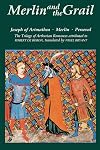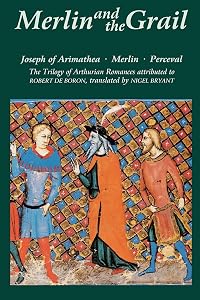
Merlin and the Grail: Joseph of Arimathea, Merlin, Perceval: The Trilogy of Arthurian Prose Romances attributed to Robert de Boron
by Robert de Boron
On This Page
Description
It is hard to overstate the importance of this trilogy of prose romances in the development of the legend of the Holy Grail and in the evolution of Arthurian literature as a whole. They give a crucial new impetus to the story of the Grail by establishing a provenance for the sacred vessel - and for the Round Table itself - in the Biblical past; and through the controlling figure of Merlin they link the story of Joseph of Arimathea with the mythical British history of Vortigern and show more Utherpendragon, the birth of Arthur, and the sword in the stone, and then with the knightly adventures of Perceval's Grail quest and the betrayal and death of Arthur, creating the very first Arthurian cycle. Ambitious, original and complete in its conception, this trilogy - translated here for the first time - is a finely paced, vigorous piece of storytelling that provides an outstanding example of the essentially oral nature of early prose.NIGEL BRYANT is head of drama at Marlborough College and he has also provided editions in English of The High Book of the Grail: A translation of the thirteenth century romance of Perlesvaus. show less
Tags
Recommendations











Member Reviews
It’s a bloody masterpiece. In three short romances, Robert (or his redactor) creates an origin story for the Grail, tells the quest for it, and then the death of Arthur. In the process he creates something that we can recognise as the Arthurian legend today, not just rumours and whispering of it.
How he does this is very clever. Before you dive in to Joseph of Arimathea, it’s worth reading the Gospel of Nicodemus and some of the Pilate Cycle. These are all short works. Bear in mind that at the time people thought they were actual historical documents. Our author has wound his story around this history. It opens with an orthodox statement of faith. In the introduction (short but excellent), Bryant mentions a theory that this may be to show more counter accusations of Catharism. Well, possibly, but Robert is on dangerous ground anyway, playing around with truth.
In Merlin Robert switches to the Canonical Gospels and Geoffrey of Monmouth’s History of the Kings of Britain. Again, it’s worth having read these beforehand; and again they were all thought at the time to be genuine historical documents on the one had and an actual history on the other. Merlin is a kind of anti-Christ, as it were – not evil, but his life a reflection of Jesus’. I particularly enjoyed how Bryant translates his direct speech into the same rhythms and tone as Nicol Williamson uses in Boorman’s Excalibur. He does a similar thing in one of his other Arthurian translations where he quotes Monty Python’s Quest for the Holy Grail as often as he can.
Perceval opens in a sort of dreamland. Castles that move about, in a forest that can’t be mapped, though which lone knights can quest. A land bound with enchantments. Perceval’s achieving of the Grail is a sort of double-edged sword. On the one hand the enchantments are unbound, but on the other time starts. We’re suddenly in the 13th Century where knights are not lone superheroes but soldiers who can be killed.
I enjoyed this all the more for having read the other books mentioned above, but really you’re ready for this if you’ve read Chrétien de Troyes. As they say in blurbs, if you only read one Arthurian romance this year... show less
How he does this is very clever. Before you dive in to Joseph of Arimathea, it’s worth reading the Gospel of Nicodemus and some of the Pilate Cycle. These are all short works. Bear in mind that at the time people thought they were actual historical documents. Our author has wound his story around this history. It opens with an orthodox statement of faith. In the introduction (short but excellent), Bryant mentions a theory that this may be to show more counter accusations of Catharism. Well, possibly, but Robert is on dangerous ground anyway, playing around with truth.
In Merlin Robert switches to the Canonical Gospels and Geoffrey of Monmouth’s History of the Kings of Britain. Again, it’s worth having read these beforehand; and again they were all thought at the time to be genuine historical documents on the one had and an actual history on the other. Merlin is a kind of anti-Christ, as it were – not evil, but his life a reflection of Jesus’. I particularly enjoyed how Bryant translates his direct speech into the same rhythms and tone as Nicol Williamson uses in Boorman’s Excalibur. He does a similar thing in one of his other Arthurian translations where he quotes Monty Python’s Quest for the Holy Grail as often as he can.
Perceval opens in a sort of dreamland. Castles that move about, in a forest that can’t be mapped, though which lone knights can quest. A land bound with enchantments. Perceval’s achieving of the Grail is a sort of double-edged sword. On the one hand the enchantments are unbound, but on the other time starts. We’re suddenly in the 13th Century where knights are not lone superheroes but soldiers who can be killed.
I enjoyed this all the more for having read the other books mentioned above, but really you’re ready for this if you’ve read Chrétien de Troyes. As they say in blurbs, if you only read one Arthurian romance this year... show less
Ratings
Members
- Recently Added By
Author Information
Some Editions
Series
Belongs to Publisher Series
Arthurian Studies (48)
Work Relationships
Is contained in
Common Knowledge
- Canonical title
- Merlin and the Grail: Joseph of Arimathea, Merlin, Perceval: The Trilogy of Arthurian Prose Romances attributed to Robert de Boron
- Original publication date
- 2001
- Original language
- Old French
Classifications
Statistics
- Members
- 141
- Popularity
- 232,242
- Reviews
- 1
- Rating
- (4.35)
- Languages
- English, Italian
- Media
- Paper, Ebook
- ISBNs
- 7
- ASINs
- 2