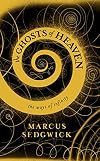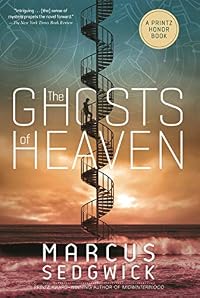
The Ghosts of Heaven
by Marcus Sedgwick
On This Page
Description
Four linked stories of discovery and survival begin with a Paleolithic-era girl who makes the first written signs, continue with Anna, who people call a witch, then a mad twentieth-century poet who watches the ocean knowing the horrors it hides, and concluding with an astronaut on the first spaceship from Earth sent to colonize another world.Tags
Recommendations







Member Reviews
There is a note at the beginning of The Ghosts of Heaven with instructions from Mr. Sedgwick on the reading order and the fact that there really is no particular order in which the individual stories need to be read. This may appear an odd statement at first because the stories do connect. It is upon finishing all four quarters though in which the instructions and Mr. Sedgwick’s intent not only make sense but reveal themselves to be master strokes of writing, not only within the connectivity of the four stories brilliantly woven together, but the theme of spirals really comes to the fore.
In addition to all of that bookish goodness, there is the fact that the individual stories are entertaining and extremely well-written as stand-alone show more pieces. Suspenseful, intense and very enlightening, they make for great reading. In each, Mr. Sedgwick plays with the narrative format to differentiate each story. From the lyrical poem of Quarter 1 to the first-person narration of Quarter 3, not only are they completely unique but they also showcase Mr. Sedgwick’s writing skills.
One thing is for certain; The Ghosts of Heaven packs a powerful punch into each of its four stories, including chilling messages, fully developed characters, and beautifully-wrought settings. The spiral theme is a gorgeous study of nature’s laws and its impact on human behavior, however unconscious. The four stories also explore the range of human experience and emotion, from primitive man all the way to the future of mankind. It is not just an absolutely fantastic novel but an impressive story for this time of year in which one is already inclined to reflection. show less
In addition to all of that bookish goodness, there is the fact that the individual stories are entertaining and extremely well-written as stand-alone show more pieces. Suspenseful, intense and very enlightening, they make for great reading. In each, Mr. Sedgwick plays with the narrative format to differentiate each story. From the lyrical poem of Quarter 1 to the first-person narration of Quarter 3, not only are they completely unique but they also showcase Mr. Sedgwick’s writing skills.
One thing is for certain; The Ghosts of Heaven packs a powerful punch into each of its four stories, including chilling messages, fully developed characters, and beautifully-wrought settings. The spiral theme is a gorgeous study of nature’s laws and its impact on human behavior, however unconscious. The four stories also explore the range of human experience and emotion, from primitive man all the way to the future of mankind. It is not just an absolutely fantastic novel but an impressive story for this time of year in which one is already inclined to reflection. show less
Spirals are everywhere. Ok. But can someone please explain why I am feeling weird after reading this book?
And why I am still not clear about what I just read?
And why do I feel spirals are creepier than they already are?
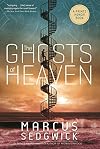
And why I really want to climb staircase like this?
Found a fun fact-
If you draw a spiral that spins down, down, down..... you might end up being depressed.
If you draw one that expands out, out, out.... you will feel kind of light.
Or maybe it just works with me.
And why I am still not clear about what I just read?
And why do I feel spirals are creepier than they already are?
And why I really want to climb staircase like this?
Found a fun fact-
If you draw a spiral that spins down, down, down..... you might end up being depressed.
If you draw one that expands out, out, out.... you will feel kind of light.
Or maybe it just works with me.
It's true that the book stars off with the weakest story (while each story can be read in any order, Sedgwick must know that the majority of people are going to read it in the order presented), but the following ones get stronger and stronger as they go along, and culminates in the last story, which is the best and maybe the most ambitious (though I could argue for the first one).
While the theme is loosely spirals, it's more about humanity's thirst for and yet fear of knowledge, and the dangerous of knowing too much (but that this doesn't excuse living in ignorance).The protagonist of the first story searches for that knowledge, and, while she survives the initial invasion, she's eventually trapped with a big idea circling (spiraling? show more :D) her conscious; Anna is punished for knowing too much and not fitting in with the others, though it seems as though they gets theirs; Charles peeked too far into the realm of knowledge and suffers for it; Ben finds out that he has gone insane from such knowledge, but manages to break the circle.
The first story was OK; free verse and poetry aren't really my cup of tea and I was really curious about some questions that didn't seem to get answered. The second story was good - heartbreaking to see how easy it is for your neighbors to turn on you so quickly and senselessly. The third story (which had the best title) had some real potential that I don't think it lived up to - I assumed (maybe erroneously) that the doctor would join Charles in his descent, but he managed to remain unscathed though touched by the cliche of the "mentally ill but wise" man. The fourth and last story was my favorite - I've always had a weakness for space horror, and space psychological horror in particular, and even more of a weakness forweird"the killer was you driven crazy from the future all along!" sci-fi shit so this really hit all my buttons. There was genuine atmosphere of tension, an interesting mystery/reveal, and some good twists. show less
While the theme is loosely spirals, it's more about humanity's thirst for and yet fear of knowledge, and the dangerous of knowing too much (but that this doesn't excuse living in ignorance).
The first story was OK; free verse and poetry aren't really my cup of tea and I was really curious about some questions that didn't seem to get answered. The second story was good - heartbreaking to see how easy it is for your neighbors to turn on you so quickly and senselessly. The third story (which had the best title) had some real potential that I don't think it lived up to - I assumed (maybe erroneously) that the doctor would join Charles in his descent, but he managed to remain unscathed though touched by the cliche of the "mentally ill but wise" man. The fourth and last story was my favorite - I've always had a weakness for space horror, and space psychological horror in particular, and even more of a weakness for
I love books that elicit a comment spoken aloud at the end. And Sedgwick writes those books!
This book takes place at four different times of history - prehistoric, 1700s (?) England, twentieth century Long Island, and sometime in the future in space. Each character is presented with a representation of a coil or spiral and they wonder at how it relates to their life. The first is a girl who wants to be chosen by the magic man who draws on the cave wall to ensure a good hunt. The second is the daughter of a cunning woman who delivers babies and dispenses herbal potions to the villagers. After the mother's death, the girl is charged with being a witch. The third person is a man who has taken a position as assistant to the director of an show more asylum. The fourth person is a man on a space ship bound to another world who is woken periodically from a hibernating sleep to make sure everything is OK. But one time things are not.
Along with the theme of spirals, Sedgewick also uses water as a link between the characters and their settings. There is enough variation between the different times to set them apart from each other. And, like I said, the ending was very cool! show less
This book takes place at four different times of history - prehistoric, 1700s (?) England, twentieth century Long Island, and sometime in the future in space. Each character is presented with a representation of a coil or spiral and they wonder at how it relates to their life. The first is a girl who wants to be chosen by the magic man who draws on the cave wall to ensure a good hunt. The second is the daughter of a cunning woman who delivers babies and dispenses herbal potions to the villagers. After the mother's death, the girl is charged with being a witch. The third person is a man who has taken a position as assistant to the director of an show more asylum. The fourth person is a man on a space ship bound to another world who is woken periodically from a hibernating sleep to make sure everything is OK. But one time things are not.
Along with the theme of spirals, Sedgewick also uses water as a link between the characters and their settings. There is enough variation between the different times to set them apart from each other. And, like I said, the ending was very cool! show less
I think that this book is good, but it was not my favorite. All the spiraling in this book had me spiraling with thoughts of where the plot was going. The story is split into four parts, each from a different era with a person who is trying to find the meaning of something. I like the idea of the meaning of the spiral that is found in this book by its characters, but don’t know how to put it into words to share it with you. The style of this story was not anything like other books I have read. It’s a science fiction that explores time, fate, and the human experience in a spiraling way.
While this book was not one of my favorites, I have to give it five stars for the vivid descriptions and the pull to the characters that kept me glued show more til the end. The novel has a contemplative tone and though-provoking ideas that will appeal to readers who enjoy philosophical inquiries and existential exploration like fate and mortality. The complex interconnectedness between the four narratives depicted in this book is quite the puzzle to be solved by readers. show less
While this book was not one of my favorites, I have to give it five stars for the vivid descriptions and the pull to the characters that kept me glued show more til the end. The novel has a contemplative tone and though-provoking ideas that will appeal to readers who enjoy philosophical inquiries and existential exploration like fate and mortality. The complex interconnectedness between the four narratives depicted in this book is quite the puzzle to be solved by readers. show less
I read this in two days. It was weird, but good weird. I read the introduction and Marcus Sedgwick said the different sections could be read in any order. It felt a bit subversive going straight to part 2, but I did it, then part 3, 1 and 4. The book reads as four linked short stories which I guess it really is (although the spiral doesn't seem to have any real power, it just is). I enjoyed each of the stories for different reasons, even though they are all so different. Like other reviewers have said, this book is hard to categorize, sort of fantasy crossed with a whole heap of other genres. I was close to giving this five stars because it is so original, but it wasn't quite that good.
https://nwhyte.livejournal.com/3240067.html
It's a set of four loosely connected stories, a girl in prehistoric times, a medieval young woman accused of witchcraft, a doctor in a nineteenth-century asylum, and a generation starship where the cold-sleep passengers start dying. They are all well written, especially the first which is more or less in verse form, with the recurring theme of a spiral echoing across the centuries. The author's foreword suggests that the four stories can be read in any order, but I don't think that's really true. I see that it was shortlisted for the Carnegie medal - and am interested that I didn't pick up on it being intended for a younger audience, if indeed it was.
It's a set of four loosely connected stories, a girl in prehistoric times, a medieval young woman accused of witchcraft, a doctor in a nineteenth-century asylum, and a generation starship where the cold-sleep passengers start dying. They are all well written, especially the first which is more or less in verse form, with the recurring theme of a spiral echoing across the centuries. The author's foreword suggests that the four stories can be read in any order, but I don't think that's really true. I see that it was shortlisted for the Carnegie medal - and am interested that I didn't pick up on it being intended for a younger audience, if indeed it was.
Members
- Recently Added By
Lists

Science Fiction
72 works; 1 member

For me to read
20 works; 1 member

Books recommended by Calgary Public Library staff
1,588 works; 4 members
Author Information

58+ Works 7,561 Members
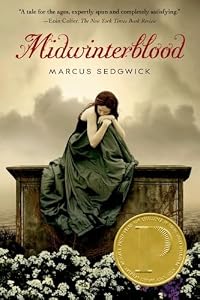
Marcus Sedgwick was born in East Kent, England. He is primarily a young adult author. His books include She Is Not Invisible, White Crow, Revolver, and The Ghosts of Heaven. He won the 2014 Michael L. Printz Award for Midwinterblood. His first adult novel, A Love Like Blood, was published in 2014. (Bowker Author Biography)
Awards and Honors
Awards
Work Relationships
Is abridged in
Classifications
Statistics
- Members
- 394
- Popularity
- 78,525
- Reviews
- 16
- Rating
- (3.73)
- Languages
- English, German
- Media
- Paper, Ebook
- ISBNs
- 17
- ASINs
- 2