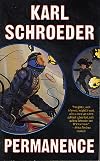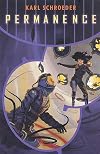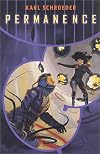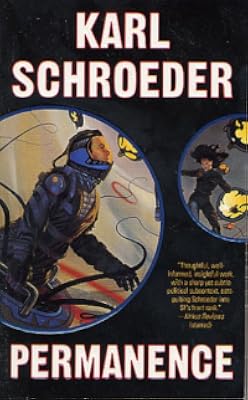
Permanence
by Karl Schroeder
On This Page
Description
Young Rue Cassels of the Cycler Compact - a civilization based around remote brown dwarf stars - is running for her life from her bullying brother, Jentry, who has stolen her family inheritance and threatens to sell her into slavery. Fleeing in a shuttle spacecraft from the sparsely populated and austere comet-mining habitat she has lived in her whole life, she spots a distant, approaching object, and stakes a legal claim to it. It is not the valuable comet she hoped for but something even show more more wonderful, an abandoned Cycler starship.Since the discovery of a faster-than-light drive, unfortunately operable only between larger stars, the Cycler Compact civilization has gradually dwindled. It's much cheaper for the star-based civilizations of the new Rights Economy to bypass the stops that can't be made with the new technology, and the civilizations of the brown stars are gradually sinking into anarchy and chaos. It has been decades since the last Cycler ship passed anywhere near the system in which Rue grew up. Her discovery unleashes a fury of action, greed, and interstellar intrigue as many factions attempt to take advantage of the last great opportunity to revitalize-and perhaps control - the Compact.This is the story of Rue's quest to visit and claim this ship and its treasures, set against a background of warring empires, strange alien artifacts, and fantastic science. It is a story of hope and danger, of a strange and compelling religion, Permanence, unique to this star-faring age, and of the rebirth of life and belief in a place at the edge of forever. show lessTags
Recommendations








Member Reviews
This book is a top notch sci-fi read, blending new ideas with a classic feel, and has immediately catapulted Karl Schroeder into my favorite authors list. This book falls into the category of hard sci-fi, but with interesting characters, a well thought out story, and some philosophy thrown in for good measure.
The scientific concepts that are integrated into the setting offer a look at some of the more recent ideas about what exists between solar systems, from Kuiper Belt objects to Brown Dwarfs and their possible planetary systems, referred to in the book as the Halo worlds. The setting implies the frequency of these objects is higher than what we know of today, making these dark worlds reachable with a pre-Faster-Than-Light technology. show more Humans have discovered FTL drives as well, but they seem to require the deep gravity wells of normal stars to work.
The aliens of this universe are few and far between as well, and none of them are anything like humans, so much so that humanity still feels very alone in the universe. I love authors who pull off unique aliens as that is what I expect such an alternative evolutionary track would do, and it helps to make it feel like it could be real.
The book includes some philosophical & religious exploration as well, centered mostly on what it takes to build a sustainable galactic type civilization that could encompass many different intelligent species. The religion of many people in the current universe is called Permanence. This religion is based on the methodology and technology required for maintaining the current human civilization and also on expanding it. The religion still maintains it's following among the Halo worlds, but is repressed on the worlds around stars, where FTL can be used. From a philosophical side, the book explores the implications of FTL vs. non-FTL travel between worlds, and it's affects on the sustainability of a civilization spread across the stars.
There's plenty of politics here as well, with the repressive like Right Economy which nano tags everything with a value and ownership, allowing the enforcement of payment on all uses of information and items owned by others. Ultimately this appears as a libertarian dystopia, exposing the flaws in extreme economic libertarianism. There's also some repression of freedom of religion as well, but there is not much else discussed to expose what other types of rights might also be repressed.
As my initial introduction to Karl Schroeder, I found the book highly enjoyable and look forward to reading many more novels by him. In fact, I think he has managed to claim a spot in my short list of all-time favorite authors. show less
The scientific concepts that are integrated into the setting offer a look at some of the more recent ideas about what exists between solar systems, from Kuiper Belt objects to Brown Dwarfs and their possible planetary systems, referred to in the book as the Halo worlds. The setting implies the frequency of these objects is higher than what we know of today, making these dark worlds reachable with a pre-Faster-Than-Light technology. show more Humans have discovered FTL drives as well, but they seem to require the deep gravity wells of normal stars to work.
The aliens of this universe are few and far between as well, and none of them are anything like humans, so much so that humanity still feels very alone in the universe. I love authors who pull off unique aliens as that is what I expect such an alternative evolutionary track would do, and it helps to make it feel like it could be real.
The book includes some philosophical & religious exploration as well, centered mostly on what it takes to build a sustainable galactic type civilization that could encompass many different intelligent species. The religion of many people in the current universe is called Permanence. This religion is based on the methodology and technology required for maintaining the current human civilization and also on expanding it. The religion still maintains it's following among the Halo worlds, but is repressed on the worlds around stars, where FTL can be used. From a philosophical side, the book explores the implications of FTL vs. non-FTL travel between worlds, and it's affects on the sustainability of a civilization spread across the stars.
There's plenty of politics here as well, with the repressive like Right Economy which nano tags everything with a value and ownership, allowing the enforcement of payment on all uses of information and items owned by others. Ultimately this appears as a libertarian dystopia, exposing the flaws in extreme economic libertarianism. There's also some repression of freedom of religion as well, but there is not much else discussed to expose what other types of rights might also be repressed.
As my initial introduction to Karl Schroeder, I found the book highly enjoyable and look forward to reading many more novels by him. In fact, I think he has managed to claim a spot in my short list of all-time favorite authors. show less
Permanence is classical Big Dumb Object space opera, with weaknesses in characterization and plotting papered over with quick writing and some actually interesting ideas about deep time.
Rue Cassels is escaping from her abusive half-brother and the tiny cometary mining station she calls home when she stumbles across a find of incredible, mind-boggling wealth. A distant speck of light is not just a chunk of rock, not just a slower-than-light Cycler starship, but an alien Cycler. The discovery tosses Rue into the deep end of human politics.
Small-town girl Rue is a mite out of her depth (despite deep wells of cunning, decency, and resilience), and xenoarcheologist Michael Bequith becomes a secondary point of view. Bequith is much more show more interesting than the standard YA protagonist is Rue. He's the human fixer for the truly gifted Dr. Herat, but both of them have become disenchanted with their discipline. For decades, humanity has been searching for aliens that they could have diplomatic relationships with. However, while life is common, sentient technological life is incredibly rare. The handful of existing equivalent species will have nothing to do with humans out of various forms of revulsion: Autotrophs find the fact that we eat grotesque. Slyphs regard altering the environment to suit you rather than vice-versa a sin worthy of genocide. And there's a species of nomadic interstellar solipsists. Every other species is dead, nothing than more than ruins, many of then wiped out 65 million years ago by a theorized empire of Von Neumann berseker probes called the Chicxulub.
Herat has about given up hope, and so has Besquith. His academic work is a cover for his banned religion of NeoShintoism, which uses AI and VR to capture the Kami of alien worlds, but an experience on a ringworld fragment has left Besquith profoundly shaken.
Rue's Cycler, the Envy, represents a lot of hope. For Rue, it's wealth, freedom, and a lifeline for her civilization based in the dark halo worlds, which have been bypassed by the FTL ships of Earth's Rights Economy. For Besquith, it's a chance to find his faith again. And for Admiral Chrisler of the Right's Economy, it's a chance to win a war that's his side is losing via unloosing automated weapons, whatever the cost.
The parts that I found most interesting concern the Right's Economy and the Chicxulub. The Right's Economy is a nightmare of DRM, where everything has a price and money and is funneled upwards to Right's Owners back on Earth. Even military starships require constant microtransactions to operate. Most people find this awful, and a growing rebellion is winning the war. Yet some kind of unified government is necessary to prevent humanity from splintering into transhuman fragments. (Notably, Rue is off-baseline. Growing up on a cold and dim cometary hab means she finds ordinary light and heat blinding and stifling. Unclear how much is genetics and how much is just adaptation). And both the Rights Economy and the rebels, using FTL ships that only work around major stars, would leave Rue's home of the Cycler Compact habitats to wither and die.
The sweep of big ideas makes up for some, well, not bad characterization, but not exactly great characterization and plotting. Rue, for all her good qualities, get by mostly on luck. Some of which is expected (hey, we need an inciting incident of finding the starship), some of which is earned (and she should be able to turn it on), but there's one chance drift into a secret rebel base which really stretched my credulity. The Rights Economy seems like a bad joke, but given that this book came out in 2002, the iTunes Store opened in 2003, and the Oblivion Horse Armor DLC fiasco happened in 2006, Schroeder was weirdly prescient--an apt bit of writing given that he's also a serious futurist. show less
Rue Cassels is escaping from her abusive half-brother and the tiny cometary mining station she calls home when she stumbles across a find of incredible, mind-boggling wealth. A distant speck of light is not just a chunk of rock, not just a slower-than-light Cycler starship, but an alien Cycler. The discovery tosses Rue into the deep end of human politics.
Small-town girl Rue is a mite out of her depth (despite deep wells of cunning, decency, and resilience), and xenoarcheologist Michael Bequith becomes a secondary point of view. Bequith is much more show more interesting than the standard YA protagonist is Rue. He's the human fixer for the truly gifted Dr. Herat, but both of them have become disenchanted with their discipline. For decades, humanity has been searching for aliens that they could have diplomatic relationships with. However, while life is common, sentient technological life is incredibly rare. The handful of existing equivalent species will have nothing to do with humans out of various forms of revulsion: Autotrophs find the fact that we eat grotesque. Slyphs regard altering the environment to suit you rather than vice-versa a sin worthy of genocide. And there's a species of nomadic interstellar solipsists. Every other species is dead, nothing than more than ruins, many of then wiped out 65 million years ago by a theorized empire of Von Neumann berseker probes called the Chicxulub.
Herat has about given up hope, and so has Besquith. His academic work is a cover for his banned religion of NeoShintoism, which uses AI and VR to capture the Kami of alien worlds, but an experience on a ringworld fragment has left Besquith profoundly shaken.
Rue's Cycler, the Envy, represents a lot of hope. For Rue, it's wealth, freedom, and a lifeline for her civilization based in the dark halo worlds, which have been bypassed by the FTL ships of Earth's Rights Economy. For Besquith, it's a chance to find his faith again. And for Admiral Chrisler of the Right's Economy, it's a chance to win a war that's his side is losing via unloosing automated weapons, whatever the cost.
The parts that I found most interesting concern the Right's Economy and the Chicxulub. The Right's Economy is a nightmare of DRM, where everything has a price and money and is funneled upwards to Right's Owners back on Earth. Even military starships require constant microtransactions to operate. Most people find this awful, and a growing rebellion is winning the war. Yet some kind of unified government is necessary to prevent humanity from splintering into transhuman fragments. (Notably, Rue is off-baseline. Growing up on a cold and dim cometary hab means she finds ordinary light and heat blinding and stifling. Unclear how much is genetics and how much is just adaptation). And both the Rights Economy and the rebels, using FTL ships that only work around major stars, would leave Rue's home of the Cycler Compact habitats to wither and die.
The sweep of big ideas makes up for some, well, not bad characterization, but not exactly great characterization and plotting. Rue, for all her good qualities, get by mostly on luck. Some of which is expected (hey, we need an inciting incident of finding the starship), some of which is earned (and she should be able to turn it on), but there's one chance drift into a secret rebel base which really stretched my credulity. The Rights Economy seems like a bad joke, but given that this book came out in 2002, the iTunes Store opened in 2003, and the Oblivion Horse Armor DLC fiasco happened in 2006, Schroeder was weirdly prescient--an apt bit of writing given that he's also a serious futurist. show less
(Reviewed December 16, 2007)
After the majesty and brilliant imagination of Ventus, the author's previous novel, I had high expectations for Permanence. Schroeder showed such a competence for world-creation and characterisation in Ventus, I felt like I wanted to live in his book, and was sorry to have to read the last page. It was like an enormous, delicious feast that left me wanting more. So it was to my immense disappointment to find that in contrast, reading Permanence is like eating a bowl of mud. To wit: Thin, underdeveloped characters (excuse me, but how old is Rue Cassels? She acts like a teenager, but is apparently much older. All I could see through the entire book was a shrill, emotionally overwrought child wandering around show more like she owned the place and somehow being wooed by a 45 year-old sexually repressed subservient monk), a plot that packs a million things in, but still manages to feel meandering, pointless and dull (I honestly thought part one was an experiment in plot drift), a central conceit that seems clever and imaginative at first but quickly becomes frustrating and repetitive (I never want to read the word "cycler" ever again), and an irritating propaganda-like push for something called NeoShintoism (note the pretentious CamelCase), whose practitioners are the most smug, self-satisfied douche bags this side of a Tibetan monastery. And to top it all off, just as the most interesting aspect of the book starts to get going (the discovery and utilisation of the Jentry's Envy), suddenly we're trapped on the most boring, insipid, poorly developed planet I have ever experienced in a sci-fi novel for a quarter of its length! Why?? What made Schroeder think it would be a good idea to abandon such a fascinating concept as an alien spacecraft designed specifically for other aliens to use and have his idiotic characters wander around aimlessly for two-hundred pages working through their bland childhood angst? Is his editor a naked mole rat? How could you not see that this makes for bad storytelling? It boggles the mind. And don't get me started on the ending. This book should have been titled "Deus Ex Machina, and How Not To Utilise It". People who say Absolution Gap's ending is bad (which it isn't if you read the rest of the stories set in the RS universe, but that's neither here nor there) should read this book and have their eyes opened to how truly bad endings can be.
You may be wondering, if I hated it so much, why I gave this book two stars instead of one. Well, there's genuinely interesting stuff in here. The exploration of the Jentry's Envy is fantastically imaginative and gripping, and the expectation that they would return to it is basically what kept me reading. The first chapter is tense and exciting and shows a promise never quite fulfilled, and the sense of cold, remote, empty space is palpable and something that I genuinely enjoy. But I can get that in pretty much any Alastair Reynolds or Greg Egan novel, and without all the lameness that comes with it in this case.
If you like deep space hard sci-fi, you will more than likely enjoy the first half of this book (although a word of warning, there is FTL travel), and especially if you enjoy the BDO style. But as soon as the Jentry's Envy is under human control, close the book, put it down, and walk away; there is nothing more for you here.
Seriously, how do you go from Ventus, to this? I am baffled. Baffled I tell you! show less
After the majesty and brilliant imagination of Ventus, the author's previous novel, I had high expectations for Permanence. Schroeder showed such a competence for world-creation and characterisation in Ventus, I felt like I wanted to live in his book, and was sorry to have to read the last page. It was like an enormous, delicious feast that left me wanting more. So it was to my immense disappointment to find that in contrast, reading Permanence is like eating a bowl of mud. To wit: Thin, underdeveloped characters (excuse me, but how old is Rue Cassels? She acts like a teenager, but is apparently much older. All I could see through the entire book was a shrill, emotionally overwrought child wandering around show more like she owned the place and somehow being wooed by a 45 year-old sexually repressed subservient monk), a plot that packs a million things in, but still manages to feel meandering, pointless and dull (I honestly thought part one was an experiment in plot drift), a central conceit that seems clever and imaginative at first but quickly becomes frustrating and repetitive (I never want to read the word "cycler" ever again), and an irritating propaganda-like push for something called NeoShintoism (note the pretentious CamelCase), whose practitioners are the most smug, self-satisfied douche bags this side of a Tibetan monastery. And to top it all off, just as the most interesting aspect of the book starts to get going (the discovery and utilisation of the Jentry's Envy), suddenly we're trapped on the most boring, insipid, poorly developed planet I have ever experienced in a sci-fi novel for a quarter of its length! Why?? What made Schroeder think it would be a good idea to abandon such a fascinating concept as an alien spacecraft designed specifically for other aliens to use and have his idiotic characters wander around aimlessly for two-hundred pages working through their bland childhood angst? Is his editor a naked mole rat? How could you not see that this makes for bad storytelling? It boggles the mind. And don't get me started on the ending. This book should have been titled "Deus Ex Machina, and How Not To Utilise It". People who say Absolution Gap's ending is bad (which it isn't if you read the rest of the stories set in the RS universe, but that's neither here nor there) should read this book and have their eyes opened to how truly bad endings can be.
You may be wondering, if I hated it so much, why I gave this book two stars instead of one. Well, there's genuinely interesting stuff in here. The exploration of the Jentry's Envy is fantastically imaginative and gripping, and the expectation that they would return to it is basically what kept me reading. The first chapter is tense and exciting and shows a promise never quite fulfilled, and the sense of cold, remote, empty space is palpable and something that I genuinely enjoy. But I can get that in pretty much any Alastair Reynolds or Greg Egan novel, and without all the lameness that comes with it in this case.
If you like deep space hard sci-fi, you will more than likely enjoy the first half of this book (although a word of warning, there is FTL travel), and especially if you enjoy the BDO style. But as soon as the Jentry's Envy is under human control, close the book, put it down, and walk away; there is nothing more for you here.
Seriously, how do you go from Ventus, to this? I am baffled. Baffled I tell you! show less
Some interesting ideas and multiple themes: a coming-of-age story; alien contact that defies the usual clichés; sociopolitical and economic roadblocks presented by faster than light travel (or lack thereof); spirituality in an age of cyberware. But the plot points get murky and things are weighted down through sheer repetition. Not enough here to warrant 470 pages....edit, edit, EDIT!
This is a very typical Male Science Fiction Author book (the good kind, at least) in that it had absolutely mind-bendingly fascinating sci-fi ideas and forgettable characters and relationships between them. When I think about this book a year from now, I will not remember the name of a single character, but I will definitely remember the unique aliens, provocative ideas, and universe-altering technology.
Full of interesting ideas, but weak characterization and dialogue. Fast read, though.
Good characters with an interesting plot. Some interesting ideas about civilisations.
Members
- Recently Added By
Lists

Exploration of alternative economical systems
40 works; 3 members
Author Information

48+ Works 4,042 Members
Awards and Honors
Awards
Distinctions
Notable Lists
Series
Belongs to Publisher Series
Gallimard, Folio SF (297)
Common Knowledge
- People/Characters
- Rue Cassels; Jentry
- First words
- Rue paused just long enough to catch her breath.
- Last words
- (Click to show. Warning: May contain spoilers.)We have time.
Classifications
Statistics
- Members
- 393
- Popularity
- 79,157
- Reviews
- 9
- Rating
- (3.65)
- Languages
- English, French
- Media
- Paper, Ebook
- ISBNs
- 5
- ASINs
- 2