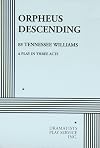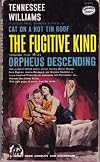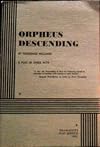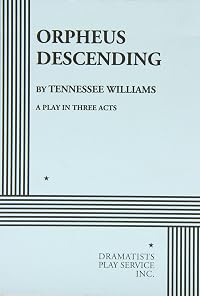
Orpheus Descending
by Tennessee Williams
On This Page
Description
Fugitive Kind, one of Tennessee Williams's earliest plays, is one of his richest in dramatic material. Written in 1937 when the playwright was still Thomas Lanier Williams,Fugitive Kind introduces the character who will inhabit most of his later plays: the marginal man or woman who, through no personal fault, is a misfit in society but who demonstrates an admirable will to survive. Signature Tennessee Williams' characters, situations, and even the title (which was used asThe Fugitive Kind show more for the 1960 film based onOrpheus Descending) have their genesis here. At age twenty-six, Williams was still learning his craft and this, his second full-length play, shows his debt to sources as diverse as thirties gangster films (The Petrified Forest, Winterset) andRomeo and Juliet. Fugitive Kind, with its star-crossed lovers and big city slum setting, takes place in a flophouse on the St. Louis waterfront in the shadow of Eads Bridge, where Williams spent Saturdays away from his shoe factory job and met his characters: jobless wayfarers on the dole, young writers and artists of the WPA, even gangsters and G-men.Fugitive Kind was also Williams's second play to be produced by The Mummers, a St. Louis theatre group devoted to drama of social protest. Called "vital and absorbing" by a contemporary review inThe St. Louis Star-Times, this play reveals the young playwright's own struggle between his radical-socialist sympathies and his poetic inclinations, and signals his future reputation as our most compassionate lyric dramatist. show lessTags
Recommendations


































Member Reviews
I read this play in college and then had the great pleasure to play a minor roll in it. The dialogue is entrancing, the story captivating and the characters are perfectly flawed. This is Williams dark horse that does not get revived enough.
I fell in love with this play when I saw it performed at the Stratford Festival in 2004. It is heartbreaking and beautiful. This was my first exposure to Williams and I was hooked.
Commedia in tre atti. Versione italiana di Gerardo Guerrieri: "La discesa d'Orfeo"
Dec 3, 2013Italian
Ratings
Members
- Recently Added By
Lists

Plays I Like
230 works; 29 members
My Play Collection
769 works; 3 members
Author Information

333+ Works 31,975 Members
After O'Neill, Williams is perhaps the best dramatist the United States has yet produced. Born in his grandfather's rectory in Columbus, Mississippi, Williams and his family later moved to St. Louis. There Williams endured many bad years caused by the abuse of his father and his own anguish over his introverted sister, who was later permanently show more institutionalized. Williams attended the University of Missouri, and, after time out to clerk for a shoe company and for his own mental breakdown, also attended Washington University of St. Louis and the University of Iowa, from which he graduated in 1938. Williams began to write plays in 1935. During 1943 he spent six months as a contract screenwriter for MGM but produced only one script, The Gentleman Caller. When MGM rejected it, Williams turned it into his first major success, The Glass Menagerie (1945). In this intensely autobiographical play, Williams dramatizes the story of Amanda, who dreams of restoring her lost past by finding a gentleman caller for her crippled daughter, and of Amanda's son Tom, who longs to escape from the responsibility of supporting his mother and sister. After The Glass Menagerie,Williams wrote his masterpiece, A Streetcar Named Desire, (1947), along with a steady stream of other plays, among them such major works as Summer and Smoke(1948), Cat on a Hot Tin Roof (1954), and Suddenly Last Summer (1958). His plays celebrate the "fugitive kind," the sensitive outcasts whose outsider status allows them to perceive the horror of the world and who often give additional witness to that horror by becoming its victims. Stephen S. Stanton has summed up Williams's "virtues and strengths" as "a genius for portraiture, particularly of women, a sensitive ear for dialogue and the rhythms of natural speech, a comic talent often manifesting itself in "black comedy,' and a genuine theatrical flair exhibited in telling stage effects attained through lighting, costume, music, and movements." After The Night of the Iguana (1961), Williams continued to write profusely---and constantly to revise his work---but it became more difficult to get productions of his plays and, if they were produced, to win critical or popular acclaim for them. Williams won the Pulitzer Prize for drama for A Streetcar Named Desire and Cat on a Hot Tin Roof. He won the New York Drama Critics Circle Award for these two and for The Glass Menagerie and The Night of the Iguana. (Bowker Author Biography) show less
Series
Belongs to Publisher Series
Work Relationships
Common Knowledge
- Canonical title
- Orpheus Descending
- Original title
- Orpheus Descending
- Alternate titles
- The Fugitive Kind
- Original publication date
- 1958-02-05, with Battle of Angels (1945) (1945)
- People/Characters
- Carol Cutrere; Vee Talbott; Val Xavier; Lady Torrance; Jabe Torrance; Beulah (show all 7); Dolly
- Important places*
- Mississippi, Verenigde Staten
- Related movies
- The Fugitive Kind (1959 | IMDb); Orpheus Descending (1990 | IMDb)
- Dedication
- For Marion Black Vaccaro
- First words
- SCENE: The set represents in norealistic fashion a general dry-goods store and part of a connected "confectionery" in a small Southern town.
*Some information comes from Common Knowledge in other languages. Click "Edit" for more information.
Classifications
Statistics
- Members
- 200
- Popularity
- 163,530
- Reviews
- 3
- Rating
- (3.69)
- Languages
- English, Greek
- Media
- Paper, Ebook
- ISBNs
- 4
- UPCs
- 1
- ASINs
- 9