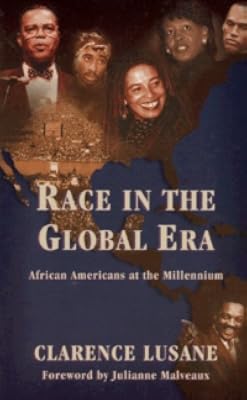
Race in the Global Era: African Americans at the Millennium
by Clarence Lusane
On This Page
Description
This is a provocative, accessible collection that examines U.S. racial barriers, boundaries, and identities through critiques of constructed, marketed, and consumed images.Tags
Member Reviews
In “Race in the Global Era (copyright 1997), Clarence Lusane (Professor of International Race Politics, inter alia, at American University) seeks, through a series of essays, to evaluate the status of “blackness” at the beginning of the 21st century. His topics range from welfare, to poverty, to O.J., to crack cocaine, to Tupac, to Louis Farrakhan, and to gender politics.
He asks us, “What are white folks thinking about in these days of great transitions when they think about race?" His answer is that “they are thinking some pretty appalling, disturbing, and wrong ideas.” In fact, much of the thrust of his essays is aimed at setting out, and setting straight, media distortion on the realities of race. He offers data to show more counter some of the more egregiously incorrect notions that many whites have about blacks as revealed by polls from the date of his manuscript [and again just recently in the run-up to the recent election].
Several riffs of thought stand out in his essays. Professor Lusane asserts that color blindness is advocated in the mainstream as an attempt to neutralize the social power of race. What he means is that policies can legitimately be deemed “color-blind” only if all parties can start from the same place. But what “color blind” policies do is to jettison “the ramifications of a long history of racial oppression marked not only by the oppression of people of color, but significantly, by substantial white privilege.” Thus, “underneath the progressive notion that race is a social “construct” and should not matter, is an insistence that race will not matter even in circumstances where racial inequities prevail…. In this way, liberals blind themselves to real racial issues, and conservatives “use the rhetoric of color blindness to justify the elimination of social programs and policies deemed to remedy problems that disproportionately affect racial minorities.”
Whites do not want to incur either the responsibility or the sacrifice for the plight of the poor, Professor Lusane charges. Instead, cherished American doctrines of self-reliance and responsibility (always more relevant to myth than to reality) are invoked to help dissipate guilt and sympathy, as well as to deflect attention from the roles of government, policymakers, and corporations in determining conditions of black life.
Professor Lusane gives admirable coverage to the patriarchal nature of much of black music, religious thought, and even political organizing. He observes “while black women have made great strides in countless fields – even as they continue to carry the disproportionate, multiple burdens and responsibilities of childrearing, homemaking, and socialization – they have become the demons of choice for New Democrat liberals, old-line conservatives, and prominent black nationalists.” He bemoans the characterization of black women as “traitorous” for exposing less than admiral behavior in prominent black males (e.g., Clarence Thomas, Marion Barry, etc.) He also excoriates the role of gangsta rappers in promulgating negative attitudes toward women.
The arguments in this book are well-taken, but they aren’t universal enough to elevate this book to a timeless status. With the wonderful diversity of African-American voices now on blogs and the election of Barack Obama to the presidency, much of what the author discusses could use updating. The book definitely provides a useful overview of current black culture, however, for those just starting out in their studies. show less
He asks us, “What are white folks thinking about in these days of great transitions when they think about race?" His answer is that “they are thinking some pretty appalling, disturbing, and wrong ideas.” In fact, much of the thrust of his essays is aimed at setting out, and setting straight, media distortion on the realities of race. He offers data to show more counter some of the more egregiously incorrect notions that many whites have about blacks as revealed by polls from the date of his manuscript [and again just recently in the run-up to the recent election].
Several riffs of thought stand out in his essays. Professor Lusane asserts that color blindness is advocated in the mainstream as an attempt to neutralize the social power of race. What he means is that policies can legitimately be deemed “color-blind” only if all parties can start from the same place. But what “color blind” policies do is to jettison “the ramifications of a long history of racial oppression marked not only by the oppression of people of color, but significantly, by substantial white privilege.” Thus, “underneath the progressive notion that race is a social “construct” and should not matter, is an insistence that race will not matter even in circumstances where racial inequities prevail…. In this way, liberals blind themselves to real racial issues, and conservatives “use the rhetoric of color blindness to justify the elimination of social programs and policies deemed to remedy problems that disproportionately affect racial minorities.”
Whites do not want to incur either the responsibility or the sacrifice for the plight of the poor, Professor Lusane charges. Instead, cherished American doctrines of self-reliance and responsibility (always more relevant to myth than to reality) are invoked to help dissipate guilt and sympathy, as well as to deflect attention from the roles of government, policymakers, and corporations in determining conditions of black life.
Professor Lusane gives admirable coverage to the patriarchal nature of much of black music, religious thought, and even political organizing. He observes “while black women have made great strides in countless fields – even as they continue to carry the disproportionate, multiple burdens and responsibilities of childrearing, homemaking, and socialization – they have become the demons of choice for New Democrat liberals, old-line conservatives, and prominent black nationalists.” He bemoans the characterization of black women as “traitorous” for exposing less than admiral behavior in prominent black males (e.g., Clarence Thomas, Marion Barry, etc.) He also excoriates the role of gangsta rappers in promulgating negative attitudes toward women.
The arguments in this book are well-taken, but they aren’t universal enough to elevate this book to a timeless status. With the wonderful diversity of African-American voices now on blogs and the election of Barack Obama to the presidency, much of what the author discusses could use updating. The book definitely provides a useful overview of current black culture, however, for those just starting out in their studies. show less
Members
- Recently Added By
Author Information

10+ Works 301 Members
Clarence Lusane is Assistant Professor at the School of International Service, American University. He is also a journalist whose work has appeared in publications like The Chicago Tribune, The Miami Herald, The Progressive, Colorlines, Race and Class, The Washington Post, and The Black Scholar
Classifications
- Genres
- Anthropology, Nonfiction, Sociology, Politics and Government, General Nonfiction, History
- DDC/MDS
- 305.896 — Society, government, & culture Social sciences, sociology & anthropology Social group - Age, Gender, Ethnicity Ethnic and national groups Other ethnic and national groups Africans and people of African descent; Blacks of African origin
- LCC
- E185.615 .L93 — History of the United States United States
- BISAC
Statistics
- Members
- 17
- Popularity
- 1,391,410
- Reviews
- 1
- Rating
- (3.00)
- Languages
- English
- Media
- Paper
- ISBNs
- 2