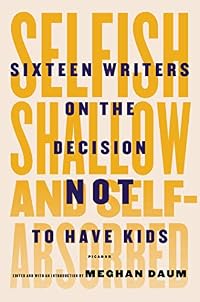
Selfish, Shallow, and Self-Absorbed: Sixteen Writers on the Decision Not to Have Kids
by Meghan Daum
On This Page
Description
One of the main topics of cultural conversation during the last decade was the supposed "fertility crisis," and whether modern women could figure out a way to have it all-a successful, demanding career and the required 2.3 children-before their biological clock stopped ticking. Now, however, conversation has turned to whether it's necessary to have it all (see Anne-Marie Slaughter) or, perhaps more controversial, whether children are really a requirement for a fulfilling life. The idea that show more some women and men prefer not to have children is often met with sharp criticism and incredulity by the public and mainstream media.In this provocative and controversial collection of essays curated by writer Meghan Daum, sixteen acclaimed writers explain why they have chosen to eschew parenthood. Contributors include Lionel Shriver, Sigrid Nunez, Kate Christiensen, Elliott Holt, Geoff Dyer, and Tim Kreider, among others, who will give a unique perspective on the overwhelming cultural pressure of parenthood. Selfish, Shallow, and Self-Absorbed makes a thoughtful and passionate case for why parenthood is not the only path in life, taking our parent-centric, kid-fixated, baby-bump-patrolling culture to task in the process. What emerges is a more nuanced, diverse view of what it means to live a full, satisfying life. show lessTags
Recommendations


Member Reviews
This book was much better than I expected. I thought there was no need for me to read this since I've chosen not to have children and am comfortable with that choice. I didn't think I needed to know why others made the same choice. However, I found that this book is about much more than the decision not to have children. Many of the writers had reasoning I never thought about and there is a lot of social commentary in the book that's worth considering.
I was surprised by how many of the writers were childless by way of abortion or who had at one point really wanted kids. I've never been in the latter camp and I've always been extremely careful not to become pregnant, so I don't really think about abortion. It is interesting to consider show more how many different paths there are to the same end state.
I am happy to be living in a time where society discusses this issue and when we are moving in the direction of it not being a foregone conclusion that everyone should want to have children. Based on the conversations I still have regularly about my choice, I know there is still a long way to go. show less
I was surprised by how many of the writers were childless by way of abortion or who had at one point really wanted kids. I've never been in the latter camp and I've always been extremely careful not to become pregnant, so I don't really think about abortion. It is interesting to consider show more how many different paths there are to the same end state.
I am happy to be living in a time where society discusses this issue and when we are moving in the direction of it not being a foregone conclusion that everyone should want to have children. Based on the conversations I still have regularly about my choice, I know there is still a long way to go. show less
A lot of the women in this compendium describe their desire to not have kids/have kids as a life-long, ever-changing saga based on what they're doing and who they are at the time they were asked. I think that is very truthful. Yes, there were a couple who knew from forever that they would not be having children, but there were also many who did a lot of soul-searching to come to that conclusion. Many who did want children but weren't able or circumstances weren't right, and now have come to change their minds. This is every person's prerogative, but the social narrative is still one of "maternal instincts" and not of a normal person weighing pros and cons before making an important life decision.
[a:Laura Kipnis|71247|Laura show more Kipnis|https://d.gr-assets.com/authors/1405548043p2/71247.jpg]'s essay struck me especially of all the stories told in this book. She talks about the social history (in the Western world) of the maternal instinct, how many changes around the time of the Industrial Revolution also changed the way we view our children. Infant mortality went down, making it more acceptable for parents to create emotional attachments with their children early on. Men started to become primary breadwinners, children were no longer needed to supplement household labour and economic needs, birthrates declined so families became smaller...children began to cost more than they contributed, and the motherhood narrative changed in order to justify it, turning children into beautiful miracles and women into naturally nurturing biologically dictated mothers. We can keep telling women who don't want children that they'll change their mind when they're older, or they'll regret it if they don't, reassure them that all women can do it, it's natural...but we don't realize how recent those ideas are or how dangerous it can be to call things "natural". For example, since women are such natural mothers and caregivers, they don't need social support for it, they can still take on the majority of the child care even when they're working full-time, etc. On the current declining birth rate, Kipnis says: "But until there's a better social deal for women--not just fathers doing more child care but vastly more social resources directed at the situation, including teams of well-paid professionals on standby (not low-wage-earning women with their own children at home)--birthrates will certainly continue to plummet." Hear, hear. show less
[a:Laura Kipnis|71247|Laura show more Kipnis|https://d.gr-assets.com/authors/1405548043p2/71247.jpg]'s essay struck me especially of all the stories told in this book. She talks about the social history (in the Western world) of the maternal instinct, how many changes around the time of the Industrial Revolution also changed the way we view our children. Infant mortality went down, making it more acceptable for parents to create emotional attachments with their children early on. Men started to become primary breadwinners, children were no longer needed to supplement household labour and economic needs, birthrates declined so families became smaller...children began to cost more than they contributed, and the motherhood narrative changed in order to justify it, turning children into beautiful miracles and women into naturally nurturing biologically dictated mothers. We can keep telling women who don't want children that they'll change their mind when they're older, or they'll regret it if they don't, reassure them that all women can do it, it's natural...but we don't realize how recent those ideas are or how dangerous it can be to call things "natural". For example, since women are such natural mothers and caregivers, they don't need social support for it, they can still take on the majority of the child care even when they're working full-time, etc. On the current declining birth rate, Kipnis says: "But until there's a better social deal for women--not just fathers doing more child care but vastly more social resources directed at the situation, including teams of well-paid professionals on standby (not low-wage-earning women with their own children at home)--birthrates will certainly continue to plummet." Hear, hear. show less
Read: September 2023
Rating: 5/5 stars, best of 2023
It is probably wrong how much I loved this book of essays about why thirteen women and three men chose to remain childless, considering that I am reading it four months after the birth of my third child!
But I really did. It was fascinating to read the viewpoints from 'the other side' and I confess to a twinge of envy at the idea of getting up in the morning and not having to take care of anyone other than myself. I can't even imagine it. I had my first child at eighteen and my third at thirty-seven; I have never been a childless adult, not even for a second. Their lives seem unbelievable and somewhat decadent to me in many ways.
My favourite essay was A Thousand Other Things by Kate show more Christensen. I felt her pain and grief for the children she'd never have, even as she chose not to have them, and her writing was so honest and compelling that I am definitely going to check out some of her fiction as well to see if it matches up.
My least favourite was The New Rhoda by Paul Lisicky. It read like an overly-pretentious short story; completely inauthentic.
One thing that jumped out to me in the vast majority of the essays though, was that everyone seemed to believe that mothers and children are stuck in the annoying, attention hogging baby/toddler stage for all time. One of the writers, I've forgotten which one, wrote about not having the time to include children in her life because she wouldn't be able to be a writer and spend long stretches of time at her desk anymore. Perhaps that is true for the first three or four years if they don't go to a nursery or a childminder. After that, they are at school for eight hours a day, and by the time they get to their teenage years, you're lucky if you see your child at all!
Aside those mild complaints, I really enjoyed reading from those other perspectives and I know I will re-read this again more than once in the years to come. show less
Rating: 5/5 stars, best of 2023
It is probably wrong how much I loved this book of essays about why thirteen women and three men chose to remain childless, considering that I am reading it four months after the birth of my third child!
But I really did. It was fascinating to read the viewpoints from 'the other side' and I confess to a twinge of envy at the idea of getting up in the morning and not having to take care of anyone other than myself. I can't even imagine it. I had my first child at eighteen and my third at thirty-seven; I have never been a childless adult, not even for a second. Their lives seem unbelievable and somewhat decadent to me in many ways.
My favourite essay was A Thousand Other Things by Kate show more Christensen. I felt her pain and grief for the children she'd never have, even as she chose not to have them, and her writing was so honest and compelling that I am definitely going to check out some of her fiction as well to see if it matches up.
My least favourite was The New Rhoda by Paul Lisicky. It read like an overly-pretentious short story; completely inauthentic.
One thing that jumped out to me in the vast majority of the essays though, was that everyone seemed to believe that mothers and children are stuck in the annoying, attention hogging baby/toddler stage for all time. One of the writers, I've forgotten which one, wrote about not having the time to include children in her life because she wouldn't be able to be a writer and spend long stretches of time at her desk anymore. Perhaps that is true for the first three or four years if they don't go to a nursery or a childminder. After that, they are at school for eight hours a day, and by the time they get to their teenage years, you're lucky if you see your child at all!
Aside those mild complaints, I really enjoyed reading from those other perspectives and I know I will re-read this again more than once in the years to come. show less
Most of the essayists all seem to arrive at their decision to remain childless due to a fear of not being able to live an actualized life and a fear that children will prohibit them from writing. Fear permeates each and every essay as well as a disdain for a life in away preoccupied with domesticity.
Felicitously, I was simultaneously reading Sarah Ruhl's 100 Essays I Don't Have Time to Write and in her very first essay, On Interruptions, she perfectly encapsulates my reaction to the essays in Selfish, Shallow & Self-Absorbed when she writes:
"I found that life intruding on writing was, in fact, life. And that, tempting as it may be
for a writer who is also a parent, one must not think of life as an intrusion. At the end
of the day, show more writing has very little to do with writing, and much to do with life. And life,
by definition, is not an intrusion."
I don't believe that everyone should or needs to have kids to live a happy or fulfilled life. My issue with most of the essays here are that they take the leap that having kids pretty much means death to the self and introspection and to any measure of autonomy.
One thought that struck me while reading the essays is that all of the writers seem to be types who utter grand proclamations and boast of their own power and self importance. They are soap box standers. I see an old version of myself in these writers. The me before kids. I realize that I am no longer this person (as much) because if kids do anything to you, they humble the crap out of you. You realize that one can no longer be a know-it-all because these little beings render so many of your "I will nevers" and "I wonts" obsolete. I am also aware that kids have caused me to be malleable and flexible in ways that I wasn't before. The constant need to change course and find creative ways to get through difficulties makes it hard to issue such rigid, black and white, hard line rules for living. I realize that everything can change on a dime from second to second and that there are no hard and fast rules....for anything.
While I can't relate to the view points of many of these writers and disagree with their line of thinking and proclamations, I can say that these essays caused me to think and to ponder and to write and for this reason, I truly liked reading this book.
These writers discuss struggling with paying bills, needing to work countless hours at menial day jobs and yet balk at the idea of giving yourself up to a relationship where one partner pays the bills while the other cares for the kids (as opposed to waiting tables) - with happiness!!- and then has the freedom to pursue their art without the drudgery of job that just pays the bills.
Sometimes the biggest freedom can be found in allowing yourself to need others and to BE needed by others.
Oh, and as an aside, I wrote most of this with a 14 month old trying to type on my key board, trying to nurse and crying for my attention. Annoying for sure, but that's life and I am lucky to have mine. show less
Felicitously, I was simultaneously reading Sarah Ruhl's 100 Essays I Don't Have Time to Write and in her very first essay, On Interruptions, she perfectly encapsulates my reaction to the essays in Selfish, Shallow & Self-Absorbed when she writes:
"I found that life intruding on writing was, in fact, life. And that, tempting as it may be
for a writer who is also a parent, one must not think of life as an intrusion. At the end
of the day, show more writing has very little to do with writing, and much to do with life. And life,
by definition, is not an intrusion."
I don't believe that everyone should or needs to have kids to live a happy or fulfilled life. My issue with most of the essays here are that they take the leap that having kids pretty much means death to the self and introspection and to any measure of autonomy.
One thought that struck me while reading the essays is that all of the writers seem to be types who utter grand proclamations and boast of their own power and self importance. They are soap box standers. I see an old version of myself in these writers. The me before kids. I realize that I am no longer this person (as much) because if kids do anything to you, they humble the crap out of you. You realize that one can no longer be a know-it-all because these little beings render so many of your "I will nevers" and "I wonts" obsolete. I am also aware that kids have caused me to be malleable and flexible in ways that I wasn't before. The constant need to change course and find creative ways to get through difficulties makes it hard to issue such rigid, black and white, hard line rules for living. I realize that everything can change on a dime from second to second and that there are no hard and fast rules....for anything.
While I can't relate to the view points of many of these writers and disagree with their line of thinking and proclamations, I can say that these essays caused me to think and to ponder and to write and for this reason, I truly liked reading this book.
These writers discuss struggling with paying bills, needing to work countless hours at menial day jobs and yet balk at the idea of giving yourself up to a relationship where one partner pays the bills while the other cares for the kids (as opposed to waiting tables) - with happiness!!- and then has the freedom to pursue their art without the drudgery of job that just pays the bills.
Sometimes the biggest freedom can be found in allowing yourself to need others and to BE needed by others.
Oh, and as an aside, I wrote most of this with a 14 month old trying to type on my key board, trying to nurse and crying for my attention. Annoying for sure, but that's life and I am lucky to have mine. show less
I really enjoyed the writing and opinions in this book. Written by 12 women and 4 men, these essays are thought-provoking and well thought out by individuals who know themselves, what they want, and what they *don't* want.
I love that the #1 common thread throughout was the desire to have more time for reading and writing. You are preaching to the choir on that one! And let's not forget another important benefit of being child-free: time to sleep.
Contributors come from various backgrounds: intact homes, broken homes, single-parent homes, heterosexual, homosexual, black, white, Jewish, you name it.
What I found most thought-provoking was the complete annihilation of the myth that those who choose a child-free life are somehow "just being show more selfish"...in fact, people actually HAVE children for myriad selfish reasons, whether to meet the expectations of family, society at large, spousal pressure, or what have you. Also, this pressure is not the same across the board for all racial and economic groups; perhaps this is no secret, but it's certainly not discussed openly.
Unfortunately, I had to return this book to the library, but it's definitely worth a purchase. I've only read a handful of the contributing authors--Pam Houston of "Cowboys Are My Weakness" fame comes to mind--but if I'd had time, I'm sure I would've enjoyed all 16 essays. Editor Meghan Daum is no slouch, either. Her story is contributed in the Introduction.
Highly recommended and a must-read for anyone grappling with the decision whether to have children, those who are sick of the pressure from others to have children, and anyone who thinks of her (or him) self as a feminist. show less
I love that the #1 common thread throughout was the desire to have more time for reading and writing. You are preaching to the choir on that one! And let's not forget another important benefit of being child-free: time to sleep.
Contributors come from various backgrounds: intact homes, broken homes, single-parent homes, heterosexual, homosexual, black, white, Jewish, you name it.
What I found most thought-provoking was the complete annihilation of the myth that those who choose a child-free life are somehow "just being show more selfish"...in fact, people actually HAVE children for myriad selfish reasons, whether to meet the expectations of family, society at large, spousal pressure, or what have you. Also, this pressure is not the same across the board for all racial and economic groups; perhaps this is no secret, but it's certainly not discussed openly.
Unfortunately, I had to return this book to the library, but it's definitely worth a purchase. I've only read a handful of the contributing authors--Pam Houston of "Cowboys Are My Weakness" fame comes to mind--but if I'd had time, I'm sure I would've enjoyed all 16 essays. Editor Meghan Daum is no slouch, either. Her story is contributed in the Introduction.
Highly recommended and a must-read for anyone grappling with the decision whether to have children, those who are sick of the pressure from others to have children, and anyone who thinks of her (or him) self as a feminist. show less
I am pretty vocal about the fact that I won’t be having children. I’ve written about it in the past (http://askmusings.com/2013/03/no-kids-for-me-why-is-that-seen-as-a-bad-thing/), and I’m currently writing a book aimed at folks like myself. My husband and I found each other online in part because we both said ‘no’ to the ‘want kids’ question on OK Cupid. So when I saw this book reviewed in a few different places I figured I would pick it up.
It’s a collection of essays by writers, so it is necessarily a bit limited in that regard. It primarily features women, although there are contributions by men. I’m not sure of the racial demographics of the writers; none of the stories (if I’m recalling correctly) take on show more whether they think they’ve encountered more (or less) push-back because of their ethnicity.
The book provides for some chuckles, and elicited a few head nods from me. I could related to some folks, but not fully. I mean, I wasn’t one of the writers, so I can’t expect to have my exact feelings related back to me in essay form, but I was a bit disappointed because most of the essays still seemed a bit apologetic about not wanting children, and really interested in making the concession that people who choose not to have children are a bit off, wrong, or even, yes, selfish. I found that disappointing, because I was hoping for something different.
One essay in particular really rubbed me the wrong way. Lionel Shriver, who wrote “We Need to Talk About Kevin” (a book I hope to read some day) wrote a weirdly misogynistic and frankly delusional essay that almost had me giving up on the book (hers is the fifth essay in). Obviously she can only speak for herself in this most personal of essays, but she presumes to speak for me, and that is obnoxious. She says things like “In contrast to our predecessors, we seldom ask ourselves whether we serve a greater social purpose; we are more likely to ask ourselves if we are happy.” I’m not sure what version of reality she exists in, but I would argue they are both equal, or even completely oppositely weighted. Lots of people are making sacrifices because they understand that the way we’ve been living isn’t doing anyone any favors.
She also seems to call out those who complain about the fact that people ‘like her’ aren’t having children (e.g. well-educated, white, affluent) for what they are (not-so-subtle racism), but then seems to agree, with such disturbing lines as “we don’t consider the importance of raising another generation of our own people, however we might choose to define them.” That reads dangerously close to expressing distress over not enough white folks in the world, and that’s super creepy.
In addition to that weird (hopefully unintentional?) racism, she also makes an argument that absolutely infuriated me. She suggests that by not having children, we are ignoring our duty to the future, because we are denying the world the creation of people who might solve the world’s problems. Essentially, it’s similar to that anti-choice argument of ‘what if you’re aborting the next Einstein?’ Aside from the fact that maybe my kid would grow up to be a serial killer, so by not reproducing I could be saving the world from that pain, this claim essentially ignores the fact that maybe WE can solve the world’s problems. She seems to making a point that women exist to create the people who change the world, as opposed to changing the world ourselves. I am not okay with that at all. I firmly believe that I have the opportunity to change the world (probably in very small ways, but ways that matter); I don’t think the only way I can do that is to give birth to a child who will then change the world. She falls into the trap that so many of us are trying to claw our way out of: the idea that my worth exists only in the children I create, not in the other things I create as well.
So yeah, that essay aside, the book is probably worth a read. I just wish it were better, and more original that the sheepishness so many of us who choose not to have children feel compelled to express to those who do want children. I wish there were more writers who owned their choice as completely valid and not one needing justification. But that isn’t in here as much as I’d hoped. show less
It’s a collection of essays by writers, so it is necessarily a bit limited in that regard. It primarily features women, although there are contributions by men. I’m not sure of the racial demographics of the writers; none of the stories (if I’m recalling correctly) take on show more whether they think they’ve encountered more (or less) push-back because of their ethnicity.
The book provides for some chuckles, and elicited a few head nods from me. I could related to some folks, but not fully. I mean, I wasn’t one of the writers, so I can’t expect to have my exact feelings related back to me in essay form, but I was a bit disappointed because most of the essays still seemed a bit apologetic about not wanting children, and really interested in making the concession that people who choose not to have children are a bit off, wrong, or even, yes, selfish. I found that disappointing, because I was hoping for something different.
One essay in particular really rubbed me the wrong way. Lionel Shriver, who wrote “We Need to Talk About Kevin” (a book I hope to read some day) wrote a weirdly misogynistic and frankly delusional essay that almost had me giving up on the book (hers is the fifth essay in). Obviously she can only speak for herself in this most personal of essays, but she presumes to speak for me, and that is obnoxious. She says things like “In contrast to our predecessors, we seldom ask ourselves whether we serve a greater social purpose; we are more likely to ask ourselves if we are happy.” I’m not sure what version of reality she exists in, but I would argue they are both equal, or even completely oppositely weighted. Lots of people are making sacrifices because they understand that the way we’ve been living isn’t doing anyone any favors.
She also seems to call out those who complain about the fact that people ‘like her’ aren’t having children (e.g. well-educated, white, affluent) for what they are (not-so-subtle racism), but then seems to agree, with such disturbing lines as “we don’t consider the importance of raising another generation of our own people, however we might choose to define them.” That reads dangerously close to expressing distress over not enough white folks in the world, and that’s super creepy.
In addition to that weird (hopefully unintentional?) racism, she also makes an argument that absolutely infuriated me. She suggests that by not having children, we are ignoring our duty to the future, because we are denying the world the creation of people who might solve the world’s problems. Essentially, it’s similar to that anti-choice argument of ‘what if you’re aborting the next Einstein?’ Aside from the fact that maybe my kid would grow up to be a serial killer, so by not reproducing I could be saving the world from that pain, this claim essentially ignores the fact that maybe WE can solve the world’s problems. She seems to making a point that women exist to create the people who change the world, as opposed to changing the world ourselves. I am not okay with that at all. I firmly believe that I have the opportunity to change the world (probably in very small ways, but ways that matter); I don’t think the only way I can do that is to give birth to a child who will then change the world. She falls into the trap that so many of us are trying to claw our way out of: the idea that my worth exists only in the children I create, not in the other things I create as well.
So yeah, that essay aside, the book is probably worth a read. I just wish it were better, and more original that the sheepishness so many of us who choose not to have children feel compelled to express to those who do want children. I wish there were more writers who owned their choice as completely valid and not one needing justification. But that isn’t in here as much as I’d hoped. show less
An astonishing collection of essays based on the decision to live "childfree." But the stories went way beyond the child topic and portrayed people's interesting lives, the good and the bad. All contributors were writers, mostly women but some men.
I can relate to both sides of the issue. For most of my adult life, I was single and "childfree." And, no, I did not use my freedom to sip margaritas on some stupid, boring beach, or frequent gourmet restaurants, as the stereotype goes. Instead, I was in and out of school for a total of 10 years, had two careers, the second of which was wonderful, traveled the world numerous times, lived abroad for several years, became fluent in a second language, wrote and published poetry and short stories, show more and read stacks and stacks of books. None of this would have been possible with children.
Was I lonely? No, I was too busy to be lonely, except on holidays.
Despite loving my life, society taught me that I was not enough without a husband and kids. No one ever pressured me to have kids, perhaps because I wasn't married. But I still absorbed the pressure, as it's all around us.
By the time I was ready to adopt, it was totally my choice with no pressure at all. In fact, no one expected me to, not in late middle age. By then, I was tired of my adventures and ready to stay home. It was the perfect choice for me then, and I loved it! Not all of it. Not the blood, sweat, and tears. (Yes, parenting can be hard!) But for me, it was all worth it. First, I enjoyed my freedom and adventures. And only then was I ready to "settle down" and be a mom, when the timing was right. If given the choice as a young person, I'd recommend freedom first. I was blessed to have both, in series.
Now my girls are young adults and they admire me for my adventures. Yes, you can have it all. Just not all at once!
This essay collection is highly recommended for its excellent, timely topic. show less
I can relate to both sides of the issue. For most of my adult life, I was single and "childfree." And, no, I did not use my freedom to sip margaritas on some stupid, boring beach, or frequent gourmet restaurants, as the stereotype goes. Instead, I was in and out of school for a total of 10 years, had two careers, the second of which was wonderful, traveled the world numerous times, lived abroad for several years, became fluent in a second language, wrote and published poetry and short stories, show more and read stacks and stacks of books. None of this would have been possible with children.
Was I lonely? No, I was too busy to be lonely, except on holidays.
Despite loving my life, society taught me that I was not enough without a husband and kids. No one ever pressured me to have kids, perhaps because I wasn't married. But I still absorbed the pressure, as it's all around us.
By the time I was ready to adopt, it was totally my choice with no pressure at all. In fact, no one expected me to, not in late middle age. By then, I was tired of my adventures and ready to stay home. It was the perfect choice for me then, and I loved it! Not all of it. Not the blood, sweat, and tears. (Yes, parenting can be hard!) But for me, it was all worth it. First, I enjoyed my freedom and adventures. And only then was I ready to "settle down" and be a mom, when the timing was right. If given the choice as a young person, I'd recommend freedom first. I was blessed to have both, in series.
Now my girls are young adults and they admire me for my adventures. Yes, you can have it all. Just not all at once!
This essay collection is highly recommended for its excellent, timely topic. show less
Members
- Recently Added By
Lists

Reading Glasses Podcast
410 works; 3 members
Author Information

8+ Works 1,913 Members
Awards and Honors
Common Knowledge
- Original publication date
- 2016
- Quotations
- I'm pretty sure that having it all might *not* be. I think maybe having it all is chopping yourself up into too many little pieces, taking care of everybody's needs except your own.
What if I have become sure that personal freedom is the thing I hold most dear?
People want to be prevented, restricted. The hamster not only loves his cage, he'd be lost without it. That's why children are so convenient: you have children because you're struggling to get by as an artist—which is actua... (show all)lly what being an artist means—or failing to get on with your career. Then you can persuade yourself that your children prevented you from having this career that had never looked like working out.
Meanwhile, another world went on around us. People in that world bought life insurance, health insurance, houses, summer property to be passed on to children, grandchildren. They weren't exactly in the here and now. They were... (show all) busy turning to some future, but what is the future when you are always feeding it money? Doesn't it get tiring to give so much away to a world that you'll never get to touch and see?
Classifications
- Genres
- General Nonfiction, Nonfiction
- DDC/MDS
- 306.874 — Society, Government, and Culture Social sciences, sociology & anthropology Social Behavior - Dating, Marriage, Divorce Marriage, partnerships, unions; family Intrafamily relationships Parent-child relationship
- LCC
- HQ755.8 .S4428 — Social sciences The family. Marriage, Women and Sexuality The Family. Marriage. Women The family. Marriage. Home Parents. Parenthood
- BISAC
Statistics
- Members
- 439
- Popularity
- 69,599
- Reviews
- 22
- Rating
- (3.78)
- Languages
- English, Italian
- Media
- Paper, Audiobook, Ebook
- ISBNs
- 6
- ASINs
- 2