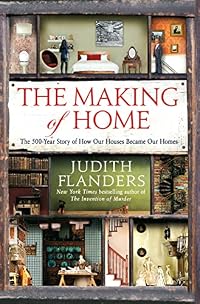
The Making of Home: The 500-Year Story of How Our Houses Became Our Homes
by Judith Flanders 
On This Page
Description
"Flanders traces the evolution of the house from the sixteenth to the early twentieth century across northern Europe and America, showing how the homes we know today bear only a faint resemblance to homes throughout history. What turned a house into a home?"--Dust jacket flap.Tags
Recommendations


















Member Reviews
I knew this history of domestic living spaces would be informative but I’m pleased it was also so engaging. In a smart (even scholarly) but conversational narrative voice, Flanders begins in post-feudal Europe and weaves politics, economics, technology, psychology, work and culture (especially marriage) into an understanding of how homes have evolved in northwest Europe and North America.
She explores the physical structure over centuries as the home’s size increases; as its style and layout become more complex and afford more privacy; as its furnishings become padded and upholstered and, instead of being placed against the walls, are grouped companionably in the center of rooms (where it seemed “the furniture was socializing on show more its own”); how the industrial revolution sparked consumerism and the acquisition of stoves, window-glass, curtains, lighting, tableware, and other accoutrements; and how modern utilities (water, sewer, gas, electricity) changed cooking and cleaning practices.
She also explores marriage from its origins as a familial “property arrangement” into (by 1500) a socially independent partnership of equals ... and then its backslide when technology took over the heaviest male tasks of the household, freeing men to earn money outside the home and decreasing respect for work done in the home.
A very satisfying read. I’m interested in more by Flanders, especially The Victorian House.
(Review based on an advance reading copy provided by the publisher.) show less
She explores the physical structure over centuries as the home’s size increases; as its style and layout become more complex and afford more privacy; as its furnishings become padded and upholstered and, instead of being placed against the walls, are grouped companionably in the center of rooms (where it seemed “the furniture was socializing on show more its own”); how the industrial revolution sparked consumerism and the acquisition of stoves, window-glass, curtains, lighting, tableware, and other accoutrements; and how modern utilities (water, sewer, gas, electricity) changed cooking and cleaning practices.
She also explores marriage from its origins as a familial “property arrangement” into (by 1500) a socially independent partnership of equals ... and then its backslide when technology took over the heaviest male tasks of the household, freeing men to earn money outside the home and decreasing respect for work done in the home.
A very satisfying read. I’m interested in more by Flanders, especially The Victorian House.
(Review based on an advance reading copy provided by the publisher.) show less
This copiously researched 500 year history of homes in Europe and America has an almost overwhelming amount of detail, but is so fascinating I kept interrupting the lives of people around me to share something I had just read. Stretching from the tiny, crowded, windowless shacks of our ancestors to the paradigm shifting development of modern suburbs, Judith Flanders has written an eye-opening account.
Included in its scope are 500 years of evolving attitudes about family, marriage, children, gender roles, manners, human waste disposal, how brightly lit a home needs to be, when privacy is required, and what having a clean home means. Flanders describes the difficult ways people got water into their houses before plumbing, how meals were show more cooked over an open fire (stew was the main menu item for a long time), and how the Industrial Revolution came about. The effects of religion, technology, and changing economic circumstances are explored, and one book-long theme involves home versus house, and the fact that some languages and cultures don’t make a distinction between the two words.
There were all sorts of oddities I didn’t expect. At different points in history beds used to be kept in the parlour for show, sand was put on the floor to soak up grease and wax, people shared beds with their servants, and what little furniture there was stayed pushed against the wall and only moved into the center as needed--the better not to trip over it in the interior dimness that was standard for hundreds of years.
Another thing that interested me is that preserved historic houses are mainly the best of the best, not representative of where most people lived, and they are also the most recent examples of their kind--no one would have saved earlier inferior dwellings as they were replaced. For instance, as awful as they are the slave quarters on view for tourists are actually upgrades, and vast improvements over what enslaved people had to endure for most of the history of slavery in the American South. show less
Included in its scope are 500 years of evolving attitudes about family, marriage, children, gender roles, manners, human waste disposal, how brightly lit a home needs to be, when privacy is required, and what having a clean home means. Flanders describes the difficult ways people got water into their houses before plumbing, how meals were show more cooked over an open fire (stew was the main menu item for a long time), and how the Industrial Revolution came about. The effects of religion, technology, and changing economic circumstances are explored, and one book-long theme involves home versus house, and the fact that some languages and cultures don’t make a distinction between the two words.
There were all sorts of oddities I didn’t expect. At different points in history beds used to be kept in the parlour for show, sand was put on the floor to soak up grease and wax, people shared beds with their servants, and what little furniture there was stayed pushed against the wall and only moved into the center as needed--the better not to trip over it in the interior dimness that was standard for hundreds of years.
Another thing that interested me is that preserved historic houses are mainly the best of the best, not representative of where most people lived, and they are also the most recent examples of their kind--no one would have saved earlier inferior dwellings as they were replaced. For instance, as awful as they are the slave quarters on view for tourists are actually upgrades, and vast improvements over what enslaved people had to endure for most of the history of slavery in the American South. show less
A fascinating review of the ways the house, a physical object, has become "home", a concept. Flanders explores the changes in language, layout, fixtures, and finishings--and their import. The discussion of how technological change wound up sparing men labor, only to increase women's as it enabled more to be done, is timely, as is the discussion of how houses became private spaces, turning the labor done within them into women's work, and hence nonproductive labor.
I enjoyed it because it's written well, in that there are no stumbling blocks to understanding like jargon or self-conscious wit. I was fascinated by all the factoids, and the organization of them made sense.
(Do note that this focuses on the colonies/ USA, England, France, Netherlands, and northern Europe.) (Included are not too many footnotes, end references, bibliography, index, and plate sections with 32 illustrations.)
But to me it seems like, ultimately, just a dense package of trivia. Ok, yes, it's history, not psychology (and at one point Flanders mocks a psychological interpretation), and not architecture (some modern, and not so modern, houses were designed deliberately to be *un* comfortable and inconvenient). But still, I show more thought I was going to get more about how the way we live affects our thoughts. Instead, it was more, our thoughts affect the way we have been living. One example is that cheap labor in England meant slower adoption of modern improvements and technology - why invest in a water heater when you had a maid and a fireplace (something like that).
The use of art as evidence is compelling, but more, as Flanders makes clear, for what is presented by the commissioned portraits and less so by a literal reading. Neither then nor now does anyone actually live in a House Beautiful set. And many of the homes that look poor to us are rich relative to the majority of people at the time... again, how often are the apartments of the Projects photographed for magazines? They're not now, and weren't then, so (combined with evidence from household estate inventories and other sources), historians have pieced together a reality that shocks a modern reader... then, the 99% lived 4-7 (or more) in a one room home that we'd call a hovel.
Staircases, livestock, the roles of children, the definition of dirt, the power of the housewife, the fact that 'labour-saving' appliances ironically made more tasks women's work and relieved the men... so many interesting bits.... Some people will be bothered that there's no actual narrative, but I wasn't. My main objection is that there's no conclusion or resonance, no answer to the question, "So what, what does it mean, why tell this story?"
I do recommend the book, 3.5 stars rounded up. Let's see if I can get you to add it with some samples:
------------
'[S]eparate spheres' were never more than an idea, and an idea for the prosperous. To believe they had a full, physical reality, creating borders between home and not-home, between public and private, is comparable to believing that a nation's borders are a painted line on the ground, which has been there since the creation of the world.
In 1871 the British census... only classed female labour outside the house as 'productive', which implicitly rendered all work inside the house as 'un-productive.' The 1881 census... re-categorized housewives as 'unoccupied.'
Period-room displays [as in history museums] might carefully confine themselves to items from a single region, or date, even though the contents of real homes have always been gathered over decades if not centuries, while trade routes from the sixteenth century onwards enabled goods to arrive from across the world.
A prosperous woman in Charleston, South Carolina, in 1791 inadvertently makes plain how low the level of lighting usually was. One supper party she attended, she marvelled, 'was so lighted we could see every body.'
The nitrogen in men's urine (women's is more acidic) speeds up the decomposition of kitchen refuse, and is still recommended for compost heaps today.
-------------
Btw, Flanders makes a distinction between countries/languages that have two words for house & home, and those who have only one, but I don't understand what that distinction is supposed to mean, exactly. Something about primacy of privacy or family, maybe, I'd guess? If you can figure out what she was trying to say please let me know. show less
(Do note that this focuses on the colonies/ USA, England, France, Netherlands, and northern Europe.) (Included are not too many footnotes, end references, bibliography, index, and plate sections with 32 illustrations.)
But to me it seems like, ultimately, just a dense package of trivia. Ok, yes, it's history, not psychology (and at one point Flanders mocks a psychological interpretation), and not architecture (some modern, and not so modern, houses were designed deliberately to be *un* comfortable and inconvenient). But still, I show more thought I was going to get more about how the way we live affects our thoughts. Instead, it was more, our thoughts affect the way we have been living. One example is that cheap labor in England meant slower adoption of modern improvements and technology - why invest in a water heater when you had a maid and a fireplace (something like that).
The use of art as evidence is compelling, but more, as Flanders makes clear, for what is presented by the commissioned portraits and less so by a literal reading. Neither then nor now does anyone actually live in a House Beautiful set. And many of the homes that look poor to us are rich relative to the majority of people at the time... again, how often are the apartments of the Projects photographed for magazines? They're not now, and weren't then, so (combined with evidence from household estate inventories and other sources), historians have pieced together a reality that shocks a modern reader... then, the 99% lived 4-7 (or more) in a one room home that we'd call a hovel.
Staircases, livestock, the roles of children, the definition of dirt, the power of the housewife, the fact that 'labour-saving' appliances ironically made more tasks women's work and relieved the men... so many interesting bits.... Some people will be bothered that there's no actual narrative, but I wasn't. My main objection is that there's no conclusion or resonance, no answer to the question, "So what, what does it mean, why tell this story?"
I do recommend the book, 3.5 stars rounded up. Let's see if I can get you to add it with some samples:
------------
'[S]eparate spheres' were never more than an idea, and an idea for the prosperous. To believe they had a full, physical reality, creating borders between home and not-home, between public and private, is comparable to believing that a nation's borders are a painted line on the ground, which has been there since the creation of the world.
In 1871 the British census... only classed female labour outside the house as 'productive', which implicitly rendered all work inside the house as 'un-productive.' The 1881 census... re-categorized housewives as 'unoccupied.'
Period-room displays [as in history museums] might carefully confine themselves to items from a single region, or date, even though the contents of real homes have always been gathered over decades if not centuries, while trade routes from the sixteenth century onwards enabled goods to arrive from across the world.
A prosperous woman in Charleston, South Carolina, in 1791 inadvertently makes plain how low the level of lighting usually was. One supper party she attended, she marvelled, 'was so lighted we could see every body.'
The nitrogen in men's urine (women's is more acidic) speeds up the decomposition of kitchen refuse, and is still recommended for compost heaps today.
-------------
Btw, Flanders makes a distinction between countries/languages that have two words for house & home, and those who have only one, but I don't understand what that distinction is supposed to mean, exactly. Something about primacy of privacy or family, maybe, I'd guess? If you can figure out what she was trying to say please let me know. show less
Today, it may seem like the way we live in our homes is how it has always been. Judith Flanders, however, sets us right in this book. What we consider a home today is far removed from what it was a couple of hundred years ago. In fact, the word “home” has changed over time from where groups of people, usually who are related to each other but not all, came together to live and work to what it means today. Most people today only live with relatives and usually do not work there, keeping their living and working spaces segregated.
Flanders outlines how our homes as a cultural entity and our houses as an architectural entity have changed over time. Looking at elements such as economics, privacy, division of labor, technology, show more furnishings, and developed environments, she shows the ways these elements related to the concept of house and home, the changes that occurred, and the reasons such changes took place where and when they did.
This book was quite enlightening, and I found the topic fascinating. The ways in which a change in one aspect in life trickles through other aspects in life can be seen clearly when considering how we live in our homes. I also appreciated the art plates provided to illustrate her depictions of how our houses have been lived in through the centuries. show less
Flanders outlines how our homes as a cultural entity and our houses as an architectural entity have changed over time. Looking at elements such as economics, privacy, division of labor, technology, show more furnishings, and developed environments, she shows the ways these elements related to the concept of house and home, the changes that occurred, and the reasons such changes took place where and when they did.
This book was quite enlightening, and I found the topic fascinating. The ways in which a change in one aspect in life trickles through other aspects in life can be seen clearly when considering how we live in our homes. I also appreciated the art plates provided to illustrate her depictions of how our houses have been lived in through the centuries. show less
What a wonderful book. The amount of research that has been done is tremendous. I loved not only the background and history that Ms. Flanders brought to 'The Making of Home' but how she gave it that personal feel, so it didn't feel as if one were reading a history text. My favorite part of the book was the 'Home Furnishing' section and the area of utensils and such. I have always found that fascinating and Ms. Flanders made it even more so with her comparison between classes and countries. With her subtle wit and smooth writing style, this is a quick and fluid read. I definitely recommend this book to anyone who enjoys historical background.
I'm not at all sure I actually finished this, so, back into the queue.
Members
- Recently Added By
Author Information

15+ Works 5,550 Members
Judith Flanders is a social historian. Her works include the best-selling The Invention of Murder, and Inside the Victorian Home. She is senior research fellow at the University of Buckingham.
Judith Flanders is a LibraryThing Author, an author who lists their personal library on LibraryThing.
Some Editions
Common Knowledge
- Original publication date
- 2014-10-02
- Dedication
- For Naomi and Evangelia Antonakos
and in memory of Stephen Antonakos (1926-2013) - First words
- In 1900, a young girl in a strange land was asked by a resident why she wasn't content to remain in their 'beautiful country', but instead longed to return to 'the dry, grey' place she came from.
- Last words
- (Click to show. Warning: May contain spoilers.)No place like home.
- Publisher's editor
- Ravi Mirchandani
Classifications
- Genres
- History, Nonfiction, General Nonfiction, Sociology, Art & Design
- DDC/MDS
- 392.3 — Society, government, & culture Customs, etiquette & folklore Customs of life cycle and domestic life Family and home relations
- LCC
- GT170 .F53 — Geography, Anthropology and Recreation Manners and customs (General) Manners and customs (General) Houses. Dwellings
- BISAC
Statistics
- Members
- 315
- Popularity
- 100,978
- Reviews
- 7
- Rating
- (3.82)
- Languages
- English
- Media
- Paper, Ebook
- ISBNs
- 6
- ASINs
- 3