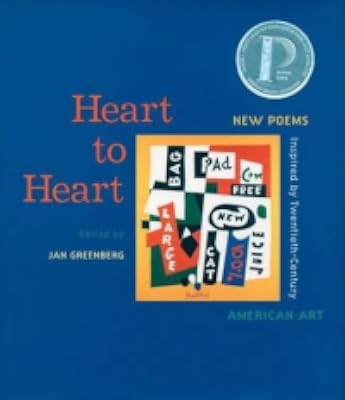
Heart to Heart : New Poems Inspired by Twentieth-Century American Art
by Jan Greenberg (Editor)
On This Page
Description
A compilation of poems by Americans writing about American art in the twentieth century, including such writers as Nancy Willard, Jane Yolen, and X.J. Kennedy.Tags
Recommendations







Member Reviews
Fantastic concept. Seeing the works of art through the poets' eyes really helped me see more in them, connect with them on a deeper level. Many were new to me, though, and that was interesting, too.
I really liked what [a:Bobbi Katz|1969|Bobbi Katz|https://s.gr-assets.com/assets/nophoto/user/f_50x66-6a03a5c12233c941481992b82eea8d23.png] did in "Lessons from a Painting by Rothko" for one of Marc Rothko's untitled colored boxes from 1960. She used a particular format (that I've forgotten the name for) that repeats lines in each subsequent verse, giving (me, at least) a sense of opening up, then bringing together, then opening up again.
Some of the pieces didn't appeal to me as much as they might to you, and vice-versa. I won't be buying show more this, but I do recommend it to English teachers of children age 12-17 or so. And I think it would make a great gift from a god- or grandparent.
Bio. notes for both poets and artists included at end.
I do wish the size of the original artwork had been mentioned - artists do think about the impact the piece will make on those seeing it in person, as opposed to just in a book.
I hope I can find the companion, [b:Side by Side: New Poems Inspired by Art from Around the World|3086742|Side by Side New Poems Inspired by Art from Around the World|Jan Greenberg|https://d.gr-assets.com/books/1328813265s/3086742.jpg|3117821]. show less
I really liked what [a:Bobbi Katz|1969|Bobbi Katz|https://s.gr-assets.com/assets/nophoto/user/f_50x66-6a03a5c12233c941481992b82eea8d23.png] did in "Lessons from a Painting by Rothko" for one of Marc Rothko's untitled colored boxes from 1960. She used a particular format (that I've forgotten the name for) that repeats lines in each subsequent verse, giving (me, at least) a sense of opening up, then bringing together, then opening up again.
Some of the pieces didn't appeal to me as much as they might to you, and vice-versa. I won't be buying show more this, but I do recommend it to English teachers of children age 12-17 or so. And I think it would make a great gift from a god- or grandparent.
Bio. notes for both poets and artists included at end.
I do wish the size of the original artwork had been mentioned - artists do think about the impact the piece will make on those seeing it in person, as opposed to just in a book.
I hope I can find the companion, [b:Side by Side: New Poems Inspired by Art from Around the World|3086742|Side by Side New Poems Inspired by Art from Around the World|Jan Greenberg|https://d.gr-assets.com/books/1328813265s/3086742.jpg|3117821]. show less
Jan Greenberg was inspired by visual art at an early age – and it inspired her own writing. She has complied these poems inspired by American artwork to open the mind to the possibilities of artwork, and to inspire the reader/writer/viewer/artist to look at the world and art with imagination and insight.
Her goal was to demonstrate the diversity of poetry and thought that could be inspired by visual art. In doing so, she was able to demonstrate connections between art, poetry, imagination, and possibility. Just as the artwork gives a new dimension to the poetry, each poem gives a new dimension to the artwork – demonstrating the power of art to inspire language.
This collection is relevant to writers and artists and those who enjoy show more reading and viewing poetry and visual art. It would be particularly relevant to writing/art students.
The poems are remarkably diverse representing free verse, sonnets, rhymed verse, and experimental verse. The language/tone/style is specific to selection, and demonstrates a rich depth and breadth of poetry forms and styles.
The book is organized into four motifs; stories, voices (voice of character in the art), impressions (descriptive poems), and expressions (nature of art). The index includes biographical notes on the poets and artists as well as an alphabetical index of art selections and poets.
A few poems I found particularly moving from each motif:
Stories
A Word, Gary Gildner – inspired by The Red One, Arthur Dove.
The humor and youthful delight of this poem capture the bold colors and shape of the artwork. The poem itself questions definitions and inspires imagination and laughter.
Voices
From Above, Angela Johnson – inspired by Tar Beach, Faith Ringgold.
This poem reminds me of my childhood fantasy of flying and soaring above – a fanasy I often return to to relax and recover from stress. The sensory and texture of the poem is reflected in the textures and setting of the artwork as well.
Impressions
Map, J.Patrick Lewis – inspired by Map, Jasper Johns.
The language of this poem captured the jagged movement, sharp edges, and messy connections within the artwork. It captures a visual and emotional sense of the anguish and brute force that shaped America. Two powerful passages: “ who wrestled and pinned history to the map.” “ Spread an easel of colors on fifty pieces of scissored history – and painted itself a self.”
Expressions
Pas de Trois, Sandy Asher – inspired by Number 27, Jackson Pollock
This delightful poem connects artist to writer to sculptor to dancer, and expresses the idea that unlike other forms dance only exists with the dancer. It is a lovely metaphor and seems to energize the lines and movements within Pollocks painting – when I look at it after reading the poem, I am able to see the dancer and movement within the art.
I found this book captivating, and was really amazed by the connections between the language and visual art. As an actress I have done several performance projects based upon visual art – and have felt what an overwhelming connection can occur when art forms inspire each other. However, I was really surprised to feel that same emotional connection within the poetry. The energy and emotion just shot from the page and allowed for so many openings and connections. I would love to use this text with drama students to inspire performance art – incorporating both the poem and visual art.
Due to the diversity of art styles and subjects as well as the diversity of poems – this collection has something for everyone. Each reader will respond to and connect with different selections – which proves the editor’s purpose that artwork has incredible power to inspire.
I feel the greatest strength is the diversity of visual art as well as diversity of poetry. It captures the immense possibility and inspires imagination. So often poetry is taught by structure/form. This collection really inspires the reader to break through and discover a voice through poetry. show less
Her goal was to demonstrate the diversity of poetry and thought that could be inspired by visual art. In doing so, she was able to demonstrate connections between art, poetry, imagination, and possibility. Just as the artwork gives a new dimension to the poetry, each poem gives a new dimension to the artwork – demonstrating the power of art to inspire language.
This collection is relevant to writers and artists and those who enjoy show more reading and viewing poetry and visual art. It would be particularly relevant to writing/art students.
The poems are remarkably diverse representing free verse, sonnets, rhymed verse, and experimental verse. The language/tone/style is specific to selection, and demonstrates a rich depth and breadth of poetry forms and styles.
The book is organized into four motifs; stories, voices (voice of character in the art), impressions (descriptive poems), and expressions (nature of art). The index includes biographical notes on the poets and artists as well as an alphabetical index of art selections and poets.
A few poems I found particularly moving from each motif:
Stories
A Word, Gary Gildner – inspired by The Red One, Arthur Dove.
The humor and youthful delight of this poem capture the bold colors and shape of the artwork. The poem itself questions definitions and inspires imagination and laughter.
Voices
From Above, Angela Johnson – inspired by Tar Beach, Faith Ringgold.
This poem reminds me of my childhood fantasy of flying and soaring above – a fanasy I often return to to relax and recover from stress. The sensory and texture of the poem is reflected in the textures and setting of the artwork as well.
Impressions
Map, J.Patrick Lewis – inspired by Map, Jasper Johns.
The language of this poem captured the jagged movement, sharp edges, and messy connections within the artwork. It captures a visual and emotional sense of the anguish and brute force that shaped America. Two powerful passages: “ who wrestled and pinned history to the map.” “ Spread an easel of colors on fifty pieces of scissored history – and painted itself a self.”
Expressions
Pas de Trois, Sandy Asher – inspired by Number 27, Jackson Pollock
This delightful poem connects artist to writer to sculptor to dancer, and expresses the idea that unlike other forms dance only exists with the dancer. It is a lovely metaphor and seems to energize the lines and movements within Pollocks painting – when I look at it after reading the poem, I am able to see the dancer and movement within the art.
I found this book captivating, and was really amazed by the connections between the language and visual art. As an actress I have done several performance projects based upon visual art – and have felt what an overwhelming connection can occur when art forms inspire each other. However, I was really surprised to feel that same emotional connection within the poetry. The energy and emotion just shot from the page and allowed for so many openings and connections. I would love to use this text with drama students to inspire performance art – incorporating both the poem and visual art.
Due to the diversity of art styles and subjects as well as the diversity of poems – this collection has something for everyone. Each reader will respond to and connect with different selections – which proves the editor’s purpose that artwork has incredible power to inspire.
I feel the greatest strength is the diversity of visual art as well as diversity of poetry. It captures the immense possibility and inspires imagination. So often poetry is taught by structure/form. This collection really inspires the reader to break through and discover a voice through poetry. show less
Wonderful combination of American art and poetry. These 43 poems were commissioned to compliment the selected works of American art, which span the history of American art. There is a wide range of art and poetry - something to appeal to almost any reader. There are four official categories - Stories, Voices, Impressions, and Expressions along with notes about each poet and artist.
I love the way the poems encourage readers to explore the works of art in a fresh way. This could be a wonderful tool to encourage students to write their own responses to works of art or to draw visual responses to classroom texts. There is such a wonderful variety of subjects and paintings, this collection as many entry points into a variety of subjects in show more and out of fine arts. show less
I love the way the poems encourage readers to explore the works of art in a fresh way. This could be a wonderful tool to encourage students to write their own responses to works of art or to draw visual responses to classroom texts. There is such a wonderful variety of subjects and paintings, this collection as many entry points into a variety of subjects in show more and out of fine arts. show less
This is an anthology of poetry by American poets inspired by famous works of American art. Editor Jan Greenberg divides the poets' reaction to the poems into four categories--memories, assuming the voice of the subjects, impressions of the poet, and expressions of the subject matter. The book also contains good notes on authors and artists in the back of the book.
Greenberg introduces this collection by stating that the poems, which are inspired by the images, are arranges in “four distinct but complimentary motifs:” there are stories, which are “poems that conjured a memory or tell an anecdote.” Some examples of poem/art pairings include “Woman at the Piano” (poem) by William Jay Smith with “Woman at the Piano” (painting) by Elie Nadelman; “The Bison Returns” (poem) by Tony Johnston and “Standing Buffalo” (sculpture) by Charles M. Russell; and “Early Sunday Morning” (poem) by Dan Masterson and “Early Sunday Morning” (painting) by Edward Hopper.
Another motif is that of voices, which “contains poems in which the poet steps inside the artwork and assumes the voice show more of the object or person depicted there.” Some examples of poem/art pairings in this motif include “From Above” (poem) by Angela Johnson and “Tar Beach” (painting and textile) by Faith Ringgold; “Martha Graham in ‘Letter to the World’” (poem) by Lyn Lifshin and “Martha Graham, Letter to the World” (photograph) by Barbara Morgan; and “America Talks” (poem) by Peter F. Neumeyer and “Barber Shop” (painting) by Jacob Lawrence.
The third motif is impressions, which display “the poets’ powers of description as they examine the elements of the artwork and offer vibrant word pictures based on what is contained there.” Notable poem/art pairings in this section include “Red Hills and Bones” (poem) by Laura Kasischke and “Red Hills and Bones” (painting) by Georgia O’Keeffe; “Big French Bread” (poem) by Marvin Bell and “French Bread” (mixed media) by Red Grooms; and “Diamante for Chuck” (poem) by Jan Greenberg and “Self-Portrait (painting) by Chuck Close.
Finally, the fourth motif, expressions, “explores aspects of visual form that concern the nature of art and the artist.” Included in this section are “”Lessons from a Painting by Rothko” (poem) by Bobbi Katz and “Untitled” (painting) by Mark Rothko; “River Song (poem) by Warren Woessner and “Brooklyn Bridge: Variation on an Old Theme” (painting) by Joseph Stella; and “The World, Starring You” (poem) by Naomi Shihab Nye and “The Cathedrals of Broadway (painting) by Florine Stettheimer.
What is notable about the art is that Greenberg includes a variety of mediums here: there is mixed media, oil on canvas, photographs, sculptures, aerographs, prints, silkscreens, and collages. The wide array of mediums presented will appeal to all tastes. Further, the poems are presented in a variety of formats: there is free verse but also standardized verses such as sonnets and patterns. Heart to Heart is an excellent, accessible interdisciplinary work appropriate for middle school ages and up. show less
Another motif is that of voices, which “contains poems in which the poet steps inside the artwork and assumes the voice show more of the object or person depicted there.” Some examples of poem/art pairings in this motif include “From Above” (poem) by Angela Johnson and “Tar Beach” (painting and textile) by Faith Ringgold; “Martha Graham in ‘Letter to the World’” (poem) by Lyn Lifshin and “Martha Graham, Letter to the World” (photograph) by Barbara Morgan; and “America Talks” (poem) by Peter F. Neumeyer and “Barber Shop” (painting) by Jacob Lawrence.
The third motif is impressions, which display “the poets’ powers of description as they examine the elements of the artwork and offer vibrant word pictures based on what is contained there.” Notable poem/art pairings in this section include “Red Hills and Bones” (poem) by Laura Kasischke and “Red Hills and Bones” (painting) by Georgia O’Keeffe; “Big French Bread” (poem) by Marvin Bell and “French Bread” (mixed media) by Red Grooms; and “Diamante for Chuck” (poem) by Jan Greenberg and “Self-Portrait (painting) by Chuck Close.
Finally, the fourth motif, expressions, “explores aspects of visual form that concern the nature of art and the artist.” Included in this section are “”Lessons from a Painting by Rothko” (poem) by Bobbi Katz and “Untitled” (painting) by Mark Rothko; “River Song (poem) by Warren Woessner and “Brooklyn Bridge: Variation on an Old Theme” (painting) by Joseph Stella; and “The World, Starring You” (poem) by Naomi Shihab Nye and “The Cathedrals of Broadway (painting) by Florine Stettheimer.
What is notable about the art is that Greenberg includes a variety of mediums here: there is mixed media, oil on canvas, photographs, sculptures, aerographs, prints, silkscreens, and collages. The wide array of mediums presented will appeal to all tastes. Further, the poems are presented in a variety of formats: there is free verse but also standardized verses such as sonnets and patterns. Heart to Heart is an excellent, accessible interdisciplinary work appropriate for middle school ages and up. show less
This is a collection of poems by various authors that were inspired by specific art works in the twentieth-century. There is a wide variety to the art pieces selected offering a diverse representation of both art and poetry.
This book is a compilation of poetry by different authors that has been inspired by famous and less-known 20th century American art. The poems in this book are broken into four distinct varieties: stories, voices, impressions and expressions. The poems in the grouping "stories" relate an anecdote, those in "voices" express the voice of the object/person in the artwork, in "impressions" the poems utilize imagery to describe an aspect of the artwork, and in "expressions" the writer's view of the artwork and art is communicated. The illustrations are an integral part of this book, as the poems are based off the illustrations. They are prints of original works of art throughout American history.
Members
- Recently Added By
Lists

Sonlight Books
1,487 works; 25 members

Art-inspired fiction
45 works; 2 members
Author Information

Awards and Honors
Awards
Distinctions
Classifications
Statistics
- Members
- 358
- Popularity
- 88,097
- Reviews
- 8
- Rating
- (4.10)
- Languages
- English
- Media
- Paper
- ISBNs
- 3
- ASINs
- 1