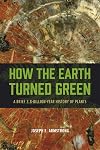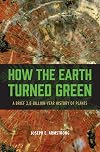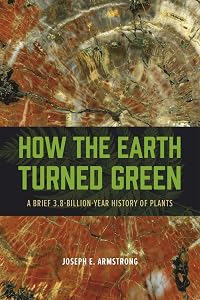
How the Earth Turned Green: A Brief 3.8-Billion-Year History of Plants
by Joseph E. Armstrong
On This Page
Description
On this blue planet, long before pterodactyls took to the skies and tyrannosaurs prowled the continents, tiny green organisms populated the ancient oceans. Fossil and phylogenetic evidence suggests that chlorophyll, the green pigment responsible for coloring these organisms, has been in existence for some 85% of Earth ?s long history ?that is, for roughly 3.5 billion years. In How the Earth Turned Green, Joseph E. Armstrong traces the history of these verdant organisms, which many would call show more plants, from their ancient beginnings to the diversity of green life that inhabits the Earth today. Using an evolutionary framework, How the Earth Turned Green addresses questions such as: Should all green organisms be considered plants? Why do these organisms look the way they do? How are they related to one another and to other chlorophyll-free organisms? How do they reproduce? How have they changed and diversified over time? And how has the presence of green organisms changed the Earth ?s ecosystems? More engaging than a traditional textbook and displaying an astonishing breadth, How the Earth Turned Green will both delight and enlighten embryonic botanists and any student interested in the evolutionary history of plants. show lessTags
Recommendations










Member Reviews
Engaging and humorous "brief" history that thoroughly backstops a whole lot of science at a time when paleobiology, molecular clockwork and fossil record realignment are shaking the tree of life from deep time to present. Armstrong is a dedicated, life-long botanist who has prepared much material and enlightenment for students and professionals.
Armstrong's erudite recap is a workout requiring lots of highlighting and go-fetch in chapter-sized bites for the non-botanist. A bigger glossary and direction to online resources would be useful additions. At stake is one's essential self-interest, courtesy of living in a green world.
Armstrong's erudite recap is a workout requiring lots of highlighting and go-fetch in chapter-sized bites for the non-botanist. A bigger glossary and direction to online resources would be useful additions. At stake is one's essential self-interest, courtesy of living in a green world.
This is not a "brief" history. In spite of several bilogy classes back when I was in college a lot of this material was in depth and quite a slog to read. Informative and a good resource for those interested in the subject but not an easy ead by any means.
Ratings
Members
- Recently Added By
Lists

Geology - Fossils/Palentology
12 works; 3 members
Author Information

1 Work 40 Members
Joseph E. Armstrong is an award-winning teacher, professor of botany, head curator of the Vasey Herbarium, and director of the Organismal Biology and Public Outreach Sequence for Biological Sciences Majors, all at Illinois State University.
Classifications
- Genres
- Science & Nature, Nonfiction, General Nonfiction, History
- DDC/MDS
- 580 — Natural sciences & mathematics Plants (Botany) Plants
- LCC
- QK45.2 .A76 — Science Botany Botany General
- BISAC
Statistics
- Members
- 40
- Popularity
- 688,185
- Reviews
- 2
- Rating
- (4.25)
- Languages
- English
- Media
- Paper, Ebook
- ISBNs
- 3
- ASINs
- 2