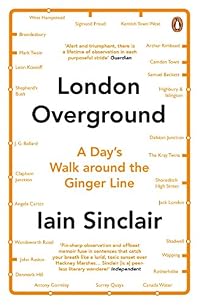
London Overground: A Day's Walk Around the Ginger Line
by Iain Sinclair
On This Page
Description
Iain Sinclair explores modern London through a day's hike around the London Overground route. The completion of the full circle of London Overground provides Iain Sinclair with a new path to walk the shifting territory of the capital. With thirty-three stations and thirty-five miles to tramp - plus inevitable and unforeseen detours and false steps - he embarks on a marathon circumnavigation at street level, tracking the necklace of garages, fish farms, bakeries, convenience cafes, cycle show more repair shops and Minder lock-ups which enclose inner London. 'He is incapable of writing a dull paragraph' Scotland on Sunday 'Sinclair breathes wondrous life into monstrous man-made landscapes' Times Literary Supplement 'If you are drawn to English that doesn't just sing, but sings the blues and does scat and rocks the joint, try Sinclair. His sentences deliver a rush like no one else's' Washington Post show lessTags
Recommendations













Member Reviews
Ian Sinclair is an acquired taste. His prose is often overblown - metaphor is heaped upon metaphor and imagery runs riot. He's also apt to veer off on lengthy digressions on some of his pet obsessions - usually obscure writers, painters, philosophers or other nefarious flaneurs that he has known and loved. Fortunately, I have acquired the taste and am happy to follow him on his ramblings, mainly because I know most of the areas of London he visits and I have also read or seen the works of most of the people he writes about.
Sinclair is what is fashionably, if a tad pretentiously, called a psychogeographer. In this book he follows the trail of the recently joined up and rebranded Ginger Line - the circular overground London railway. On show more his travels, he discusses the likes of Angela Carter, J.G.Ballard, Leon Kossof, Sigmund Freud etc. What I also like about him is that I share most of his views on London past and present: a fascination for walking and making discoveries from the past. Like him, I see railways and roads less as the city's arteries and more as mystic ley lines that draw together and trace bits of the history of London. I also share his anger and sadness about much of what has and is happening to London in the 21st century. I can best sum this up with the example of a visit I made two week's ago to the Bryant and May factory in East London. This is where the famous matchgirls' strike took place in the 1880s - one of the seminal events in the struggle for workers' and women's rights. The factory is (of course) now a gated community of luxury flats. This means that the wall display describing the history of the factory and the strike is inaccessible to the general public. I went with a group and we phoned in advance to gain entry but, when we arrived, the man at the entrance was very reluctant to let us in and it was only after several lengthy phone calls that we gained access. A perfect metaphor for much of what is happening to London! show less
Sinclair is what is fashionably, if a tad pretentiously, called a psychogeographer. In this book he follows the trail of the recently joined up and rebranded Ginger Line - the circular overground London railway. On show more his travels, he discusses the likes of Angela Carter, J.G.Ballard, Leon Kossof, Sigmund Freud etc. What I also like about him is that I share most of his views on London past and present: a fascination for walking and making discoveries from the past. Like him, I see railways and roads less as the city's arteries and more as mystic ley lines that draw together and trace bits of the history of London. I also share his anger and sadness about much of what has and is happening to London in the 21st century. I can best sum this up with the example of a visit I made two week's ago to the Bryant and May factory in East London. This is where the famous matchgirls' strike took place in the 1880s - one of the seminal events in the struggle for workers' and women's rights. The factory is (of course) now a gated community of luxury flats. This means that the wall display describing the history of the factory and the strike is inaccessible to the general public. I went with a group and we phoned in advance to gain entry but, when we arrived, the man at the entrance was very reluctant to let us in and it was only after several lengthy phone calls that we gained access. A perfect metaphor for much of what is happening to London! show less
The book opens with a memorable image of the author witnessing one bird after another being struck by traffic as each starts to feast on those that have previously been struck and killed. The author goes on to consider walking along the route of Chaucer's pilgrims, then meets some travellers on the Orange line and decides instead to walk round that - in a day. He enlists an artist film-maker friend and they make the trek. The author draws on trips he's made in preparation for the journey and on trips he subsequently makes to fill out his story of the route and the day. They travel past football pitches and cemeteries, and many luxury flat developments. The author recollects his previous experiences of east and (on a more limited basis) show more west London and in particular his memories of memorable people he has known, such as Angela Carter and J.G. Ballard. There's also a memorable piece on Freud and the last months of his life spent in Hampstead. These are mostly the bright moments in the book. We learn there's a great deal, normally associated with the movement of market forces, that the author really isn't keen on. The book ends with an account of an accident later suffered by his companion on the walk from which he is luck to escape with his life.
This was my first encounter with the work of Iain Sinclair. I suspect that, for all the mixed feelings I experienced as I read this (there's no point just railing against market forces and their work), it won't be my last. It's not an easy read, stylistically, but it's certainly memorable and I'm glad I stuck with it... show less
This was my first encounter with the work of Iain Sinclair. I suspect that, for all the mixed feelings I experienced as I read this (there's no point just railing against market forces and their work), it won't be my last. It's not an easy read, stylistically, but it's certainly memorable and I'm glad I stuck with it... show less
Ratings
Members
- Recently Added By
Author Information

87+ Works 4,605 Members
Iain Sinclair is a professional theatre director and dramaturge based in Sydney, Australia. He is a graduate of both The Royal Academy of Dramatic Art (RADA) and King's College London. His works includes Our Town and Blood Wedding for the Sydney Theatre Company, as well as The Seed for Company B. Belvoir.
Some Editions
Common Knowledge
- Canonical title
- London Overground: A Day's Walk Around the Ginger Line
Classifications
- Genres
- Travel, Nonfiction, General Nonfiction
- DDC/MDS
- 914.21048612 — History & geography Geography & travel Geography of and travel in Europe England and Wales Greater London subdivisions and modified standard subdivisions Travel; guidebooks 1837- 2000- 2000-2019 2010-2019
- LCC
- DA684.25 .S57 — History of Europe, Asia, Africa and Oceania Great Britain History of Great Britain England Local history and description London
- BISAC
Statistics
- Members
- 98
- Popularity
- 327,975
- Reviews
- 2
- Rating
- (3.73)
- Languages
- English
- Media
- Paper, Ebook
- ISBNs
- 3
- ASINs
- 2