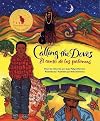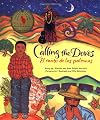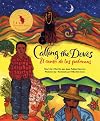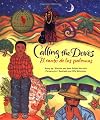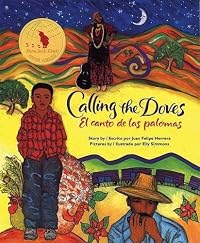
Calling the Doves/El canto de las palomas
by Juan Felipe Herrera
On This Page
Description
The author recalls his childhood in the mountains and valleys of California with his farmworker parents who inspired him with poetry and song.Tags
Recommendations


Member Reviews
The Poet Laureate of the United States, Mexican-American Juan Felipe Herrera, tells the story of his life in bilingual free-style poetry illustrated with colorful and often whimsical art work by Elly Simmons.
Herrera was born “on the road” in Fowler, California and grew up traveling with his migrant farmworker parents from labor camp to labor camp. Wherever they stopped, they set up a tent and slept under the stars in any kind of weather.
This is not a story about hardship however, but rather conveys the joys of family, love, traditions, and community. Eventually Juan's father build them a home on top of an abandoned car:
“From the distance, my house was
a short loaf of bread on wheels.
Inside it was a warm cave of show more conversations.”
Herrera fondly remembers his mother’s songs and his father’s stories, and all they shared together:
“A frying pan, a griddle to cook the tortillas,
and a jar of forks and knives -
these were the necessary ingredients.
And, of course, wood for the fire.
The sky was my blue spoon,
the wavy clay of the land was my plate.”
When Herrera was eight, his mother told his father they needed to settle down in one place so Juan could go to school. The biography ends with their journey to a permanent location:
“As the cities came into view, I knew
one day I would follow my own road.
I would let my voice fly the way my mother recited poems,
the way my father called the doves.”
Evaluation: What a beautiful, evocative tribute to Herrera’s parents and childhood. Herrera, who has won a number of awards for his books of poetry, shows that a life that might seem hard to adults can, to a child, seem full of magic, as long as there is love. The gorgeous art by Simmons adds to a sense of magical wonder and warmth.
This book provides a balance to all the negative accounts of migrant farmworker life, which indeed is full of hardship. According to a 2005 National Agricultural Workers Survey, US Dept. of Labor, farm work the second lowest paid job in the nation, after domestic labor. It is also ranked as one of the three most dangerous occupations in the United States. The stress from uncertainty is high for parents, and children of migrant farmworkers have higher rates of pesticide exposure, malnutrition and dental disease than the general population. Many migrant children work alongside their parents: by the time a migrant child is 12, he/she may work in the fields between 16-18 hours per week. And yet, sometimes there can be much to celebrate as well, if one finds new perspectives to think about life, as this story shows. show less
Herrera was born “on the road” in Fowler, California and grew up traveling with his migrant farmworker parents from labor camp to labor camp. Wherever they stopped, they set up a tent and slept under the stars in any kind of weather.
This is not a story about hardship however, but rather conveys the joys of family, love, traditions, and community. Eventually Juan's father build them a home on top of an abandoned car:
“From the distance, my house was
a short loaf of bread on wheels.
Inside it was a warm cave of show more conversations.”
Herrera fondly remembers his mother’s songs and his father’s stories, and all they shared together:
“A frying pan, a griddle to cook the tortillas,
and a jar of forks and knives -
these were the necessary ingredients.
And, of course, wood for the fire.
The sky was my blue spoon,
the wavy clay of the land was my plate.”
When Herrera was eight, his mother told his father they needed to settle down in one place so Juan could go to school. The biography ends with their journey to a permanent location:
“As the cities came into view, I knew
one day I would follow my own road.
I would let my voice fly the way my mother recited poems,
the way my father called the doves.”
Evaluation: What a beautiful, evocative tribute to Herrera’s parents and childhood. Herrera, who has won a number of awards for his books of poetry, shows that a life that might seem hard to adults can, to a child, seem full of magic, as long as there is love. The gorgeous art by Simmons adds to a sense of magical wonder and warmth.
This book provides a balance to all the negative accounts of migrant farmworker life, which indeed is full of hardship. According to a 2005 National Agricultural Workers Survey, US Dept. of Labor, farm work the second lowest paid job in the nation, after domestic labor. It is also ranked as one of the three most dangerous occupations in the United States. The stress from uncertainty is high for parents, and children of migrant farmworkers have higher rates of pesticide exposure, malnutrition and dental disease than the general population. Many migrant children work alongside their parents: by the time a migrant child is 12, he/she may work in the fields between 16-18 hours per week. And yet, sometimes there can be much to celebrate as well, if one finds new perspectives to think about life, as this story shows. show less
In this 1995 memoir the poet laureate (of California in 2012, and of the United States in 2015) recalls his pre-school childhood while traveling with his parents, migrant farmworkers, from crop to crop in California. He remembers, sleeping under the stars, the call of wolves at night, the turkeys who chased him, and his father singing like a dove and his mother spontaneously reciting poetry at dinner, and the colors of everything.
Simmons’s bright palette and sweeping lines beautifully vivify the illustrations.
Simmons’s bright palette and sweeping lines beautifully vivify the illustrations.
A boy’s original recounting of his sensitive migrant Mexican Family’s crossing the border from Mexico to work in the fields of California picking fruits and vegetables for a living. The boy reminisces about his childhood recalling the early morning breakfast under the blue skies, the gathering of friends for parties, his father songs, and his mother’s healing traditions. His childhood opened up the way for him to explore the world.
I like this story because it shows some of the sacrifices this Family had to make in order to survive in America without losing the love and affection they had for each other or their traditions.
This book can be used to discuss various cultures and their traditions.
I like this story because it shows some of the sacrifices this Family had to make in order to survive in America without losing the love and affection they had for each other or their traditions.
This book can be used to discuss various cultures and their traditions.
This is a good for both ELL or Native speakers. The author paints a picture throughout the book about his childhood life as a migrant life worker. He talks about he celebrated different fiestas and how the other migrant families would also celebrate together with his families. They would also sing and his dad calling the doves.
This story is about a boy that has a family that lives in California that is of Mexican descent. They might not have much money but they make what is best with what they have. He describes his life events from his family to the community he lives with. His dad is a campesino and his mother heals people. His father sings to the doves and his mother recites poems, without them he would have not been introduced to poetry or music and he is very thankful for that. In the end he is happy of who he is and takes pride in his family.
Herrera, J.F. (2001). Calling the doves: El canto de las palomas. San Francisco: Children’s Book Press.
In Calling the Doves: El Canto de las Palomas, the author tells the story of his childhood through the use of words and vibrant illustrations. The author, Juan Herrera, grew up in a small migrant family that traveled throughout the United States. During the story, he reminisces about childhood memories from that time. He discusses memories such as sitting around the breakfast table, moving from different farms, and his mother’s ability to cure sick children and animals. He shares with the readers details of his culture and how his childhood helped shape him into the adult he is today. This is a timeless story that can be show more appreciated by readers of all times and places. Herrera’s words serve as a diary of his childhood as a migrant worker. These are his memories and they are a wonderful tool for readers to learn about the migrant worker culture through the first hand experience of the author. This book is the winner of the Ezra Jack Keats New Writer Award.
This story is told in both English and Spanish. Each page contains both languages and a vibrant illustration depicting the author’s words. This book is an excellent tool for any library where there are Spanish speaking patrons. It can be used by Spanish speaking patrons as a learning tool for learning to speak English, as well as a learning tool for English speaking patrons to learn Spanish. In a school library or classroom, this book can be used to teach about the Latino culture. Not only are students being exposed to stories of migrant workers, they are also being exposed to the Spanish language and Latino art. show less
In Calling the Doves: El Canto de las Palomas, the author tells the story of his childhood through the use of words and vibrant illustrations. The author, Juan Herrera, grew up in a small migrant family that traveled throughout the United States. During the story, he reminisces about childhood memories from that time. He discusses memories such as sitting around the breakfast table, moving from different farms, and his mother’s ability to cure sick children and animals. He shares with the readers details of his culture and how his childhood helped shape him into the adult he is today. This is a timeless story that can be show more appreciated by readers of all times and places. Herrera’s words serve as a diary of his childhood as a migrant worker. These are his memories and they are a wonderful tool for readers to learn about the migrant worker culture through the first hand experience of the author. This book is the winner of the Ezra Jack Keats New Writer Award.
This story is told in both English and Spanish. Each page contains both languages and a vibrant illustration depicting the author’s words. This book is an excellent tool for any library where there are Spanish speaking patrons. It can be used by Spanish speaking patrons as a learning tool for learning to speak English, as well as a learning tool for English speaking patrons to learn Spanish. In a school library or classroom, this book can be used to teach about the Latino culture. Not only are students being exposed to stories of migrant workers, they are also being exposed to the Spanish language and Latino art. show less
A comforting tale of growing up as the son of a migrant farmer from Mexico. The word choices and languages are as colorful as the illustrations!
Members
- Recently Added By
Author Information

47+ Works 2,183 Members
Juan Felipe Herrara was named at the U.S.next Poet Laureate by the Library of Congress. He was Poet Laureate of California from 2012-2014 and is the author of more than a dozen books of poetry. (Bowker Author Biography)
Awards and Honors
Awards
Notable Lists
Classifications
Statistics
- Members
- 250
- Popularity
- 129,332
- Reviews
- 8
- Rating
- (4.29)
- Languages
- English, Spanish
- Media
- Paper
- ISBNs
- 9
- ASINs
- 1