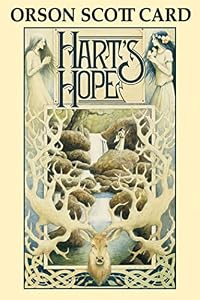
Hart's Hope
by Orson Scott Card
On This Page
Description
Enter the city of Hart's Hope, ruled by gods both powerful and indifferent, riddled with sorcery and revenge. The city was captured by a rebellious lord, Palicrovol, who overthrew the cruel king, Nasilee, hated by his people. Palicrovol, too, was cruel, as befitted a king. He took the true mantle of kinghood by forcing Asineth, now queen by her father's death, to marry him, raping her to consummate the marriage. But he was not cruel enough to rule. He let her live after her humiliation; live show more to bear a daughter; live to return from exile and retake the throne of Hart's Hope. But she, in turn, sent Palicrovol into exile to breed a son who would, in the name of the God, take back the kingdom from its cruel queen. show lessTags
Recommendations


























Member Reviews
Burland's king Nasilee's reign is destroying the country, so Palicroval is urged to overthrow him for the good of the country.
He defeats Nasilee. Then, to solidify his position, he takes Nasilee's young daughter Asineth as a bride, publicly consummating the marriage (rape, in other words) so there's no doubt. He can't, however, bring himself to kill her, though his advisors all agree he should. Instead, he sends her away with the wizard Sleeve, and turns to Enziquelvinisensee Evelvenin, the most beautiful woman in the world, whose hand he'd won before his quest.
Asineth, bitter and bent on revenge, is pregnant with Palicroval's child, which ends up being a 10-month baby--magically significant. She sacrifices the child and uses it to show more become Queen Beauty, turning Sleeve into a court jester and taking Enziquelvinisensee Evelvenin's appearance for herself, turning the real Enziquelvinisensee Evelvenin into a hag.
She returns to the capital and takes over, allowing Palicroval to go anywhere in the land but the capital. She magically watches him and torments him for her amusement.
Finally, the gods take a hand and cause Palicroval to father a child, Orem, whose task, though he's unaware of it, is to set things right.
This is a rather unusually written story--told as an epistle to Palicroval, with the epistle-writer's commentary and advice along with the narrative. It took me a while to get used to the style, but once I did, it added to the feel of the story. It's distant--the omniscient POV doesn't allow the reader deeply into any of the characters' thoughts or emotions--but the story is epic in scale, spanning centuries and involving gods and the fate of a nation; and it's a morality tale as well, so the style fits the story.
The action is gritty, from the rape to the torments Queen Beauty visits on Palicroval, to the events Orem endures on his unknowing quest. Nothing is sugar-coated or coyly avoided, and that too serves the story, showing how even good intentions can result in evil and victims become villains.
And it shows the dangers of attracting the attention of the gods. Isn't there a famous saying about that? Or perhaps its just a truism. The gods' intervention led to the changing fortunes of Palicroval, and the existence and eventual fate of Orem.
It's not that much of a spoiler to say that the ending is open-ended. That, too, serves the story, giving a reason for the epistle to Palicroval.
I'll be re-reading this one more than once, I'm sure. show less
He defeats Nasilee. Then, to solidify his position, he takes Nasilee's young daughter Asineth as a bride, publicly consummating the marriage (rape, in other words) so there's no doubt. He can't, however, bring himself to kill her, though his advisors all agree he should. Instead, he sends her away with the wizard Sleeve, and turns to Enziquelvinisensee Evelvenin, the most beautiful woman in the world, whose hand he'd won before his quest.
Asineth, bitter and bent on revenge, is pregnant with Palicroval's child, which ends up being a 10-month baby--magically significant. She sacrifices the child and uses it to show more become Queen Beauty, turning Sleeve into a court jester and taking Enziquelvinisensee Evelvenin's appearance for herself, turning the real Enziquelvinisensee Evelvenin into a hag.
She returns to the capital and takes over, allowing Palicroval to go anywhere in the land but the capital. She magically watches him and torments him for her amusement.
Finally, the gods take a hand and cause Palicroval to father a child, Orem, whose task, though he's unaware of it, is to set things right.
This is a rather unusually written story--told as an epistle to Palicroval, with the epistle-writer's commentary and advice along with the narrative. It took me a while to get used to the style, but once I did, it added to the feel of the story. It's distant--the omniscient POV doesn't allow the reader deeply into any of the characters' thoughts or emotions--but the story is epic in scale, spanning centuries and involving gods and the fate of a nation; and it's a morality tale as well, so the style fits the story.
The action is gritty, from the rape to the torments Queen Beauty visits on Palicroval, to the events Orem endures on his unknowing quest. Nothing is sugar-coated or coyly avoided, and that too serves the story, showing how even good intentions can result in evil and victims become villains.
And it shows the dangers of attracting the attention of the gods. Isn't there a famous saying about that? Or perhaps its just a truism. The gods' intervention led to the changing fortunes of Palicroval, and the existence and eventual fate of Orem.
It's not that much of a spoiler to say that the ending is open-ended. That, too, serves the story, giving a reason for the epistle to Palicroval.
I'll be re-reading this one more than once, I'm sure. show less
Life ain't fair. The world ain't fair. Good guys are only good according to those who believe in them, bad guys might only be bad because someone doesn't believe in them.
Is a 12 year old rape victim justified in tormenting her rapist? Does the rapist deserve to be tormented if the rape was for a good purpose? Is the changing of heads of state a good purpose? Is it an evil queen who rules with absolute power and torments her tormentors and yet gives a good life to her people? Is a princess who intends to marry an already married man (who became married via rape) an innocent?
Does power always corrupt? Do horrifying incidents always create horrifying villains? At what point does revenge consume the avenger?
Anyway, all these questions are show more asked. None of them are answered. Which is nice because I don't want someone else telling me what the moral of the story is. show less
Is a 12 year old rape victim justified in tormenting her rapist? Does the rapist deserve to be tormented if the rape was for a good purpose? Is the changing of heads of state a good purpose? Is it an evil queen who rules with absolute power and torments her tormentors and yet gives a good life to her people? Is a princess who intends to marry an already married man (who became married via rape) an innocent?
Does power always corrupt? Do horrifying incidents always create horrifying villains? At what point does revenge consume the avenger?
Anyway, all these questions are show more asked. None of them are answered. Which is nice because I don't want someone else telling me what the moral of the story is. show less
I am a fan of Card's Ender series, but I couldn't warm to this book, an early effort and his first try at fantasy. It's just too gruesome. It has a fairy tale feel in its rather distant, stilted omniscient point of view, written more as a series of vignettes then a sustained narrative. When we think "fairy tale" thanks to Disney we often think of childish, sweet and romantic stuff, where there's a nice bright line between villains and heroes. Of course a lot of the original material isn't that way--in the Grimm Brother's version of Cinderella the stepsisters cut off parts of their feet to try to make the glass slipper fit and in the end both they and the stepmother are punished by having their eyes pecked out by crows. Well, this isn't show more the Disney sort of fairy tale, that's for certain. Early on the graphic rape of a twelve-year-old girl as thousands look on is unsparingly depicted. No one is innocent, no one is good--or even completely evil here. One "hero" of this book is the rapist, and the victim's revenge is cruel beyond belief. I'm not saying by the way this isn't a book worth reading, that I can't understand why for some it might appeal, but this is just too brutal for me. show less
Hart's Hope is an early work by Orson Scott Card. The book is told as a series of little vignettes, recounting history in an almost fairy tale like fashion. Each tale starts with a title that describes what will happen in the following text, and then proceeds to do so. The story is told from the perspective of Enziquelvinisensee Evelvenin, although this information is not revealed until the closing pages of the book and recounts the rise and fall of the terrible Queen Beauty. The story takes place in Burland, a magical land watched over by four gods: The Hart, a powerful symbol of male virility and power, the Sweet Sisters, conjoined twins who preside over all female concerns, and the nascent God, who appears to be a fantasy show more representation of the Judeo-Christian God, including his followers' insistence that other Gods should not be worshiped. In Burland, magic is derived from blood. The more powerful and important to the caster the source of that blood, the more powerful the resulting magic. Living blood is the most powerful kind, making most magical acts take place in the limited time between when the sacrifice's blood is shed and when the sacrifice dies.
The story starts with a prophetic dream sent to the general Zymas, the right hand man of Nasilee, the King of Burland. Nasilee is apparently a cruel tyrant, and the gods send Zymas to secure a replacement in the form of Palicrovol, a young count who is presumably destined to be a better ruler of the land. After overthrowing Nasilee, Palicrovol cements his position as ruler by forcibly taking Nasilee's twelve year old daughter Asineth as his bride and publicly raping her to demonstrate the consummation of the marriage. Palicroval's wizard advisor Sleeve advises killing Asineth immediately afterwards, as Palicroval intends to marry Enziquelvinisensee (the most beautiful woman in the world), but Palicroval instead spares her life and sends her off into exile with Sleeve to keep an eye on her. Asineth has a child (a magically powerful ten-month child to boot) and after learning the ways of both men's magic and women's magic she sacrifices her own child to acquire near omnipotent power. Using this power she defeats all the gods, binding them into forms in which their powers are rendered ineffective. She then conquers Burland and sets about taking her revenge. She steals Enziquelvinisensee's beauty for her own, making her victim appear to be a hideously ugly woman, and takes the name Queen Beauty for herself. Her ironic punishments continue as she transforms Sleeve into an idiot lecherous dwarf, Zymas into a withered weak old man, and then forces Palicrovol to unwillingly have sex with her in her new body before she exiles him to the countryside. Beauty assumes the throne of Burland in the city of Hart's Hope, and renames it Inwit.
Three hundred years pass in which Beauty rules Burland, tormenting Palicrovol and the three twisted creatures that had once been his closest companions. Because Beauty can see through his eyes, Palicrovol has taken to wearing golden discs over his eyes and hiring cadres of wizards to try to ward off her power. Beauty torments anyone who helps Palicrovol, and foils any attempt he makes to retake Hart's Hope and overthrow her. The Gods manipulate events so that Palicrovol finds a peasant woman on a riverbank and fathers a child with her: Orem, the protagonist of the story and who is blessed with immunity to magic of all kinds. Orem grows to a man and finds his way to Inwit. After a series of adventures in which he befriends a street urchin, meets the Sweet Sisters working in a brothel, offends a wizard, and ends up imprisoned, Orem comes to the attention of Beauty. Beauty, having had a prophetic dream herself, takes him as her husband. With Orem's help, she conceives a child, a twelve month child. Orem is the "Little King" and wanders the palace, amusing the courtiers who regard him as a fool, but learning from the cryptic statements of Sleeve and Enziquelvinisensee the truth of Beauty's power, and that she intends to kill someone close to her and use the power of her victim's blood to extend her reign and increase her power. Orem assumes that he is the intended victim, but finds out the child is. After releasing the Gods from their imprisonment, Orem learns that the child's sacrifice is necessary to destroy Beauty's power. In the end, Orem accepts the sacrifice, Beauty is overthrown, Palicrovol takes Inwit, and seeks revenge against Orem for daring to sit on the throne of Burland even temporarily.
In a way, despite her vicious nature, one ends up feeling sorry for Beauty. Despite having attained power sufficient to allow her to master the gods themselves, she can think of no use for this power other than simply playing out her revenge against those who wronged her. Her entire being is consumed with tormenting those who wronged her (and those close to those who wronged her). Oddly, it does not appear that Beauty is a bad ruler of Burland, just an indifferent one. There is no evidence that she does anything particularly nasty towards anyone other than Palicrovol and those close to him (although the punishments meted out to lawbreakers in Inwit seem particularly harsh, but no one in the book seems to think of them as being overly so). Beauty ends up seeming like nothing more than a scarred little girl drunk with power and unsure as to where to go after she has gotten her revenge other than to simply extend her revenge ad infinitum. Beauty has reached a dead end. She has no further ambitions, no love for anyone, and no hope of a future other than a dreary continuation of her vengeful existence.
On the other hand, none of those who oppose her save the virtuous Enziquelvinisensee and the innocent Orem seem to be particularly nice people either. Zymas, while in Nasilee's service was brutal and vicious, slaughtering entire villages that failed to pay their taxes. Palicrovol was willing to rape a twelve year old girl in a public display in his quest for power, and upon returning to power after his long exile immediately seeks to kill the man who was instrumental in restoring him to authority. Sleeve wanted Asineth killed and is willing to kill a year old child to end Beauty's reign (even Enziquelvinisensee is willing to go along with this, making her maybe not so virtuous after all). In the book, mercy is rarely rewarded and often seems cruel: Asineth's life is spared due to an act of mercy, which results in the terrible events of the book. A man who befriends Orem and tells him how to enter Inwit is killed; a street urchin who teaches him the ways of life in Inwit is imprisoned and maimed; a courtier who befriends Orem is forced into exile and so on. Every act of mercy in the book takes on a dark aura. While imprisoned, Orem and the other prisoners spit and urinate on each other to keep themselves awake despite the bitter cold of the cages in which they are confined. To restore God to his rightful place, his body must be killed. To restore the Sweet Sisters, they must be reconjoined.
Love and sex are also twisted. Of the four sex acts described in the book, two are outright acts of rape, while the other two are acts of power: engaged in solely to create a child for a particular purpose. Even actual love, such as that the wizard Gallowglass feels for his dead wife and children is twisted, as he uses his magical powers to keep them in a halfway state between life and death, unable to let them go despite their desire to be released from their horrific condition. Orem even has to sacrifice himself to save the Hart, although he is restored so he can complete his part in the Gods' design. In the end, despite Orem's sacrifice of himself and his own child to fulfill the ambitions of the Gods, even he is cast aside. Unlike the heroes of many fantasy stories in which the protagonist is heaped with honors for overthrowing the villain, having accomplished his purpose, Orem is dealt with as a tool the Gods no longer need, and set aside to be driven into exile and hunted by a vengeful king.
Hart's Hope is written in the style of a fairy tale, but it is certainly a dark and depressing one. Despite the nightmare quality of the world depicted, the story remains compelling. Every character, no matter how objectionable in personality, is well-drawn. Even at its grimmest, the story contains a thin thread of hope that things might be better. This is a frightening and sad book, but one that is well-worth reading for any fantasy fan.
This review has also been posted to my blog Dreaming About Other Worlds. show less
The story starts with a prophetic dream sent to the general Zymas, the right hand man of Nasilee, the King of Burland. Nasilee is apparently a cruel tyrant, and the gods send Zymas to secure a replacement in the form of Palicrovol, a young count who is presumably destined to be a better ruler of the land. After overthrowing Nasilee, Palicrovol cements his position as ruler by forcibly taking Nasilee's twelve year old daughter Asineth as his bride and publicly raping her to demonstrate the consummation of the marriage. Palicroval's wizard advisor Sleeve advises killing Asineth immediately afterwards, as Palicroval intends to marry Enziquelvinisensee (the most beautiful woman in the world), but Palicroval instead spares her life and sends her off into exile with Sleeve to keep an eye on her. Asineth has a child (a magically powerful ten-month child to boot) and after learning the ways of both men's magic and women's magic she sacrifices her own child to acquire near omnipotent power. Using this power she defeats all the gods, binding them into forms in which their powers are rendered ineffective. She then conquers Burland and sets about taking her revenge. She steals Enziquelvinisensee's beauty for her own, making her victim appear to be a hideously ugly woman, and takes the name Queen Beauty for herself. Her ironic punishments continue as she transforms Sleeve into an idiot lecherous dwarf, Zymas into a withered weak old man, and then forces Palicrovol to unwillingly have sex with her in her new body before she exiles him to the countryside. Beauty assumes the throne of Burland in the city of Hart's Hope, and renames it Inwit.
Three hundred years pass in which Beauty rules Burland, tormenting Palicrovol and the three twisted creatures that had once been his closest companions. Because Beauty can see through his eyes, Palicrovol has taken to wearing golden discs over his eyes and hiring cadres of wizards to try to ward off her power. Beauty torments anyone who helps Palicrovol, and foils any attempt he makes to retake Hart's Hope and overthrow her. The Gods manipulate events so that Palicrovol finds a peasant woman on a riverbank and fathers a child with her: Orem, the protagonist of the story and who is blessed with immunity to magic of all kinds. Orem grows to a man and finds his way to Inwit. After a series of adventures in which he befriends a street urchin, meets the Sweet Sisters working in a brothel, offends a wizard, and ends up imprisoned, Orem comes to the attention of Beauty. Beauty, having had a prophetic dream herself, takes him as her husband. With Orem's help, she conceives a child, a twelve month child. Orem is the "Little King" and wanders the palace, amusing the courtiers who regard him as a fool, but learning from the cryptic statements of Sleeve and Enziquelvinisensee the truth of Beauty's power, and that she intends to kill someone close to her and use the power of her victim's blood to extend her reign and increase her power. Orem assumes that he is the intended victim, but finds out the child is. After releasing the Gods from their imprisonment, Orem learns that the child's sacrifice is necessary to destroy Beauty's power. In the end, Orem accepts the sacrifice, Beauty is overthrown, Palicrovol takes Inwit, and seeks revenge against Orem for daring to sit on the throne of Burland even temporarily.
In a way, despite her vicious nature, one ends up feeling sorry for Beauty. Despite having attained power sufficient to allow her to master the gods themselves, she can think of no use for this power other than simply playing out her revenge against those who wronged her. Her entire being is consumed with tormenting those who wronged her (and those close to those who wronged her). Oddly, it does not appear that Beauty is a bad ruler of Burland, just an indifferent one. There is no evidence that she does anything particularly nasty towards anyone other than Palicrovol and those close to him (although the punishments meted out to lawbreakers in Inwit seem particularly harsh, but no one in the book seems to think of them as being overly so). Beauty ends up seeming like nothing more than a scarred little girl drunk with power and unsure as to where to go after she has gotten her revenge other than to simply extend her revenge ad infinitum. Beauty has reached a dead end. She has no further ambitions, no love for anyone, and no hope of a future other than a dreary continuation of her vengeful existence.
On the other hand, none of those who oppose her save the virtuous Enziquelvinisensee and the innocent Orem seem to be particularly nice people either. Zymas, while in Nasilee's service was brutal and vicious, slaughtering entire villages that failed to pay their taxes. Palicrovol was willing to rape a twelve year old girl in a public display in his quest for power, and upon returning to power after his long exile immediately seeks to kill the man who was instrumental in restoring him to authority. Sleeve wanted Asineth killed and is willing to kill a year old child to end Beauty's reign (even Enziquelvinisensee is willing to go along with this, making her maybe not so virtuous after all). In the book, mercy is rarely rewarded and often seems cruel: Asineth's life is spared due to an act of mercy, which results in the terrible events of the book. A man who befriends Orem and tells him how to enter Inwit is killed; a street urchin who teaches him the ways of life in Inwit is imprisoned and maimed; a courtier who befriends Orem is forced into exile and so on. Every act of mercy in the book takes on a dark aura. While imprisoned, Orem and the other prisoners spit and urinate on each other to keep themselves awake despite the bitter cold of the cages in which they are confined. To restore God to his rightful place, his body must be killed. To restore the Sweet Sisters, they must be reconjoined.
Love and sex are also twisted. Of the four sex acts described in the book, two are outright acts of rape, while the other two are acts of power: engaged in solely to create a child for a particular purpose. Even actual love, such as that the wizard Gallowglass feels for his dead wife and children is twisted, as he uses his magical powers to keep them in a halfway state between life and death, unable to let them go despite their desire to be released from their horrific condition. Orem even has to sacrifice himself to save the Hart, although he is restored so he can complete his part in the Gods' design. In the end, despite Orem's sacrifice of himself and his own child to fulfill the ambitions of the Gods, even he is cast aside. Unlike the heroes of many fantasy stories in which the protagonist is heaped with honors for overthrowing the villain, having accomplished his purpose, Orem is dealt with as a tool the Gods no longer need, and set aside to be driven into exile and hunted by a vengeful king.
Hart's Hope is written in the style of a fairy tale, but it is certainly a dark and depressing one. Despite the nightmare quality of the world depicted, the story remains compelling. Every character, no matter how objectionable in personality, is well-drawn. Even at its grimmest, the story contains a thin thread of hope that things might be better. This is a frightening and sad book, but one that is well-worth reading for any fantasy fan.
This review has also been posted to my blog Dreaming About Other Worlds. show less
I've had this book on my list for a long time and I finally found a copy at a library sale. I was surprised to find this is an Arthurian style fantasy. A wicked king is overthrown by a 'good' king, who then commits a grievous sin to unite the kingdom. This leads to a dark time for the kingdom, and years of grief and struggle. Very different for Card, I don't know of anything else by him in this style. I enjoyed it, it definitely is different than most fantasy available, and it was interesting to read. There's not a lot of suspense, but what happens is good.
I feel very mixed about this book.
I liked some of the magic and a lot of the religious aspects of the book (the religions/worship that were present in the book, not that the book is preachy), but overall, a lot of the book felt a little over the top.
This is a very early foray for Card into fantasy, and it does feel like it. He has definitely refined his fantasy writing since this time. It's not a total waste, but I feel like a lot of potential was lost.
I liked some of the magic and a lot of the religious aspects of the book (the religions/worship that were present in the book, not that the book is preachy), but overall, a lot of the book felt a little over the top.
This is a very early foray for Card into fantasy, and it does feel like it. He has definitely refined his fantasy writing since this time. It's not a total waste, but I feel like a lot of potential was lost.
I took a writing class with Orson Scott Card, and he referenced this book a couple times. He said he couldn't recommend it to anyone, because of its content. I agree that it's quite a bit of a downer. My dad said he got halfway through it an threw the book in the garbage.
The main thing I noticed is that the majority of the characters are twisted and evil. It seems there are no good people in this world. Even some characters who seem good at first become wicked soon afterwards.
The book is extremely graphic, mainly to show the moral depravity of the world. The magic system is good, but not very well explained. If Card hadn't explained it to us in class, I don't think I would have figured it out very easily.
All that aside, this is an show more extremely well developed world, and when you consider the length of the book, it's really quite amazing.
My recommendation is to make sure to finish it. All the depressing parts may be difficult to get through, but it all pays off very well in the end. show less
The main thing I noticed is that the majority of the characters are twisted and evil. It seems there are no good people in this world. Even some characters who seem good at first become wicked soon afterwards.
The book is extremely graphic, mainly to show the moral depravity of the world. The magic system is good, but not very well explained. If Card hadn't explained it to us in class, I don't think I would have figured it out very easily.
All that aside, this is an show more extremely well developed world, and when you consider the length of the book, it's really quite amazing.
My recommendation is to make sure to finish it. All the depressing parts may be difficult to get through, but it all pays off very well in the end. show less
Members
- Recently Added By
Author Information

575+ Works 213,255 Members
Orson Scott Byron Walley Card, was born in 1951 and studied theater at Brigham Young University. He received his B.A. in 1975 and his M.A. in English in 1981. He wrote plays during that time, including Stone Tables (1973) and the musical, Father, Mother, Mother and Mom (1974). A Mormon, Scott served a two-year mission in Brazil before starting show more work as a journalist in Utah. He also designed games at Lucas Film Games, 1989-92. He is best known for his science fiction novels, including the popular Ender series. Well known titles include A Planet Called Treason (1979), Treasure Box (1996), and Heartfire (1998). He has also written the guide called How to Write Science Fiction and Fantasy (1990). His novel Ender's Game and its sequel Speaker for the Dead, both won Hugo and Nebula awards, making Card the only author to win both prizes in consecutive years. His titles Shadows in Flight, Ruins and Ender's Game made The New York Times Best Seller List. He is also the author of The First Formic War Series, which includes the titles Earth Unaware, Earth Afire, and Earth Awakens. (Bowker Author Biography) show less
Some Editions
Awards and Honors
Awards
Series
Belongs to Publisher Series
Common Knowledge
- Canonical title
- Hart's Hope
- Original title
- The Falling Woman
- Original publication date
- 1986
- People/Characters
- Palicrovol; Zymas; the Flower Princess; Sleeve; Queen Beauty; Youth (show all 7); Orem
- Dedication
- To Mark Park,
Who knows the Little King
From the heart out. - First words
- O Palicrovol, with death and vengeance in your eyes, I write to you because over the centuries there are tales you have forgotten, and tales you never knew.
- Last words
- (Click to show. Warning: May contain spoilers.)But you: come to me now, my husband, and tell me which blessing of those I gave you , you were able to receive.
- Original language*
- English
*Some information comes from Common Knowledge in other languages. Click "Edit" for more information.
Classifications
Statistics
- Members
- 1,178
- Popularity
- 21,128
- Reviews
- 16
- Rating
- (3.45)
- Languages
- 7 — Dutch, English, French, German, Hungarian, Italian, Spanish
- Media
- Paper, Audiobook, Ebook
- ISBNs
- 30
- ASINs
- 9