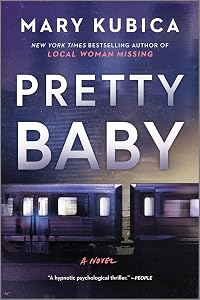
Pretty Baby
by Mary Kubica
On This Page
Description
A chance encounter sparks an unrelenting web of lies in this stunning new psychological thriller from national bestselling author Mary Kubica.Heidi Wood has always been a charitable woman: she works for a nonprofit and takes in stray cats. Still, her husband and daughter are horrified when Heidi returns home one day with a young woman named Willow and her four-month-old baby in tow. Disheveled and apparently homeless, this girl could be a criminal—or worse. But despite her family's show more objections, Heidi invites Willow and the baby to take refuge in their home.
Heidi spends the next few days helping Willow get back on her feet, but as clues into Willow's past begin to surface, Heidi is forced to decide how far she's willing to go to help a stranger. What begins as an act of kindness quickly spirals into a story far more twisted than anyone could have anticipated.
. show less
Tags
Recommendations














Member Reviews
This is the first book by Mary Kubica that I’ve read, and after finishing this one I’m looking forward to reading her other books in my TBR stack. Good stuff! PRETTY BABY is filled with characters that you’re never really sure about. They seem one way on the surface, but what’s hiding underneath?
The story is told from the point of view of three characters: Heidi, the over-the-top, socially conscious do-gooder; Willow, the homeless girl with a baby who Heidi brings home; and Chris, Heidi’s fed up, workaholic husband. Heidi’s stray cats are one thing, but a stranger in their home who might be dangerous is more than Chris can take. While Chris researches who in the heck this girl could be, the whole situation starts to have an show more interesting effect on Heidi. Woven into that is Willow’s heart wrenching story.
This book contains some dark subject matter, and yep, it’s very sad, but at the same time I couldn’t put it down. It’s fast paced with memorable, complex characters, and some surprise twists to keep you on your toes. I love emotional suspense/thrillers, and PRETTY BABY fits the bill perfectly.
Disclosure: I received a copy of this book from the publisher through NetGalley in excchange for an honest review. show less
The story is told from the point of view of three characters: Heidi, the over-the-top, socially conscious do-gooder; Willow, the homeless girl with a baby who Heidi brings home; and Chris, Heidi’s fed up, workaholic husband. Heidi’s stray cats are one thing, but a stranger in their home who might be dangerous is more than Chris can take. While Chris researches who in the heck this girl could be, the whole situation starts to have an show more interesting effect on Heidi. Woven into that is Willow’s heart wrenching story.
This book contains some dark subject matter, and yep, it’s very sad, but at the same time I couldn’t put it down. It’s fast paced with memorable, complex characters, and some surprise twists to keep you on your toes. I love emotional suspense/thrillers, and PRETTY BABY fits the bill perfectly.
Disclosure: I received a copy of this book from the publisher through NetGalley in excchange for an honest review. show less
Pretty Baby, Mary Kubica, author, Cassandra Campbell, Tom Taylorson, Jorjeana Marie, narrators
I have read a lot of suspense novels, and this one is one of the best I have read in ages. The author did not have resort to explicit sex or foul language to make her point. It was cleverly written, and from the first word until the last, there were surprises.
The story is told from the perspective of four different personalities. Willow Greer, Chris and Heidi Wood, and Claire Dalloway. Rolling out in alternate segments, as each tells their own story, the mystery and tension continue to rise until the end.
Claire Dallaway is 8 years old, and her mother loves her more than peanut butter loves jelly. She has a younger sister, Lily, who is two show more years old and she is very close to her, often taking care of her while her parents are out. They live very modestly in Ogalalla, a rural town in Nebraska. Claire is a very capable and very happy little girl until the day a stranger knocks on the door and brings very bad news. Claire and Lily are orphans. An automobile accident has ended the lives of their parents. The Department of Family Services takes over and soon, Lily, who is young, is adopted and they are separated.
Claire, at 8-years old, is not so lucky, but when she is about 9, Joseph and Miriam show up and pretend to be related to her. They have two sons, older than Claire, Matthew and Isaac, and as a family, they seem picture perfect. Joseph had wanted to become a priest, but he was not celibate, and he married the girl he impregnated, giving up his dream. Instead, he became a Professor of Religious Studies, a seeming pillar of society. His wife was mentally ill, but when medicated, hid it well. The problem was, she was rarely medicated. Joseph was a hard taskmaster. He literally erased Claire’s past by destroying all evidence of her family, even forcing her to tear up her photos. Soon, he is forcing her to do other things, things only a disturbed man would make a child do. Claire is no longer a very happy, little girl. Claire is a prisoner. At nine years old, she does not go to school, never leaves the house and is basically Miriam’s attendant. She helps with household chores and cooking. Joseph threatens her with all sorts of biblical horror stories and even threatens to do terrible things to Lily which terrifies her and keeps her obedient.
She has no contact with anyone in the family except Joseph and Miriam, until one night, when she was ten or eleven, Matthew, six years older than Claire, began to visit her. He talks to her and tells her odd little facts, like “did you know that cockroaches can live for a week without their heads?” He secretly leaves her books to read. He sneaks her out of the house and takes her to the library. Time goes by. Matthew moves out, but comes back and visits her. When Joseph discovers he has been sneaking her out of the house, tragedy ensues. At sixteen, Claire is on the run, alone, frightened and unprepared. She has a suitcase and money that Matthew has provided for her. She and Matthew both disappear, but not in the same direction.
Meanwhile, in Chicago, Heidi Wood, a woman who works for a literacy program begins to notice a girl with a crying baby on the train platform she goes to daily. The teen, she thinks, can’t be more than 15 or 16. Heidi is described as a caregiver by nature; she is immediately drawn to the girl and wants to help her. She manages to convince the girl to come home with her, to get cleaned up, to have a decent meal, and to get out of the wet weather plaguing Chicago.
Chris Wood is a bit of a workaholic, preoccupied and unaware of the trouble brewing in his home. He works in Investment Banking, traveling frequently for his job, and Heidi has become a little jealous of a new statuesque female associate, Cassidy Hudson, that joined his firm and works with him on projects. Heidi is older than Cassidy and although beautiful and well-built, her shape had changed from the natural results of age and pregnancy. Although she had wanted a larger family, she could no longer bear children because during her second pregnancy, it was discovered that she had Cancer and had to have an abortion and some serious surgery to save herself. The choice to save her own life, over the future child’s life, tormented her, but she said nothing to anyone and would not seek help.
Zoe is the 12-year old only child of Chris and Heidi. She goes to private school. When her mother brings home the teenager, Willow Greer and her infant, Ruby, Zoe is resentful and also surprised. Heidi will bridge no argument against the teen from her husband or her daughter and soon becomes inordinately involved with the baby. She begins calling her Juliet, the name she had given the child she had to abort, even though the sex of that child was never known.
The teenager Willow is not communicative and it soon became obvious that she had been abused. She did not like to be touched and did not seem to understand how to properly care for the child. She is very secretive about her past. Heidi became more and more involved with her, showing her how to properly care for Ruby, buying necessities, and then taking over and caring for the child herself. If she kept Willow with them for more than 48 hours without notifying the authorities, it would become an illegal act, no longer an act of kindness, but although mindful of that fact, she began to ignore it and believe that she would not be punished for doing something kind for someone in need.
Heidi begins to lie to her husband and her daughter. She begins to neglect Zoe. She begins to suspect her husband of infidelity. She begins a rapid descent into paranoia, and begins to imagine many other things with devastating consequences. She behaves erratically, makes false accusations, and throws Willow out of the house, refusing to let her take the child.
As the story unwinds, closely kept secrets are exposed. Willow has a past. The child has another past. The system proved to have sorely failed Willow. The reader watches as a human being breaks down from hidden emotional pain, a human being who never recovered from the loss of her uterus or her aborted child. The reader witnesses the cruelty and depraved behavior of a man who represents himself as G-d-fearing. Who, if anyone, will be punished for all of the acts of injustice, even those made in an effort to bring justice home?
All of the threads of the story are knitted together perfectly at the end. There are no unanswered questions. There is a roller coaster ride to a very satisfying conclusion. The book serves a greater purpose. It shines a light on the overworked social services and the incompetence of some of the professionals within an overburdened, underfunded system. It exposes the confused state of mind of someone mentally ill, emotionally disabled and unable to ask for help until they no longer recognize they need it. It illuminates the apathy, blindness and distance people some put between themselves and those they witness suffering, often ignoring or not understanding what they are faced with and are unable to provide the proper guidance or help. Sometimes, it is dangerous to look the other way, but often, we all take the easy way out.
The young woman we now know as Claire simply slipped through the cracks, partly because of a system without proper resources and staff and partly because of dishonest people who sought to do harm to others. Sometimes, those capable of doing evil are smarter than those who are the do- gooders. The perception shown by the author, into such situations, made the story even more notable and plausible. The characters were authentic. The analysis of love, obsession, secrets, lies, madness and the tragedies that followed these characters was insightful and spot-on. The story was read by the narrators in perfect pitch for each character. They literally became the characters and it was easy to discern who was speaking at all times. By the way, “Do you know that camels have three eyelids?” show less
I have read a lot of suspense novels, and this one is one of the best I have read in ages. The author did not have resort to explicit sex or foul language to make her point. It was cleverly written, and from the first word until the last, there were surprises.
The story is told from the perspective of four different personalities. Willow Greer, Chris and Heidi Wood, and Claire Dalloway. Rolling out in alternate segments, as each tells their own story, the mystery and tension continue to rise until the end.
Claire Dallaway is 8 years old, and her mother loves her more than peanut butter loves jelly. She has a younger sister, Lily, who is two show more years old and she is very close to her, often taking care of her while her parents are out. They live very modestly in Ogalalla, a rural town in Nebraska. Claire is a very capable and very happy little girl until the day a stranger knocks on the door and brings very bad news. Claire and Lily are orphans. An automobile accident has ended the lives of their parents. The Department of Family Services takes over and soon, Lily, who is young, is adopted and they are separated.
Claire, at 8-years old, is not so lucky, but when she is about 9, Joseph and Miriam show up and pretend to be related to her. They have two sons, older than Claire, Matthew and Isaac, and as a family, they seem picture perfect. Joseph had wanted to become a priest, but he was not celibate, and he married the girl he impregnated, giving up his dream. Instead, he became a Professor of Religious Studies, a seeming pillar of society. His wife was mentally ill, but when medicated, hid it well. The problem was, she was rarely medicated. Joseph was a hard taskmaster. He literally erased Claire’s past by destroying all evidence of her family, even forcing her to tear up her photos. Soon, he is forcing her to do other things, things only a disturbed man would make a child do. Claire is no longer a very happy, little girl. Claire is a prisoner. At nine years old, she does not go to school, never leaves the house and is basically Miriam’s attendant. She helps with household chores and cooking. Joseph threatens her with all sorts of biblical horror stories and even threatens to do terrible things to Lily which terrifies her and keeps her obedient.
She has no contact with anyone in the family except Joseph and Miriam, until one night, when she was ten or eleven, Matthew, six years older than Claire, began to visit her. He talks to her and tells her odd little facts, like “did you know that cockroaches can live for a week without their heads?” He secretly leaves her books to read. He sneaks her out of the house and takes her to the library. Time goes by. Matthew moves out, but comes back and visits her. When Joseph discovers he has been sneaking her out of the house, tragedy ensues. At sixteen, Claire is on the run, alone, frightened and unprepared. She has a suitcase and money that Matthew has provided for her. She and Matthew both disappear, but not in the same direction.
Meanwhile, in Chicago, Heidi Wood, a woman who works for a literacy program begins to notice a girl with a crying baby on the train platform she goes to daily. The teen, she thinks, can’t be more than 15 or 16. Heidi is described as a caregiver by nature; she is immediately drawn to the girl and wants to help her. She manages to convince the girl to come home with her, to get cleaned up, to have a decent meal, and to get out of the wet weather plaguing Chicago.
Chris Wood is a bit of a workaholic, preoccupied and unaware of the trouble brewing in his home. He works in Investment Banking, traveling frequently for his job, and Heidi has become a little jealous of a new statuesque female associate, Cassidy Hudson, that joined his firm and works with him on projects. Heidi is older than Cassidy and although beautiful and well-built, her shape had changed from the natural results of age and pregnancy. Although she had wanted a larger family, she could no longer bear children because during her second pregnancy, it was discovered that she had Cancer and had to have an abortion and some serious surgery to save herself. The choice to save her own life, over the future child’s life, tormented her, but she said nothing to anyone and would not seek help.
Zoe is the 12-year old only child of Chris and Heidi. She goes to private school. When her mother brings home the teenager, Willow Greer and her infant, Ruby, Zoe is resentful and also surprised. Heidi will bridge no argument against the teen from her husband or her daughter and soon becomes inordinately involved with the baby. She begins calling her Juliet, the name she had given the child she had to abort, even though the sex of that child was never known.
The teenager Willow is not communicative and it soon became obvious that she had been abused. She did not like to be touched and did not seem to understand how to properly care for the child. She is very secretive about her past. Heidi became more and more involved with her, showing her how to properly care for Ruby, buying necessities, and then taking over and caring for the child herself. If she kept Willow with them for more than 48 hours without notifying the authorities, it would become an illegal act, no longer an act of kindness, but although mindful of that fact, she began to ignore it and believe that she would not be punished for doing something kind for someone in need.
Heidi begins to lie to her husband and her daughter. She begins to neglect Zoe. She begins to suspect her husband of infidelity. She begins a rapid descent into paranoia, and begins to imagine many other things with devastating consequences. She behaves erratically, makes false accusations, and throws Willow out of the house, refusing to let her take the child.
As the story unwinds, closely kept secrets are exposed. Willow has a past. The child has another past. The system proved to have sorely failed Willow. The reader watches as a human being breaks down from hidden emotional pain, a human being who never recovered from the loss of her uterus or her aborted child. The reader witnesses the cruelty and depraved behavior of a man who represents himself as G-d-fearing. Who, if anyone, will be punished for all of the acts of injustice, even those made in an effort to bring justice home?
All of the threads of the story are knitted together perfectly at the end. There are no unanswered questions. There is a roller coaster ride to a very satisfying conclusion. The book serves a greater purpose. It shines a light on the overworked social services and the incompetence of some of the professionals within an overburdened, underfunded system. It exposes the confused state of mind of someone mentally ill, emotionally disabled and unable to ask for help until they no longer recognize they need it. It illuminates the apathy, blindness and distance people some put between themselves and those they witness suffering, often ignoring or not understanding what they are faced with and are unable to provide the proper guidance or help. Sometimes, it is dangerous to look the other way, but often, we all take the easy way out.
The young woman we now know as Claire simply slipped through the cracks, partly because of a system without proper resources and staff and partly because of dishonest people who sought to do harm to others. Sometimes, those capable of doing evil are smarter than those who are the do- gooders. The perception shown by the author, into such situations, made the story even more notable and plausible. The characters were authentic. The analysis of love, obsession, secrets, lies, madness and the tragedies that followed these characters was insightful and spot-on. The story was read by the narrators in perfect pitch for each character. They literally became the characters and it was easy to discern who was speaking at all times. By the way, “Do you know that camels have three eyelids?” show less
Pretty Baby is an engrossing psychological thriller that begins when Heidi brings a young homeless woman and her 4 month old baby home from the city.
Heidi's husband and teenage daughter are both horrified, but Heidi plays down their concerns about the mysterious Willow; her charitable nature winning over any concern for the safety of her own family unit.
We slowly begin to learn more about Willow and her shady past and just how she came to be living on the streets with her baby. I kept wondering if I'd have to the courage to do what Heidi did, take in a complete stranger, but as Heidi's random act of kindness begins to have repercussions, I stopped admiring her and began to worry for her instead.
The novel builds to a great climax, show more although it doesn't end how you'd expect it to, earning it an additional star for me.
Pretty Baby is an intelligent thriller as well as being chock-full of suspense and I actually enjoyed it more than Gone Girl and The Girl on the Train.
* Copy courtesy of JAM PR and Harlequin MIRA * show less
Heidi's husband and teenage daughter are both horrified, but Heidi plays down their concerns about the mysterious Willow; her charitable nature winning over any concern for the safety of her own family unit.
We slowly begin to learn more about Willow and her shady past and just how she came to be living on the streets with her baby. I kept wondering if I'd have to the courage to do what Heidi did, take in a complete stranger, but as Heidi's random act of kindness begins to have repercussions, I stopped admiring her and began to worry for her instead.
The novel builds to a great climax, show more although it doesn't end how you'd expect it to, earning it an additional star for me.
Pretty Baby is an intelligent thriller as well as being chock-full of suspense and I actually enjoyed it more than Gone Girl and The Girl on the Train.
* Copy courtesy of JAM PR and Harlequin MIRA * show less
Mary Kubica’s second psychological chiller, Pretty Baby, has been hotly anticipated since the success of her debut novel, The Good Girl.
When Heidi Wood spies a young homeless girl toting a squalling infant and a battered suitcase during a rainstorm on Chicago’s streets she tentatively offers her a raincoat, then a meal and on another cold and wet day, a place to stay. Heidi’s husband and daughter are horrified that she has invited a stranger into their midst, Willow could be a thief, a criminal, or worse, but Heidi sees only a vulnerable young woman and a beautiful baby girl desperately in need of refuge. A refuge she is determined to provide…but at what cost?
Pretty Baby unfolds from the perspectives of Heidi, her husband Chris, show more and Willow.
We learn Heidi works for a non profit organisation, Chris works in finance, traveling regularly for his job, and together they have a twelve year old daughter, Zoe, who is on the cusp of teenage rebellion. Their lives are comfortable and ordered, until it is upset by the introduction of Willow and her baby.
“Heidi was the first one in a long time who was nice to me.”
Willow claims to be eighteen, though Heidi suspects she is much younger. Willow is defensive and secretive, afraid of thunderstorms, she is bruised and scarred. The baby, Ruby, is just four months old. She resists the Wood’s prying into her past, but the reader is privy to it as Willow relates her history to ‘The lady with the long, silver hair, combed straight. And big teeth. Like a horse’s.’
“I didn’t want to hurt her,” I say. “Or her family.”
As the story progresses, tension grows. Chris and Zoe are irritated by Willow and Ruby’s presence, and while simply Zoe rolls her eyes, texting her displeasure to her best friend, Chris, who is absent more often than not, hires a private detective to investigate Willow. meanwhile Heidi is growing increasingly attached to Ruby, delighting in her infant gurgles and the warmth of her small body, as Willow watches silently. The dynamics between the characters twist and warp as Kubica takes the plot in a direction sure to surprise and unnerve.
“I peer down at the baby in my arms and think: Juliet is here. She is safe.”
An intense and engaging read, Pretty Baby offers an unpredictable story and intriguing characters. Recommended. show less
When Heidi Wood spies a young homeless girl toting a squalling infant and a battered suitcase during a rainstorm on Chicago’s streets she tentatively offers her a raincoat, then a meal and on another cold and wet day, a place to stay. Heidi’s husband and daughter are horrified that she has invited a stranger into their midst, Willow could be a thief, a criminal, or worse, but Heidi sees only a vulnerable young woman and a beautiful baby girl desperately in need of refuge. A refuge she is determined to provide…but at what cost?
Pretty Baby unfolds from the perspectives of Heidi, her husband Chris, show more and Willow.
We learn Heidi works for a non profit organisation, Chris works in finance, traveling regularly for his job, and together they have a twelve year old daughter, Zoe, who is on the cusp of teenage rebellion. Their lives are comfortable and ordered, until it is upset by the introduction of Willow and her baby.
“Heidi was the first one in a long time who was nice to me.”
Willow claims to be eighteen, though Heidi suspects she is much younger. Willow is defensive and secretive, afraid of thunderstorms, she is bruised and scarred. The baby, Ruby, is just four months old. She resists the Wood’s prying into her past, but the reader is privy to it as Willow relates her history to ‘The lady with the long, silver hair, combed straight. And big teeth. Like a horse’s.’
“I didn’t want to hurt her,” I say. “Or her family.”
As the story progresses, tension grows. Chris and Zoe are irritated by Willow and Ruby’s presence, and while simply Zoe rolls her eyes, texting her displeasure to her best friend, Chris, who is absent more often than not, hires a private detective to investigate Willow. meanwhile Heidi is growing increasingly attached to Ruby, delighting in her infant gurgles and the warmth of her small body, as Willow watches silently. The dynamics between the characters twist and warp as Kubica takes the plot in a direction sure to surprise and unnerve.
“I peer down at the baby in my arms and think: Juliet is here. She is safe.”
An intense and engaging read, Pretty Baby offers an unpredictable story and intriguing characters. Recommended. show less
Two and a half stars. This book could easily have been a hundred pages shorter and it wouldn't have lost anything. This book really screwed with me the first time I read it. I think I might have read it since then. So, this is either my second or third read, that I'm writing now in 2020. I remembered most of what happens, which I find reassuring in the moment. This is a book about a group of adults with boundary issues. Some have good intentions. Others were brought up to have certain ideas. A few others are Obviously Evil.
Heidi is a social worker type who can't bear anyone, from critters to feral kittens to people, suffering. She's also a fixer and in some instances, a placator. As long as she gets her way, that is. A contrast to that show more is that a terrible tragedy drives much of Heidi's characterization. She had cancer, and in order to receive treatment, terminated a highly desired pregnancy. She has one biological daughter, Zoe, who is twelve and sullen. Chris and Heidi hate that she's not five anymore. Heidi intended to have lots of biological children, and her illness took that away from her. She clearly never sought help. I felt terrible for her, and that she thought psychiatry so unworthy. At the book's end, she winds up in a mental institution anyway. One way she copes with her circumstances, or not, of not having as many biological children as she wanted, specifically babies who relied on her, was to buy tons of baby clothing. She put it into an intentionally mislabeled box and lied to her husband with every purchase. Some cost a nearly hundred dollars. That was really well-written characterization, kind of creepy but also sad. However. Mainly she overdramatizes -everything- about the underprivileged that she's just so fortunate to help, and I shudder to imagine what she'd think of me. So, her "I must save you" instinct irreparably explodes when she sees a homeless teenager holding a baby in the rain in a train station. Heidi blames herself and other commuters for not doing anything. I sighed and knew what was coming, both because I've read the book before and I used to be like Heidi, especially wanting to save homeless teenagers. There's a variety of factors at play. No one person can solve homelessness. It's a system, and a long conversation that is beyond the scope of this book review.
Heidi convinces the homeless teen to eat with her at a diner and overdramatizes every little thing the homeless girl, named Willow, and other diners are doing: dipping forkfuls of French toast in syrup. Sitting. Chewing. Heidi, -stop-. She's irritated that Willow isn't taking any help Heidi is offering. Heidi, -she is under no obligation to do so.- Back the fuck off. By continually badgering her, you're making it abundantly clear this is about your need to rescue people, not about her actual welfare. Heidi goes home and complains to her husband Chris, who she's convinced is having an affair with the office hottie. Then, it switches to Chris' POV. He thinks to himself that his daughter's best friend's mom would be hot if she weren't constantly in medical scrubs. This, from a guy standing in his boxers looking at her! Gross. His and Heidi's POVs dominate the book. Willow has some sections to herself, but 90% are to reveal her tragic backstory. The other 10% is a huge plot twist that I enjoyed.
Heidi and Chris quickly grow to be fucking insufferable. Heidi commends Willow for not knowing about the Safe Haven law, and I almost had to stop reading due to Heidi's cruelty and selfishness in that single sentence. It quickly becomes apparent that the book didn't need Willow's POV until the plot twist. I get that having her POV in there was to humanize her, and not make it seem like the plot twist was coming out of nowhere, but... she also could have just opened up to Heidi slowly. The book could have largely been a dual POV or even better: solely from Heidi's POV since I hated Chris.
When Willow and the baby stay with Heidi's family, Heidi dresses the baby in some of the clothes she bought. Zoe asks about the clothing, and Heidi brushes her off with, "It's cute." How is it that she can be insufferable for most of the book, but so clearly a heartbroken woman with serious mental health issues at the same time? On first read especially, I wondered how the author did this so well. Around the sixty percent mark of the book, Heidi grows unstable enough to prepare to stab Willow in order to hang on to the baby. She yells at her. She calls in sick from work for days, in order to take care of the baby, solely the baby. She ignores Chris' calls and largely Zoe. Zoe is understandably upset that Heidi missed a whole soccer game. Her coach was kind enough to call a cab so Zoe could get home after the game. Heidi's mental health continues to deteriorate until she winds up in a mental institution and talks to a shrink.
This book was sad on first read and unbearably creepy on the second, plus too long. I'm not sure I'll read it again show less
Heidi is a social worker type who can't bear anyone, from critters to feral kittens to people, suffering. She's also a fixer and in some instances, a placator. As long as she gets her way, that is. A contrast to that show more is that a terrible tragedy drives much of Heidi's characterization. She had cancer, and in order to receive treatment, terminated a highly desired pregnancy. She has one biological daughter, Zoe, who is twelve and sullen. Chris and Heidi hate that she's not five anymore. Heidi intended to have lots of biological children, and her illness took that away from her. She clearly never sought help. I felt terrible for her, and that she thought psychiatry so unworthy. At the book's end, she winds up in a mental institution anyway. One way she copes with her circumstances, or not, of not having as many biological children as she wanted, specifically babies who relied on her, was to buy tons of baby clothing. She put it into an intentionally mislabeled box and lied to her husband with every purchase. Some cost a nearly hundred dollars. That was really well-written characterization, kind of creepy but also sad. However. Mainly she overdramatizes -everything- about the underprivileged that she's just so fortunate to help, and I shudder to imagine what she'd think of me. So, her "I must save you" instinct irreparably explodes when she sees a homeless teenager holding a baby in the rain in a train station. Heidi blames herself and other commuters for not doing anything. I sighed and knew what was coming, both because I've read the book before and I used to be like Heidi, especially wanting to save homeless teenagers. There's a variety of factors at play. No one person can solve homelessness. It's a system, and a long conversation that is beyond the scope of this book review.
Heidi convinces the homeless teen to eat with her at a diner and overdramatizes every little thing the homeless girl, named Willow, and other diners are doing: dipping forkfuls of French toast in syrup. Sitting. Chewing. Heidi, -stop-. She's irritated that Willow isn't taking any help Heidi is offering. Heidi, -she is under no obligation to do so.- Back the fuck off. By continually badgering her, you're making it abundantly clear this is about your need to rescue people, not about her actual welfare. Heidi goes home and complains to her husband Chris, who she's convinced is having an affair with the office hottie. Then, it switches to Chris' POV. He thinks to himself that his daughter's best friend's mom would be hot if she weren't constantly in medical scrubs. This, from a guy standing in his boxers looking at her! Gross. His and Heidi's POVs dominate the book. Willow has some sections to herself, but 90% are to reveal her tragic backstory. The other 10% is a huge plot twist that I enjoyed.
Heidi and Chris quickly grow to be fucking insufferable. Heidi commends Willow for not knowing about the Safe Haven law, and I almost had to stop reading due to Heidi's cruelty and selfishness in that single sentence. It quickly becomes apparent that the book didn't need Willow's POV until the plot twist. I get that having her POV in there was to humanize her, and not make it seem like the plot twist was coming out of nowhere, but... she also could have just opened up to Heidi slowly. The book could have largely been a dual POV or even better: solely from Heidi's POV since I hated Chris.
When Willow and the baby stay with Heidi's family, Heidi dresses the baby in some of the clothes she bought. Zoe asks about the clothing, and Heidi brushes her off with, "It's cute." How is it that she can be insufferable for most of the book, but so clearly a heartbroken woman with serious mental health issues at the same time? On first read especially, I wondered how the author did this so well. Around the sixty percent mark of the book, Heidi grows unstable enough to prepare to stab Willow in order to hang on to the baby. She yells at her. She calls in sick from work for days, in order to take care of the baby, solely the baby. She ignores Chris' calls and largely Zoe. Zoe is understandably upset that Heidi missed a whole soccer game. Her coach was kind enough to call a cab so Zoe could get home after the game. Heidi's mental health continues to deteriorate until she winds up in a mental institution and talks to a shrink.
This book was sad on first read and unbearably creepy on the second, plus too long. I'm not sure I'll read it again show less
This is a great psychological thriller – one that will keep many people up late as they find themselves unable to stop reading.
Heidi Wood brings home Willow, a homeless teen, and Ruby, her infant daughter. Despite the objections of her husband Chris and her daughter Zoe, Heidi finds herself more and more drawn into the care of the two. We can guess from the beginning that things will not end well.
There are three narrators – Heidi, Chris, and Willow – who take turns giving their perspective. This narrative technique works well in that we learn what motivates each character. We also see how the behaviour of one person can be (mis)interpreted by another, the incident with the condom being a good example. But then it becomes clear show more that the reliability of all narrators can be questioned because of their being blind to what is going on, refusing to be truthful about motives, or keeping secrets.
There is a great deal of suspense. Much of the suspense is created by the mystery surrounding Willow because of her unwillingness to talk about her life. What is her story? Can she be trusted? Willow and Ruby may have been in danger on the streets, but does Heidi put her family in danger by bringing Willow home? And then there are the secrets that virtually all the characters have: Zoe barely talks to her parents, Heidi and Chris are not totally open with each other, and Willow is unwilling to tell her story to the family that has given shelter to her and Ruby.
Characters are well developed. All are flawed but the reader will sympathize with all of them because the author succeeded in humanizing them all. Even behaviour that might initially seem bizarre is made understandable because sufficient background has been provided. I especially liked the use of foil characters; Heidi and Chris serve as distinct contrasts to each other. Heidi is “driven by feelings and emotions” while Chris is left-brained and logical.
There are several twists as the plot unfolds. I guessed the truth about Willow and Ruby and what would happen to the Wood family because there are many clues to the truth, but that did not mean my interest waned.
Reviewers have compared this book to Gone Girl and The Girl on the Train, but I found Pretty Baby to be more psychologically plausible than both of these. I predict it will be the next thriller blockbuster.
Note: I received an ARC of this book from the publisher via NetGalley. show less
Heidi Wood brings home Willow, a homeless teen, and Ruby, her infant daughter. Despite the objections of her husband Chris and her daughter Zoe, Heidi finds herself more and more drawn into the care of the two. We can guess from the beginning that things will not end well.
There are three narrators – Heidi, Chris, and Willow – who take turns giving their perspective. This narrative technique works well in that we learn what motivates each character. We also see how the behaviour of one person can be (mis)interpreted by another, the incident with the condom being a good example. But then it becomes clear show more that the reliability of all narrators can be questioned because of their being blind to what is going on, refusing to be truthful about motives, or keeping secrets.
There is a great deal of suspense. Much of the suspense is created by the mystery surrounding Willow because of her unwillingness to talk about her life. What is her story? Can she be trusted? Willow and Ruby may have been in danger on the streets, but does Heidi put her family in danger by bringing Willow home? And then there are the secrets that virtually all the characters have: Zoe barely talks to her parents, Heidi and Chris are not totally open with each other, and Willow is unwilling to tell her story to the family that has given shelter to her and Ruby.
Characters are well developed. All are flawed but the reader will sympathize with all of them because the author succeeded in humanizing them all. Even behaviour that might initially seem bizarre is made understandable because sufficient background has been provided. I especially liked the use of foil characters; Heidi and Chris serve as distinct contrasts to each other. Heidi is “driven by feelings and emotions” while Chris is left-brained and logical.
There are several twists as the plot unfolds. I guessed the truth about Willow and Ruby and what would happen to the Wood family because there are many clues to the truth, but that did not mean my interest waned.
Reviewers have compared this book to Gone Girl and The Girl on the Train, but I found Pretty Baby to be more psychologically plausible than both of these. I predict it will be the next thriller blockbuster.
Note: I received an ARC of this book from the publisher via NetGalley. show less
I almost put this book down half-way through because, while I realize I'm supposed to suspend my disbelief and all that, I was completely frustrated with the character of Heidi. Heidi is a mother of a twelve-year-old daughter, but she always thought she would have more children. However, her second pregnancy ended when she received a cancer diagnosis and her subsequent treatment meant she could no longer have children. Still grieving years later, Heidi practically adopts a homeless woman with a baby, bringing them into her home and caring for them, first out of kindness, then to the detriment of her own daughter and husband, and then she starts to think of this new baby as her own - and this is about when I wanted to scream, because why show more must so many female characters be defined by their reproductive systems and the lack of a working one be a massive psychological wound? Alas, sigh. I did like the character of Willow/Claire and her story did make getting to the end of this book worth it. show less
Members
- Recently Added By
Lists

Kirkus Starred Fiction Reviews of Books Published in 2015
310 works; 6 members

Books Read in 2017
4,249 works; 129 members
Author Information

20+ Works 13,833 Members
Mary Kubica is a New York bestselling author. She holds a Bachelor of Arts degree in History and American Literature from Miami University in Oxford, Ohio. Her novels include; Don't You Cry, Pretty Baby and The Good Girl. (Bowker Author Biography)
Some Editions
Work Relationships
Is abridged in
Common Knowledge
- Canonical title
- Pretty Baby
- Original title
- Pretty Baby
- Original publication date
- 2015-07-28
- People/Characters
- Heidi Wood; Chris Wood; Zoe Wood; Willow Geer; Ruby Geer; Cassidy Knudsen (show all 8); Amber Adler; Graham
- Important places
- Chicago, Illinois, USA; Ogallala, Nebraska, USA; Omaha, Nebraska, USA
- Dedication
- For the ones I've lost
- First words
- The first time I see her, she is standing at the Fullerton Station, on the train platform, clutching an infant in her arms.
- Last words
- (Click to show. Warning: May contain spoilers.)Did you know sea otters hold hands when sleeping so they never, ever drift apart?
Classifications
Statistics
- Members
- 1,240
- Popularity
- 19,823
- Reviews
- 73
- Rating
- (3.54)
- Languages
- 23 — Czech, Danish, Dutch, English, Estonian, Finnish, French, German, Greek, Hungarian, Italian, Lithuanian, Norwegian, Polish, Romanian, Russian, Slovak, Spanish, Swedish, Turkish, Portuguese (Portugal), Portuguese (Brazil), Chinese, simplified
- Media
- Paper, Audiobook, Ebook
- ISBNs
- 45
- ASINs
- 12