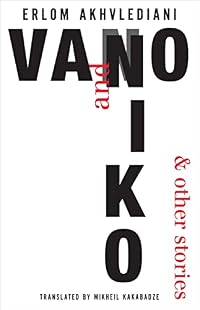
Vano and Niko: A Novel (Georgian Literature Series)
by Erlom Akhvlediani
On This Page
Description
"Vano and Niko" resembles a catalogue of all the relationships that are possible between people. It is a parable that demonstrates that not only humans but all living beings are engaged in the search for the other. Peter Handke, who met Erlom Akhvlediani in 1975, described the parables as "exhilarating and at the same time paradoxical"; in his view they show us the redemptive "third way," that of waylessness. Travelling this third way calls for courage and the Vano and Niko parables show more therefore have something ominous about them. "Vano and Niko" was one of Akhvlediani's earlier works, written in the 1950s. Today "Vano and Niko" has cult status and the book is famous throughout Georgia, even forming part of the philosophy curriculum. This edition of "Vano and Niko" includes the two other parts to Akhvlediani's trilogy of parables: "The Story of the Lazy Mouse" and "The Man Who Lost His Self and Other Stories." show lessTags
Member Reviews
Typically, this is the part of the book review where I write about the plot then I review the construction. Vano & Niko and Other Stories by Georgian author Erlom Akhvlediani (translated by Mikheil Kakabadze) doesn’t lend itself to that format.
That’s because the stories are more like poems…but not poems. I wouldn’t normally use a phrase like ‘word pictures’ but it’s difficult not to. Please don’t let that put you off. Each piece–they’re short pieces of a few pages each–paint a portrait of a relationship or a person or a way of being. They’re very true and real. I can’t say I understood every one of them but some of them were so immediate they were breath-taking. Those will be personal for each reader, but the show more ones that spoke to me most were so powerful I had to resist the urge to post them in there entirety. They’re the sort of thing you want to press upon everyone you meet and say, ‘Read this piece of insightful writing immediately.’
The book is short–not even 200 pages–but profound. It encompasses a trilogy. Vano and Niko, which is a collection of short pieces about the various sorts of relationships between people as demonstrated by two people named Vano and Niko. Proving that no matter the names, all humans are the same. The second set of short pieces are The Story of the Lazy Mouse, which are about animals taking on certain human characteristics and what it gets them. The third set are the most philosophical and is called The Man Who Lost Himself.
It’s the sort of book that makes a person wonder how many books are written in other languages that are waiting out there to be discovered.
In Mikheil Kakabadze’s introduction he explains:
it is well known that poetry and meaning disappear to some extent in a translation. However, I would like to ask the reader, when he or she comes across something apparently incomprehensible in these stories, instead of trying to dig too deeply for meaning, to think in images…
It’s a different way of reading, but doing so helped me immensely.
I give this one 4/5 only because it may be slightly inaccessible to some readers. If you’re willing to put in the work, though, it’s so rewarding.
[I received this book free from Netgalley in exchange for an honest review.] show less
That’s because the stories are more like poems…but not poems. I wouldn’t normally use a phrase like ‘word pictures’ but it’s difficult not to. Please don’t let that put you off. Each piece–they’re short pieces of a few pages each–paint a portrait of a relationship or a person or a way of being. They’re very true and real. I can’t say I understood every one of them but some of them were so immediate they were breath-taking. Those will be personal for each reader, but the show more ones that spoke to me most were so powerful I had to resist the urge to post them in there entirety. They’re the sort of thing you want to press upon everyone you meet and say, ‘Read this piece of insightful writing immediately.’
The book is short–not even 200 pages–but profound. It encompasses a trilogy. Vano and Niko, which is a collection of short pieces about the various sorts of relationships between people as demonstrated by two people named Vano and Niko. Proving that no matter the names, all humans are the same. The second set of short pieces are The Story of the Lazy Mouse, which are about animals taking on certain human characteristics and what it gets them. The third set are the most philosophical and is called The Man Who Lost Himself.
It’s the sort of book that makes a person wonder how many books are written in other languages that are waiting out there to be discovered.
In Mikheil Kakabadze’s introduction he explains:
it is well known that poetry and meaning disappear to some extent in a translation. However, I would like to ask the reader, when he or she comes across something apparently incomprehensible in these stories, instead of trying to dig too deeply for meaning, to think in images…
It’s a different way of reading, but doing so helped me immensely.
I give this one 4/5 only because it may be slightly inaccessible to some readers. If you’re willing to put in the work, though, it’s so rewarding.
[I received this book free from Netgalley in exchange for an honest review.] show less
Ratings
Members
- Recently Added By
Lists

Caucasus
122 works; 2 members
Author Information
4 Works 14 Members
Series
Belongs to Publisher Series
Classifications
- Genres
- General Fiction, Fiction and Literature
- DDC/MDS
- 899.969 — Literature & rhetoric Literatures of other languages Literatures of non-Austronesian languages of Oceania, of Austronesian languages, of miscellaneous languages Literature of Basque, Summerian, Elamite, Etruscan, Caucausian and Artificial languages Caucasian languages Georgian
- LCC
- PK9169 .A924 .A2 — Language and Literature Indo-Iranian languages and literatures Indo-Iranian philology and literature Caucasian languages Georgian
- BISAC
Statistics
- Members
- 8
- Popularity
- 2,494,038
- Reviews
- 1
- Rating
- (4.00)
- Languages
- English
- Media
- Paper
- ISBNs
- 1