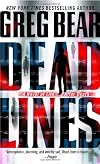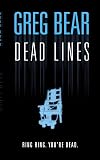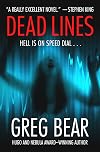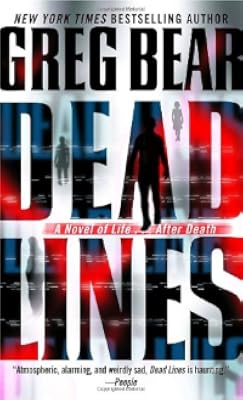
Dead Lines: A Novel of Life . . . After Death
by Greg Bear
On This Page
Description
In the near future, wireless bandwidth for data transmission is at a premium, with demand outstripping supply. Then a brand-new channel is discovered that allows almost infinite volumes of data to be transmitted instantaneously. But strange things are happening to the users of this bandwidth, and the most likely explanation is scariest of all: This new channel may well be the pathway the dead use to get from this life to the next. If true, and the world continues to clog it with spam, mp3s, show more and phone calls, what will happen to the most important journey humanity's souls will ever make? show lessTags
Recommendations










Member Reviews
There are as many good reasons to love this novel as there are to despise it.
On one side, this Greg Bear guy has an old-school approach to gender anything. Women are sexual objects or plot devices, and some assertions about the male and female "mind" are, honestly, ridiculous. Plot development is clunky and some bad psychology makes it even clunkier. For example [SPOILER ALERT]
Peter has lost his daughter exactly two years before. He needs to be reminded by a random detective who seems caring more than him about finding the girl's murderer. This would make sense if he was that kind of character, but he is not, so how doesn't he remember? Or, why are we not given a hint that he doesn't want to remember?
[END OF SPOILER]
There are so many show more threads that don't lead anywhere... The detective, the tech side, everything is left hanging.
On the other side, the characters are likeable, the ending is truly moving, in a bitter-sweet sort of way, and there is an atmosphere of melancholy and missed opportunities, of loss and grief, that reminded me of Dandelion Wine.
Also, Greg Bear writes male protagonists that are exactly my sort of man: middle aged, sweet but rugged and reserved, with a killer sense of humour and a dislike of drama, kinda Hemingway without the machismo.
I know I will read again this novel, because of the golden sunset atmosphere, all the nonsensical plot development notwithstanding. show less
On one side, this Greg Bear guy has an old-school approach to gender anything. Women are sexual objects or plot devices, and some assertions about the male and female "mind" are, honestly, ridiculous. Plot development is clunky and some bad psychology makes it even clunkier. For example [SPOILER ALERT]
Peter has lost his daughter exactly two years before. He needs to be reminded by a random detective who seems caring more than him about finding the girl's murderer. This would make sense if he was that kind of character, but he is not, so how doesn't he remember? Or, why are we not given a hint that he doesn't want to remember?
[END OF SPOILER]
There are so many show more threads that don't lead anywhere... The detective, the tech side, everything is left hanging.
On the other side, the characters are likeable, the ending is truly moving, in a bitter-sweet sort of way, and there is an atmosphere of melancholy and missed opportunities, of loss and grief, that reminded me of Dandelion Wine.
Also, Greg Bear writes male protagonists that are exactly my sort of man: middle aged, sweet but rugged and reserved, with a killer sense of humour and a dislike of drama, kinda Hemingway without the machismo.
I know I will read again this novel, because of the golden sunset atmosphere, all the nonsensical plot development notwithstanding. show less
Peter Russell is a largely out-of-work director and photographer (of titillating films and nude shots) with a gentle fondness for the ladies and a tragic love of the drink he no longer allows himself to have. He's recently-divorced, and only one of his two daughters still lives. Then a chance at redemption arrives: he's offered an opportunity to promote a new telecom company, one that has developed a revolutionary new communications device called Trans. Trans transmits with utter clarity across a newly-discovered bandwidth. His great opportunity is tainted, however: by self-doubt, fear of failure, the recent death of his best friend... and a new darkness that has entered his life. Everywhere he turns he sees things, things he shouldn't show more see. Dead things and memories of the living. Hungry things. And he isn't the only one...
On the surface of it this doesn't sound terrifically unusual. However, the actual book is quite different from others I've read. It doesn't concentrate on the plot so much as Peter Russell, a complex and fascinating person. He's the perfect conduit with which to draw the reader into the story.
The plot unfurls and unwinds rather than racing along, free to take some rather unusual twists and turns. This is one of the few books I've read where the reader's attention isn't drawn to the twists, with each one baldly pointed out; instead they're simply a part of what's happening, completely natural and organic. There are multiple mysteries wrapped up in this book's plot, but it's easy to forget to think of them as mysteries because they simply unfold as another natural part of the larger succession of events. Who killed Peter's daughter? What mysterious force at his friend Joseph's odd mansion blocks the Trans from working there? And can anything reverse the horror that is being visited upon the living?
So many details in this book ring true and bring it alive. Greg Bear takes the story at least one or two steps further than any other author would, and he does it beautifully. If you don't need constant explosions and chainsaws in order to enjoy your thrillers and horror, if you're looking for a kind of fear that maybe, just maybe, highlights some of the beauty in this world, then I highly recommend Greg Bear's "Dead Lines." Once I started I could barely put it down.
Full review at ErrantDreams show less
On the surface of it this doesn't sound terrifically unusual. However, the actual book is quite different from others I've read. It doesn't concentrate on the plot so much as Peter Russell, a complex and fascinating person. He's the perfect conduit with which to draw the reader into the story.
The plot unfurls and unwinds rather than racing along, free to take some rather unusual twists and turns. This is one of the few books I've read where the reader's attention isn't drawn to the twists, with each one baldly pointed out; instead they're simply a part of what's happening, completely natural and organic. There are multiple mysteries wrapped up in this book's plot, but it's easy to forget to think of them as mysteries because they simply unfold as another natural part of the larger succession of events. Who killed Peter's daughter? What mysterious force at his friend Joseph's odd mansion blocks the Trans from working there? And can anything reverse the horror that is being visited upon the living?
So many details in this book ring true and bring it alive. Greg Bear takes the story at least one or two steps further than any other author would, and he does it beautifully. If you don't need constant explosions and chainsaws in order to enjoy your thrillers and horror, if you're looking for a kind of fear that maybe, just maybe, highlights some of the beauty in this world, then I highly recommend Greg Bear's "Dead Lines." Once I started I could barely put it down.
Full review at ErrantDreams show less
To call a book about a bunch of dead people not being able to be pass on to wherever it is dead people are supposed to go a good fun read seems almost perverse, yet that is exactly Greg Bear’s Dead Lines is. The lines, in this case, are lines of communication, both on this plane of existence and whatever lies beyond this world.
Part of the premise is easy enough to believe: with the proliferation of cellular cell phones and other wireless devices, we are running out of bandwidth for these devices to operate in. Enter a bizarre scientist as brilliant, misunderstood and eccentric as Nikola Tesla with a solution: he has hit upon a scheme to utilize some previously unknown, “forbidden”, frequencies that will provide unlimited bandwidth show more and instant communication across the entire planet. The secret to this instantaneous communication described in a manner very reminiscent of interstellar travel used in Dune, folded space. Problems arise as it becomes apparent this dimensional folding is preventing spirits of the deceased from completing their final journey and channeling some less than desirable entities back into this world.
What follows is a captivating story that, while predictable in the outcome, has just enough twists to keep the reader from being bored. Formalized religion is left out of the plot lines, but spirituality and karma heavily influences the action. While clearly a work of fiction meant to entertain readers, Greg Bear provides a lot of thought provoking material to ponder here about what happens when we die.
Filled with eccentric, well-developed and unforgettable characters, good dialog and a semi-original plot, Dead Lines weighs in at a solid four stars. If offbeat spirit filled fiction is your thing, you will enjoy this work. If you’ve ever attended a séance or seen shadow things in the corner of your eye while telling spooky stories, you will readily identify with this story. show less
Part of the premise is easy enough to believe: with the proliferation of cellular cell phones and other wireless devices, we are running out of bandwidth for these devices to operate in. Enter a bizarre scientist as brilliant, misunderstood and eccentric as Nikola Tesla with a solution: he has hit upon a scheme to utilize some previously unknown, “forbidden”, frequencies that will provide unlimited bandwidth show more and instant communication across the entire planet. The secret to this instantaneous communication described in a manner very reminiscent of interstellar travel used in Dune, folded space. Problems arise as it becomes apparent this dimensional folding is preventing spirits of the deceased from completing their final journey and channeling some less than desirable entities back into this world.
What follows is a captivating story that, while predictable in the outcome, has just enough twists to keep the reader from being bored. Formalized religion is left out of the plot lines, but spirituality and karma heavily influences the action. While clearly a work of fiction meant to entertain readers, Greg Bear provides a lot of thought provoking material to ponder here about what happens when we die.
Filled with eccentric, well-developed and unforgettable characters, good dialog and a semi-original plot, Dead Lines weighs in at a solid four stars. If offbeat spirit filled fiction is your thing, you will enjoy this work. If you’ve ever attended a séance or seen shadow things in the corner of your eye while telling spooky stories, you will readily identify with this story. show less
Though he made his name in the 80s and early 90s as a hard SF writer, Greg Bear has more recently branched out into that catch-all mainstream category of techno-thriller. In this case, the SF part of things is just a means to get the ghost story that makes up most of the plot underway. This book really belongs in the horror genre than anywhere else.
I must say I enjoyed this book a fair deal more than I thought I would. Its light, but well told. The characters are well drawn and though it takes a while for the creepy parts to kick in, the story of Peter Russell, an ex-softcore director and his tribulations are compelling enough reading to get you through. There is a genuine enough scary bit towards the end, and the conclusion, while not show more unexpected, is satisfying. Overall, this was a quick, entertaining read.
One thing I would like to point out is that the blurb at the back gives way too much away. Seeing as I picked this up because I like the author, I didn't bother reading the blurb until I was about 1/5th of the way into the book - and it STILL gave away way too much. Anyone wanting to avoid spoilers should stay away from the back cover! show less
I must say I enjoyed this book a fair deal more than I thought I would. Its light, but well told. The characters are well drawn and though it takes a while for the creepy parts to kick in, the story of Peter Russell, an ex-softcore director and his tribulations are compelling enough reading to get you through. There is a genuine enough scary bit towards the end, and the conclusion, while not show more unexpected, is satisfying. Overall, this was a quick, entertaining read.
One thing I would like to point out is that the blurb at the back gives way too much away. Seeing as I picked this up because I like the author, I didn't bother reading the blurb until I was about 1/5th of the way into the book - and it STILL gave away way too much. Anyone wanting to avoid spoilers should stay away from the back cover! show less
Greg Bear narrows the line between horror and science fiction in this novel. The plot involves a new communications technology that promises to revolutionize the cell phone. It promises zero distortion and complete connectivity. But using the phone seems to free the dead to return.
The first problem I encountered is the feeling that this isn’t what people want. We repeatedly are willing to sacrifice communications quality for data rates. Ok, so I’m surprised Greg Bear missed that.
The main character is somewhat unbelievable. I couldn’t empathize with him. He is a director of porn theater. But his female leads respect him too much. And the reasons for his involvement in the phone business don’t seem reasonable.
Then he had to rely show more on a pop-in character, a psychic, to explain how the technology works and why it’s a problem. The character never appeared again. I really expect an experienced writer to avoid plot devices like this. It didn’t even feel like it fit into the story.
Too much was unexplained in the book. We don’t know why the phone interferes with the process of death. Why are the dead appearing to people. What happened in Europe? It seemed to be a major event and harbinger of things to come, and we never hear of it again.
The end of the book felt premature and anticlimactic. I really feel like I missed something, maybe I did?
I normally really like Greg Bear, he has written some excellent science fiction with some good takes on the latest science. This book doesn’t fit.
http://books.randolphking.com/?p=896 show less
The first problem I encountered is the feeling that this isn’t what people want. We repeatedly are willing to sacrifice communications quality for data rates. Ok, so I’m surprised Greg Bear missed that.
The main character is somewhat unbelievable. I couldn’t empathize with him. He is a director of porn theater. But his female leads respect him too much. And the reasons for his involvement in the phone business don’t seem reasonable.
Then he had to rely show more on a pop-in character, a psychic, to explain how the technology works and why it’s a problem. The character never appeared again. I really expect an experienced writer to avoid plot devices like this. It didn’t even feel like it fit into the story.
Too much was unexplained in the book. We don’t know why the phone interferes with the process of death. Why are the dead appearing to people. What happened in Europe? It seemed to be a major event and harbinger of things to come, and we never hear of it again.
The end of the book felt premature and anticlimactic. I really feel like I missed something, maybe I did?
I normally really like Greg Bear, he has written some excellent science fiction with some good takes on the latest science. This book doesn’t fit.
http://books.randolphking.com/?p=896 show less
Not a bad book, but not a particularly brilliant one either. A middle-aged former softcore porn director gets roped into helping to market a new wireless phone technology. About the same time, he starts seeing ghosts, while pondering the deaths of his daughter and his best friend, and helping other friends deal with their own mortality. The story is engaging, but takes a long time to lead up to the climax that is already described on the back cover. Decent airplane reading, but nothing profound. The "science" is just fantasy, not anything even remotely based on reality.
Like an M Night Shyamalan movie, it starts out slow and interesting and very slowly builds. That's where it diverges, as it takes a long time for it to get to the part where it's supposed to be scary... but never quite makes it. The climax takes on more of a murder mystery feel, which wasn't what I was looking for. Still, I always enjoy Bear's writing style and was a welcome change my my usual Sci-Fi fare.
Members
- Recently Added By
Author Information

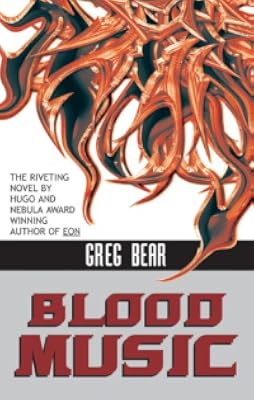
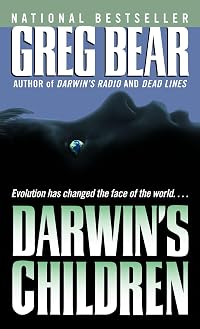
Greg Bear was born in San Diego, California, on August 20, 1951. He received a Bachelor of Arts degree from San Diego State University in 1973. At age 14, he began submitting pieces to magazines and at 15 he sold his first story to Robert Lowndes' Famous Science Fiction. It would be five years before he sold another piece, but by 23 he was selling show more stories regularly. He has written more than 30 science fiction and fantasy books and has won numerous awards for his work. In 1984, Hardfought and Blood Music won the Nebula Awards for best novella and novelette; Blood Music went on to win the Hugo Award. The novel version of that story, also called Blood Music, won the Prix Apollo in France. In 1987, Tangents won the Hugo and Nebula awards for best short story. He also won a Nebula in 1994 for Moving Mars and in 2001 for Darwin's Radio. Both Dinosaur Summer and Darwin's Radio have been awarded the Endeavour for best novel published by a Northwest science fiction author. He is also an illustrator and his work has appeared in Galaxy, Fantasy and Science Fiction, and Vertex, and in both hardcover and paperback books. He was a founding member of ASFA, the Association of Science Fiction Artists. His works include City at the End of Time, Hull Zero Three, The Mongoliad, Mariposa, Halo: Cryptum, Halo: Primordium and Halo: Silentium. (Bowker Author Biography) show less
Some Editions
Awards and Honors
Distinctions
Series
Belongs to Publisher Series
Heyne Allgemeine Reihe (52283)
Common Knowledge
- Original title
- Dead Lines
- Original publication date
- 2004
- First words
- Paul is dead.
- Blurbers
- King, Stephen
Classifications
Statistics
- Members
- 578
- Popularity
- 50,994
- Reviews
- 18
- Rating
- (2.99)
- Languages
- English, German, Spanish
- Media
- Paper, Audiobook, Ebook
- ISBNs
- 20
- ASINs
- 3