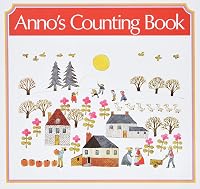
Anno's Counting Book
by 安野 光雅
On This Page
Description
A counting book depicting the growth in a village and surrounding countryside during twelve months.Tags
Recommendations










Member Reviews
This is a wordless picture book with a simple concept: each two-page spread illustrates a number from 0-12 in counting order. Spread #1 features 1 tree, 1 house, 1 dog, etc. You can guess what Spread #2 shows! What’s unexpected is how charming the illustrations are as one house on a hill by a river becomes a whole village, populated with children, adults, and all sorts of plants and animals. There’s a wedding, a train is built next to the town, and seasons come and go. Mitsumasa Anno takes a simple concept, accessible to even very young children, and turns it into an visual feast for young and old.
This is a wordless picture book with a simple concept: each two-page spread illustrates a number from 0-12 in counting order. Spread #1 features 1 tree, 1 house, 1 dog, etc. You can guess what Spread #2 shows! What’s unexpected is how charming the illustrations are as one house on a hill by a river becomes a whole village, populated with children, adults, and all sorts of plants and animals. There’s a wedding, a train is built next to the town, and seasons come and go. Mitsumasa Anno takes a simple concept, accessible to even very young children, and turns it into an visual feast for young and old.
If a picture is worth a thousand words, Anno’s Counting Book is well worth the time invested. The book is simple and contains illustrations for the 13 numbers included. The book starts with the number zero and a picture of an empty field. The next page has one house, one squirrel, one snowman, and one bird amongst other representations of one. The next page, you guessed it, contains images of two (two trucks, two houses, two rabbits, two children). The book continues to multiply the subjects all the way through the number twelve. There are no words on these pages, only illustrations.
There is a lot more to this book than meets the eye. It was not until the number twelve that I saw the snow and realized each number was a representation show more of a month. As the months progress a simple empty field turns into a bustling community. Blocks on the left of the page begin to be colored in as the numbers progress. The boxes even turn into columns after the number ten; representing the base-ten place value that we use. This is much more involved than most young adolescents would pick up on, but it fits my theory that all good books have something for all ages. The author’s note in the back gives adults more to think about. Anno explains a reason for counting, a possible history of counting, and why today’s number system is superior to counting long ago.
This book is timeless.
I just read that Mitsumasa Anno lives in the suburbs of Tokyo will be 88 years-old in a few days. I can picture him and I sitting outside in a garden, sipping tea, painting, and philosophizing about numbers. show less
There is a lot more to this book than meets the eye. It was not until the number twelve that I saw the snow and realized each number was a representation show more of a month. As the months progress a simple empty field turns into a bustling community. Blocks on the left of the page begin to be colored in as the numbers progress. The boxes even turn into columns after the number ten; representing the base-ten place value that we use. This is much more involved than most young adolescents would pick up on, but it fits my theory that all good books have something for all ages. The author’s note in the back gives adults more to think about. Anno explains a reason for counting, a possible history of counting, and why today’s number system is superior to counting long ago.
This book is timeless.
I just read that Mitsumasa Anno lives in the suburbs of Tokyo will be 88 years-old in a few days. I can picture him and I sitting outside in a garden, sipping tea, painting, and philosophizing about numbers. show less
What a simple but fantastic number counting book for children. The illustrations build as you go through the story. The book starts with zero, which is such a tricky concept to understand for small children. The snowy scene then builds and changes as you go through the numbers 0-12.Along the side of the illustrations you see a base ten frame that add a unfix cube with each new number. Then when you go past 10 a new set of cubes starts along side the ten. I love the mathematical connection for students and children will love counting the sets of each number that they find on each new page. Students will also enjoy this as a wordless picture book, and they can tell a story about the changing seasons and the people and animals you see show more depicted on the pages. show less
Anno's approach to numbers is simple but brilliant. Each double page shows a scene in the countryside with items in the scene that match the number tile on the page. We have the numerical symbol, a cube, and the items in the picture - three ways to understand the number. When we get past 10, the cubes befin a new stack alongside to match with our teaching of "tens". This is a classic that does not dumb down like other counting books may, instead giving the child leeway to draw his or her own conclusions.
There is nothing average or simple about this counting book by award winning author/illustrator, Mitsumasa Anno. Cleverly he takes the reader through to the number 12 in order to visit the times of day and the turning of the seasons. But none of the pages are as simple as they seem on first glance. Repeat readings of this book will show you the very many different ways Anno considers the numbers, one to one correspondence, grouping, scales, and more. All done through the visual description of everyday living. This book begs to be enjoyed over and over again by readers of all ages.
Through simple, yet enticing illustrations, this wordless book is dedicated to counting. The book begins with the number 0 and a blank, snowy page. As the pages are turned the numbers go higher and more things to count are added to the illustrations. Children will surely love exploring the drawings as they get more intricate with every page. The book goes from 0-12 to represent the number of months in a year. Readers will also notice the seasons changing from page to page.
Members
- Recently Added By
Lists

Wordless Books
157 works; 15 members

Early Picture Books
467 works; 9 members
Author Information

79+ Works 9,036 Members
Awards and Honors
Common Knowledge
- Canonical title*
- 1,2,3 tanti... impariamo a contare!
- Original publication date
- 1975
*Some information comes from Common Knowledge in other languages. Click "Edit" for more information.
Classifications
- Genres
- Picture Books, Children's Books
- DDC/MDS
- 513.211 — Natural sciences & mathematics Mathematics Arithmetic Arithmetic operations Addition, Subtraction, Multiplication and Division Addition and Counting
- LCC
- PZ7 .A5875 .A — Language and Literature Fiction and juvenile belles lettres Fiction and juvenile belles lettres Juvenile belles lettres
- BISAC
Statistics
- Members
- 1,971
- Popularity
- 10,770
- Reviews
- 56
- Rating
- (4.22)
- Languages
- English, Italian, Spanish
- Media
- Paper
- ISBNs
- 17
- UPCs
- 1
- ASINs
- 11