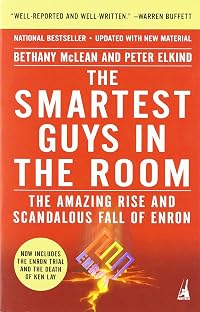
The Smartest Guys in the Room: The Amazing Rise and Scandalous Fall of Enron
by Bethany McLean, Peter Elkind
On This Page
Description
Just as Watergate was the defining political story of its time, so Enron is the biggest business story of our time. And just as All the President's Men was the one Watergate book that gave readers the full story, with all the drama and nuance, The Smartest Guys in the Room is the one book you have to read to understand this amazing business saga.Tags
Recommendations
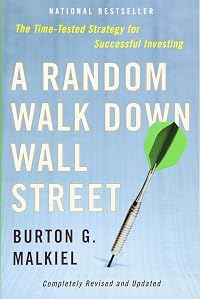
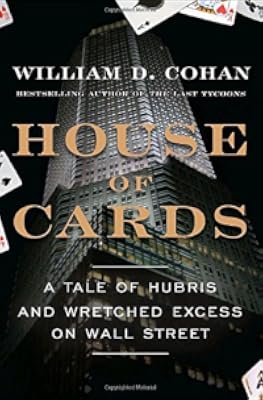
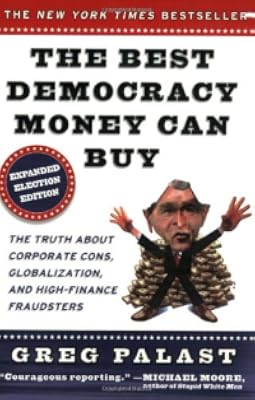
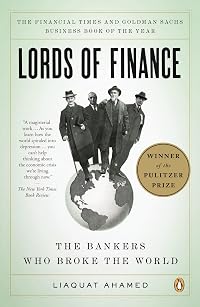
Member Reviews
I will be thinking about this book for a long time! What is it really about, anyway? What is truly wonderful is... the authors tell us, and I suspect they're right, that pretty much none of the folks involved in this massive fraud, none of them felt they were doing anything wrong.
One of the most chilling statements by the authors... this book came out around 2003. The authors wondered whether accounting and finance would be more transparent or whether the next bull market would be build on similar illusions. Ach, the real estate bubble sure looked a lot like Enron. How can something worthless get painted up to look valuable and then sold.
This is really the interesting puzzle. Is illusion really a polar opposite of reality? Is it more show more like illusion has its own sort of reality. There are layers and layers of reality. Hmm, I have been learning about photoshop and its layers of pixel transformation. Yeah, accounting is really like photoshop. The image is a kind of reality. What does it mean for a picture to be accurate? Yeah, photoshop and ebay. How much of ebay selling is driven by photoshop?
It's really sad to think, how much of our economy and society has been spun around by the creation of layers and layers of illusion, where folks have totally lost track of any underlying reality? OK, that is a nice puzzle. Our analytical powers have grown just as tremendously. We can analyze any phenomenon and discover layers of layers of construction to the point where any sort of logical stopping point is lost. We can build up layers and we can dig through layers. It becomes a big abstract game.
That was a theme through part of this book, the purity of the trading ethic. Everything is an abstract game. Of course this is hideously destructive. But the puzzle is, how so? If reality isn't some stopping point, some top-most illusion that cannot be painted over, or some bottom-most layer that resists all analysis, if the layers are infinitely extendable in either direction, then where is the reality?
Maybe all the layers are real, maybe the reality is just that interplay of levels. No layer cancels out the reality of any other layer. If one layer can cancel the reality of another, the whole structure devolves into accelerating gaming. But if layers instead enhance each other's reality... if it is *all* real, all worthy of cherishing...
It is a curious business, all the strategies we use to isolate and purify and protect what is really worth caring about, and to discard and deny reality to what is not worth caring about. The Smartest Guys sure draws a vivid picture of one such strategy and where it led. show less
One of the most chilling statements by the authors... this book came out around 2003. The authors wondered whether accounting and finance would be more transparent or whether the next bull market would be build on similar illusions. Ach, the real estate bubble sure looked a lot like Enron. How can something worthless get painted up to look valuable and then sold.
This is really the interesting puzzle. Is illusion really a polar opposite of reality? Is it more show more like illusion has its own sort of reality. There are layers and layers of reality. Hmm, I have been learning about photoshop and its layers of pixel transformation. Yeah, accounting is really like photoshop. The image is a kind of reality. What does it mean for a picture to be accurate? Yeah, photoshop and ebay. How much of ebay selling is driven by photoshop?
It's really sad to think, how much of our economy and society has been spun around by the creation of layers and layers of illusion, where folks have totally lost track of any underlying reality? OK, that is a nice puzzle. Our analytical powers have grown just as tremendously. We can analyze any phenomenon and discover layers of layers of construction to the point where any sort of logical stopping point is lost. We can build up layers and we can dig through layers. It becomes a big abstract game.
That was a theme through part of this book, the purity of the trading ethic. Everything is an abstract game. Of course this is hideously destructive. But the puzzle is, how so? If reality isn't some stopping point, some top-most illusion that cannot be painted over, or some bottom-most layer that resists all analysis, if the layers are infinitely extendable in either direction, then where is the reality?
Maybe all the layers are real, maybe the reality is just that interplay of levels. No layer cancels out the reality of any other layer. If one layer can cancel the reality of another, the whole structure devolves into accelerating gaming. But if layers instead enhance each other's reality... if it is *all* real, all worthy of cherishing...
It is a curious business, all the strategies we use to isolate and purify and protect what is really worth caring about, and to discard and deny reality to what is not worth caring about. The Smartest Guys sure draws a vivid picture of one such strategy and where it led. show less
I read this book in two chunks. Read the first hundred pages or so and stopped because my disgust with the people involved got the better of me. Similar to reading a book about Trump, there is a certain nose pinching distance one has to read from. Picked it up a month or so ago and was utterly fascinated the rest of the way. The first part is a little slower, setting up the beginnings of the company and the background of the players, but definitely picks up and runs into pure fascination. Lots of well organized detail presented in a fashion I could mostly understand--can't say I can explain much of it but while reading it I did maintain a decent grasp of the accounting shenanigans. You don't have to love numbers to enjoy this tragedy. show more There is enough workplace drama, high wire act gambles and operatic human downfalls to keep anyone's attention. There is a rooting interest for those with the most guilt in this debacle to get their comeuppance--and some do--but the ultimate feeling is one of despair for the guilty rarely see that they have done anything wrong, the victims are never made whole and the system keeps rolling merrily along. Many of the same factors involved in the Enron collapse were contributory to the crash of the housing market so what should have been a warning of things to come--was given lip-service instead of being properly addressed. Fascinating read that still applies though the collapse was over twenty years ago. show less
Readable account of this canary-in-the-coalmine scandal (though there were plenty of other canaries) about a company that slowly rotted from the beginning while using accounting tricks to make it seem like it was in good shape. The corporate culture of excess was a huge contributor, since people got to spend money on themselves any way they wanted as long as they could “book” results. Another important part was the company’s transition away from building actual things to trading—financial companies in which individuals get performance bonuses, I now think, are inherently parasites; paying for performance, especially paying huge sums for performance, is the best possible way to get accounting fraud. What’s really striking is show more how relatively small the amounts started compared to the payouts now common on Wall Street: when you get $100,000 for your job, but see someone close to you pulling in $1.5 million, you start to think “how do I get in on that?” and the answer is usually “cook the books.” Enron took it to extremes in every direction, as the book recounts, with pretty readable explanations of the special purpose vehicles used to hide Enron’s losses.
Something I hadn’t picked up last time I read about this: a big part of the immediate bad decisions that combined with the fraud to drive Enron down was its big investment in video-on-demand, which it thought it could make financially rewarding very quickly. But the content owners in Hollywood wouldn’t cut good deals! Quelle surprise.
As I was finishing this book, I was reading the big investor complaint against Bank of America, and one of the amazing things in the complaint was that by 2006 Countrywide’s CEO was internally admitting that they did a terrible job with option ARMs (also known as pick-a-pay, where you were negatively amortizing if you paid the minimum, and most people did), and complaining that the business wasn’t as good for them as it was for World Savings, which supposedly had much higher underwriting standards and did a better job of controlling eligibility. Yeah, not so much (World Savings also turned into a financial nightmare under the weight of its bad mortgages). Mozilo didn’t understand that its competition had also, driven by the selling imperative, made exactly the same unsustainable decisions. Basically, Enron didn’t teach anyone in positions of power anything, because they were willing to step on anyone if they got paid big. Without the huge disproportion in compensation between those on the top and those on the bottom, the incentive to subvert controls would have been much smaller; bring back the 90% top rate! show less
Something I hadn’t picked up last time I read about this: a big part of the immediate bad decisions that combined with the fraud to drive Enron down was its big investment in video-on-demand, which it thought it could make financially rewarding very quickly. But the content owners in Hollywood wouldn’t cut good deals! Quelle surprise.
As I was finishing this book, I was reading the big investor complaint against Bank of America, and one of the amazing things in the complaint was that by 2006 Countrywide’s CEO was internally admitting that they did a terrible job with option ARMs (also known as pick-a-pay, where you were negatively amortizing if you paid the minimum, and most people did), and complaining that the business wasn’t as good for them as it was for World Savings, which supposedly had much higher underwriting standards and did a better job of controlling eligibility. Yeah, not so much (World Savings also turned into a financial nightmare under the weight of its bad mortgages). Mozilo didn’t understand that its competition had also, driven by the selling imperative, made exactly the same unsustainable decisions. Basically, Enron didn’t teach anyone in positions of power anything, because they were willing to step on anyone if they got paid big. Without the huge disproportion in compensation between those on the top and those on the bottom, the incentive to subvert controls would have been much smaller; bring back the 90% top rate! show less
This is a very well-written book that explains in great detail what happened at Enron. And not just the last 100 pages that reads like a mystery novel where you already know the end; it explains in lay language who was involved with Enron from the beginning, their personality traits, their business traits, and everything that made Enron both a powerhouse and a den of thieves.
What I found especially innovative, besides financial considerations that I never had studied before (and some were definitely over my head) was the people became a cast of characters. From Fastow's disregard of others to Lay's inability to speak truthfully about Enron's status, from Baxter's suicide to Skilling's inevitable meltdown, each of these people is given show more his (and her) own biographical sketch and then the world in Enron, as they saw it.
Definitely a must-read for anyone interested in how corrupt people can be. The word sociopath came to mind often. show less
What I found especially innovative, besides financial considerations that I never had studied before (and some were definitely over my head) was the people became a cast of characters. From Fastow's disregard of others to Lay's inability to speak truthfully about Enron's status, from Baxter's suicide to Skilling's inevitable meltdown, each of these people is given show more his (and her) own biographical sketch and then the world in Enron, as they saw it.
Definitely a must-read for anyone interested in how corrupt people can be. The word sociopath came to mind often. show less
The Smartest Guys in the Room is a thoroughly researched account of the rise and fall of Enron, one of the largest business failures in the history of corporate America. McLean and Elkind provide an incredibly detailed history of the company from its early beginnings to the eventual collapse and resulting horrendous impact on employees, pension plan participants and the vast array of stockholders who lost billions of dollars. While the book clearly describes the complex financial structures and lack of managerial competence, it could be somewhat confusing to a reader with limited knowledge of accounting and finance principles. The real meat of the book, the story that really compels you to keep reading, is the focus on the main show more characters involved in this saga - Lay, Skilling, Pai, Rice, Mark, the numerous finance and accounting staff who played key roles, the company's board of directors, and last but not least, Andy Fastow, the Chief Financial Officer of the company. The book presents most of the individuals in a fairly balanced light (i.e., they all played roles in running the company into the ground), however the authors really cast Fastow as the arch villain. This is probably the case, given the amount of personal financial gain he manufactured through his financial and accounting strategies, however, it is clear that many people smelled the rotting fish, but did nothing about it because they too also achieved spectacular wealth. No one wanted to shut down the gravy train. The rampant greed, coupled with the loose to non-existent ethical barometer that permeated the company, made the company's demise seem inevitable. A well-written book in the vein of Barbarians at the Gate and Den of Thieves. show less
My primary reaction continues to be disbelief. Despite being in the business world as the story unfolded in real time, I learned a lot of detail here. My big question: how in the hell did they think they’d get away with this? Or maybe they were just arrogant enough to not care HOW but led with the confidence that they WOULD. Either way it’s a massive lesson for the business world, leaders and consultants we’re still impacted by today. Great book!
This is a great book about a truly remarkable part of our economic history. I have a minor physical complaint I might as well get off my chest: In their desire to make sure readers get bang for buck (fear not: you do), the publishers have elected to set this book in miniscule type, meaning firstly that you may need reading glasses if not before then after reading it, and secondly that while this looks like a 400 page book, if it were ordinarily typeset it would have the heft of an MM Kaye novel.
On the other hand, if over-length in a business book is the sort of thing that dissuades you, don't let it: this is one of the most riveting books on the history of finance you'll read, and it gets more and more addictive the further you go on. show more
As a number of reviewers have noted, it is simply staggering that Enron can have ever got where it got to at all, let alone stayed there for the best part of a decade, with all the ostenisble checks and balances that sophisticated capital markets provide. Staggering. In checks and balances I don't mean regulators, who will always be the last ones to find out where market-based moral turpitude is concerned, but investors, stock analysts, brokers, lenders, rating agencies and fund managers: people who don't just earn huge remuneration, but stake their reputations on being sceptical in the face of unconvincing bluster.
But as McLean and Elkind make clear in chapter after chapter, barely disguised and unconvinving bluster was, in large part, all Enron was. For all the "black box" accounting, it is simply inconceivable that Enron's true internal wiring could be kept anything like properly secret, since far too many people had to know about it. Internal and external to Enron there must have been junior lawyers, accountants, auditors, traders and marketers who all had to know what was going on, and people *do* talk: they gossip, they change jobs, they make inappropriate remarks. What's more, the existence (if not the detail) of many of the more toxic situations - the LJM Partnerships, the prepay contracts - were on the public record, so the burning question to my mind, which McLean and Elkind do not address, isn't so much how people could have been so greedy and deceitful (that's not hard to understand at all), but what sociological and psychological factors caused everyone else, collectively, to entirely suspend the critical faculties which they used to evaluate risks in the market. This is no idle query: accurately calibrating and understanding risk is the very key to making money on Wall Street: it's hardly an incidental oversight.
Making a pejorative moral assessment of the acts of the Skillings and Lays with the benefit of hindsight is futile, self-serving, and actually unjust: our moral view of corporate behaviour *today* is conditioned and informed by the example of Enron; before Enron, the received propriety of the business and financial community was ipso facto different - if it had not been, given the market-wide (if unwitting) "complicity" documented by this book - Enron *simply couldn't have happened*.
If we assume that, in the context of the markets, "received propriety" is really no more than fiscal prudence - aimed at making sure people don't needlessly mislead, deceive or unfairly disadvantage each other (and is enforced by short sellers as effectively as regulators), the far more interesting question is *how could the prevailing moral framework have failed so badly*? Why was it so inadequate at dealing with outcomes of actions we can now see (with the benefit of hindsight and our newly adjusted moral binoculars) are transparently odious?
And that prompts a deeper question yet: what could it be about the prevailing, Post-Enron economic mores which could allow a disaster on a similar scale to happen again? That's the 300 pound gorilla that all the post-facto moralisers (and they are as prevalent within the investment banking community as without it) will never address.
Had Elkind and MacLean ventured into that territory this would have been an outstanding book (it is still worth 5 stars in my view): as it was - and with an admirable absence of judgmental prurience - the writers stick to pure reportage, to the point where the epilogue ends rather abruptly without so much as a conclusion.
But that's small beer: this is a fascinating, rewarding read. show less
On the other hand, if over-length in a business book is the sort of thing that dissuades you, don't let it: this is one of the most riveting books on the history of finance you'll read, and it gets more and more addictive the further you go on. show more
As a number of reviewers have noted, it is simply staggering that Enron can have ever got where it got to at all, let alone stayed there for the best part of a decade, with all the ostenisble checks and balances that sophisticated capital markets provide. Staggering. In checks and balances I don't mean regulators, who will always be the last ones to find out where market-based moral turpitude is concerned, but investors, stock analysts, brokers, lenders, rating agencies and fund managers: people who don't just earn huge remuneration, but stake their reputations on being sceptical in the face of unconvincing bluster.
But as McLean and Elkind make clear in chapter after chapter, barely disguised and unconvinving bluster was, in large part, all Enron was. For all the "black box" accounting, it is simply inconceivable that Enron's true internal wiring could be kept anything like properly secret, since far too many people had to know about it. Internal and external to Enron there must have been junior lawyers, accountants, auditors, traders and marketers who all had to know what was going on, and people *do* talk: they gossip, they change jobs, they make inappropriate remarks. What's more, the existence (if not the detail) of many of the more toxic situations - the LJM Partnerships, the prepay contracts - were on the public record, so the burning question to my mind, which McLean and Elkind do not address, isn't so much how people could have been so greedy and deceitful (that's not hard to understand at all), but what sociological and psychological factors caused everyone else, collectively, to entirely suspend the critical faculties which they used to evaluate risks in the market. This is no idle query: accurately calibrating and understanding risk is the very key to making money on Wall Street: it's hardly an incidental oversight.
Making a pejorative moral assessment of the acts of the Skillings and Lays with the benefit of hindsight is futile, self-serving, and actually unjust: our moral view of corporate behaviour *today* is conditioned and informed by the example of Enron; before Enron, the received propriety of the business and financial community was ipso facto different - if it had not been, given the market-wide (if unwitting) "complicity" documented by this book - Enron *simply couldn't have happened*.
If we assume that, in the context of the markets, "received propriety" is really no more than fiscal prudence - aimed at making sure people don't needlessly mislead, deceive or unfairly disadvantage each other (and is enforced by short sellers as effectively as regulators), the far more interesting question is *how could the prevailing moral framework have failed so badly*? Why was it so inadequate at dealing with outcomes of actions we can now see (with the benefit of hindsight and our newly adjusted moral binoculars) are transparently odious?
And that prompts a deeper question yet: what could it be about the prevailing, Post-Enron economic mores which could allow a disaster on a similar scale to happen again? That's the 300 pound gorilla that all the post-facto moralisers (and they are as prevalent within the investment banking community as without it) will never address.
Had Elkind and MacLean ventured into that territory this would have been an outstanding book (it is still worth 5 stars in my view): as it was - and with an admirable absence of judgmental prurience - the writers stick to pure reportage, to the point where the epilogue ends rather abruptly without so much as a conclusion.
But that's small beer: this is a fascinating, rewarding read. show less
Members
- Recently Added By
Lists

LT picks: Blue Books
197 works; 44 members

Top Five Books of 2013
1,562 works; 721 members

Penguin Random House
458 works; 4 members
Author Information

4+ Works 2,411 Members

5 Works 1,594 Members
Awards and Honors
Notable Lists
Common Knowledge
- Original publication date
- 2003
- People/Characters
- Jeffrey K. Skilling
- Related movies
- Enron: The Smartest Guys in the Room (2005 | IMDb)
- Epigraph
- OUR VALUES
RESPECT: We treat others as we would like to be treated ourselves. We do not tolerate abusive or disrespectful treatment. Ruthlessness, callousness, and arrogance don't belong here.
INTEGRITY: We wor... (show all)k with customers and prospects openly, honestly, and sincerely. When we say we will do something, we will do it; when we say we cannot or will not do something, then we won't do it.
COMMUNICATION: We have an oblication to communicate. Here, we take the time to talk with one another ... and to listen. We believe that information is meant to move and that information moves people.
EXCELLENCE: We are satisfied with nothing less than the very best in everything we do. We will continue to raise the bar for everyone. The great fun here will be for all of us to discover just how good we really can be.
--From Enron's 1998 Annual Report - Dedication
- For Chris
--B. M.
For Laura
--P. E. - First words
- (Introduction): On a cool Texas night in late January, Cliff Baxter slipped out of bed.
It is no accident that Ken Lay's career in the energy buisness began -- and, most likely, ended -- in the city of Houston, Texas. - Last words
- (Click to show. Warning: May contain spoilers.)"We should have flown up on Southwest Airlines," he said, "and stayed at the Ramada Inn."
(Click to show. Warning: May contain spoilers.)(Epilogue): What he believes about Enron and what happened to it has never changed: "They killed a great company." - Canonical DDC/MDS
- 333.790973
- Canonical LCC
- HD9502.U54
Classifications
- Genres
- Business, Nonfiction, General Nonfiction, History
- DDC/MDS
- 333.790973 — Society, government, & culture Economics Economics of land and energy Conservation, Alternative Energy Sources Energy - alternative, renewable Standard subdivisions Biography; History by Place North America United States
- LCC
- HD9502 .U54 — Social sciences Industries. Land use. Labor Industries. Land use. Labor Special industries and trades Energy industries. Energy policy. Fuel trade
- BISAC
Statistics
- Members
- 1,472
- Popularity
- 15,902
- Reviews
- 21
- Rating
- (4.03)
- Languages
- English, French, Turkish
- Media
- Paper, Audiobook, Ebook
- ISBNs
- 13
- UPCs
- 1
- ASINs
- 16