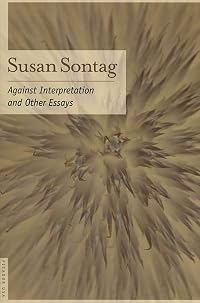
Against Interpretation: And Other Essays
by Susan Sontag 
On This Page
Description
First published in 1966, this collection includes two of Sontag's most famous essays, her thoughts on Sartre, Camus, psychoanalysis, contemporary religious thought, and much more.Tags
Recommendations




Member Reviews
This was Sontag's first essay-collection, first published in 1966 when she had broken out of academia and was starting to make her way as a critic in New York and Paris. It includes several of her most famous pieces — "Against interpretation", "On style", "Notes on camp", etc., as well as a selection of book, film and theatre reviews.
"Against interpretation" sets the tone for the whole book, really: Sontag is on a mission to persuade the world of the arts that they have all been focussing too much on content at the expense of form. Works of art (novels, films, paintings, poems, plays, ...) should not do their aesthetic work through the ideas they present, but by the elegance and originality of the way in which they engage with the show more viewer. This is a message which she develops further in many of her reviews, and it is also at the heart of "Notes on camp" — camp is all about the disconnect between style and substance.
Picking the book up fifty years on, the first thing that struck me was the tremendous confidence and authority she expresses. About everything from philosophy and anthropology to Japanese science-fiction films and New York "Happenings", she has read all the relevant background literature (like all properly-scary critics, she's normally better-informed than the author whose work she's taking apart), made up her mind, and tells us without any equivocation or self-doubt exactly what's good and bad about the work. I can well imagine that the presumption of this young woman telling them what to think must have made quite a few elderly male readers of the Partisan Review and NYRB splutter over their cornflakes back in the early sixties...
It's interesting to see how many of the names that really mattered (to someone like Sontag) in the early sixties have faded into the background a bit now: Sartre, Genet, Camus, Antonin Artaud, Claude Lévi-Strauss, Simone Weil, Robert Bresson, Alain Robbe-Grillet, Alain Resnais, Jean-Luc Godard. We still know who most of them are, and perhaps have one or two of them in our personal pantheons as well, but we'd be unlikely to come up with that exact list. Barthes and Foucault were only just beginning to show up on the map then, and Derrida (whose first major book only came out in 1967) doesn't even get a mention. (There is also the interesting question of how much room she leaves for non-French intellectuals. Answer: not much. We do get mention of a handful of Germans, Hungarians, Russians, Japanese and maybe two Americans in the course of the book, but France occupies about 95% of the seats in her intellectual debating-chamber at this point...)
In a silly anachronistic way, it's also amusing to see how often Sontag writes things in a way that would set 21st century feminists' teeth on edge. When she opens her essay on Camus with the memorable sentence, "Great writers are either husbands or lovers", we're supposed to understand that she's using that image to make us imagine two particular kinds of relationships between writer and reader, and that this doesn't have anything to do with the gender or sexuality that either of them happen to have in real life. We still understand and enjoy the image, of course, but she'd never get away with that nowadays!
Something similar applies to her comments about "homosexuals" at various points, e.g. in "Notes on camp" and in her review of Blues for Mister Charlie. Baldwin gets taken to task for using a play that's ostensibly about racism to deal covertly with his own sexual hang-ups — a perceptive judgement by Sontag, but the way she delivers it is more than a little brusque. show less
"Against interpretation" sets the tone for the whole book, really: Sontag is on a mission to persuade the world of the arts that they have all been focussing too much on content at the expense of form. Works of art (novels, films, paintings, poems, plays, ...) should not do their aesthetic work through the ideas they present, but by the elegance and originality of the way in which they engage with the show more viewer. This is a message which she develops further in many of her reviews, and it is also at the heart of "Notes on camp" — camp is all about the disconnect between style and substance.
Picking the book up fifty years on, the first thing that struck me was the tremendous confidence and authority she expresses. About everything from philosophy and anthropology to Japanese science-fiction films and New York "Happenings", she has read all the relevant background literature (like all properly-scary critics, she's normally better-informed than the author whose work she's taking apart), made up her mind, and tells us without any equivocation or self-doubt exactly what's good and bad about the work. I can well imagine that the presumption of this young woman telling them what to think must have made quite a few elderly male readers of the Partisan Review and NYRB splutter over their cornflakes back in the early sixties...
It's interesting to see how many of the names that really mattered (to someone like Sontag) in the early sixties have faded into the background a bit now: Sartre, Genet, Camus, Antonin Artaud, Claude Lévi-Strauss, Simone Weil, Robert Bresson, Alain Robbe-Grillet, Alain Resnais, Jean-Luc Godard. We still know who most of them are, and perhaps have one or two of them in our personal pantheons as well, but we'd be unlikely to come up with that exact list. Barthes and Foucault were only just beginning to show up on the map then, and Derrida (whose first major book only came out in 1967) doesn't even get a mention. (There is also the interesting question of how much room she leaves for non-French intellectuals. Answer: not much. We do get mention of a handful of Germans, Hungarians, Russians, Japanese and maybe two Americans in the course of the book, but France occupies about 95% of the seats in her intellectual debating-chamber at this point...)
In a silly anachronistic way, it's also amusing to see how often Sontag writes things in a way that would set 21st century feminists' teeth on edge. When she opens her essay on Camus with the memorable sentence, "Great writers are either husbands or lovers", we're supposed to understand that she's using that image to make us imagine two particular kinds of relationships between writer and reader, and that this doesn't have anything to do with the gender or sexuality that either of them happen to have in real life. We still understand and enjoy the image, of course, but she'd never get away with that nowadays!
Something similar applies to her comments about "homosexuals" at various points, e.g. in "Notes on camp" and in her review of Blues for Mister Charlie. Baldwin gets taken to task for using a play that's ostensibly about racism to deal covertly with his own sexual hang-ups — a perceptive judgement by Sontag, but the way she delivers it is more than a little brusque. show less
The endurance and magnificence of this essay collection lie not with their ability to persuade but their stimulating arguments and ideas. However—this is a reductive take on an otherwise complex topic—I completely agree that society's eagerness and obsession to interpret / interpretations ad nauseam may be harmful and art should be felt rather than interpreted. Also controversial in places, Sontag's take on form over content forces sceptics to reconsider, reexamine this seemingly insoluble debate much like the unending fights about separation between the art and the artist. I don't agree either that Bresson is a better director than Bergman or the pretentious snob Godard should be put in a pedestal as if Truffaut or Varda, the show more pioneer of the French New Wave, did not exist. Her essay Resnais' Muriel proposes some good points about the film's issues but admittedly, since he's one of my all time favourite directors whose works I think depict the plane of time and memory brilliantly, it is hard not to snort and take a little offence. How this includes essays about B movies under the sci-fi genre and the "high" and "low" culture prove Sontag as a compelling and admirable polymath.
"In one case, fantasy beautifies the world. In the other, it neutralizes it."
This collection of essays focuses mostly on French and American works it is difficult not to think that works from other countries which are just as deserving have been left out. Of course I do not expect Sontag to touch on everything but it is a bit limiting for me. Overall, I really liked the essays Against interpretation, The artist as exemplary sufferer, The death of tragedy, Going to theater, etc., The imagination of disaster, A note on novels and films, Notes on "Camp" and One culture and the new sensibility. Her wit and biting disapproval on Henry Miller and Eugene Ionesco's works are very amusing. There is so much to absorb from Against Interpretation and Other Essays that a reread is absolutely necessary. Even though I give this collection 3 stars it's not about my disagreement with some of Sontag's criticisms and arguments but rather my lack of knowledge on some of its subjects. Indeed my intellectual infatuation with Sontag persists and with that thick hair of hers I am as smitten as ever. show less
"In one case, fantasy beautifies the world. In the other, it neutralizes it."
This collection of essays focuses mostly on French and American works it is difficult not to think that works from other countries which are just as deserving have been left out. Of course I do not expect Sontag to touch on everything but it is a bit limiting for me. Overall, I really liked the essays Against interpretation, The artist as exemplary sufferer, The death of tragedy, Going to theater, etc., The imagination of disaster, A note on novels and films, Notes on "Camp" and One culture and the new sensibility. Her wit and biting disapproval on Henry Miller and Eugene Ionesco's works are very amusing. There is so much to absorb from Against Interpretation and Other Essays that a reread is absolutely necessary. Even though I give this collection 3 stars it's not about my disagreement with some of Sontag's criticisms and arguments but rather my lack of knowledge on some of its subjects. Indeed my intellectual infatuation with Sontag persists and with that thick hair of hers I am as smitten as ever. show less
There don't seem to be as many public intellectuals around as there used to be. Sure, there are more commentators than ever—look at the many, many bloggers out there, as well as other individuated voices carving out their own identity, even within larger publications. But the public intellectual in the middle of the 20th century seemed to comprise something different, something a bit larger in scope. These days, criticism tends to be done piecewise, either commenting or reacting incrementally on each new publication or event, or slowly embodying a larger critique through the slow, steady work of embodying it.
Sontag and other writers of her era offer a different model, one with well-polished fusillades and other attacks levied against show more their contemporaries. The grasp of these essays seem to be more wide-ranging, composed than today's blog posts—not just because they're more formally edited, but because by necessity they have to encompass so much more. There was the electrifying intellectual community in New York that met, discussed, and argued in person, of course. But there wasn't twitter, blogs, anything that could be used for large amounts of smaller pieces. Instead, Sontag and others worked through periodicals like the New York Review of Books, or the Partisan Review. These published maybe bi-weekly or monthly at most, meaning that they could only run so much, and that any reaction had to necessarily stand the test of time more than a snap blog-post that'll be obsolete in days.
This isn't necessarily to bemoan the current condition, only to recognize that a certain sensibility is so hard to find these days, and that you have to really seek it out compared to earlier. The New York Review of Books still exists (and continues to put out superb work), but it isn't the center of the intellectual conversation the way it used to be. They just Wrote Differently back then, in a way that's hard to articulate without reading Didion, Sontag, Wilson, and others.
This, then is to say that Sontag comes across as very refreshing—not just because she's intellectually brilliant (which she is), or that she provides a novel way of looking at art (which she does), but because she writes so damn well that it's hard not to be carried away by her conclusions because they just sound so damn good.
Sontag's larger point that "form" and "content" are often unjustly separated, and the latter elevated above the former, is laid out in the very first title essay, and expounded upon or eliptically mentioned in almost every single other essay. The effect, which would be less noticable in reading each essay individually, is to see her argument substantiated in the richness of its results. In elevating content above form (and I'll dispense with the air quotes, even though Sontag justly uses them throughout), we cut off the ways in which how a work formally functions determines its aim and effect on the audience. In a certain sense, focusing on the content reveals an impoverished vocabulary or schema for understanding a given art-form, a mistake that Sontag dearly wants to correct by foregrounding how a work... well, works!
And to her credit, Sontag's argument has seen an effect in much of the art criticism since. In film, for example, editing is now recognized as one of the (if not THE) attributes that determine the essence of a movie. In games, we see mechanics-oriented criticism on the rise, though that case is easier to make with the more explicit interaction compared to the way other art-forms will subtly shift our attention around.
While a good chunk of the book is concerned with this kind of meta-criticism, there are some more traditional criticism of specific works—valuable because they instantiate and substantiate her larger program, but still kind of floaty if you haven't experienced the works she's talking about. When she's writing to introduce a body of work to the audience, such as some of the foreign thinkers, or her entertaining essay about the "happenings," she is lively and enjotable throughout. But when she's writing an apologia for work she expects her intellectual community to already know, it can leave the average reader in the dark.
This weakness is partially a function of time (since contemporary works aren't so contemporary any more) but also of the widening intellectual pluralism that she herself champions in essays like the famous "Notes on Camp." And in that, at least, the drawbacks are to be excused and even celebrated. show less
Sontag and other writers of her era offer a different model, one with well-polished fusillades and other attacks levied against show more their contemporaries. The grasp of these essays seem to be more wide-ranging, composed than today's blog posts—not just because they're more formally edited, but because by necessity they have to encompass so much more. There was the electrifying intellectual community in New York that met, discussed, and argued in person, of course. But there wasn't twitter, blogs, anything that could be used for large amounts of smaller pieces. Instead, Sontag and others worked through periodicals like the New York Review of Books, or the Partisan Review. These published maybe bi-weekly or monthly at most, meaning that they could only run so much, and that any reaction had to necessarily stand the test of time more than a snap blog-post that'll be obsolete in days.
This isn't necessarily to bemoan the current condition, only to recognize that a certain sensibility is so hard to find these days, and that you have to really seek it out compared to earlier. The New York Review of Books still exists (and continues to put out superb work), but it isn't the center of the intellectual conversation the way it used to be. They just Wrote Differently back then, in a way that's hard to articulate without reading Didion, Sontag, Wilson, and others.
This, then is to say that Sontag comes across as very refreshing—not just because she's intellectually brilliant (which she is), or that she provides a novel way of looking at art (which she does), but because she writes so damn well that it's hard not to be carried away by her conclusions because they just sound so damn good.
Sontag's larger point that "form" and "content" are often unjustly separated, and the latter elevated above the former, is laid out in the very first title essay, and expounded upon or eliptically mentioned in almost every single other essay. The effect, which would be less noticable in reading each essay individually, is to see her argument substantiated in the richness of its results. In elevating content above form (and I'll dispense with the air quotes, even though Sontag justly uses them throughout), we cut off the ways in which how a work formally functions determines its aim and effect on the audience. In a certain sense, focusing on the content reveals an impoverished vocabulary or schema for understanding a given art-form, a mistake that Sontag dearly wants to correct by foregrounding how a work... well, works!
And to her credit, Sontag's argument has seen an effect in much of the art criticism since. In film, for example, editing is now recognized as one of the (if not THE) attributes that determine the essence of a movie. In games, we see mechanics-oriented criticism on the rise, though that case is easier to make with the more explicit interaction compared to the way other art-forms will subtly shift our attention around.
While a good chunk of the book is concerned with this kind of meta-criticism, there are some more traditional criticism of specific works—valuable because they instantiate and substantiate her larger program, but still kind of floaty if you haven't experienced the works she's talking about. When she's writing to introduce a body of work to the audience, such as some of the foreign thinkers, or her entertaining essay about the "happenings," she is lively and enjotable throughout. But when she's writing an apologia for work she expects her intellectual community to already know, it can leave the average reader in the dark.
This weakness is partially a function of time (since contemporary works aren't so contemporary any more) but also of the widening intellectual pluralism that she herself champions in essays like the famous "Notes on Camp." And in that, at least, the drawbacks are to be excused and even celebrated. show less
This book makes me think that Susan Sontag was pretty cool in addition to being really smart. She seems to be really interested in certain aspects of culture and themes in art, and then just writes essays on the subject (a very European style of discourse). My favorites in this collection were "Camus' Notebooks" (especially the idea that writers should either be "husbands" or "lovers" to their readers...each category has it's own plusses), essays about the films of Bresson and Godard, "Notes on 'Camp'", and "One culture and the new sensibility."
All of these essays were written in the 1960s, but excluding some of the references, I believe many are still relevant today regarding art criticism. I skipped most of the section dealing with show more plays and theater, but with a section on the novel, a section on film, and another on broader trends, there's plenty to get caught up in. show less
All of these essays were written in the 1960s, but excluding some of the references, I believe many are still relevant today regarding art criticism. I skipped most of the section dealing with show more plays and theater, but with a section on the novel, a section on film, and another on broader trends, there's plenty to get caught up in. show less
Penguin Books has included all of the work of Susan Sontag, including all essaistic work, in its series of Penguin Modern Classics. Against interpretation and other essays is the earliest collection of essays, published originally in 1966. Reading all volumes, six in all, one gets to know Susan Sontag herself pretty well, too. In an introduction or afterword in some of the collections of essays, Sontag looks back, and reflects on her style of writing or choice of subject matter at the time. While Sontag has a clear eye, and open, for what happens and develops in the cultural scene at home, that is in the United States, particularly in New York, her passion is with French and German literary culture, while her overall style and approach show more make her work attractive to international readers around the world.
There is some merit, to read the essays backwards, so to say, i.e. start with some of the later volumes and turn last to Against interpretation and other essays. The later essays show Susan Sontag as a very contemplative, very mature and erudite writer. the essays in the later collections, for instance in Under the sign of Saturn. Essays tend to be longer, and the passion displayed in the choice of topic is expressed in depth, rather than scope. The later essays, focussing on writers, such as Artaud or Benjamin are very balanced compositions, which will inspire and interest readers both unfamiliar and familiar with the topic, at a length of 30 - 50 pages. The most recent essays tend to be book-length, such as Illness as metaphor, which is great because of its originality, and AIDS and its metaphors and Regarding the pain of others which seem too long, and losing unity and focus.
Susan Sontag (1933 - 2004) studied English Literature, and pursued advanced higher education, closed with a doctorate in Philosophy. In 1958, she lived in Paris for a year, an experience she later described as "perhaps, the most important period of her life." Sontag has written both fiction and non-fiction. Her novels, also all re-issued by Penguin Classics seem to be undervalued.
Against interpretation and other essays is passionate in its vigorousness and hunger to explore new themes and topics. Susan Sontag wrote that she would sometimes watch two or three films per day during those years in the early 1960s. She was to maintain a life-long interest in film and photography, and throughout her essaistic work there are many essays devoted to this branch of the arts. In her later career, Sontag was also active as a director, both on the stage and as a producer of films. Her approach to describing the French cinema is very analytic and besides technique, focused on French philosophy, tying trends in French thought, such as Sartre's existentialism to great film makers such as Godard. However, in her essays Sontag's focus is so much at depth and detail, that she fails to describe a more overall trend of so-called nouvelle vague as a binding element in her essays about the French cinema.
Her interest in film and photography does not an interest in the theatre, as demonstrated in various essays drama, although drama in Sontag's essays is usually discussed in the broader context of literature and cultural philosophy.
Written in the early 1960s, based on her experience during those years and the perhaps five or six years before that, Against interpretation and other essays focuses on cultural phenomena important or emergent during that period. There is a critical essay on Albert Camus's Notebooks and literary criticism on works by authors such as Michel Leiris, Sartre on Genet, and essays about Ionesco, "Going to the theatre" and "The death of tragedy".
Against interpretation and other essays contains a number of landmark essays, such as "Notes on 'Camp'" (1963) and "Happenings: an art of radical juxtaposition", both essays in which Susan Sontag was one of the first to spot and highlight concurrent cultural trends during the 1960s. The essay collection begins with Sontag's two essays "Against interpretation" and "On style" which form a programmatic introduction to all of her essaistic work.
The essays by Susan Sontag are very cerebral, and the choice of topics and her way of writing display a great erudition as befits a great author. The essays in Against interpretation and other essays, while originally published in 1966, have lost nothing in their power or importance as defining cultural trends. They are as important to readers who wish to develop a base of knowledge as an underpinning to understanding modern art today as they were half a century ago!
An interesting detail, is the choice of the photo for the cover of the Penguin Modern Classics edition. It shows Susan Sontag as somewhat timid, but clearly holding her ground in a world dominated by man. In this early essay collection, Sontag went out to explore and develop her own, personal style. The essays speak of great passion and courage, daring to criticize even the greatest masters of arts in essays written with vigor. In Against interpretation and other essays showed herself as an author "with balls".
Highly recommended. show less
There is some merit, to read the essays backwards, so to say, i.e. start with some of the later volumes and turn last to Against interpretation and other essays. The later essays show Susan Sontag as a very contemplative, very mature and erudite writer. the essays in the later collections, for instance in Under the sign of Saturn. Essays tend to be longer, and the passion displayed in the choice of topic is expressed in depth, rather than scope. The later essays, focussing on writers, such as Artaud or Benjamin are very balanced compositions, which will inspire and interest readers both unfamiliar and familiar with the topic, at a length of 30 - 50 pages. The most recent essays tend to be book-length, such as Illness as metaphor, which is great because of its originality, and AIDS and its metaphors and Regarding the pain of others which seem too long, and losing unity and focus.
Susan Sontag (1933 - 2004) studied English Literature, and pursued advanced higher education, closed with a doctorate in Philosophy. In 1958, she lived in Paris for a year, an experience she later described as "perhaps, the most important period of her life." Sontag has written both fiction and non-fiction. Her novels, also all re-issued by Penguin Classics seem to be undervalued.
Against interpretation and other essays is passionate in its vigorousness and hunger to explore new themes and topics. Susan Sontag wrote that she would sometimes watch two or three films per day during those years in the early 1960s. She was to maintain a life-long interest in film and photography, and throughout her essaistic work there are many essays devoted to this branch of the arts. In her later career, Sontag was also active as a director, both on the stage and as a producer of films. Her approach to describing the French cinema is very analytic and besides technique, focused on French philosophy, tying trends in French thought, such as Sartre's existentialism to great film makers such as Godard. However, in her essays Sontag's focus is so much at depth and detail, that she fails to describe a more overall trend of so-called nouvelle vague as a binding element in her essays about the French cinema.
Her interest in film and photography does not an interest in the theatre, as demonstrated in various essays drama, although drama in Sontag's essays is usually discussed in the broader context of literature and cultural philosophy.
Written in the early 1960s, based on her experience during those years and the perhaps five or six years before that, Against interpretation and other essays focuses on cultural phenomena important or emergent during that period. There is a critical essay on Albert Camus's Notebooks and literary criticism on works by authors such as Michel Leiris, Sartre on Genet, and essays about Ionesco, "Going to the theatre" and "The death of tragedy".
Against interpretation and other essays contains a number of landmark essays, such as "Notes on 'Camp'" (1963) and "Happenings: an art of radical juxtaposition", both essays in which Susan Sontag was one of the first to spot and highlight concurrent cultural trends during the 1960s. The essay collection begins with Sontag's two essays "Against interpretation" and "On style" which form a programmatic introduction to all of her essaistic work.
The essays by Susan Sontag are very cerebral, and the choice of topics and her way of writing display a great erudition as befits a great author. The essays in Against interpretation and other essays, while originally published in 1966, have lost nothing in their power or importance as defining cultural trends. They are as important to readers who wish to develop a base of knowledge as an underpinning to understanding modern art today as they were half a century ago!
An interesting detail, is the choice of the photo for the cover of the Penguin Modern Classics edition. It shows Susan Sontag as somewhat timid, but clearly holding her ground in a world dominated by man. In this early essay collection, Sontag went out to explore and develop her own, personal style. The essays speak of great passion and courage, daring to criticize even the greatest masters of arts in essays written with vigor. In Against interpretation and other essays showed herself as an author "with balls".
Highly recommended. show less
Sontag is excellent as always, and is a critic sorely missed in culture and art. Some of the essays are a somewhat irrelevant (theatre and book reviews in the 1960s) but serve as a nice historical document. Where this book really hits home is where Sontag always does - in critical analysis. The concluding essay, One Culture and the new sensibility and an analysis of science fiction films with comparisons to cultures of destruction, The imagination of disaster are favourites.
At best, provoking and original. At worst, academic/philosophical/lit crit navel-gazing.
Members
- Recently Added By
Lists

50 Books by Women Authors
50 works; 10 members

culture
320 works; 1 member

sotiris' favourites circa january 2023
43 works; 2 members
Author Information

111+ Works 21,399 Members
Susan Sontag was born in New York City on January 16, 1933. She received a B.A. from the University of Chicago and did graduate work in philosophy, literature and theology at Harvard University and Saint Anne's College, Oxford University. She was the author of 17 books including four novels, a collection of short stories, several plays, and eight show more works of nonfiction. Her novels are The Benefactor, Death Kit, The Volcano Lover, and In America, which won the 2000 National Book Award for fiction. On Photography received the 1978 National Book Critics Circle Award. Her stories and essays have appeared in numerous magazines including The New Yorker, The New York Review of Books, The Times Literary Supplement, and Art in America. She also wrote and directed four feature films and stage plays in the United States and Europe. She died from leukemia on December 28, 2004 at the age of 71. (Bowker Author Biography) show less
Susan Sontag has a Legacy Library. Legacy libraries are the personal libraries of famous readers, entered by LibraryThing members from the Legacy Libraries group.
Awards and Honors
Awards
Distinctions
Series
Belongs to Publisher Series
Work Relationships
Is contained in
Common Knowledge
Classifications
- Genres
- Literature Studies and Criticism, Nonfiction, Philosophy, Art & Design
- DDC/MDS
- 809.04 — Literature & rhetoric Literature, rhetoric & criticism History, description, critical appraisal of more than two literatures By Period 20th century, 1900-1999
- LCC
- PN771 .S62 — Language and Literature Literature (General) Literature (General) Literary history By period Modern
- BISAC
Statistics
- Members
- 2,311
- Popularity
- 8,607
- Reviews
- 17
- Rating
- (3.92)
- Languages
- 13 — Chinese, Dutch, English, French, German, Hungarian, Italian, Japanese, Polish, Russian, Spanish, Turkish, Portuguese (Portugal)
- Media
- Paper, Audiobook, Ebook
- ISBNs
- 47
- ASINs
- 26