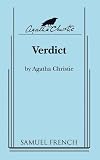
Verdict
by Agatha Christie
On This Page
Description
Melodrama Characters: 6 male, 4 female Interior Set The Hendryks, refugees in England, have lost everything. Karl with his talents, charm, and hard work rebuilds their lives. But Anya, his wife, is fatally ill and so her old friend, Lisa, who secretly loves karl, lives with them and runs the house. The three are very close. Their serenity is shattered when wealthy, brainless but headstrong Hellen Rolander bribes her way into taking private lessons from Karl. Her infatuation for him being show more unreturned she doesn't stop at murder to clear the way. But after Anya's dead, Hellen realizing her schemes were futile commits suicide. So Anya's death is pinned on Lisa backed by evidence from a scandal mongering char lady. Lisa's found not guilty and after their mutual agony she and Karl build a new life from the wreckage. show lessTags
Recommendations
















Member Reviews
Agatha Christie may be my favorite author, but even the great Christie wrote a few clunkers. This play is one of them. The melodrama reminds me of soap operas. The stage instructions have the actors constantly entering and exiting rooms and moving around rooms. One or another of the characters is constantly making and serving coffee, while the housekeeper keeps announcing they’re out of tea and popping out to the local shop to restock. This may be safely skipped by all but Christie completists.
Paying For What You Want
A review of the Samuel French / Concord Theatricals playscript (January 22, 2014) of the original Samuel French paperback (1958).
Helen show more murders the wife through an overdose, but the sister-in-law is arrested based on faulty evidence by the housekeeper . The reveals come while everyone awaits the verdict from a subsequent court trial.
I did overall enjoy Verdict although it didn't break into 4 or 5 star territory. There is a seemingly abrupt "happy ending," which comes along so quickly that I suspect it might have been forced on Christie by the theatrical producers who wanted to avoid a downer ending.
This playscript counts against my Agatha Christie binge goal, so I now have 22 novels (if I include the 6 published under the pseudonym Mary Westmacott), 5 short story collections, 13** theatrical plays (+ several harder to find 1-act radio plays) and 1 autobiography left to go.
Footnotes
* I could not find any trace of an original Spanish proverb of this line, assuming it was something like Toma lo que quieras y paga por ello”, dice Dios.. It is possible that Christie invented the phrase as a way to foreshadow that you will end up paying for things that you take... or murder for.
** The number of theatrical plays might need revision as I've discovered there are two different versions of the play adapted from the novel [book:Towards Zero|12168274] (1944). There is #1 Towards Zero (The Martha's Vineyard or the so-called Outdoor Version) (1945) and #2 [book:Towards Zero: A Stage Play|18053199] (1956) written in cooperation with Gerald Verner.
Trivia and Link
I have found that the most complete source for the theatrical works is online at Concord Theatricals, although they include several adaptations from the novels which were made posthumously without Agatha Christie's participation. I won't count those as part of the official canon. show less
A review of the Samuel French / Concord Theatricals playscript (January 22, 2014) of the original Samuel French paperback (1958).
The only way you can learn about life is by experience. The Spanish have a proverb*, “‘Take what you want and pay for it,’ says God.” That’s sound, Professor Hendryk, very sound.Verdict is that rare creature among Agatha Christie playscripts which is not based on an earlier novel or short story. The setup is that a Professor Karl Hendryk is caring for an ailing wife along with a sister-in-law and a scamming and rather treacherous housekeeper. A young student Helen is crushing on the Prof and wants private lessons, which Hendryk refuses. When he eventually relents,
I did overall enjoy Verdict although it didn't break into 4 or 5 star territory. There is a seemingly abrupt "happy ending," which comes along so quickly that I suspect it might have been forced on Christie by the theatrical producers who wanted to avoid a downer ending.
This playscript counts against my Agatha Christie binge goal, so I now have 22 novels (if I include the 6 published under the pseudonym Mary Westmacott), 5 short story collections, 13** theatrical plays (+ several harder to find 1-act radio plays) and 1 autobiography left to go.
Footnotes
* I could not find any trace of an original Spanish proverb of this line, assuming it was something like Toma lo que quieras y paga por ello”, dice Dios.. It is possible that Christie invented the phrase as a way to foreshadow that you will end up paying for things that you take... or murder for.
** The number of theatrical plays might need revision as I've discovered there are two different versions of the play adapted from the novel [book:Towards Zero|12168274] (1944). There is #1 Towards Zero (The Martha's Vineyard or the so-called Outdoor Version) (1945) and #2 [book:Towards Zero: A Stage Play|18053199] (1956) written in cooperation with Gerald Verner.
Trivia and Link
I have found that the most complete source for the theatrical works is online at Concord Theatricals, although they include several adaptations from the novels which were made posthumously without Agatha Christie's participation. I won't count those as part of the official canon. show less
Not really much of a mystery. More of a domestic story.
Not really much of a mystery. More of a domestic story.
Not really much of a mystery. More of a domestic story.
Not really much of a mystery. More of a domestic story.
Ratings
Members
- Recently Added By
Lists

Agatha Christie’s plays
18 works; 1 member

My Play Collection
769 works; 3 members
Author Information

2,157+ Works 440,725 Members
One of the most successful and beloved writer of mystery stories, Agatha Mary Clarissa Christie was born in 1890 in Torquay, County Devon, England. She wrote her first novel, The Mysterious Affair at Styles, in 1920, launching a literary career that spanned decades. In her lifetime, she authored 79 crime novels and a short story collection, 19 show more plays, and six novels written under the name of Mary Westmacott. Her books have sold over a billion copies in the English language with another billion in 44 foreign languages. Some of her most famous titles include Murder on the Orient Express, Mystery of the Blue Train, And Then There Were None, 13 at Dinner and The Sittaford Mystery. Noted for clever and surprising twists of plot, many of Christie's mysteries feature two unconventional fictional detectives named Hercule Poirot and Miss Jane Marple. Poirot, in particular, plays the hero of many of her works, including the classic, The Murder of Roger Ackroyd (1926), and Curtain (1975), one of her last works in which the famed detective dies. Over the years, her travels took her to the Middle East where she met noted English archaeologist Sir Max Mallowan. They married in 1930. Christie accompanied Mallowan on annual expeditions to Iraq and Syria, which served as material for Murder in Mesopotamia (1930), Death on the Nile (1937), and Appointment with Death (1938). Christie's credits also include the plays, The Mousetrap and Witness for the Prosecution (1953; film 1957). Christie received the New York Drama Critics' Circle Award for 1954-1955 for Witness. She was also named Dame Commander of the Order of the British Empire in 1971. Christie died in 1976. (Bowker Author Biography) show less
Some Editions
Series
Belongs to Publisher Series
Il giallo Mondadori (2167)
Work Relationships
Common Knowledge
- Canonical title
- Verdict
- Original title
- Verdict
- Original publication date
- 1958
Classifications
Statistics
- Members
- 32
- Popularity
- 880,737
- Reviews
- 6
- Rating
- (3.00)
- Languages
- Dutch, English, Finnish
- Media
- Paper
- ISBNs
- 3
- ASINs
- 1