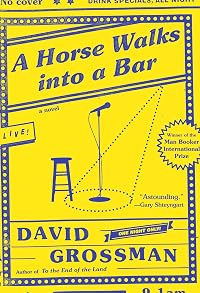
A Horse Walks into a Bar: A novel
by David Grossman
On This Page
Description
"A stand-up comedian recalls some of his darkest moments and traumatic memories from childhood on stage in front of a live audience"--Tags
Recommendations



Member Reviews
David Grossman
Grossman (1954-) is an Israeli author.. He has written a number of fiction and non-fiction books, and has garnered a long list of literary prizes, the most recent being the International Man Booker for his novel: A Horse Walks into a Bar.
A Horse Walks into a Bar
The jacket blurb provides a good summary of the novel: "In a little dive in a small Israeli city, Dov Greenstein, a comedian a bit past his prime, is doing a night of stand-up. In the audience is a district court justice, Avishai Lazar, whom Dov knew as a boy, along with a few others who remember Dov as an awkward, scrawny kid who walked on his hands to confound the neighbourhood bullies. Gradually, as it teeters between hilarity and hysteria, Dov's patter becomes a show more kind of memoir, taking us back into the terrors of his childhood: we meet his beautiful flower of a mother, a Holocaust survivor in need of constant monitoring, and his punishing father, a striver who had little understanding of his creative son. Finally, recalling his week at a military camp for youth--where Lazar witnessed what would become the central event of Dov's childhood--Dov describes the indescribable while Lazar wrestles with his own part in the comedian's story of loss and survival."
What the summary leaves out is that Dov calls Lazar, after decades of no contact, to ask that Lazar attend the stand-up performance. Lazar is reluctant and then embarrassed when he realises that he had blocked Dov from his memory despite their past friendship as school boys. Lazar agrees to go to the show but asks, "Why do you need me there?" Dov responds, "I want you to look at me. I want you to see me, really see me, and then afterward tell me. Tell you what? What you saw."
Another important character in the story is a very small, handicapped woman in the audience whom Dov does not at first recognise as from his neighbourhood who knew him as a boy. Dov calls her Pitz, short for “Pitzel”, a Yiddish word for a very small person, often a baby or toddler. Her real name is Eurycleia, the name of the family nurse who recognised Odysseus, by a scar on his leg, when he returned in disguise to kill the suitors. Grossman' choice of name is not coincidence. His Eurycleia also guards a truth, the truth of what she knows of Dov as a boy who was kind-hearted, sympathetic, and generous towards a handicapped, abused little girl. This is not how Dov sees, or portrays, himself and Pitz often interjects to contradict the stream of Dov's self-disparaging monologue. She is like Lear's Fool: knowledgeable, perceptive and ready to speak to her truth. This Eurycleia sees the scars on Dov's psyche, but she also sees past them to another person whom she insists on recognising through the increasingly tortured monologue punctuated by slapstick and Dov's extreme facial and physical mobility.
Writing in the Guardian Bookmarks (June 16, 2107) the writer Andrew O'Hagan (on another subject) talked about "people bent out of shape--by their pasts, by their ambitions or by their illusions." This is what we see in the novel. Grossman describes it through Lazar's thoughts: "The radiance of personality...The inner glow. Or the inner darkness. The secret, the tremble of singularity. Everything that lies beyond the words that describe a person, beyond the things that happened to him and the things that went wrong and became warped in him."
In exploring the "tremble of singularity" through the layers of Dov's life, Grossman indivualizes the universal experiences of love, loss, family, growth from childhood to maturity, blasted lives, relationships in family and with friends, and the rippling, generational effects of the past, particularly of past horrors. In so doing, he makes Dov real and speaks to any reader. At the same time Grossman reinforces the realisation that however close one might come to the 'singularity' it is impossible to really know another person and even, perhaps, oneself.
Grossman is good on the mentality of crowds and how they can be manipulated. Watching the reaction of the audience to Dov's early monologue, Lazar thinks, "'This man is not handsome or exciting or attractive but he's figured out how to touch people in exactly the places that turn them into a rabble, into riffraff." At another point, Lazar sees how Dov, "works himself up into a frenzy, and by doing so works them up, too. He inflames himself and ignites them, too. I can't quite understand how it works, but it does. Even I can feel the vibrations in the air, in my body, and I tell myself that maybe it's just hard to remain indifferent when faced with a man so throughly fused with the primal element."
Other themes weave through the novel: how memory is fallible and how it can completely forget or distort points of life; the side effects of one's own experiences and of the actions of others that can shape life; how the constant actions and reactions of life can be like a chess game.
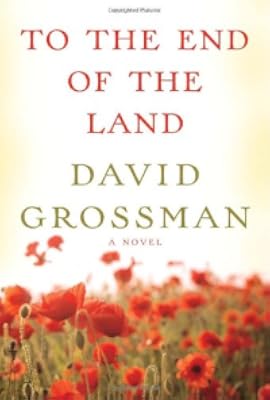
In his very fine novel, To the End of the Land, Grossman tells the story of Ora, who leaves her home in Jerusalem to walk across Israel to Galilee, in order to avoid the "notifiers" from the army who might arrive at any moment to inform her of the death of her son. I was intrigued to see Grossman return to the concept in this novel a few times. When Dov recounts a traumatic experience from his childhood he notes, "It's like nothing can really start until I actually know. Isn't that so?" It is holding at-bay the fact, or even the possibility, of unwelcome knowledge that will turn life onto a very different track, fracture memories and form and manipulate those that will henceforth structure life.
About half-way through the performance, Lazar recalls what it was that Dov had asked him to try to see: "the thing that comes out of a person against his will. The thing that only one person in the world might have." Lazar's conclusion is reached towards the end of the night.
Early in the novel, when Dov is trying to convince Lazar to come to his show, he admits that he is not as excited as he used to be about stand-up; before, it had been "like tight-rope walking for me. At any minute you could crash and burn in front of the whole audience." The tight-rope is a perfect metaphor for this novel. Can Dov hold the interest of his audience as he moves from stand-up (with some pretty fair jokes) to a lacerating examination of his life? And, can Grossman keep the attention of the reader through 200 pages? You have to read the book for the answer on the first tight-rope. On the second, my answer is a resounding yes. This is a complex, layered, gripping novel that works because of Grossman's talent as a writer, and as a keen observer of life. show less
Grossman (1954-) is an Israeli author.. He has written a number of fiction and non-fiction books, and has garnered a long list of literary prizes, the most recent being the International Man Booker for his novel: A Horse Walks into a Bar.
A Horse Walks into a Bar
The jacket blurb provides a good summary of the novel: "In a little dive in a small Israeli city, Dov Greenstein, a comedian a bit past his prime, is doing a night of stand-up. In the audience is a district court justice, Avishai Lazar, whom Dov knew as a boy, along with a few others who remember Dov as an awkward, scrawny kid who walked on his hands to confound the neighbourhood bullies. Gradually, as it teeters between hilarity and hysteria, Dov's patter becomes a show more kind of memoir, taking us back into the terrors of his childhood: we meet his beautiful flower of a mother, a Holocaust survivor in need of constant monitoring, and his punishing father, a striver who had little understanding of his creative son. Finally, recalling his week at a military camp for youth--where Lazar witnessed what would become the central event of Dov's childhood--Dov describes the indescribable while Lazar wrestles with his own part in the comedian's story of loss and survival."
What the summary leaves out is that Dov calls Lazar, after decades of no contact, to ask that Lazar attend the stand-up performance. Lazar is reluctant and then embarrassed when he realises that he had blocked Dov from his memory despite their past friendship as school boys. Lazar agrees to go to the show but asks, "Why do you need me there?" Dov responds, "I want you to look at me. I want you to see me, really see me, and then afterward tell me. Tell you what? What you saw."
Another important character in the story is a very small, handicapped woman in the audience whom Dov does not at first recognise as from his neighbourhood who knew him as a boy. Dov calls her Pitz, short for “Pitzel”, a Yiddish word for a very small person, often a baby or toddler. Her real name is Eurycleia, the name of the family nurse who recognised Odysseus, by a scar on his leg, when he returned in disguise to kill the suitors. Grossman' choice of name is not coincidence. His Eurycleia also guards a truth, the truth of what she knows of Dov as a boy who was kind-hearted, sympathetic, and generous towards a handicapped, abused little girl. This is not how Dov sees, or portrays, himself and Pitz often interjects to contradict the stream of Dov's self-disparaging monologue. She is like Lear's Fool: knowledgeable, perceptive and ready to speak to her truth. This Eurycleia sees the scars on Dov's psyche, but she also sees past them to another person whom she insists on recognising through the increasingly tortured monologue punctuated by slapstick and Dov's extreme facial and physical mobility.
Writing in the Guardian Bookmarks (June 16, 2107) the writer Andrew O'Hagan (on another subject) talked about "people bent out of shape--by their pasts, by their ambitions or by their illusions." This is what we see in the novel. Grossman describes it through Lazar's thoughts: "The radiance of personality...The inner glow. Or the inner darkness. The secret, the tremble of singularity. Everything that lies beyond the words that describe a person, beyond the things that happened to him and the things that went wrong and became warped in him."
In exploring the "tremble of singularity" through the layers of Dov's life, Grossman indivualizes the universal experiences of love, loss, family, growth from childhood to maturity, blasted lives, relationships in family and with friends, and the rippling, generational effects of the past, particularly of past horrors. In so doing, he makes Dov real and speaks to any reader. At the same time Grossman reinforces the realisation that however close one might come to the 'singularity' it is impossible to really know another person and even, perhaps, oneself.
Grossman is good on the mentality of crowds and how they can be manipulated. Watching the reaction of the audience to Dov's early monologue, Lazar thinks, "'This man is not handsome or exciting or attractive but he's figured out how to touch people in exactly the places that turn them into a rabble, into riffraff." At another point, Lazar sees how Dov, "works himself up into a frenzy, and by doing so works them up, too. He inflames himself and ignites them, too. I can't quite understand how it works, but it does. Even I can feel the vibrations in the air, in my body, and I tell myself that maybe it's just hard to remain indifferent when faced with a man so throughly fused with the primal element."
Other themes weave through the novel: how memory is fallible and how it can completely forget or distort points of life; the side effects of one's own experiences and of the actions of others that can shape life; how the constant actions and reactions of life can be like a chess game.
In his very fine novel, To the End of the Land, Grossman tells the story of Ora, who leaves her home in Jerusalem to walk across Israel to Galilee, in order to avoid the "notifiers" from the army who might arrive at any moment to inform her of the death of her son. I was intrigued to see Grossman return to the concept in this novel a few times. When Dov recounts a traumatic experience from his childhood he notes, "It's like nothing can really start until I actually know. Isn't that so?" It is holding at-bay the fact, or even the possibility, of unwelcome knowledge that will turn life onto a very different track, fracture memories and form and manipulate those that will henceforth structure life.
About half-way through the performance, Lazar recalls what it was that Dov had asked him to try to see: "the thing that comes out of a person against his will. The thing that only one person in the world might have." Lazar's conclusion is reached towards the end of the night.
Early in the novel, when Dov is trying to convince Lazar to come to his show, he admits that he is not as excited as he used to be about stand-up; before, it had been "like tight-rope walking for me. At any minute you could crash and burn in front of the whole audience." The tight-rope is a perfect metaphor for this novel. Can Dov hold the interest of his audience as he moves from stand-up (with some pretty fair jokes) to a lacerating examination of his life? And, can Grossman keep the attention of the reader through 200 pages? You have to read the book for the answer on the first tight-rope. On the second, my answer is a resounding yes. This is a complex, layered, gripping novel that works because of Grossman's talent as a writer, and as a keen observer of life. show less
This is one you should read in one (longish) sitting; it's absolutely brilliant, but only works if you immerese yourself completely. Because there are no chapters- the whole thing is one single stand-up comedy session in a club in Netanya, Israel. I must make mention of the excellent translation too; the reader never feels it's a foreign text; we absolutely believe in the comic asides, word play and the way the comedian plays with the audience.
And watching the routine is some guy the comic invited along, some face from the past, whose shared history is gradually revealed, and whose own scars from life also become apparent.
But this is Dov's story, as his jokes and witty observations hark back to his childhood, and lead up to a crescendo show more of heartbreak, the swan song of his performing career, even as the disgruntled hecklers walk out... show less
And watching the routine is some guy the comic invited along, some face from the past, whose shared history is gradually revealed, and whose own scars from life also become apparent.
But this is Dov's story, as his jokes and witty observations hark back to his childhood, and lead up to a crescendo show more of heartbreak, the swan song of his performing career, even as the disgruntled hecklers walk out... show less
Jokes, more than one wag has noted, are a great way to ignore the tragic. In David Grossman’s novel that consists in a single lengthy stand-up routine, jokes and tragedy go hand in hand. Dov Greenstein, a 57 year old Israeli comedian, has cajoled his boyhood friend, retired district court justice Avishai Lazar, to attend his set just this once and, if possible, give him some notes. Lazar hasn’t seen or spoken to Greenstein since they were 14. He is understandably wary, suspecting a hidden agenda. But nothing could prepare him for the two hours of truth telling (and jokes) that lie ahead. It’s a harrowing experience for all concerned. And maybe not exactly as funny as some of the patrons might have expected.
David Grossman’s show more writing here is exquisitely controlled, full of nuance and complex pacing. Through Lazars’ perspective we plummet down a helter skelter of emotional twists and turns. At times we empathize with Dov. At times we loathe him. But throughout he is inordinately compelling, a testament to a life lived in the shadow of tragedy. I was enthralled.
Certainly recommended. show less
David Grossman’s show more writing here is exquisitely controlled, full of nuance and complex pacing. Through Lazars’ perspective we plummet down a helter skelter of emotional twists and turns. At times we empathize with Dov. At times we loathe him. But throughout he is inordinately compelling, a testament to a life lived in the shadow of tragedy. I was enthralled.
Certainly recommended. show less
In this short novel, a stand-up comedian invites a childhood friend to his show, although they haven’t been in contact for years. The guest -- and narrator -- takes in the performance in a rather detached fashion at first, assessing his friend and the audience reaction to his material. There’s a tone of desperation in the comedian’s act; he moves in manic fashion around the stage and attempts to interact directly with audience members, especially those who heckle him. It’s a painfully slow train wreck, but then the comedian takes a surprising turn and begins telling of a traumatic childhood experience, after which he lost contact with his friend. The narrative bounces around from the comedian’s on-stage delivery, to flashback, show more to the friend’s reflections and feelings of guilt, to the audience’s response.
At first, I struggled to stay engaged in this book because the comedian didn’t appeal to me. But the narrative shift transformed him immediately into a sympathetic figure and further defined the friend as an important dramatic player, and I was hooked. I finished this novel with perhaps more questions than answers, which should make for excellent book club discussion. show less
At first, I struggled to stay engaged in this book because the comedian didn’t appeal to me. But the narrative shift transformed him immediately into a sympathetic figure and further defined the friend as an important dramatic player, and I was hooked. I finished this novel with perhaps more questions than answers, which should make for excellent book club discussion. show less
This is like a train wreck. I felt like I couldn't look & yet I couldn't look away either. I was yanked in fairly quickly to a stream-of-consciouness style (a stream-of-stand-up-comedy-ness monologue) that's quick, & harsh, & brutal, & funny, & touching, & uncomfortable. And using the conceit of the observer to see, really see, the storyteller, the comedian, the one sharing his guts on the stage, puts you in a prime seat in the audience, as uncomfortable & as stifling as it might be. Uncomfortable in a bad way. Uncomfortable in a good way. And I cried. Certainly a unique book & one I will not quickly forget.
I must give hearty praise to translator Jessica Cohen too. As claustrophobic as this feels (like you're really stuck in a dive bar show more watching a comedian that veers between humor & very uncomfortable talk) & as fast as it feels (just like you're listening to the pace of a comedian as he acts & reacts in relation to the audience), it's as if she has channeled all the energy & tension & funneled it into the English translation. Just bravo. show less
I must give hearty praise to translator Jessica Cohen too. As claustrophobic as this feels (like you're really stuck in a dive bar show more watching a comedian that veers between humor & very uncomfortable talk) & as fast as it feels (just like you're listening to the pace of a comedian as he acts & reacts in relation to the audience), it's as if she has channeled all the energy & tension & funneled it into the English translation. Just bravo. show less
A Horse Walks Into a Bar is undeniably dark. It focuses on a stand-up comedian telling the tale of his miserable life in the face of an increasingly hostile crowd that just wants light entertainment. It is claustrophobic; the action hardly departs from the small-town nightclub Dovaleh is performing in, other than through his reminiscences. It is uncomfortable, as Grossman places us firmly in the audience watching this man fall apart, through the eyes of an old acquaintance that Dovaleh has asked to attend. The reader squirms right along with the audience and the performer as his attempts to get through his tale fall flat, or even provoke outrage. It is compelling, as the novel forces you to choose between walking out on Dovaleh's act. show more like some of the characters, or staying the course to hear the final punchline. It is also funny; some of the jokes that Dovaleh delivers in the course of his monologue cracked me up.
Coming from a city and country where stand-up comedians are an integral part of our popular culture, I was attracted to this book's premise, and I wasn't disappointed. I have seen shows like Dovaleh's, where the comedian departed from jokes and ventured into the deeply personal, and I've seen the audience response. I've seen guys walk out of a comedian's account of his experience with multiple sclerosis because it wasn't funny enough for them. Grossman captured this awkward "should we really be laughing?" dynamic perfectly, and gives us a perfect rendition of a quintessential sad clown. show less
Coming from a city and country where stand-up comedians are an integral part of our popular culture, I was attracted to this book's premise, and I wasn't disappointed. I have seen shows like Dovaleh's, where the comedian departed from jokes and ventured into the deeply personal, and I've seen the audience response. I've seen guys walk out of a comedian's account of his experience with multiple sclerosis because it wasn't funny enough for them. Grossman captured this awkward "should we really be laughing?" dynamic perfectly, and gives us a perfect rendition of a quintessential sad clown. show less
It's often said that many comedians are rather sad people. Comedian Dovaleh Greenstein is no exception. He chooses the night of his 58th birthday to unload his inner turmoil to a packed house. He begins with his usual shtick but it quickly becomes very personal. Like many patrons in the audience, I too wanted to walk out. It's not an easy read, it's actually quite depressing yet it gives one pause to stop and consider how humanity can crush one's spirit or save it.
I read this book as one of the selections in the Booker International Longlist.
I read this book as one of the selections in the Booker International Longlist.
Members
- Recently Added By
Lists

Jewish Books
367 works; 24 members

Books With Interesting Titles
173 works; 14 members

Books Read in 2017
4,249 works; 129 members

Books Read in 2018
4,360 works; 110 members

Entertainment
174 works; 1 member
Author Information

91+ Works 8,019 Members
David Grossman was born in Jerusalem on January 25, 1954, is an Israeli author of fiction, nonfiction, and youth and children's literature. His books have been translated into many languages. He is most known for his non-fiction work, The Yellow Wind. This is his study of the Palestinians in the Israeli-occupied West Bank and Gaza Strip. He was show more awarded the Prime Minister's Prize for Hebrew literature (1984) and the Israeli Publishers Association Prize for best Hebrew novel (1985). Grossman lives in Mevasseret Zion on the outskirts of Jerusalem. He is married to Michal Grossman, a child psychologist and the mother of his three children. (Bowker Author Biography) show less
Some Editions
Awards and Honors
Awards
Distinctions
Notable Lists
Series
Belongs to Publisher Series
Otavan kirjasto (269)
Common Knowledge
- Canonical title*
- Kommt ein Pferd in die Bar
- Original title
- סוס אחד נכנס לבר
- Original publication date
- 2014
- People/Characters
- Dovaleh Greenstein
- Important places
- Israel
- First words
- "GOOD EVENING! GOOD EVENING! Good evening to the majestic city of Ceasariyaaaaaah!"
- Quotations
- ...I suddenly know in the clearest and simplest way that I do not want or need to be here.
Take everything people value away from them, and they have nothing left to lose—but give them some of what they want, and they may be too afraid to let go of the little that they have. - Last words
- (Click to show. Warning: May contain spoilers.)"Good night, everyone."
- Original language
- Hebrew
*Some information comes from Common Knowledge in other languages. Click "Edit" for more information.
Classifications
- Genres
- General Fiction, Fiction and Literature
- DDC/MDS
- 892.48 — Literature & rhetoric Literatures of other languages Afro-Asiatic literatures Jewish, Israeli, and Hebrew Hebrew miscellany
- LCC
- PJ5054 .G728 .S8813 — Language and Literature Oriental languages and literatures Oriental philology and literature Hebrew Literature Individual authors and works
- BISAC
Statistics
- Members
- 875
- Popularity
- 30,994
- Reviews
- 57
- Rating
- (3.57)
- Languages
- 12 — Chinese, Danish, Dutch, English, Finnish, French, German, Hebrew, Portuguese, Romanian, Slovenian, Swedish
- Media
- Paper, Audiobook, Ebook
- ISBNs
- 32
- UPCs
- 1
- ASINs
- 10