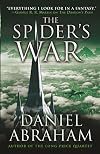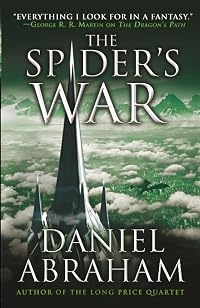
On This Page
Description
"Lord Regent Geder Palliako's great war has spilled across the world, nation after nation falling before the ancient priesthood and the weapon of dragons. But even as conquest follows conquest, the final victory retreats before him like a mirage. Schism and revolt begin to erode the foundations of the empire, and the great conquest threatens to collapse into a permanent war of all against all. In Carse, with armies on all borders, Cithrin bel Sarcour, Marcus Wester, and Clara Kalliam are show more faced with the impossible task of bringing a lasting peace to the world. Their tools: traitors high in the imperial army, the last survivor of the dragon empire, and a financial scheme that is either a revolution or the greatest fraud in the history of the world"-- show lessTags
Recommendations




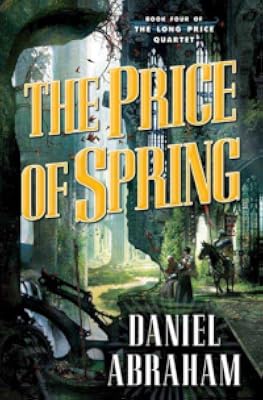


Member Reviews
The Spider's War by Daniel Abraham is the final installment of The Dagger and the Coin series. This is a satisfying end to an fascinating and different type of epic fantasy series. The "dagger" (the might of armies) has it's final clash with the "coin" (the might of commerce) to see which will shape the future of their world. Here there be spoilers!
The Antean Empire has spread across the world, taking city after city. Yet even as the conquests continue the final victory over everything appears just out of reach.Revolt is brewing by those tired of war and oppression. Lord Regent Geder Palliako has a mess on his hands, not enough men to handle it all and the words of the Spider Priests urging him on. Even so, the Antean war nothing show more compared to the endless battle that will come if the Spider Priests are not stopped. Cithrin bel Sarcour, Marcus Wester, and Clara Kalliam are faced with the impossible task of bringing a lasting peace to the world. How do you put an end to an idea?
This series has done something different. It has explored a part of fantasy that is so overlooked: commerce. The way Abraham has explored the theme between the two types of power, traditional military might (the dagger) versus the power of money (the coin), has been fascinating. His commentary on both is thought provoking and reflects back aspects of modern society in a way that I should have expected but didn't.
All of these characters have become some of my favorites. I love the arcs each has taken, even the bad guy.I feel compassion for Geder even though he's a complete tyrant. Here was a guy who is socially awkward, used to hiding in behind books suddenly given the highest power in the land and with priests whispering bad advice into his ear. How could he have NOT ended up out of control? He makes decisions based on the emotions of the moment and then blames everyone else when things don't quite go right. I'm sure we've all known someone like this, though probably not to such an extreme degree. There is a small part of him that understands the horror he's become and his conscience is trying to talk to him but he's so far gone he completely incapable of understanding that it's his conscience recoiling from all the atrocities he's committed is what's making him feel bad and ruining his health. It's nice he had his noble moment at the end even if it was more for him to feel like a hero than because it was the right thing to do. Cithrin has really come into her own. She's gone from a totally naive young girl to someone wielding the wealth of the world. She has so much power at her fingertips and has completely changed the course of this world's history by trading gold for paper money. It's a good thing she opted to use her power for the greater good! Marcus and Yardem were so much fun. I wish I could buy these guys a drink (or 10) at the local pub. I'm so happy where they ended up at the end of the story. Man I'd love to read more about these guys and have Yardem as a POV character. It would be great to get inside his head. Clara was a complete surprise. The spoiled noble lady turned loyal traitor, working to betray her country in order to save it. It's a brilliant take on the theme of patriotism. I'm so happy she put stupid protocol aside so her and Vincen can be happy together. I feel slightly conflicted about Inys. I don't think we were given enough page time with him to truly understand dragonkind. It was funny having a melodramatic, depressed dragon but surely there is much more to his story.
It has been one long journey for these characters and this world. I'm glad I went along for the ride. If you're looking for something different in your epic fantasy I would highly recommend The Dagger and the Coin. Rich world building, complex characters that all go on wonderful arcs, war, politics, commerce, exploration of interesting themes and wonderful prose. The ending ties things up just enough that to be satisfying while leaving it apparent that this is just several years in these characters lives. There is so much more they could go on to accomplish. I hope Daniel Abraham writes more in this world at some point. show less
The Antean Empire has spread across the world, taking city after city. Yet even as the conquests continue the final victory over everything appears just out of reach.
This series has done something different. It has explored a part of fantasy that is so overlooked: commerce. The way Abraham has explored the theme between the two types of power, traditional military might (the dagger) versus the power of money (the coin), has been fascinating. His commentary on both is thought provoking and reflects back aspects of modern society in a way that I should have expected but didn't.
All of these characters have become some of my favorites. I love the arcs each has taken, even the bad guy.
It has been one long journey for these characters and this world. I'm glad I went along for the ride. If you're looking for something different in your epic fantasy I would highly recommend The Dagger and the Coin. Rich world building, complex characters that all go on wonderful arcs, war, politics, commerce, exploration of interesting themes and wonderful prose. The ending ties things up just enough that to be satisfying while leaving it apparent that this is just several years in these characters lives. There is so much more they could go on to accomplish. I hope Daniel Abraham writes more in this world at some point. show less
[Please not that while this is published as a review for the 5th volume, it really is about the quintet in its entirety. Also, spoilers abound.]
I caught a bad case of the summer flu recently and as that tends to make somewhat unfocused, I looked around for some light reading that would not require too much attention to get me through the period of sickness. I eventually hit on Daniel Abraham’s Fantasy series The Dagger and the Coin which, as it turned out, did its job quite nicely, keeping me pleasantly distracted from my frequent bouts of coughing and sneezing. And I even got a bit more than I bargained for, as you will find out if you manage to make your way to the end of this overlong review.
Abraham is also the author of the Long show more Price Quartet, which in my opinion is one of the best Fantasy series in recent memory, and definitely one of the most originals, eschewing pretty much all of the traditional trappings of Epic Fantasy in a series of four novels that are as concise as they are intricate, taking place in a vaguely Asian-inspired yet highly original world and telling a story that is both epic and essentially human.
The Long Price Quartet won a lot of critical acclaim but apparently was not particularly successful commercial, and it seems not unlikely that this had a part in Abraham's decision to go for something more traditional with his next Fantasy series (he also wrote a series of Paranormal novels as M.L.N. Hanover and co-authored the hugely successfully, still ongoing space opera The Expanse). This starts with a distinctly more sprawling format (five medium-sized volumes rather than four slim ones) and continues with a pseudo-Medieval setting that will seem instantly familiar to most readers of Epic Fantasy. Abraham does not go quite as far as to include elves and dwarves, but he does have dragons, and they do play an important part, even if it is mostly in past events.
The Dagger and the Coin takes place in a world ruled by dragons, dragons who enslaved humans and split them apart into thirteen different races. When the first novel, The Dragon’s Path, starts, the dragons have been gone for thousands of years, presumably disappeared down the eponymous Dragon’s Path into civil war and mutual self-destruction. The Empire of Antea is expanding ruthlessly, and in its grasp for domination it is aided by the priests of the mysterious spider goddess who not only have the ability to discern whether someone is lying or believes what he says, but also possess uncanny powers of conviction. And while Antea, led by its Lord Regent, conquers one nation after another a small group of people set themselves to resist its apparently invincible forces...
So far, so conventional. But Daniel Abraham would not be the author he is if all he did was regurgitate well-chewed Fantasy tropes, and one takes a closer look things start to appear quite different.
(This paranthesis marks the border to spoiler country; so if you're worried about spoilers, do turn back here.)
Starting with its title, The Dagger and the Coin promises to concern itself not only with war and fighting, but also pay attention to finance and banking. This is not totally new especially in historical novels (Abraham gives a nod to Dorothy Dunnett's House of Niccolo series in his acknowledgements) but it's extremely rare especially in Fantasy novels. Dagger and coin, then, mark the two opposed paths of war and banking, each of them also represented by one of the four point of view characters (a number the novels stick to, although with occasional brief excursions to different characters): Geder, the Lord Regent of Antea, and Cithrin, a young but brilliant banker.
Geder is clearly the villain of the series, although that is not obvious from the start: When we first meet him, he comes across the Fantasy version of a geek who is majorly into "speculative history," something his peers wrinkle their collective nose at and is being harsly bullied. In short, Abraham initially sets Geder up as a character to if not like, then at least to sympathize with and gradually reveals his pettiness, his self-delusions and his potential for cruelty. And while Cithrin is clearly Geder's antipode, the novels hint again and again that in some ways she also is his mirror image. Abraham may not quite be on the level with Bertolt Brecht's dictum that robbing a bank is the by far the lesser crime when compared to founding a bank but he also leaves no doubt that banks are not necessarily a force for good and generally more interested in profit than making the world a better place.
The extremes of good and evil do remain clearly distinguishable in The Dagger and the Coin (this is no Grimdark Fantasy), but between them there is a large grey zone where things become murky and hard to distinguish. This is already a far cry from traditional Epic Fantasy, but Abraham even does one better by making precisely the denial of this moral grey zone, the insistence that there is only black and white, only absolute Truth and absolutely Evil, absolute Truth or absolute Falsehood - which is so characteristic of most Epic Fantasy - the central tenet of his version of the very traditional ancient-evil-that-is-being-reawakened, namely the spider goddess and her priests. Except that again things are not at all as they first appear - when two of our protagonists go forth to heroically slay the evil goddess it turns out that she does not even exist. Like the Long Pride Quartet, The Dagger and the Coin is a human-scaled story (dragons notwithstanding); there are no gods here except those created by man and only very few magic, and the ancient evil turns out to be if not man- then dragon-made and feeds (metaphorically) on very human weaknesses.
This is also Fantasy that does not shy away from recognisable references to the real world - the money-making scheme which Cithrin cooks up pretty much describes the invention of paper money and the way the Antean Empire's grasp for world domination unfolds and ultimately fails (not to mention its institutionalized racism) bears more than a passing resemblance to Nazi Germany. And I do not believe that is accident or Abraham running out of ideas of his own, but rather think that he is opening up his world intentionally, inviting the reader to draw those parallels, because he is after more than just telling an entertaining story with his novels. This is probably most obvious in the series' title and the central conflict it designates: Dagger and coin clearly have a symbolic significance beyond the borders of the Fantasy world of the novels. The dagger obviously stands in for violence and conquest (although one does wonder why Abraham did not go for the more genre-appropriate sword – maybe he wanted a reminiscence to “cloak and dagger”? or he is already indicating with that choice that he will not be doing things quite the traditional way? Or maybe it’s just the number of syllables…) while the coin not quite so obviously (not until you’ve actually started reading the novels, that is) stands in for negotiations and compromise. So far, so conventional, but things do get more complicated – for one thing, the dichotomy is not all that clear-cut, good and evil divided by grades rather than essence. Which is something most contemporary Epic Fantasy has figured out these days; Daniel Abraham takes things not simply a step farther, however (like for example Joe Abercrombie does), but in a completely different direction. If the side of peace intends to win, then it cannot simply vanquish the side of conquest, because that would just repeat what they were doing and merely prolong the conflict rather than ending it. Instead, what is needed is to “overcome the idea of war” as one character puts it (more or less, I’m quoting from memory) and find a means to resolve the conflict that does not rely on violence.
In short, The Dagger and the Coin is pacifist Epic Fantasy, and you don’t come across that very often. Of course there is lots of Fantasy that is not about violence at all, but as soon as things get Epic, they usually get violent, too, and it's all about epic heroes swinging epic swords in epic battles. We do not get much of that in these novels – there is barely any fighting at, and what is happening in the way of battles almost always happens offstage (we do get glimpses of the not-so-pretty aftermath, however). Abraham does not quite avoid that other staple of Epic Fantasy narrative, the travelogue, but he does keep it to a minimum and actually uses it for advancing the plot or deepening character development rather than for showing off his world building skills. Of course, the reason for the latter may be that world building is markedly one of the weaker points of The Dagger and the Coin (and where it falls short of Abraham's earlier Fantasy series). It is great in the particulars, especially the descriptive passages which are full of richly imagined, vivid details, but remains strangely vague when it comes to the bigger picture. I am certain that Abraham has everything worked out in his notes, but I felt that he just doesn’t let enough of it filter down into the actual novel, and that can be a bit frustrating. Partly this is certainly intentional - the novels do not spoon-feed the reader with bland infodump gruel but rather serve it up as small tasty morsels over the course of the narrative. Which is very commendable in principle but I could not help but feel that Abraham maybe errs too much on the side of nutritional value and leaves the reader unsatisfied - to name but the most striking instance, it is certainly possible to piece together what must have more or less happened for the dragons to disappear, but one really wishes this would have been fleshed out a bit more.
In general, however, what I probably loved most about The Dagger and the Coin is precisely the way it does not overstate what it has to say, but rather puts it in front of the readers and then lets them draw their own conclusions. So, for example, religion is never explicitly criticized in any of the novels, but I cannot help but find it significant that the spiders whose function is to make the human race destroy itself by inducing them to endless war against each other coalesce into a religion in the mind of their victims. Another example is the choice of point of view characters - not all of them are exactly likeable and in fact one of them is the main villain of the series - who, of course, does not think of himself as a villain at all, and it is left to the reader to see through his rationalizations and self-delusions. And even the likeable characters are not entirely reliable, particular in the way they think about themselves, so the reader has to be constantly critical of them and pay attention to how other characters assess them (not simply taking them at face value, either, of course). Which, it has to be said, somewhat lessens the emotional involvement with the characters, but at the same time considerably enhances the intellectual pleasure to be gotten from the series as a whole. Whether that is an adequate pay-off, every reader will have to decide for themselves, but I for my part certainly enjoyed it. In any case, Abraham is subtle where other authors of Epic Fantasy are ham-fisted, he lets readers work out implications on their own where others work them over with a sledgehammer - and yes, I think that this is another instance of the coin and dagger metaphor, this time raised to a meta-level.
The project Abraham pursues with The Dagger and the Coin is very ambitious; unfortunately, however, in the end he does not quite manage to pull it off. On the level of plot, the way the priests of the spider goddess are defeated seems a bit too neat and pat, and not all that plausible – the cult is rife with apostasy and schism, and still every single of its priests heeds the call of their leader when he calls in a meeting? Based on the way Abraham has described the cult and its purpose before, namely as something that is meant to bring discord and violence wherever it goes, this just seems not very likely. More seriously, there are issues on the level of imagery and concept as well: Frying all of the priests in a giant blast of fire is not exactly what I’d call a non-violent solution and was rather disappointing after Cithrin had declared on several occasions that she was looking for a peaceful way to resolve the conflict. I kept waiting for her to come up with something really ingenious and overwhelmingly clever, and I don't think the actual plan was either.
The most serious problem, however, is that the central conflict is not really solved by means of banking at all - if one wants to be generous, one could say that a workable plan is found by people applying a banker's mindset to the issues to be solved, but that plan itself does not involve anything banking-related at all, but only involves some fairly crude deception and some terminal violence, the latter in particular going completely against the grain of the general argument. I suppose one might argue that this shows that nothing is ever resolved without compromise, even if one has to comprise on making compromises itself, but that seems like a lazy way out. I find another line of thought more interesting, namely that the series at its heart is not about violence vs. negotiation at all, but something quite different.
I said before that one way to view the ending is that Anthea is pacified and the priests of the spider goddess overcome is by applying a certain mindset to the situation, one that is not rooted in war and conquest and would thus just perpetuate the conflict and work in favour of the spiders. In other words, the way to overcome the spiders is to perceive and interpret things in a certain way, a way that is not prescribed by violence. Just to fully accept that there is more than one story to be told about the world already undermines the worldview the spiders attempt to propagate and in the end, Cithrin overcomes them by - telling a different story. As one of the characters in The Spider's War puts it (actual quote this time): “To look at the world and doubt the stories you’ve heard of it is your right. Your responsibility, even."
And this is what I think really lies at the centre of this series - the difference between the dagger and the coin, between warriors and bankers, between conquerors and negotiators is not one of essence, but it lies in the kind of stories they tell about the world and themselves. And it is those stories The Dagger and the Coin is about Once you pay attention to it, you notice the storytelling motif pop up all over the five novels, and all kinds of things start falling into place - there is, for example, the troupe of actors two of the point of view characters travel with for a while in the first volume of the series and which then keep showing up at the most unexpected places. Once one realizes that these novels are mainly about the power of stories this takes on an entirely new significance and a much greater importance. Or take what I said above about untrustworthy point of view characters - this also relates to stories. To quote again: "I find that unless we are very, very careful there can be a difference between who we are and the stories we tell ourselves about who we are." Which, of course, is blatantly what happens to Geder but can also be observed to a lesser degree in several other characters. And there are the priests of the spider goddess who also figure into this theme. They have the special power to discern whether someone is telling a lie or telling a truth - but they fail to see that there is a difference between what is perceived as truth and what is true. Therefore, all they ever can tell is whether someone believes to be telling the truth but not whether what he says is the truth. So every opinion which is believed to be true becomes an absolute truth for them, and as there is an infinite number of opinions - of stories told about the world - none of which they can doubt since are held to be true and therefore must be true, everyone who disagrees of necessity becomes an apostate and needs to be eradicated. I don't think I need to explain how and where this refers to our real world, or, indeed, is easily applicable to current events.
So maybe David Abraham is not missing his subject of the dagger / coin dichotomy at all, but only introduced it as a sleight of hand, to distract us while he introduces another subject, tells a different story. Given the evidence, this appears very likely - but even so, I'd consider The Dagger and the Coin is not quite as great as the Long Price Quartet due to other issues I have mentioned above. I still found it very much worth reading, however, not just because it was a fun romp but because presents the very rare case of a Fantasy series which invites readers to use their minds when reading it and which rewards continued thinking about it after they have closed the final volume. It certainly occupied my thoughts to quite some degree, as you can see by the rather ridiculous length of this review. show less
I caught a bad case of the summer flu recently and as that tends to make somewhat unfocused, I looked around for some light reading that would not require too much attention to get me through the period of sickness. I eventually hit on Daniel Abraham’s Fantasy series The Dagger and the Coin which, as it turned out, did its job quite nicely, keeping me pleasantly distracted from my frequent bouts of coughing and sneezing. And I even got a bit more than I bargained for, as you will find out if you manage to make your way to the end of this overlong review.
Abraham is also the author of the Long show more Price Quartet, which in my opinion is one of the best Fantasy series in recent memory, and definitely one of the most originals, eschewing pretty much all of the traditional trappings of Epic Fantasy in a series of four novels that are as concise as they are intricate, taking place in a vaguely Asian-inspired yet highly original world and telling a story that is both epic and essentially human.
The Long Price Quartet won a lot of critical acclaim but apparently was not particularly successful commercial, and it seems not unlikely that this had a part in Abraham's decision to go for something more traditional with his next Fantasy series (he also wrote a series of Paranormal novels as M.L.N. Hanover and co-authored the hugely successfully, still ongoing space opera The Expanse). This starts with a distinctly more sprawling format (five medium-sized volumes rather than four slim ones) and continues with a pseudo-Medieval setting that will seem instantly familiar to most readers of Epic Fantasy. Abraham does not go quite as far as to include elves and dwarves, but he does have dragons, and they do play an important part, even if it is mostly in past events.
The Dagger and the Coin takes place in a world ruled by dragons, dragons who enslaved humans and split them apart into thirteen different races. When the first novel, The Dragon’s Path, starts, the dragons have been gone for thousands of years, presumably disappeared down the eponymous Dragon’s Path into civil war and mutual self-destruction. The Empire of Antea is expanding ruthlessly, and in its grasp for domination it is aided by the priests of the mysterious spider goddess who not only have the ability to discern whether someone is lying or believes what he says, but also possess uncanny powers of conviction. And while Antea, led by its Lord Regent, conquers one nation after another a small group of people set themselves to resist its apparently invincible forces...
So far, so conventional. But Daniel Abraham would not be the author he is if all he did was regurgitate well-chewed Fantasy tropes, and one takes a closer look things start to appear quite different.
(This paranthesis marks the border to spoiler country; so if you're worried about spoilers, do turn back here.)
Starting with its title, The Dagger and the Coin promises to concern itself not only with war and fighting, but also pay attention to finance and banking. This is not totally new especially in historical novels (Abraham gives a nod to Dorothy Dunnett's House of Niccolo series in his acknowledgements) but it's extremely rare especially in Fantasy novels. Dagger and coin, then, mark the two opposed paths of war and banking, each of them also represented by one of the four point of view characters (a number the novels stick to, although with occasional brief excursions to different characters): Geder, the Lord Regent of Antea, and Cithrin, a young but brilliant banker.
Geder is clearly the villain of the series, although that is not obvious from the start: When we first meet him, he comes across the Fantasy version of a geek who is majorly into "speculative history," something his peers wrinkle their collective nose at and is being harsly bullied. In short, Abraham initially sets Geder up as a character to if not like, then at least to sympathize with and gradually reveals his pettiness, his self-delusions and his potential for cruelty. And while Cithrin is clearly Geder's antipode, the novels hint again and again that in some ways she also is his mirror image. Abraham may not quite be on the level with Bertolt Brecht's dictum that robbing a bank is the by far the lesser crime when compared to founding a bank but he also leaves no doubt that banks are not necessarily a force for good and generally more interested in profit than making the world a better place.
The extremes of good and evil do remain clearly distinguishable in The Dagger and the Coin (this is no Grimdark Fantasy), but between them there is a large grey zone where things become murky and hard to distinguish. This is already a far cry from traditional Epic Fantasy, but Abraham even does one better by making precisely the denial of this moral grey zone, the insistence that there is only black and white, only absolute Truth and absolutely Evil, absolute Truth or absolute Falsehood - which is so characteristic of most Epic Fantasy - the central tenet of his version of the very traditional ancient-evil-that-is-being-reawakened, namely the spider goddess and her priests. Except that again things are not at all as they first appear - when two of our protagonists go forth to heroically slay the evil goddess it turns out that she does not even exist. Like the Long Pride Quartet, The Dagger and the Coin is a human-scaled story (dragons notwithstanding); there are no gods here except those created by man and only very few magic, and the ancient evil turns out to be if not man- then dragon-made and feeds (metaphorically) on very human weaknesses.
This is also Fantasy that does not shy away from recognisable references to the real world - the money-making scheme which Cithrin cooks up pretty much describes the invention of paper money and the way the Antean Empire's grasp for world domination unfolds and ultimately fails (not to mention its institutionalized racism) bears more than a passing resemblance to Nazi Germany. And I do not believe that is accident or Abraham running out of ideas of his own, but rather think that he is opening up his world intentionally, inviting the reader to draw those parallels, because he is after more than just telling an entertaining story with his novels. This is probably most obvious in the series' title and the central conflict it designates: Dagger and coin clearly have a symbolic significance beyond the borders of the Fantasy world of the novels. The dagger obviously stands in for violence and conquest (although one does wonder why Abraham did not go for the more genre-appropriate sword – maybe he wanted a reminiscence to “cloak and dagger”? or he is already indicating with that choice that he will not be doing things quite the traditional way? Or maybe it’s just the number of syllables…) while the coin not quite so obviously (not until you’ve actually started reading the novels, that is) stands in for negotiations and compromise. So far, so conventional, but things do get more complicated – for one thing, the dichotomy is not all that clear-cut, good and evil divided by grades rather than essence. Which is something most contemporary Epic Fantasy has figured out these days; Daniel Abraham takes things not simply a step farther, however (like for example Joe Abercrombie does), but in a completely different direction. If the side of peace intends to win, then it cannot simply vanquish the side of conquest, because that would just repeat what they were doing and merely prolong the conflict rather than ending it. Instead, what is needed is to “overcome the idea of war” as one character puts it (more or less, I’m quoting from memory) and find a means to resolve the conflict that does not rely on violence.
In short, The Dagger and the Coin is pacifist Epic Fantasy, and you don’t come across that very often. Of course there is lots of Fantasy that is not about violence at all, but as soon as things get Epic, they usually get violent, too, and it's all about epic heroes swinging epic swords in epic battles. We do not get much of that in these novels – there is barely any fighting at, and what is happening in the way of battles almost always happens offstage (we do get glimpses of the not-so-pretty aftermath, however). Abraham does not quite avoid that other staple of Epic Fantasy narrative, the travelogue, but he does keep it to a minimum and actually uses it for advancing the plot or deepening character development rather than for showing off his world building skills. Of course, the reason for the latter may be that world building is markedly one of the weaker points of The Dagger and the Coin (and where it falls short of Abraham's earlier Fantasy series). It is great in the particulars, especially the descriptive passages which are full of richly imagined, vivid details, but remains strangely vague when it comes to the bigger picture. I am certain that Abraham has everything worked out in his notes, but I felt that he just doesn’t let enough of it filter down into the actual novel, and that can be a bit frustrating. Partly this is certainly intentional - the novels do not spoon-feed the reader with bland infodump gruel but rather serve it up as small tasty morsels over the course of the narrative. Which is very commendable in principle but I could not help but feel that Abraham maybe errs too much on the side of nutritional value and leaves the reader unsatisfied - to name but the most striking instance, it is certainly possible to piece together what must have more or less happened for the dragons to disappear, but one really wishes this would have been fleshed out a bit more.
In general, however, what I probably loved most about The Dagger and the Coin is precisely the way it does not overstate what it has to say, but rather puts it in front of the readers and then lets them draw their own conclusions. So, for example, religion is never explicitly criticized in any of the novels, but I cannot help but find it significant that the spiders whose function is to make the human race destroy itself by inducing them to endless war against each other coalesce into a religion in the mind of their victims. Another example is the choice of point of view characters - not all of them are exactly likeable and in fact one of them is the main villain of the series - who, of course, does not think of himself as a villain at all, and it is left to the reader to see through his rationalizations and self-delusions. And even the likeable characters are not entirely reliable, particular in the way they think about themselves, so the reader has to be constantly critical of them and pay attention to how other characters assess them (not simply taking them at face value, either, of course). Which, it has to be said, somewhat lessens the emotional involvement with the characters, but at the same time considerably enhances the intellectual pleasure to be gotten from the series as a whole. Whether that is an adequate pay-off, every reader will have to decide for themselves, but I for my part certainly enjoyed it. In any case, Abraham is subtle where other authors of Epic Fantasy are ham-fisted, he lets readers work out implications on their own where others work them over with a sledgehammer - and yes, I think that this is another instance of the coin and dagger metaphor, this time raised to a meta-level.
The project Abraham pursues with The Dagger and the Coin is very ambitious; unfortunately, however, in the end he does not quite manage to pull it off. On the level of plot, the way the priests of the spider goddess are defeated seems a bit too neat and pat, and not all that plausible – the cult is rife with apostasy and schism, and still every single of its priests heeds the call of their leader when he calls in a meeting? Based on the way Abraham has described the cult and its purpose before, namely as something that is meant to bring discord and violence wherever it goes, this just seems not very likely. More seriously, there are issues on the level of imagery and concept as well: Frying all of the priests in a giant blast of fire is not exactly what I’d call a non-violent solution and was rather disappointing after Cithrin had declared on several occasions that she was looking for a peaceful way to resolve the conflict. I kept waiting for her to come up with something really ingenious and overwhelmingly clever, and I don't think the actual plan was either.
The most serious problem, however, is that the central conflict is not really solved by means of banking at all - if one wants to be generous, one could say that a workable plan is found by people applying a banker's mindset to the issues to be solved, but that plan itself does not involve anything banking-related at all, but only involves some fairly crude deception and some terminal violence, the latter in particular going completely against the grain of the general argument. I suppose one might argue that this shows that nothing is ever resolved without compromise, even if one has to comprise on making compromises itself, but that seems like a lazy way out. I find another line of thought more interesting, namely that the series at its heart is not about violence vs. negotiation at all, but something quite different.
I said before that one way to view the ending is that Anthea is pacified and the priests of the spider goddess overcome is by applying a certain mindset to the situation, one that is not rooted in war and conquest and would thus just perpetuate the conflict and work in favour of the spiders. In other words, the way to overcome the spiders is to perceive and interpret things in a certain way, a way that is not prescribed by violence. Just to fully accept that there is more than one story to be told about the world already undermines the worldview the spiders attempt to propagate and in the end, Cithrin overcomes them by - telling a different story. As one of the characters in The Spider's War puts it (actual quote this time): “To look at the world and doubt the stories you’ve heard of it is your right. Your responsibility, even."
And this is what I think really lies at the centre of this series - the difference between the dagger and the coin, between warriors and bankers, between conquerors and negotiators is not one of essence, but it lies in the kind of stories they tell about the world and themselves. And it is those stories The Dagger and the Coin is about Once you pay attention to it, you notice the storytelling motif pop up all over the five novels, and all kinds of things start falling into place - there is, for example, the troupe of actors two of the point of view characters travel with for a while in the first volume of the series and which then keep showing up at the most unexpected places. Once one realizes that these novels are mainly about the power of stories this takes on an entirely new significance and a much greater importance. Or take what I said above about untrustworthy point of view characters - this also relates to stories. To quote again: "I find that unless we are very, very careful there can be a difference between who we are and the stories we tell ourselves about who we are." Which, of course, is blatantly what happens to Geder but can also be observed to a lesser degree in several other characters. And there are the priests of the spider goddess who also figure into this theme. They have the special power to discern whether someone is telling a lie or telling a truth - but they fail to see that there is a difference between what is perceived as truth and what is true. Therefore, all they ever can tell is whether someone believes to be telling the truth but not whether what he says is the truth. So every opinion which is believed to be true becomes an absolute truth for them, and as there is an infinite number of opinions - of stories told about the world - none of which they can doubt since are held to be true and therefore must be true, everyone who disagrees of necessity becomes an apostate and needs to be eradicated. I don't think I need to explain how and where this refers to our real world, or, indeed, is easily applicable to current events.
So maybe David Abraham is not missing his subject of the dagger / coin dichotomy at all, but only introduced it as a sleight of hand, to distract us while he introduces another subject, tells a different story. Given the evidence, this appears very likely - but even so, I'd consider The Dagger and the Coin is not quite as great as the Long Price Quartet due to other issues I have mentioned above. I still found it very much worth reading, however, not just because it was a fun romp but because presents the very rare case of a Fantasy series which invites readers to use their minds when reading it and which rewards continued thinking about it after they have closed the final volume. It certainly occupied my thoughts to quite some degree, as you can see by the rather ridiculous length of this review. show less
A strong ending to a solid series. There's little surprise in how things all pan out here. The real interest in the book are the ruminations on history and truth that elevate this above its genre milieu. There's something to a book with characters that are human and so deeply rendered to the point that a dragon is pretty boring compared to the inner lives of the other characters.
i really kinda loved this series of five books (the writer later co-authored the excellent sf series The Expanse). although it was still classic epic fantasy, the characters and their skillsets were very much not standard issue, from the banker heroine to the socialite who becomes a spy, and from the once-renowned soldier who won't work for kings to the itinerant acting troupe. separately and together they fight a different kind of war, set up millennia ago by the dragons who designed all thirteen races before they disappeared, and ultimately they opt to create a different world. along the way, after getting to know them all so intimately (even the villain has his well-established point of view) it just becomes impossible not to get show more drawn in. show less
I love this series. LOVE IT. This has always been the series that I recommend to people who like Game of Thrones (like the politics? like the twisty characters? want a story that doesn't meanderflabby all over the place and actually has a finite story arc that is going to be finished? READ THIS) and it remains a masterstroke of the epic and the disciplined all wrapped up in one. (But if I talk too much about that I'll just repeat my review from the last book. All of that is still SO TRUE, though.)
Something Abraham really excels at is shaping real-world history into epic fantasy, turning it on its side and filling it with adventure while still showing the fundamental truths that resonate in our own world. (In this, he is much like Terry show more Pratchett, though played for fewer laughs.) The Long Price Quartet looks at nuclear deterrence theory, and this series played with both World Wars, and the rise of modern international banking.
And yet against all of that enormous plot and theme backdrop, I would say the absolute highlight of this series is the characters. All of our key players are have facets and depth and space for sympathy - even Geder (especially Geder?) - and the whole series is so much stronger for pitting these wonderful characters against epic forces. I cannot even say whose ending I am most satisfied with. (Except that I think maaaaybe I can and I think it's Clara. Because Clara. But also everyone else.) show less
Something Abraham really excels at is shaping real-world history into epic fantasy, turning it on its side and filling it with adventure while still showing the fundamental truths that resonate in our own world. (In this, he is much like Terry show more Pratchett, though played for fewer laughs.) The Long Price Quartet looks at nuclear deterrence theory, and this series played with both World Wars, and the rise of modern international banking.
And yet against all of that enormous plot and theme backdrop, I would say the absolute highlight of this series is the characters. All of our key players are have facets and depth and space for sympathy - even Geder (especially Geder?) - and the whole series is so much stronger for pitting these wonderful characters against epic forces. I cannot even say whose ending I am most satisfied with. (Except that I think maaaaybe I can and I think it's Clara. Because Clara. But also everyone else.) show less
Despite my best intentions, it took me over four years to come to the conclusion of this five-book saga, mostly because other titles kept distracting me from the goal, but now that I have finally reached the end I can say it was a very engaging and very satisfying read.
The central theme of the series, as indicated by its name, is the duality of power: exerted by armies on one side and by the laws of economy on the other, in a constantly shifting tug-of-war that in the course of the whole story sees lands ravaged by conflict and struggling to resurface from its devastation.
As the previous book, The Widow’s House, reached its end, the army from Antea was continuing its campaign of conquest and annexation under the banner of the Spider show more Goddess: Geder Palliako, the former nobody risen to the position of Regent for young Antean king Aster, still trusts the counsel of priest Basrahip but at the same time is unable to deny any longer the inner turmoil that comes from the realization that Antea is dealing with a war on too many fronts, and that even the evil power of persuasion of the priests’ voices can do little for tired, overtaxed and ill-supplied soldiers.
Geder’s adversaries - Cithrin bel Sarcour and the Medan bank; former mercenary Marcus Wester; Clara Kalliam, the widow of one of Geder’s first political victims, just to name a few - are pooling their forces to try and overthrow the Antean invasion and defeat the Goddess’ masterminds. It’s a multi-pronged assault, one which sees Cithrin on one side concocting a daring scheme based on “war gold”, which is nothing more than the invention of paper currency, and Marcus on the other planning to use the last surviving dragon, Inys, to strike the final blow. Clara, for her part, plays a subtle and dangerous double game from inside the enemy’s lines as the conspirators set up a daring scheme that involves suborning Geder himself.
It’s hard to summarize a story that has been running for five books and which sees here, in its final installment, a series of twists and turns that flow into a hair-raising epilogue - one that includes a dragon breathing fire and destruction - and to say the truth, the story itself looks less important than the characters driving it: throughout the series we saw these characters change - some for the best, some for the very worst - and the focus on their struggles always held my attention more than anything else. Daniel Abraham’s characters feel like flesh-and-blood people and particularly in this last book I felt myself invested in their individual journeys and I enjoyed the author’s way of not closing neatly those journeys but rather showing that they still had a long road to travel, even though it’s not one we will be able to follow.
Marcus Wester might be the archetype of the tired warrior carrying a painful baggage from his past, and at times he looked nothing more than that, but in the end he comes across as much more through his interactions with other characters, like Master Kit, the former spider priest turned actor, or like Yardem Hane, fellow soldier and laconic “conscience” whose sparsely worded replies have been a constant source of delightful humor throughout the story. Wester’s steadfastness is one of the rocks on which Cithrin’s growth can stand: from scared girl saddled with an important assignment to confident banker able to make or break the destinies of a country, Cithrin is the coin to Wester’s dagger, just as their dealings are the representation of the series’ dual view of the world.
My sympathies, however, have mostly focused on Clara Kalliam: I’ve been fascinated with her character from her appearance in the first book, and her elevation to POV figure made me quite happy because this lady is one of the players who enjoys the best focus in the course of the saga. At the start of her story-arc she is the accomplished wife and mother, the quiet, unassuming strength behind her husband’s power, and she fully comes to her real potential only by passing through the fire of tragedy and loss: far from diminishing her, the downfall allows her to shed the chains of convention and to play different roles - behind-the-scenes politician, revolutionary, spy - all the while hiding behind the masks of court socialite or frail old woman, and setting in motion many of the events that ultimately change the course of history.
The theme of roleplaying is indeed a recurrent one in The Dagger and the Coin: although some real actors are actual characters in the story, and their leader Master Kit is quite proficient at hiding in plain sight, everyone sooner or later must play a role - or many - and not just Clara. Cithrin starts by pretending to be older and more accomplished than she is, and then goes on affecting a brash certainty she does not possess; Marcus Wester charms Inys by feigning submission, and so on. In this world where the Goddess’ priests are able to detect lies, deception requires subtlety and often means walking on a tightrope over the abyss…
And then there is Geder: I don’t remember changing my mind about a fictional character as much as I did for Geder - where at first he elicited my sympathies, given how he started his journey as the proverbial fish out of water, his personality took some unexpected directions that made him loathsome. If he had simply turned into a villain, it would have been easy to hate him outright, but even when he is responsible for the worst atrocities, he finds a way to justify those choices as necessary and unavoidable, showing that he is as much a victim of circumstances as he is their enabler - a willing pawn, granted, but one who clearly enjoys the better consequences of those choices…. Here in The Spider’s War he goes way overboard, burning away any remaining dregs of pity I might have harbored because of his past: his desire for recognition, for respect, and the price he’s ready to pay to get them, turned him into a monster - a bumbling, insecure and troubled one, true, but still a monster. And for this very reason the way his narrative journey ends does not feel completely believable: I can’t say much about it because I want to avoid spoilers, but to me what happens does not have the “flavor” of an organic development.
This dissonance, and the way the ending winds down - almost with the proverbial whimper instead of the expected “bang” - are the reasons I can’t rate this final book as high as its predecessors, although I still consider The Dagger and the Coin one of the best fantasy series I have read so far, and Daniel Abraham as a very, very accomplished author. show less
The central theme of the series, as indicated by its name, is the duality of power: exerted by armies on one side and by the laws of economy on the other, in a constantly shifting tug-of-war that in the course of the whole story sees lands ravaged by conflict and struggling to resurface from its devastation.
As the previous book, The Widow’s House, reached its end, the army from Antea was continuing its campaign of conquest and annexation under the banner of the Spider show more Goddess: Geder Palliako, the former nobody risen to the position of Regent for young Antean king Aster, still trusts the counsel of priest Basrahip but at the same time is unable to deny any longer the inner turmoil that comes from the realization that Antea is dealing with a war on too many fronts, and that even the evil power of persuasion of the priests’ voices can do little for tired, overtaxed and ill-supplied soldiers.
Geder’s adversaries - Cithrin bel Sarcour and the Medan bank; former mercenary Marcus Wester; Clara Kalliam, the widow of one of Geder’s first political victims, just to name a few - are pooling their forces to try and overthrow the Antean invasion and defeat the Goddess’ masterminds. It’s a multi-pronged assault, one which sees Cithrin on one side concocting a daring scheme based on “war gold”, which is nothing more than the invention of paper currency, and Marcus on the other planning to use the last surviving dragon, Inys, to strike the final blow. Clara, for her part, plays a subtle and dangerous double game from inside the enemy’s lines as the conspirators set up a daring scheme that involves suborning Geder himself.
It’s hard to summarize a story that has been running for five books and which sees here, in its final installment, a series of twists and turns that flow into a hair-raising epilogue - one that includes a dragon breathing fire and destruction - and to say the truth, the story itself looks less important than the characters driving it: throughout the series we saw these characters change - some for the best, some for the very worst - and the focus on their struggles always held my attention more than anything else. Daniel Abraham’s characters feel like flesh-and-blood people and particularly in this last book I felt myself invested in their individual journeys and I enjoyed the author’s way of not closing neatly those journeys but rather showing that they still had a long road to travel, even though it’s not one we will be able to follow.
Marcus Wester might be the archetype of the tired warrior carrying a painful baggage from his past, and at times he looked nothing more than that, but in the end he comes across as much more through his interactions with other characters, like Master Kit, the former spider priest turned actor, or like Yardem Hane, fellow soldier and laconic “conscience” whose sparsely worded replies have been a constant source of delightful humor throughout the story. Wester’s steadfastness is one of the rocks on which Cithrin’s growth can stand: from scared girl saddled with an important assignment to confident banker able to make or break the destinies of a country, Cithrin is the coin to Wester’s dagger, just as their dealings are the representation of the series’ dual view of the world.
My sympathies, however, have mostly focused on Clara Kalliam: I’ve been fascinated with her character from her appearance in the first book, and her elevation to POV figure made me quite happy because this lady is one of the players who enjoys the best focus in the course of the saga. At the start of her story-arc she is the accomplished wife and mother, the quiet, unassuming strength behind her husband’s power, and she fully comes to her real potential only by passing through the fire of tragedy and loss: far from diminishing her, the downfall allows her to shed the chains of convention and to play different roles - behind-the-scenes politician, revolutionary, spy - all the while hiding behind the masks of court socialite or frail old woman, and setting in motion many of the events that ultimately change the course of history.
The theme of roleplaying is indeed a recurrent one in The Dagger and the Coin: although some real actors are actual characters in the story, and their leader Master Kit is quite proficient at hiding in plain sight, everyone sooner or later must play a role - or many - and not just Clara. Cithrin starts by pretending to be older and more accomplished than she is, and then goes on affecting a brash certainty she does not possess; Marcus Wester charms Inys by feigning submission, and so on. In this world where the Goddess’ priests are able to detect lies, deception requires subtlety and often means walking on a tightrope over the abyss…
And then there is Geder: I don’t remember changing my mind about a fictional character as much as I did for Geder - where at first he elicited my sympathies, given how he started his journey as the proverbial fish out of water, his personality took some unexpected directions that made him loathsome. If he had simply turned into a villain, it would have been easy to hate him outright, but even when he is responsible for the worst atrocities, he finds a way to justify those choices as necessary and unavoidable, showing that he is as much a victim of circumstances as he is their enabler - a willing pawn, granted, but one who clearly enjoys the better consequences of those choices…. Here in The Spider’s War he goes way overboard, burning away any remaining dregs of pity I might have harbored because of his past: his desire for recognition, for respect, and the price he’s ready to pay to get them, turned him into a monster - a bumbling, insecure and troubled one, true, but still a monster. And for this very reason the way his narrative journey ends does not feel completely believable: I can’t say much about it because I want to avoid spoilers, but to me what happens does not have the “flavor” of an organic development.
This dissonance, and the way the ending winds down - almost with the proverbial whimper instead of the expected “bang” - are the reasons I can’t rate this final book as high as its predecessors, although I still consider The Dagger and the Coin one of the best fantasy series I have read so far, and Daniel Abraham as a very, very accomplished author. show less
The five-book series resolves in an unexpected way — but I feel all the things I was most interested in weren't actually resolved at all. The author has said he won't be revisiting the series, so I feel a little disappointed — and a little wanting, after some developments the series spent five books building up to turned out to have less impact on the ur-plot than expected.
I give the series credit for turning away from a crush-the-enemy resolution. But the characters, who were the most interesting part of the series besides its epistemology, turned out unevenly.
Plot-wise, Cithrin ended up as the prime mover in the final book. But character-wise I felt like she didn't develop very much, in the series or the book. And her big banking show more innovation was actually less significant than the end of the previous book suggested. It didn't really affect the end of the Antean War in any significant way; rather, its impacts were left for the reader to imagine about the series' future. (And the characters' belief that "war gold" would be a tool for peace and prosperity is over-optimistic at best, as anyone familiar with episodes like the Mississippi Scheme or with the controversy of the Bank of England could attest.)
Marcus also stayed largely the same, but the book at least got him one very cool climactic moment that built naturally on the whole series. So I appreciate that and have few complaints for a character who was always a second-tier viewpoint character.
It was Geder, always (intentionally) a more reactive character than people perceived him to be, who was the most interesting. The series' conclusion retrospectively placed him as its key character — the story of the rise and fall of a pathetic but brutal tyrant, who was partially manipulated down dark paths but in large part entirely culpable.
(Also retrospectively fascinating: Dawson, as a character who was right for the wrong reasons.)
I still love this series despite the nits I've picked in these reviews. But I recognize that my affection is driven most of all by the author's themes, which happen to mesh perfectly with my own intellectual areas of interest. As an adventure story "The Dagger and the Coin" is enjoyable but not on the level of superlative fantasy series like "A Song of Ice and Fire." Abraham probably wouldn't disagree. show less
I give the series credit for turning away from a crush-the-enemy resolution. But the characters, who were the most interesting part of the series besides its epistemology, turned out unevenly.
Plot-wise, Cithrin ended up as the prime mover in the final book. But character-wise I felt like she didn't develop very much, in the series or the book. And her big banking show more innovation was actually less significant than the end of the previous book suggested. It didn't really affect the end of the Antean War in any significant way; rather, its impacts were left for the reader to imagine about the series' future. (And the characters' belief that "war gold" would be a tool for peace and prosperity is over-optimistic at best, as anyone familiar with episodes like the Mississippi Scheme or with the controversy of the Bank of England could attest.)
Marcus also stayed largely the same, but the book at least got him one very cool climactic moment that built naturally on the whole series. So I appreciate that and have few complaints for a character who was always a second-tier viewpoint character.
It was Geder, always (intentionally) a more reactive character than people perceived him to be, who was the most interesting. The series' conclusion retrospectively placed him as its key character — the story of the rise and fall of a pathetic but brutal tyrant, who was partially manipulated down dark paths but in large part entirely culpable.
(Also retrospectively fascinating: Dawson, as a character who was right for the wrong reasons.)
I still love this series despite the nits I've picked in these reviews. But I recognize that my affection is driven most of all by the author's themes, which happen to mesh perfectly with my own intellectual areas of interest. As an adventure story "The Dagger and the Coin" is enjoyable but not on the level of superlative fantasy series like "A Song of Ice and Fire." Abraham probably wouldn't disagree. show less
Members
- Recently Added By
Lists

2017 Hugo Eligible Novels
145 works; 14 members
Author Information

130+ Works 13,023 Members
All Editions
Series

Common Knowledge
- Canonical title
- The Spider's War
- Original title
- The Spider's War
- Original publication date
- 2016-03-08
- Dedication
- To Fred Saberhagen
He was right. - First words
- The heart of the goddess, her new temple-her true temple-had neither the grandeur of the cities nor the simple dignity of the Sinir Kushku.
- Blurbers
- Martin, George R.R.
- Original language
- English
Classifications
Statistics
- Members
- 383
- Popularity
- 81,771
- Reviews
- 18
- Rating
- (4.04)
- Languages
- English
- Media
- Paper, Audiobook, Ebook
- ISBNs
- 12
- ASINs
- 3