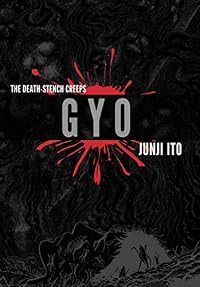
Gyo (Deluxe Edition)
by Junji Itō
Gyo (Collections and Selections — Omnibus 1-2), Junji Ito Story Collection
On This Page
Description
"The floating smell of death hangs over the island. What is it? A strange, legged fish appears on the scene ... So begins Tadashi and Kaori's spiral into the horror and stench of the sea. Here is the creepiest masterpiece of horror manga ever from the creator of Uzumaki, Junji Ito. Hold your breath until all is revealed. Something's rotten in Okinawa"--Tags
Recommendations
























Member Reviews
MUAHAHAHAHAHAHA!
Junji Ito is a MASTER of B-level gross-out horror. Of course, this is manga, and extremely simple in characterization, but that DOES NOT MATTER AT ALL.
We go from a fish -- with legs -- and a horrible stink freaking out a young couple... all the way to THE END OF THE WORLD.
Yep. Two volumes. Gross-out-horror. Over-the-top. FREAKISHLY delightful.
You remember those classic B-Movie horrors from the fifties? Do you wish you could forget them? Or how about if you could kick all the censors out the door and take any particular nasty idea and run with it, leaving no perversity unexplored, until all you have is a farting, walking mass of the undead controlled by *spoiler* *spoiler* *spoiler*.
MUAHAHAHAHAHAHA
A perfect halloween show more gross-out read. show less
Junji Ito is a MASTER of B-level gross-out horror. Of course, this is manga, and extremely simple in characterization, but that DOES NOT MATTER AT ALL.
We go from a fish -- with legs -- and a horrible stink freaking out a young couple... all the way to THE END OF THE WORLD.
Yep. Two volumes. Gross-out-horror. Over-the-top. FREAKISHLY delightful.
You remember those classic B-Movie horrors from the fifties? Do you wish you could forget them? Or how about if you could kick all the censors out the door and take any particular nasty idea and run with it, leaving no perversity unexplored, until all you have is a farting, walking mass of the undead controlled by *spoiler* *spoiler* *spoiler*.
MUAHAHAHAHAHAHA
A perfect halloween show more gross-out read. show less
I read this a long time ago in a serialized or two-volume format, but when I saw this new one-volume edition at the library, I could not resist the opportunity to read it again. This is Junji Ito at his twisted, creepy best. The story doesn't make a whole lot of sense, but the mecha-zombie imagery will haunt you forever. And as a bonus, this volume includes his best short story, "The Enigma of Amigara Fault," a ghastly tale of dread and compulsion, crime and punishment, guilt and torture.
Starts off slow with fishes scurrying around like cockroaches, but then absolutely horrifies with a shark on land. But that's just the beginning, with the story really taking off later when the creatures invade Japan. It gets more and more horrifying and disgusting (more the latter, I think) until the end. Loved the exploration of phobias, commitments, and human cruelty.
Another Ito classic. Can't go wrong with this.
Another Ito classic. Can't go wrong with this.
Gyo: The Death-Stench Creeps is a short, two-volume horror manga series created by Junji Ito. Originally published in Japan in 2002, Gyo has had several English-language releases by Viz Media. It was first translated between 2003 and 2004, a slightly updated second edition was released between 2007 and 2008, and most recently, published in 2015, was the deluxe hardcover omnibus. In addition to Gyo, the omnibus also collects two of Ito's short horror manga: "The Sad Tale of the Principal Post" and "The Enigma of Amigara Fault." The deluxe edition of Gyo is very similar in design to the recent omnibus of Ito's manga Uzumaki; the two volumes look great on the shelf together. Uzumaki was actually my introduction to Ito's work, and I show more consider it to be one of the best horror manga that I've read. Despite Gyo having been released in English three times, and despite the fact that I've been meaning to read more of Ito's manga, the series' deluxe omnibus is actually the first that I've read since Uzumaki.
While vacationing in Okinawa, Tadashi and his girlfriend Kaori witness the harbinger of what will eventually become a plague overrunning the entirety of Japan—a small, rotting fish walking on land with what appear to be mechanical legs. Accompanying it is an overwhelming and nauseating stench. Soon, countless fish and other sea creatures begin streaming out of the ocean. The only things that they have in common are the bizarre appendages and the sickening smell. Kaori and Tadashi cut their vacation short and return to Tokyo, but Kaori in particular is traumatized by the events in Okinawa and soon the creatures begin to be found in the city as well. No one knows where the walking fish originated or how they evolved; of much greater concern is the death and disease caused by their presence on land. And things are only getting worse with the passage of time.
The back cover of the omnibus describes Gyo as Ito's "creepiest masterpiece of horror manga ever." Admittedly, some of the artwork in Gyo is fantastically creepy, not to mention gruesome and grotesque. Ito is an extremely skilled illustrator, creating images that are horrifying and nightmare-inducing. And as a whole, Gyo can be exceptionally gross. However, the manga's story ends up being so utterly ridiculous that I would be hard pressed to call it a masterpiece, especially when compared to his earlier work Uzumaki. Whereas Uzumaki is surreal and bizarre, Gyo is so absurd as to be ludicrous, and only increasingly so as the manga progresses. I simply can't take Gyo seriously; I can only read the series as a comedy, whether or not it is actually intended as such. The manga is perhaps closer to being a cult classic, which I suppose might make it a masterpiece of a different sort, but that's something that could be argued either way. If nothing else, though, Gyo is a brilliantly outrageous spectacle.
Gyo is certainly not a manga that will appeal to every reader, even those who are already fans of horror manga. Though disconcerting and disgusting, especially the illustrations, the plot of Gyo is too silly to be truly terrifying. Taken alone, the art is superb, but the ridiculous nature of the story creates a weird disconnect. However, I can't deny that I was entertained by the progressively over-the-top, illogical, and random developments in the manga: sentient gas, a circus out of the middle of nowhere, characters who are oddly oblivious or overly accepting of what is going on around them, and so on. (Though, it is rather sweet how Tadashi sticks beside Kaori through to the very end.) Assuming that one can find it palatable to begin with, Gyo is a very strange manga that is difficult to look away from as Ito presses further and further into territory that is beyond believing. I kept turning the pages to see just how far he would be able to take things. Gyo may very well be one of those manga that's so good simply because it's so bad; whether that's deliberate or not, I'm not sure.
Experiments in Manga show less
While vacationing in Okinawa, Tadashi and his girlfriend Kaori witness the harbinger of what will eventually become a plague overrunning the entirety of Japan—a small, rotting fish walking on land with what appear to be mechanical legs. Accompanying it is an overwhelming and nauseating stench. Soon, countless fish and other sea creatures begin streaming out of the ocean. The only things that they have in common are the bizarre appendages and the sickening smell. Kaori and Tadashi cut their vacation short and return to Tokyo, but Kaori in particular is traumatized by the events in Okinawa and soon the creatures begin to be found in the city as well. No one knows where the walking fish originated or how they evolved; of much greater concern is the death and disease caused by their presence on land. And things are only getting worse with the passage of time.
The back cover of the omnibus describes Gyo as Ito's "creepiest masterpiece of horror manga ever." Admittedly, some of the artwork in Gyo is fantastically creepy, not to mention gruesome and grotesque. Ito is an extremely skilled illustrator, creating images that are horrifying and nightmare-inducing. And as a whole, Gyo can be exceptionally gross. However, the manga's story ends up being so utterly ridiculous that I would be hard pressed to call it a masterpiece, especially when compared to his earlier work Uzumaki. Whereas Uzumaki is surreal and bizarre, Gyo is so absurd as to be ludicrous, and only increasingly so as the manga progresses. I simply can't take Gyo seriously; I can only read the series as a comedy, whether or not it is actually intended as such. The manga is perhaps closer to being a cult classic, which I suppose might make it a masterpiece of a different sort, but that's something that could be argued either way. If nothing else, though, Gyo is a brilliantly outrageous spectacle.
Gyo is certainly not a manga that will appeal to every reader, even those who are already fans of horror manga. Though disconcerting and disgusting, especially the illustrations, the plot of Gyo is too silly to be truly terrifying. Taken alone, the art is superb, but the ridiculous nature of the story creates a weird disconnect. However, I can't deny that I was entertained by the progressively over-the-top, illogical, and random developments in the manga: sentient gas, a circus out of the middle of nowhere, characters who are oddly oblivious or overly accepting of what is going on around them, and so on. (Though, it is rather sweet how Tadashi sticks beside Kaori through to the very end.) Assuming that one can find it palatable to begin with, Gyo is a very strange manga that is difficult to look away from as Ito presses further and further into territory that is beyond believing. I kept turning the pages to see just how far he would be able to take things. Gyo may very well be one of those manga that's so good simply because it's so bad; whether that's deliberate or not, I'm not sure.
Experiments in Manga show less
Definitely does not disappoint. The art was good and gruesome and the story was weird, creepy, and admittedly a little funny. I definitely would recommend this book to those who have a taste for bizarre horror stories.
Fisherman find an odd fish in their nets, but it scurries away back into the ocean. Tadashi and his girlfriend Kaori arrive at his uncle's beach home to have a relaxing vacation with swimming and scuba diving. It doesn't go as planned when they find a horrible smelling fish with crab-like legs walk out of the water and attack them. Tadashi seals it in a bag and leaves it outside, but it escapes. They return to Tokyo, find that same fish, and discover that it's not an isolated problem.
Gyo is another installment of surreal horror from Junji Ito. Tadashi and Kaori become entrenched and almost haunted by this disgusting walking fish problem. Their relationship before the incident isn't really seen, but it grows more and more strained as the show more fish follow them and invade Japan. Tadashi is a typical young man, but Kaori is reduced to a flat, annoying character. This was the most disappointing aspect of the story. Literally 90% of her dialogue is complaining about the rotten smell coming from the fish, screaming at Tadashi, or being jealous whenever he's around any other women. The difference between their characters is troubling especially what later happens to Kaori.
The problem starts with one walking fish that floats to Tokyo in its sealed bag. Soon Okinawa is completely innundated by wakling ocean life of all kinds. Sharks, octopi, squid, and all manner of fish are walking around, attacking people. Then it spreads to Tokyo and all of Japan. Tadashi's uncle discovers that the legs are actually machinery that latches onto the creature working in conjuction with a contagion that makes them release gas from all orifices. The machinery hooks tubing into those orifices, making the creatures gas power the legs. The fish are actually dead from their time on land and the machinery turns to humans once the fish are useless, bloating them with the contagion and turning them into automatons.
Gyo has many of the staples of Ito horror, but it's the weakest of his stories for me. The disease apparently starts to produce its own machinery and that's why basically all the fish in the sea have legs. This concept tries to be scientific and it's ludicruous. I prefer when he stays in the supernatural that doesn't need explanation. This technology is defunct and left over from World War II, commenting on the Japanese involvement during the war and its effect on the world. It doesn't make the concept any more coherent or less absurd. Though it all, Gyo is a compelling read that has some of the most memorable, gross, and absurd horror I've ever seen. show less
Gyo is another installment of surreal horror from Junji Ito. Tadashi and Kaori become entrenched and almost haunted by this disgusting walking fish problem. Their relationship before the incident isn't really seen, but it grows more and more strained as the show more fish follow them and invade Japan. Tadashi is a typical young man, but Kaori is reduced to a flat, annoying character. This was the most disappointing aspect of the story. Literally 90% of her dialogue is complaining about the rotten smell coming from the fish, screaming at Tadashi, or being jealous whenever he's around any other women. The difference between their characters is troubling especially what later happens to Kaori.
The problem starts with one walking fish that floats to Tokyo in its sealed bag. Soon Okinawa is completely innundated by wakling ocean life of all kinds. Sharks, octopi, squid, and all manner of fish are walking around, attacking people. Then it spreads to Tokyo and all of Japan. Tadashi's uncle discovers that the legs are actually machinery that latches onto the creature working in conjuction with a contagion that makes them release gas from all orifices. The machinery hooks tubing into those orifices, making the creatures gas power the legs. The fish are actually dead from their time on land and the machinery turns to humans once the fish are useless, bloating them with the contagion and turning them into automatons.
Gyo has many of the staples of Ito horror, but it's the weakest of his stories for me. The disease apparently starts to produce its own machinery and that's why basically all the fish in the sea have legs. This concept tries to be scientific and it's ludicruous. I prefer when he stays in the supernatural that doesn't need explanation. This technology is defunct and left over from World War II, commenting on the Japanese involvement during the war and its effect on the world. It doesn't make the concept any more coherent or less absurd. Though it all, Gyo is a compelling read that has some of the most memorable, gross, and absurd horror I've ever seen. show less
A diver's strange encounter in the ocean is followed up by strange (and smelly) encounters on land. This grossout horror manga is shorter and not as good as Uzumaki but takes its concept to kooky places. And it's more disturbing in these times of pandemic and climate change.
Members
- Recently Added By
Lists

70 of the Best Horror Comics
178 works; 5 members

Books Read in 2021
5,361 works; 114 members
Author Information

238+ Works 18,769 Members
Series


Work Relationships
Is contained in
Contains
Common Knowledge
- Canonical title
- Gyo (Deluxe Edition) (Deluxe Edition)
- Original publication date
- 2002
- People/Characters
- Tadashi; Kaori Sawahara; Dr. Koyanagi; Ms. Yoshiyama; Owaki; Yoshida (show all 7); Nakagaki
- Important places
- Okinawa, Japan; Tokyo, Japan; Amigara Mountain, Japan
- Original language
- Japan
Classifications
- Genres
- Horror, Graphic Novels & Comics
- DDC/MDS
- 741.5952 — Arts & recreation Drawing & decorative arts Drawing and drawings Comic books, graphic novels, fotonovelas, cartoons, caricatures, comic strips History, geographic treatment, biography Asian Japanese
- LCC
- PN6790 .J33 .I85813 — Language and Literature Literature (General) Literature (General) Collections of general literature Comic books, strips, etc.
- BISAC
Statistics
- Members
- 1,126
- Popularity
- 22,333
- Reviews
- 21
- Rating
- (3.74)
- Languages
- 6 — English, French, German, Italian, Spanish, Turkish
- Media
- Paper, Ebook
- ISBNs
- 11
- ASINs
- 2