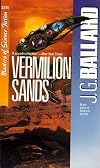
Vermilion Sands
by J. G. Ballard
On This Page
Description
VERMILION SANDS is J. G. Ballard's fantasy landscape of the future. . . a latterday Palm Springs populated by forgotten movie queens, temperemental dilettantes and drugged beachcombers, with prima donna plants that sing arias, cloud sculptures, dial-a poem computer and ravishing, jewel-eyed Jezebels. . . This novel is to be adapted for a three part BBC series.Tags
Recommendations
























Member Reviews
A fantastic collection of short stories all linked to an imaginary town of the future; Vermillion Sands, published in 1971. In my opinion this rivals some of the best collections that hover between science fiction and fantasy and my immediate benchmark was Ray Bradbury's Martian Chronicles. In these collections the dream like quality of the environment is the linking factor and as such becomes the most important element in the stories. Vermillion Sands is surrounded by sand lakes, reefs and sand spires, there is no water but thermal waves create thermal surf that invades the town that is in a state of genteel decline:
"The sand lake shimmered in the thermal gradients like an immense pool of sluggish wax"
"The beach houses jutted among show more the dunes and the fused surface of the lake in which so many objects were embedded."
"Again last night, as the dusk air moved across the desert from Vermillion Sands. I saw the faint shiver of rigging among the reefs, a topmast moving like a silver lantern through the rock spires. Watching from the veranda of my beach house, I followed its course towards the open sand sea, and saw spectral sails in this spectral ship."
Vermillion Sands is slowly sinking into the desert, many of the beach houses have been abandoned, but a few inhabitants remain and there is still a thriving artists colony and tourists arrive in the season. Films are made there, various artisans are still creating the singing statues, that haunt the dunes, psychotropic houses shape themselves to the mood and feeling of their inhabitants, Clothes are also psychotropic, poetry is created by artificial intelligence and paint creates its own pictures. As J G Ballard says in his preface to these stories; Vermillion Sands is a place in the future where no-one has to work, but that work is the ultimate play and play is the ultimate work.
Many of the stories feature a femme fatale who are curiously alike in appearance, typically they are white faced with features that are mask like. They are like many of the inhabitants of Vermillion Sands rich and elegant with a dream like quality, some are artists and all have an attraction for the principle male character who tells the story in the first person. The attraction is not always romantic, in Venus Smiles Lorraine Drexler is a sculptor and creator who makes the singing statue and her latest statue is to be placed in the town square, however the music coming forth is hideous and the narrator agrees to take it back to his own garden, where it grows creating more and more sonic modules. In Studio 5, the stars, Aurora Day forces the editors of monthly journals to print real poetry written by poets, rather than those churned out by computer. Femme fatales they might be, but their forceful presence and psychological profile often allows them to come out on top.
There are nine stories and a short preface by the author, which were written over a fourteen year period. Prima Belladonna was Ballard's first published short story in 1956 and he says his creation of Vermillion Sands never left him and so more stories followed. There is not a weak story among them and they get off with a terrific start with The Cloud-Sculptors of Coral D. Three glider pilots discover a new art form where spraying clouds with silver iodide allows them to sculpt the clouds. They come to grief when a rich female ex-film star hires them to perform at her garden party where they must compete to create the perfect cloud form of the face of the actress. It is Ballard's vision of the slightly melancholic world of Vermillion Sands where new technologies have enabled characters to indulge their psychological traits. It is a future world that is a kind of caricature of the world of the the mid twentieth century, albeit where everyone can sit back and drink their cocktails. An indulgent world it might be but I enjoyed the atmosphere that Ballard brings into effect and so 5 stars. show less
"The sand lake shimmered in the thermal gradients like an immense pool of sluggish wax"
"The beach houses jutted among show more the dunes and the fused surface of the lake in which so many objects were embedded."
"Again last night, as the dusk air moved across the desert from Vermillion Sands. I saw the faint shiver of rigging among the reefs, a topmast moving like a silver lantern through the rock spires. Watching from the veranda of my beach house, I followed its course towards the open sand sea, and saw spectral sails in this spectral ship."
Vermillion Sands is slowly sinking into the desert, many of the beach houses have been abandoned, but a few inhabitants remain and there is still a thriving artists colony and tourists arrive in the season. Films are made there, various artisans are still creating the singing statues, that haunt the dunes, psychotropic houses shape themselves to the mood and feeling of their inhabitants, Clothes are also psychotropic, poetry is created by artificial intelligence and paint creates its own pictures. As J G Ballard says in his preface to these stories; Vermillion Sands is a place in the future where no-one has to work, but that work is the ultimate play and play is the ultimate work.
Many of the stories feature a femme fatale who are curiously alike in appearance, typically they are white faced with features that are mask like. They are like many of the inhabitants of Vermillion Sands rich and elegant with a dream like quality, some are artists and all have an attraction for the principle male character who tells the story in the first person. The attraction is not always romantic, in Venus Smiles Lorraine Drexler is a sculptor and creator who makes the singing statue and her latest statue is to be placed in the town square, however the music coming forth is hideous and the narrator agrees to take it back to his own garden, where it grows creating more and more sonic modules. In Studio 5, the stars, Aurora Day forces the editors of monthly journals to print real poetry written by poets, rather than those churned out by computer. Femme fatales they might be, but their forceful presence and psychological profile often allows them to come out on top.
There are nine stories and a short preface by the author, which were written over a fourteen year period. Prima Belladonna was Ballard's first published short story in 1956 and he says his creation of Vermillion Sands never left him and so more stories followed. There is not a weak story among them and they get off with a terrific start with The Cloud-Sculptors of Coral D. Three glider pilots discover a new art form where spraying clouds with silver iodide allows them to sculpt the clouds. They come to grief when a rich female ex-film star hires them to perform at her garden party where they must compete to create the perfect cloud form of the face of the actress. It is Ballard's vision of the slightly melancholic world of Vermillion Sands where new technologies have enabled characters to indulge their psychological traits. It is a future world that is a kind of caricature of the world of the the mid twentieth century, albeit where everyone can sit back and drink their cocktails. An indulgent world it might be but I enjoyed the atmosphere that Ballard brings into effect and so 5 stars. show less
This is Ballard amped up to eleven. The surreal here is worn like a badge. Direct reference is made throughout to his most obvious touchpoint - Dali. Repetition defines this collection. The same riffs, images, even scenarios, recur; seemingly to cement the impression that Vermilion Sands is self-perpetuating. Latent urges manifest themselves in the physical world. Clothes reveal the inner psyche, sonic sculptures replay voices which mean nothing and everything, and the fabric of the living spaces warps and twists to reflect distilled memory and untapped appetites.
The women whose focus these stories are almost exclusively upon are unknowable creatures driven by selfish desires; duplicitous, and either neurotic or manipulative, or both. show more This is the male gaze reduced to the raw. There is something mesmeric about the cartoonish manner with which these characters are drawn, as if to accentuate the altered state underpinning the materializing subconscious landscape. I’m reminded of a PS3 game called Deadly Premonition which is similarly episodic and repeats itself endlessly. Made by someone obsessed with Twin Peaks, but getting things just a little off, it includes sadistic and voyeuristic killings of women which I should find appalling. There is, however, a very real sense of unease in the male anima which warrants addressing. This is echoed throughout Vermilion Sands. This collection could be viewed as misogynistic but I think that over simplifies what is happening here. The reality on offer here is a construct, a canvas for the male relator. It is from him these vacuous beings emerge, and like everything created in this world they are a telegram from the soul.
Vermilion Sands is ultimately defined by it’s borders and limitations. As a collection it most probably would have made a better novel, but pick any one story and it’s an endless feast. There is a road from this place and I imagine those who leave to reach the outer limits and dissolve into the paint soaked ether. show less
The women whose focus these stories are almost exclusively upon are unknowable creatures driven by selfish desires; duplicitous, and either neurotic or manipulative, or both. show more This is the male gaze reduced to the raw. There is something mesmeric about the cartoonish manner with which these characters are drawn, as if to accentuate the altered state underpinning the materializing subconscious landscape. I’m reminded of a PS3 game called Deadly Premonition which is similarly episodic and repeats itself endlessly. Made by someone obsessed with Twin Peaks, but getting things just a little off, it includes sadistic and voyeuristic killings of women which I should find appalling. There is, however, a very real sense of unease in the male anima which warrants addressing. This is echoed throughout Vermilion Sands. This collection could be viewed as misogynistic but I think that over simplifies what is happening here. The reality on offer here is a construct, a canvas for the male relator. It is from him these vacuous beings emerge, and like everything created in this world they are a telegram from the soul.
Vermilion Sands is ultimately defined by it’s borders and limitations. As a collection it most probably would have made a better novel, but pick any one story and it’s an endless feast. There is a road from this place and I imagine those who leave to reach the outer limits and dissolve into the paint soaked ether. show less
No one worked the crumbling outskirts of failing futuristic utopias better than Ballard. The stories in this collection, written between 1956 and 1970, all take place in or around a partially abandoned desert resort called Vermillion Sands, where clouds are carved to shape with biplanes and chemical sprays, sand-rays swoop and glide in the wake of rumbling desert schooners and rock formations pulsate in tune with the moods of passersby. Ballard was a genius at evoking sound and light, and imagining conventional cultural arts—sculpture, music, architecture—augmented by odd technologies. He made mundane, familiar spaces feel fantastical and strange, like hallucinations you haven’t had yet.
The stories in this volume largely follow a format, as if they were musical variations on a theme. The stories all concern a languishing desert resort area in the future for artists and their wealthy patrons -Vermillion Sands. Each story is a first person recollection of a given narrator's stay in Vermillion Sands, and a specific, usually disasterous turn of events that involves an enchanting, more than likely psychotic femme fatale. The fantastic environment of the stories is filled with singing plants and sculptures, flying stingrays, intelligent, mood stimulated dwellings and clothing. It all feels very Helmut Newton, but in a good way. Beautifully written stuff, full of imagery that stays with you after you've put the book down.
***1/2
***1/2
Now this was an interesting short story collection - definitely something a little different from what I am used to (not that I exactly have an expansive background in reading vintage scifi - haha).
All of them revolve around Vermillion Sands a resort the rich, famous and eccentric populated in it's heyday. Fully automated and full of fantastic retro-future themes and tech with everything being "psychotropic" being the main theme (houses, plants, clothes and whatnot! crazy stuff) - which means the stuff was affected/formed/reacted by/to human thoughts, emotions and feelings. The stories are written in the era of "The Recess" (or post-Depression economically) so there is the feeling of "trying to relive the lost glory days" and stagnant show more decadance throughout. A bulk of the stories involved the mixing eccentric personalities with psychotropic tech resulting in some pretty gnarly situations - a bit creepy too when some of the more negative emotions crop up.
To be honest - the impression that I was left with was an overall tone that reminded me of those TCM noir classic movies where most of the female characters were faded heiresses, film stars and the like (Sunset Boulevard 1950 comes to mind) and all the lead males pretty much reminded me of TCM male characters too (IIRC all the POVs were males). Anyhow - I enjoy noir/classic movies. It's one of my "guilty pleasures" (is that the right term? I was pretty miffed when my cable provider dropped TCM but now I have Netflix so I can always check the classic movies there) so I pretty much liked the theme.
Anyhow - in short - if the thought of a retro future sci-fi TCM classic movie noir overall feel/mesh appeals to you then I would highly recommend giving this tome a whirl.
Solid 4.
Favourites: "Studio 5, The Stars" - because poets. "Prima Belladona" - because I like the idea of having/tending lots of plants despite my black-thumb.
Meh (i.e. didn't find really appealing): "Cry Hope! Cry Fury!"
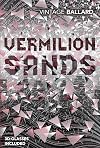
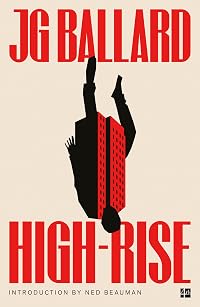
Source: Bought off MPH online - I was actually purchasing Ballard's "High Rise" (the movie cover is awesome :p - I don't usually like movie covers haha) and was checking to see if they had any other Ballard titles and they had this one! Didn't have a cover image and I didn't bother to check and was pleasantly surprised to find out it's part of the Vintage Futures series - with nifty psychedelic art which you can "animate" via a lenticular plate provided with the book. I really want to get more Ballard titles. Especially after I found out that he wrote "Empire of the Sun" - that is like one of my childhood movies (repeated reruns on tv - HAHA).
First review draft posted: 11feb2017 show less
All of them revolve around Vermillion Sands a resort the rich, famous and eccentric populated in it's heyday. Fully automated and full of fantastic retro-future themes and tech with everything being "psychotropic" being the main theme (houses, plants, clothes and whatnot! crazy stuff) - which means the stuff was affected/formed/reacted by/to human thoughts, emotions and feelings. The stories are written in the era of "The Recess" (or post-Depression economically) so there is the feeling of "trying to relive the lost glory days" and stagnant show more decadance throughout. A bulk of the stories involved the mixing eccentric personalities with psychotropic tech resulting in some pretty gnarly situations - a bit creepy too when some of the more negative emotions crop up.
To be honest - the impression that I was left with was an overall tone that reminded me of those TCM noir classic movies where most of the female characters were faded heiresses, film stars and the like (Sunset Boulevard 1950 comes to mind) and all the lead males pretty much reminded me of TCM male characters too (IIRC all the POVs were males). Anyhow - I enjoy noir/classic movies. It's one of my "guilty pleasures" (is that the right term? I was pretty miffed when my cable provider dropped TCM but now I have Netflix so I can always check the classic movies there) so I pretty much liked the theme.
Anyhow - in short - if the thought of a retro future sci-fi TCM classic movie noir overall feel/mesh appeals to you then I would highly recommend giving this tome a whirl.
Solid 4.
Favourites: "Studio 5, The Stars" - because poets. "Prima Belladona" - because I like the idea of having/tending lots of plants despite my black-thumb.
Meh (i.e. didn't find really appealing): "Cry Hope! Cry Fury!"
Source: Bought off MPH online - I was actually purchasing Ballard's "High Rise" (the movie cover is awesome :p - I don't usually like movie covers haha) and was checking to see if they had any other Ballard titles and they had this one! Didn't have a cover image and I didn't bother to check and was pleasantly surprised to find out it's part of the Vintage Futures series - with nifty psychedelic art which you can "animate" via a lenticular plate provided with the book. I really want to get more Ballard titles. Especially after I found out that he wrote "Empire of the Sun" - that is like one of my childhood movies (repeated reruns on tv - HAHA).
First review draft posted: 11feb2017 show less
‘Vermilion Sands’, de J.G. Ballard, recoge nueve relatos escritos entre 1956 y 1970. Todos están ambientados en el sugerente lugar del título, una ciudad de vacaciones para famosos, artistas y cineastas, un lugar onírico, casi una quimera. Se trata de una ciudad y una geografía salidas de la mente de Ballard, donde existen mares de arena navegados por barcos con ruedas, arrecifes de piedra y rayas que vuelan por dichos mares. A lo largo de las páginas de esta antología, nos encontraremos con más maravillas, como ropas vivas y casas psicotrópicas que absorben las emociones de sus inquilinos.
Estos son los nueve relatos incluidos:
-Los escultores de nubes de Coral D.
-Prima Belladonna.
-El juego de los biombos.
-Las estatuas show more cantantes.
-Grito de esperanza, grito de furia.
-Venus sonríe.
-Dile adiós al viento.
-Estudio 5, Las Estrellas.
-Los mil sueños de Stellavista.
Sin duda, un libro fascinante. show less
Estos son los nueve relatos incluidos:
-Los escultores de nubes de Coral D.
-Prima Belladonna.
-El juego de los biombos.
-Las estatuas show more cantantes.
-Grito de esperanza, grito de furia.
-Venus sonríe.
-Dile adiós al viento.
-Estudio 5, Las Estrellas.
-Los mil sueños de Stellavista.
Sin duda, un libro fascinante. show less
I remember this as Ballard's most surreal collection. Every story in it is also in another collection. That's probably an indication that Ballard &/or his publishers think that it's some of his finest stuff. I agree. However, this is one of many instances where I wish GoodReads had at least a 10 star rating system because I don't really equate anything of Ballard's w/, say, James Joyce's "Finnegans Wake" but giving it a 3 or a 4 doesn't seem like enuf.
Members
- Recently Added By
Lists

The 5 Parsec Shelf
50 works; 7 members

A Rainbow of Books: Colors in the Title
570 works; 24 members

Les 100 principaux titres de la science-fiction (1981)
126 works; 3 members
Author Information

291+ Works 37,728 Members
J. G. Ballard was born to British parents in Shanghai, China on November 15, 1930. While a child during World War II, he spent four years in a Japanese POW camp. This experience was the basis for the emotionally moving novel Empire of the Sun, which he adapted into a successful movie, directed by Steven Spielberg. Before becoming a full-time show more writer, he studied medicine at Cambridge University and served as a pilot in the British Royal Air Force. Ballard is best known for his science fiction writings. His early works were heavily influenced by surrealism. Most of his novels deal with death and destruction of the human spirit. Novels such as Crash, Concrete Island, and High Rise portray a society that is devolving into barbaric chaos. Crash was made into a movie by David Cronenberg in 1996. The Drowned World describes an apocalyptic society, with a hero that ushers in the destruction of the world. His novel Empire of the Sun was shortlisted for the Booker Prize and awarded the Guardian Fiction Prize and James Tait Black Memorial Prize for fiction. Empire of the Sun was filmed by Steven Spielberg in 1987, starring a young Christian Bale as Jim (Ballard). Ballard moved away from science fiction, but he is still considered one of the leading authors of the genre. He died on April 19, 2009 at the age of 78. (Bowker Author Biography) show less
Awards and Honors
Awards
Series
Belongs to Publisher Series
Work Relationships
Is contained in
Common Knowledge
- Canonical title
- Vermilion Sands
- Original title
- Vermilion Sands
- Original publication date
- 1971
- Original language
- English
- Disambiguation notice*
- Nicht identisch mit http://www.librarything.de/work/63421...
*Some information comes from Common Knowledge in other languages. Click "Edit" for more information.
Classifications
Statistics
- Members
- 590
- Popularity
- 49,737
- Reviews
- 13
- Rating
- (3.96)
- Languages
- 10 — Dutch, English, French, German, Italian, Japanese, Norwegian (Bokmål), Norwegian, Spanish, Turkish
- Media
- Paper, Ebook
- ISBNs
- 18
- ASINs
- 10