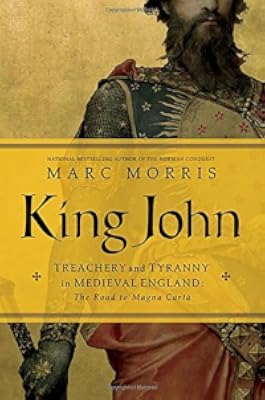
King John : treachery, tyranny and the road to Magna Carta
by Marc Morris
On This Page
Description
King John is one of those historical characters who needs little in the way of introduction. If readers are not already familiar with him as the tyrant whose misgovernment gave rise to Magna Carta, we remember him as the villain in the stories of Robin Hood. Formidable and cunning, but also cruel, lecherous, treacherous and untrusting. Twelve years into his reign, John was regarded as a powerful king within the British Isles. But despite this immense early success, when he finally crosses to show more France to recover his lost empire, he meets with disaster. John returns home penniless to face a tide of criticism about his unjust rule. The result is Magna Carta - a ground-breaking document in posterity, but a worthless piece of parchment in 1215, since John had no intention of honoring it. Like all great tragedies, the world can only be put to rights by the tyrant's death. John finally obliges at Newark Castle in October 1216, dying of dysentery as a great gale howls up the valley of the Trent. show lessTags
Recommendations









Member Reviews
King John is most famous in popular culture as a bad guy in Robin Hood movies (although the Robin Hood tales weren’t written down until hundreds of years after John) and as the king who was forced to sign the Magna Carta. According to this scholarly yet readable biography by historian Marc Morris, John really was pretty unpleasant; he seems to have been personally cowardly, fleeing from battles; he is reputed to have personally murdered his nephew Arthur to gain the throne; and he could be viciously cruel; his favorite execution method seems to have been starvation – simply locking enemies in a cell and leaving them there. In a particularly ugly case, he imprisoned the noblewoman Matilda de Briouze (aka Maud de Braose, if you’re show more googling) and her son William together; when the cell was eventually opened it was found Matilda had eaten her son’s face before dying herself.
John proved craftily devious. In 1207, he demanded one tenth the value of all loans by Jews; debtors who had been carried on the books for years now suddenly found the Exchequer demanding immediate payment – with royal power has enforcement. In 1213, beset by rebellious nobles, he made England a fief of the Papacy and did homage for it – meaning that rebels against John were also rebels against the Holy See and could be excommunicated.
He started his reign as the most powerful monarch in Europe, controlling land from the Scots border across the Channel to the Pyrenees, plus the east coast of Ireland; by alienating his nobles and his own military incompetence he’d lost almost all his continental holdings before his death.
Morris notes there is a lot more information about John than about earlier English rulers, since it was under his reign that the Chancery Office began keeping and storing duplicate copies of records. This is an easy read, well referenced and footnoted. Maps of England, Ireland, and Angevin France; a family tree; and other appropriate illustrations. My only mild criticism is Morris jumps around chronologically at the beginning; chapter’s start dates go from 1203 to 1120 to 1204 to 1189 to 1205 to 1194 to 1207 to 1202, but the last chapters are in sequence from 1208 to 1216. I found this a little confusing at first. The index seems sparse; I had trouble finding some things I wanted to look up. This is just minor nitpicking, though; I found the book educational and entertaining. show less
John proved craftily devious. In 1207, he demanded one tenth the value of all loans by Jews; debtors who had been carried on the books for years now suddenly found the Exchequer demanding immediate payment – with royal power has enforcement. In 1213, beset by rebellious nobles, he made England a fief of the Papacy and did homage for it – meaning that rebels against John were also rebels against the Holy See and could be excommunicated.
He started his reign as the most powerful monarch in Europe, controlling land from the Scots border across the Channel to the Pyrenees, plus the east coast of Ireland; by alienating his nobles and his own military incompetence he’d lost almost all his continental holdings before his death.
Morris notes there is a lot more information about John than about earlier English rulers, since it was under his reign that the Chancery Office began keeping and storing duplicate copies of records. This is an easy read, well referenced and footnoted. Maps of England, Ireland, and Angevin France; a family tree; and other appropriate illustrations. My only mild criticism is Morris jumps around chronologically at the beginning; chapter’s start dates go from 1203 to 1120 to 1204 to 1189 to 1205 to 1194 to 1207 to 1202, but the last chapters are in sequence from 1208 to 1216. I found this a little confusing at first. The index seems sparse; I had trouble finding some things I wanted to look up. This is just minor nitpicking, though; I found the book educational and entertaining. show less
I knew a little about King John from old movies, the disgruntled usurper who had to face his brother, Richard the Lionhearted, when Richard returned from captivity after returning from Crusade, who was eventually forced to sign the Magna Carta by rebellious nobles. In preparation for a trip to England, I decided it was time to learn more. In Marc Morris’ “King John” I found an avenue to its title subject as well as to the England and France of his day.
John was one of the kings “who never should have been king.” Born in 1166, the fourth son of Henry II, he appeared to be destined for a minor post until the deaths of his older brothers moved him up the line of succession. Succeeding his brother, King Richard I, in 1199, John show more embarked in a disastrous reign until his death in 1216. John presided over years of seemingly interminable dynastic and international warfare.
Author Marc Morris has crafted an intensively researched book. His writing style draws readers into trusting his conclusions and statements by supporting them with facts and logic. Instead of making bald assertions, Morris leads with “there is no good reason to believe” and “there are good reasons for supposing” followed by evidence that leads the reader to the author’s conclusion.
This work can be appreciated on at least two planes. One familiar with medieval England may revel in the dates, persons, events documented on these pages. Others, like me, who would be overwhelmed with minutiae, can benefit from a broader understanding of the era. In school I learned that dynastic states were influenced by consanguinity and marriages. The diplomacy and wars prosecuted by John were driven by an empire of England, Wales and what is now western France which his mother, Eleanor of Aquitaine, was instrumental in assembling and protecting. The concept that a king’s legacy may be divided among sons, rather than being passed exclusively through male primogeniture, perhaps necessitated by communication limitations, provides a contrast to modern times. The steps by which John lost his continental lands deepens my knowledge about how they were lost. I had understood that the barons were dissatisfied before the Magna Carta was promulgated, but I now know that they were in a state of rebellion and England in virtual civil war with French intervention. I now see the Charter more in the nature of a peace treaty than a political constitutional advance.
I recommend “King John” for Middle Ages students seeking an intense focus on John’s role and reign and for general readers desiring a broader appreciation of diplomatic and military history of the epoch.
I did receive a free copy of this book without an obligation to post a review. show less
John was one of the kings “who never should have been king.” Born in 1166, the fourth son of Henry II, he appeared to be destined for a minor post until the deaths of his older brothers moved him up the line of succession. Succeeding his brother, King Richard I, in 1199, John show more embarked in a disastrous reign until his death in 1216. John presided over years of seemingly interminable dynastic and international warfare.
Author Marc Morris has crafted an intensively researched book. His writing style draws readers into trusting his conclusions and statements by supporting them with facts and logic. Instead of making bald assertions, Morris leads with “there is no good reason to believe” and “there are good reasons for supposing” followed by evidence that leads the reader to the author’s conclusion.
This work can be appreciated on at least two planes. One familiar with medieval England may revel in the dates, persons, events documented on these pages. Others, like me, who would be overwhelmed with minutiae, can benefit from a broader understanding of the era. In school I learned that dynastic states were influenced by consanguinity and marriages. The diplomacy and wars prosecuted by John were driven by an empire of England, Wales and what is now western France which his mother, Eleanor of Aquitaine, was instrumental in assembling and protecting. The concept that a king’s legacy may be divided among sons, rather than being passed exclusively through male primogeniture, perhaps necessitated by communication limitations, provides a contrast to modern times. The steps by which John lost his continental lands deepens my knowledge about how they were lost. I had understood that the barons were dissatisfied before the Magna Carta was promulgated, but I now know that they were in a state of rebellion and England in virtual civil war with French intervention. I now see the Charter more in the nature of a peace treaty than a political constitutional advance.
I recommend “King John” for Middle Ages students seeking an intense focus on John’s role and reign and for general readers desiring a broader appreciation of diplomatic and military history of the epoch.
I did receive a free copy of this book without an obligation to post a review. show less
This book covers the life and reign of King John, the infamous king whose war with the barons brought about Magna Carta, one of the most celebrated documents in constitutional history, and certainly the most celebrated in English or British history. It is well written and researched; thanks to the preservation of most of the Pipe Rolls, we have far more written evidence of John's reign than we do of any of his predecessors, so it is possible to track his movements and activities in much more detail. That said, the book's structure is in my view flawed. Its first half switches between two narrative streams, one from 1203 which is a key turning point in the reign, the other recounting Angevin history and John's early life and the first show more few years of his reign, in alternate chapters. I found the author's rationale for this approach unconvincing and the result irritating and a bit confusing for recalling whether a particular incident I'd read about was before or after another such (hence it's not for me a five star book).
The book exposes well John's many flaws, while acknowledging his better points (though there are rather few of those). Some have said John was merely unlucky, though it seems very clear he was the author of most of his own misfortunes through his unnecessary provocation of those who might have been allies, his well founded lack of trustworthiness, pronounced treacherousness and extreme arbitrariness. Worse, in an age where kings were almost all, and arguably had to be, ruthless, John went further and many of his actions show a cold cruelty, in particular his policy of using deliberate starvation as a method of execution for some of his opponents and hostages. He was rapacious in extorting money from the whole population to fund his wars against the Scots, Welsh and Irish and his attempts to regain the Angevin empire he inherited and then lost within five years largely through his own ineptitude. His oppression of the church was such that England lay under a papal interdict for six years, with no marriage or burial services in consecrated ground able to be performed. Many of these injustices had been carried out in some instances by some of his predecessors, but John institutionalised them. It is small wonder that he was almost perpetually at war with his barons and knights. He tried to undermine Magna Carta almost as soon as he sealed it (to be fair, some of the barons didn't stick to what was agreed at Runnymede either). The barons invited Prince Louis, son of the French King Philip Augustus, to come and be their new king, and Louis conquered much of the south and was welcomed by Londoners. England came close to being ruled by the heir to the French throne; but then the situation was retrieved, ironically, by John's own death at the age of 49. The barons were unwilling to oppose and deny the birthright of John's infant son, Henry III, supported as regent by the indomitable William Marshal; within a year, England was at peace once more. A dark period of history was over. There were, of course, more trials and tribulations, and battles to come for justice and a system truly based on the rule of law, but the seeds had been sown. show less
The book exposes well John's many flaws, while acknowledging his better points (though there are rather few of those). Some have said John was merely unlucky, though it seems very clear he was the author of most of his own misfortunes through his unnecessary provocation of those who might have been allies, his well founded lack of trustworthiness, pronounced treacherousness and extreme arbitrariness. Worse, in an age where kings were almost all, and arguably had to be, ruthless, John went further and many of his actions show a cold cruelty, in particular his policy of using deliberate starvation as a method of execution for some of his opponents and hostages. He was rapacious in extorting money from the whole population to fund his wars against the Scots, Welsh and Irish and his attempts to regain the Angevin empire he inherited and then lost within five years largely through his own ineptitude. His oppression of the church was such that England lay under a papal interdict for six years, with no marriage or burial services in consecrated ground able to be performed. Many of these injustices had been carried out in some instances by some of his predecessors, but John institutionalised them. It is small wonder that he was almost perpetually at war with his barons and knights. He tried to undermine Magna Carta almost as soon as he sealed it (to be fair, some of the barons didn't stick to what was agreed at Runnymede either). The barons invited Prince Louis, son of the French King Philip Augustus, to come and be their new king, and Louis conquered much of the south and was welcomed by Londoners. England came close to being ruled by the heir to the French throne; but then the situation was retrieved, ironically, by John's own death at the age of 49. The barons were unwilling to oppose and deny the birthright of John's infant son, Henry III, supported as regent by the indomitable William Marshal; within a year, England was at peace once more. A dark period of history was over. There were, of course, more trials and tribulations, and battles to come for justice and a system truly based on the rule of law, but the seeds had been sown. show less
"King John was not a good man..." a poem by A.A. Milne is demonstrated by this biography. There is enough detail to convince this reader the judgement was correct. The childhood is covered in some detail, and the sad disfunctional family of Henry and Eleanor is clearly described. The financial pressures are laid bare, and the difficulties of ruling an England riven by the ambitions of the Magnates is also here. The continental picture is also reasonably delineated. The final good point is the full translation of Magna Carta. It is a worthy addition to your medieval library.
This book tells the story of King John in a slightly different way. It begins in 1203, which the author considers a turning point in John's reign, then sets up an alternating thread in which he discusses the circumstances leading up to John taking the throne. This thread includes Henry II and Richard, which may not be news to devote readers of all things Plantagenet. Morris writes well, but I think I've burned out on the Plantagenets; I returned this to the library unfinished. Still, I would not like to dissuade anyone who's interested in reading it.
One of the few lay books written entirely about King John, long held to be the worst King in British history, Morris tries and usually succeeds in being impartial. He has hundreds of footnotes, something I think textbooks should be forced to use. It is important when teaching or learning history to know where the writers got their information. Morris used the oldest known references, such as Roger Wendover, Coggeshall, and "Anonymous" of Bethune. If Marc Morris actually read all 226 of the tomes listed, it is really impressive.
While the information is the most important part of the book, Morris does write pretty well and it's readable.
Spoiler: King John was a pretty crap King after all.
While the information is the most important part of the book, Morris does write pretty well and it's readable.
Spoiler: King John was a pretty crap King after all.
Review to come.
Members
- Recently Added By
Lists

Library Non-Fiction
164 works; 1 member
Author Information

9+ Works 3,089 Members
Marc Morris is a historian specializing in the Middle Ages. He is also the author of A Great and Terrible King, King John, and the Wall Street Journal and USA Today bestselling The Norman Conquest. Marc lives in England.
Common Knowledge
- Canonical title
- King John : treachery, tyranny and the road to Magna Carta
- Original title
- King John : treachery, tyranny and the road to Magna Carta
- Alternate titles
- King John : treachery and tyranny in medieval England : the road to Magna Carta
- People/Characters
- John, King of England
- Important events
- Magna Carta
- Dedication
- To William
my treasure - First words
- In the summer of 1797 a group of workmen in Worcester Cathedral caused a sensation, locally if not nationally, by discovering the body of King John. (Introduction)
In 1203 King John was the ruler of a vast international empire.
The morning after John's death his body was prepared for burial. (Conclusion)
John, by the grace of God, king of England, lord of Ireland, duke of Normandy and Aquitane, count of Anjou, to the archbishops, bishops, abbots, earls, barons, justiciars, foresters, sheriffs, stewards, servants and all his o... (show all)fficial and faithful subjects greeting. (Magna Carta, 1215: A Translation) - Last words
- (Click to show. Warning: May contain spoilers.)That, therefore, is where we find John at the beginning of Chapter One. (Introduction)
(Click to show. Warning: May contain spoilers.)Instead he heard the dying man's confession, and administered the last rites.
(Click to show. Warning: May contain spoilers.)But his oppressions led to the creation of a document that ensured they would not be repeated, and which still symbolizes the rights of the subject against the power of a tyrant. (Conclusion)
(Click to show. Warning: May contain spoilers.)Given under our hand in the meadow which is called Runnymede between Windsor and Staines on the fifteenth day of June in the seventeenth year of our reign. (Magna Carta, 1215: A Translation) - Blurbers
- Childs, Jessie
Classifications
- Genres
- History, Nonfiction, Biography & Memoir, General Nonfiction
- DDC/MDS
- 942.033092 — History & geography History of Europe England and Wales England Plantagenet 1154-1399 John 1199-1216
- LCC
- DA208 .M68 — History of Europe, Asia, Africa and Oceania Great Britain History of Great Britain England History By period Early and medieval to 1485 1154-1485. Angevins. Plantagenets.
- BISAC
Statistics
- Members
- 289
- Popularity
- 111,702
- Reviews
- 7
- Rating
- (3.85)
- Languages
- English
- Media
- Paper, Audiobook, Ebook
- ISBNs
- 10
- ASINs
- 5