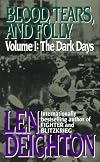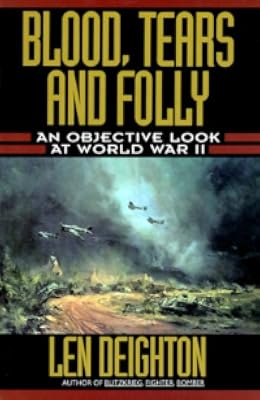
Blood, Tears and Folly: An Objective Look at World War II
by Len Deighton
On This Page
Description
Deighton explores and analyzes some of the myths and realities of the war, the mistakes and the achievements, the ironies and failures--of intelligence, technology, planning, and policies--of both the Allied and the Axis powers.Tags
Recommendations




















Member Reviews
To begin with an observation. This is not a history of the Second World War. It is rather an examination of many of the instances of mental myopia, wishful thinking and blind stupidity that cost both sides dearly in that conflict. Inevitably, to place these in context, there are large chunks of historical detail that form the greater part of the work. Moreover, it calls a halt in early 1942. This means both that the bulk of the work deals with the war between Britain and her Empire and the Axis and that the United States gets off pretty lightly. There is no mention, for example, of the bloodbath of Omaha beach, caused in large part by Bradley's refusal to accept British specialist armour, and the massacre of shipping off the American show more Eastern Seaboard, largely due to Admiral King's errors, receives only a passing mention in the summing up.
For that part of the war that the book does cover, Deighton bars no holds in his exposé of the mental deficiencies of the antagonists. It is a fine piece of historical analysis. Nevertheless, it loses one star in my rating for the number of silly errors of fact that creep in, errors that any reader with a good knowledge of the subject matter will immediately spot (as the editor should have done), and the rare occasions when he lets his prejudices get the better of him; the most striking example is in the account of the sinking of the Bismarck, when he accepts the idea that British gunfire failed to sink the battleship but then draws the conclusion that she sank because her crew scuttled her, ignoring the six or more very large torpedo holes that were calculated to be more than adequate to sink her by the 2001 expedition and were certainly there at the time of the Ballard expedition that Deighton quotes.
Nonetheless, this is remains a powerful and important work and more of it than I was comfortable with echoes on in current events. show less
For that part of the war that the book does cover, Deighton bars no holds in his exposé of the mental deficiencies of the antagonists. It is a fine piece of historical analysis. Nevertheless, it loses one star in my rating for the number of silly errors of fact that creep in, errors that any reader with a good knowledge of the subject matter will immediately spot (as the editor should have done), and the rare occasions when he lets his prejudices get the better of him; the most striking example is in the account of the sinking of the Bismarck, when he accepts the idea that British gunfire failed to sink the battleship but then draws the conclusion that she sank because her crew scuttled her, ignoring the six or more very large torpedo holes that were calculated to be more than adequate to sink her by the 2001 expedition and were certainly there at the time of the Ballard expedition that Deighton quotes.
Nonetheless, this is remains a powerful and important work and more of it than I was comfortable with echoes on in current events. show less
Deighton, in accepted-history-debunking-mode, wrote a wide-ranging history of World War Two here in his trademark crisp style. What the title doesn't make entirely clear is this: the focus is on events up to the end of 1941, from a mainly British viewpoint.
The title probably doesn't mean as much as it once did: it references Winston Churchill from his speech shortly after taking office "I have nothing to offer but blood, toil, tears, and sweat". Despite the word "objective" in the title, this book is arguably quite subjective, though none the worse for it. In these days of "alternative accounts", please be aware that someone is acknowledged as a fact-checker.
This is not a book structured around chronology: it examines the period show more through six specific themes, and often references events well outside the 1939-41 time frame.
To my mind, it's perhaps best not to read it cover to cover. It may make best sense to a reader who's already familiar with other historical accounts which cover the 1939-41 period, or with any of the six themes . show less
The title probably doesn't mean as much as it once did: it references Winston Churchill from his speech shortly after taking office "I have nothing to offer but blood, toil, tears, and sweat". Despite the word "objective" in the title, this book is arguably quite subjective, though none the worse for it. In these days of "alternative accounts", please be aware that someone is acknowledged as a fact-checker.
This is not a book structured around chronology: it examines the period show more through six specific themes, and often references events well outside the 1939-41 time frame.
To my mind, it's perhaps best not to read it cover to cover. It may make best sense to a reader who's already familiar with other historical accounts which cover the 1939-41 period, or with any of the six themes . show less
The novelist is easy to read, but I think the subject is still too large for him to approach and organize. He tracks the war until the attack on Pearl Harbor. His conclusion that after the attack people felt allied victory was inevitable is neither objective nor, in my opinion, true.
As reviewer berrypuma says, this book does concentrate mainly on the British role in WWII, although it also has good sections on the German invasion of the Soviet Union and Japan's plans to conquer South-East Asia. But the main thrust of the book is puncturing the self-satisified myths that the British were able to indulge in after being on the winning side of the war.
Deighton reserves special scorn for a British ruling class that thought that men who could write cultured essays were far more suited to national leadership than people who understood science, engineering and technlogy.
There is also plenty of detail about infighting and factionalism within the armed forces (mainly, but not limited to, the British forces). For instance, the show more RAF refused for years to supply long-range patrol aircraft to escort merchant shipping convoys, even though those aircraft would have been very useful in the fight against German submarines. For the RAF, maintaining their independence was more important than making sure desperately needed supplies got through to the UK.
You may also be surprised to read that the Bletchley Park codebreaking centre was not as successful as recent publicity has suggested.
Deighton, as usual, is able to explain technical and engineering information simply so it makes sense even to the non-technically minded.
Superb. Well worth a read - I suggest you buy or borrow it as soon as you can. show less
Deighton reserves special scorn for a British ruling class that thought that men who could write cultured essays were far more suited to national leadership than people who understood science, engineering and technlogy.
There is also plenty of detail about infighting and factionalism within the armed forces (mainly, but not limited to, the British forces). For instance, the show more RAF refused for years to supply long-range patrol aircraft to escort merchant shipping convoys, even though those aircraft would have been very useful in the fight against German submarines. For the RAF, maintaining their independence was more important than making sure desperately needed supplies got through to the UK.
You may also be surprised to read that the Bletchley Park codebreaking centre was not as successful as recent publicity has suggested.
Deighton, as usual, is able to explain technical and engineering information simply so it makes sense even to the non-technically minded.
Superb. Well worth a read - I suggest you buy or borrow it as soon as you can. show less
A critical look at the early stages of the world cataclysm. Such a big topic that one can easily study a segment Forever. Deighton was a child during the conflict and had first hand memories, and was intent on revising a great deal of the accepted mythology, created perhaps by Churchill's Memoir of WW II. It rings more truthfully than many other books. It concentrates on technology to a larger degree than many more political discussions of the war, and perhaps, rightly. It is a pity that he did not continue it to cover the later stages after the American entry into the war.
Portrays WW2 from the British perspective superficially y but with rapier like penetration on some of the many faux pas that were generated by old generals and inept politicians of the Empire. The documentation for most of these egregious errors that caused many casualties is sufficient and further substantiated in subsequent and more scholarly histories. Very suitable for someone that is seeking an excellent one book overview of WW2.
3098 Blood, Tears and Folly: An Objective Look at World War II, by Len Deighton (read 5 Aug 1998) This is a 1993 book which looks at various aspects of that part of World War II before and at the time of Pearl Harbor. Deighton is not sparing of British folly, even though Deighton is English. He is tough on Dunkirk and the days preceding it and his words are caustic and extremely critical of British behavior. He spends a great deal of time on technical aspects of weapons and equipment, which was of limited interest for me, since I cannot hope to understand the things discussed. But he has lots of insights and I reveled in much of the discussion. World War II was such a momentous event that though I followed it very closely when it was show more going on it is good to periodically revisit the subject. This was a long book--634 pages--but much of it was good reading. show less
Members
- Recently Added By
Lists

THE WAR ROOM
813 works; 24 members

Dan Carlin's Supernova in the East Book List
61 works; 1 member

Reading LIst
648 works; 1 member
Author Information

79+ Works 24,294 Members
Len Deighton was born in London, England on February 18, 1929. He served in the Royal Air Force Special Investigations Branch and graduated from the Royal College of Art in 1955. Before becoming the master of the modern spy thriller, he worked as an airline steward and as an illustrator. His first novel, The Ipcress File, was published in 1962. show more His other novels include Funeral in Berlin, Berlin Game, Mexico Set, London Match, Spy Hook, Spy Line, and Spy Sinker. He also writes television plays and cookbooks. (Bowker Author Biography) show less
Some Editions
Series
Belongs to Publisher Series
Work Relationships
Common Knowledge
- Canonical title
- Blood, Tears and Folly: An Objective Look at World War II
- Original title
- Blood, Tears and Folly: An Objective Look at World War II
- Original publication date
- 1993
- Important events
- World War II (1939 | 1945)
Classifications
Statistics
- Members
- 633
- Popularity
- 45,866
- Reviews
- 12
- Rating
- (3.78)
- Languages
- English
- Media
- Paper, Ebook
- ISBNs
- 12
- UPCs
- 1
- ASINs
- 11