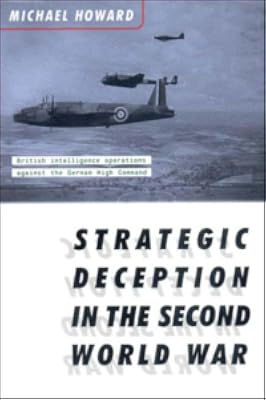
Strategic Deception in the Second World War
by Michael Eliot Howard
50 Members (5.00)
On This Page
Description
A volume in the British Government's Official History of Intelligence in the Second World War, the book has been written by a master historian renowned for his eloquence as well as for his learning.The success of these operations can be measured by the fact that by 1943 the Germans were almost wholly dependent on double agents for news of what was going on in the United Kingdom; intercepted and decrypted radio traffic showed the Allies how extensively the enemy was accepting disinformation show more and acting on it. In Britain, extremely tight communications security made possible the apprehension and control of virtually all active enemy agents.Sir Michael Howard explains how the British were able to deceive the Germans about the strategic intentions of the Allies and make them greatly overestimate Allied resources. Here is the most authoritative account available of such classic deception operations as Operation Mincemeat, which preceded the invasion of Sicily; the nonexistent U.S. Army group that pinned down an entire German Army in the Pas de Calais until Montgomery's forces had achieved a secure foothold in Normandy; and the amazing trick played on the German intelligence authorities by the great double agent Garbo. show lessTags
Recommendations























Member Reviews
Members
- Recently Added By
Author Information

38+ Works 2,757 Members
Michael Eliot Howard was born in London on Nov. 29, 1922. His father, Geoffrey Eliot Howard, ran a family company manufacturing pharmaceutical and industrial chemicals. His mother was Edith Julia Emma Edinger, a socialite and, later, art collector. He became aware of the consequences of his mother¿s Jewish ancestry only when her relatives, a sad show more procession of refugees, began arriving in England in the 1930s, fleeing Nazi persecution. Mr. Howard was educated at Wellington College and at Oxford University, where he studied history. In 1942, he joined the Army as a second lieutenant in the Coldstream Guards and was sent to join the campaign in Italy. In the postwar years, Mr. Howard returned to Oxford to complete his studies and, in the early 1950s, helped found the Department of War Studies at King¿s College. In 1960, he traveled widely in the United States on a grant from the Ford Foundation. He later taught for six months as a visiting professor at Stanford. In 1968, he moved to Oxford as a fellow of All Souls College, an elite center of postgraduate studies, and later held the Regius chair which he called the flagship of the historical profession at Oriel College, Oxford. After two decades lecturing and writing in Oxford, he moved to Yale in 1989 to take up the Robert A. Lovett Chair of Military and Naval History until his retirement from the post in 1993. Michael Eliot Howard passed away on November 1, 2019 at the age of 97. (Bowker Author Biography) show less
Common Knowledge
- Important events
- World War II (1939 | 1945)
Classifications
- Genres
- History, Nonfiction, General Nonfiction
- DDC/MDS
- 940.548641 — History & geography History of Europe History of Europe 1918- Military history of World War II Other Topics Unconventional warfare of Allies Europe British Isles
- LCC
- D810 .S7 — History of Europe, Asia, Africa and Oceania History (General) World War II (1939-1945)
- BISAC
Statistics
- Members
- 50
- Popularity
- 603,392
- Rating
- (5.00)
- Languages
- English
- Media
- Paper
- ISBNs
- 2
- ASINs
- 1