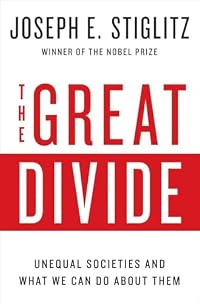
The Great Divide: Unequal Societies and What We Can Do About Them
by Joseph E. Stiglitz
On This Page
Description
Discusses the causes of inequality, including unjust and irresponsible economic policies and misguided priorities, and offers suggestions to help the United States become a more fair and equitable society. --Publisher's description.Tags
Recommendations


Member Reviews
This is a collection of the Nobel Prize-winning author's shorter pieces in the popular press, and his blogs on the Project Syndicate platform. In these he concisely describes how the market-driven economic philosophy and monetarist policy of the Reagan-Thatcher axis, coupled with the ideology that the market knows best and government interventions on behalf of the less well off should be minimized, led to the excesses of the financial sector that culminated in the crash of 2007-2008, the bankruptcy of millions of home loan borrowers who lost their lifetime savings, and the widening of the income and wealth gaps in the western market economies. He repeatedly draws attention to the damaging effects on society from these growing divisions, show more hence the title. The author has not only the diagnosis, but also recommendations for the rebuilding of the western societies and economies, and with them of the world economy as well. An absorbing and authoritative book, it is made eminently readable also by the author's warm, personalised and reasoned style, with relatively few footnotes and little jargon, and is a part of his very wide range of writings that would merit study by not just those responsible for the developed economies, but also those who are dealing with economic polcy in te less developed countries. show less
You don’t have to be a Nobel Prize winner in economics to figure out what has been happening to Americans, but you might have to be one to validate what half of America has already known on a personal level for some time: that there has been a steep economic trajectory downward for the majority of the country over the past several decades. It takes courage to point out the truth when there are those who are quick to declare us treasonous for suggesting that Americans are not still number one in education, healthcare, child poverty and a dozen other measures of the good life that has transformed the old middle class into the new working poor.
Joseph Stiglitz is quick to blame homeowners who over-extended themselves, aided by greedy show more commission-paid mortgage lenders and only gives a passing nod to the fact that you cannot pay even the lowest mortgage or rent payment without a job to give you income. It doesn’t take a PHD to figure out that it’s simple: No income, no outgo. One acquaintance of mine, half of a comfortably well-off couple, suggested to a mutual friend, a single mother who bemoaned her tough road, that perhaps the woman was living beyond her means. The single woman, an intelligent and educated woman holding down three jobs at the time and not able to secure a better job, replied that at the moment, food and shelter were beyond her means.
What Stiglitz hasn’t addressed, or perhaps hasn’t seen, is that the downturn that has lasted decades now, the unimpeded drop to the bottom, has changed our lives and our buying habits, perhaps forever. Employers know they don’t have to pay living wages to attract a flood of applicants for each position, so they don’t. Simple supply and demand. Even if the economy turned completely around tomorrow, many of us have become like the old people some of us knew as children, penny-pinching people that will not buy anything, will not consume in the way that kept the U.S. economy afloat in the past – we are simply out of the habit of buying anything. When we really need something, our first stop is now Walmart or the Dollar Store. One look at their earnings tells the story. Who do the auto manufacturers, hard goods and soft goods dealers think are going to be buying their offerings? Maybe there will be enough consumers to keep them going and maybe not, but this change in our personal spending habits will certainly have a long-term, decades perhaps, effect on our economy.
Joseph Stiglitz does address somewhat the issue of mortgage foreclosure and has it exactly right that lenders used their financial clout to seize property that people were not even behind in when it came to making payments. “So sue us!” the lenders laughed as they unleashed their own legal teams and started foreclosure procedures on millions of homeowners. The people who lost their homes are reluctant to make a thirty year commitment again, especially if the loss occurred later in their lives. Fewer homeowners mean more vacant homes or more likely, more landlords. Landlords don’t spend a lot of money on redecorating, home additions, or landscaping so those businesses will have a smaller share of the pie than they might have had. Without home ownership, citizens are less likely to feel that they have a stake in the country, they literally do not “take ownership” of their community. There are places now where home sellers know they cannot sell to anyone except the wealthy of the same state since populations are leaving those states as fast as they can, bound for what they hope will be better places with more job opportunities, lower taxes and smaller utility bills. Many people are leaving the country altogether. The numbers of expatriates are growing with millions currently living or retiring outside of the country. While the only jobs available for many in the last decade have been in the military, there are cutbacks there as well. With increasing numbers of disabled veterans and orphaned dependents, there will be more financial needs from the system. It sometimes seems that the only other jobs available to enterprising young people are selling illegal drugs and with some police departments both large and small losing the war on crime, it is looking more and more like opposing armies that are just about equally matched.
Stiglitz mentions that the laying off of teachers is bad for our future, but there has been no money to pay them living wages and education has been sacrificed to the detriment of an educated population. The founding fathers understood the importance of an informed citizenry and saw to it that we were one of the first, if not THE first civilized country to offer free education to all of its citizens. Looking back at the dark ages, we see that refuge has been sought in the educational centers of the world, notably Leiden, Paris, England’s Merchant Taylors School, and among the Puritans in our own country who made quality university education a priority. Our educated population has no jobs though. There are people with Masters and PHDs who are incredibly under-employed now and if you are over age 30, the situation is even worse, the idea being that young people will work for very little just to have a job and that older, more experienced people might ask for more reasonable wages. Job experience has been lost and so has a level of service, the commodity that has become the most scarce in the new economy.
The author correctly notes that human jobs have been rapidly replaced by machines and while we generally think of assembly line jobs where one person spends all day twisting and tightening a bolt, the truth is that other, “thinking”, jobs have been replaced. Decisions about who gets extended credit, including mortgages and insurance, as well as what we pay for the interest rates and premiums, are made almost completely by machine now, with credit scoring being the main determining factor. Our assigned number is decided by what credit we have, how long we have had it, and how recently we have used it, in addition to how well we pay our bills on time. The numbers go against the financially strapped, the young, and non-credit users. The highest credit scores are found among the elderly. Indeed, there has been more growth in the cash economy, the extent of which no one knows. Many companies and services now offer cash discounts and as customers, we don’t ask why although we have some ideas.
I was stunned that someone with such excellent credentials knew what I knew, came to the same conclusion that I had, and bothered to write about “average” people. I still don’t understand why no one is doing anything about it since it seems to me that it will eventually destroy the entire country. Is it simply that everyone is so busy trying to get their share of the goods that they don’t care about anyone or anything else, including their own legacy and descendants? Do they believe the country can continue on this track forever? Do they feel helpless about what to do to change it? Or do those who have financial security just not think it is that much of a problem? Joseph Stiglitz has some ideas that he puts forth about the direction to remedy our woes but even if we had more concrete and specific ideas, there is not the will to change anything. Our political leaders pay lip service to what we want to hear during the upcoming election cycle but do not offer much more. The 99% tried the Occupy Wall Street movement to bring problems to the attention of our leaders but maybe it is still too early for wide-spread economic revolution. Maybe we will go on this way for another 500 years with a completely underground economy like many banana republics but cycles do appear to be getting shorter so I don’t believe it will be that long. In any case, given the short span of each human life, only a century more or less, it seems we will have to make our own way through the divide, through the great valley.
Don’t let the title or Joseph Stiglitz' excellent credentials put you off: This is a highly readable book with some very short chapters that anyone can understand and appreciate if they know how to write a check. If it helps, think of it as a convenient collection of issues relevant to everyday lives of any adult in the 21st century. Read the book and map out your own family’s survival plan. Joseph Stiglitz has lifted a light illuminating the shadows, speaking about what has been hidden behind the privacy of our front doors. show less
Joseph Stiglitz is quick to blame homeowners who over-extended themselves, aided by greedy show more commission-paid mortgage lenders and only gives a passing nod to the fact that you cannot pay even the lowest mortgage or rent payment without a job to give you income. It doesn’t take a PHD to figure out that it’s simple: No income, no outgo. One acquaintance of mine, half of a comfortably well-off couple, suggested to a mutual friend, a single mother who bemoaned her tough road, that perhaps the woman was living beyond her means. The single woman, an intelligent and educated woman holding down three jobs at the time and not able to secure a better job, replied that at the moment, food and shelter were beyond her means.
What Stiglitz hasn’t addressed, or perhaps hasn’t seen, is that the downturn that has lasted decades now, the unimpeded drop to the bottom, has changed our lives and our buying habits, perhaps forever. Employers know they don’t have to pay living wages to attract a flood of applicants for each position, so they don’t. Simple supply and demand. Even if the economy turned completely around tomorrow, many of us have become like the old people some of us knew as children, penny-pinching people that will not buy anything, will not consume in the way that kept the U.S. economy afloat in the past – we are simply out of the habit of buying anything. When we really need something, our first stop is now Walmart or the Dollar Store. One look at their earnings tells the story. Who do the auto manufacturers, hard goods and soft goods dealers think are going to be buying their offerings? Maybe there will be enough consumers to keep them going and maybe not, but this change in our personal spending habits will certainly have a long-term, decades perhaps, effect on our economy.
Joseph Stiglitz does address somewhat the issue of mortgage foreclosure and has it exactly right that lenders used their financial clout to seize property that people were not even behind in when it came to making payments. “So sue us!” the lenders laughed as they unleashed their own legal teams and started foreclosure procedures on millions of homeowners. The people who lost their homes are reluctant to make a thirty year commitment again, especially if the loss occurred later in their lives. Fewer homeowners mean more vacant homes or more likely, more landlords. Landlords don’t spend a lot of money on redecorating, home additions, or landscaping so those businesses will have a smaller share of the pie than they might have had. Without home ownership, citizens are less likely to feel that they have a stake in the country, they literally do not “take ownership” of their community. There are places now where home sellers know they cannot sell to anyone except the wealthy of the same state since populations are leaving those states as fast as they can, bound for what they hope will be better places with more job opportunities, lower taxes and smaller utility bills. Many people are leaving the country altogether. The numbers of expatriates are growing with millions currently living or retiring outside of the country. While the only jobs available for many in the last decade have been in the military, there are cutbacks there as well. With increasing numbers of disabled veterans and orphaned dependents, there will be more financial needs from the system. It sometimes seems that the only other jobs available to enterprising young people are selling illegal drugs and with some police departments both large and small losing the war on crime, it is looking more and more like opposing armies that are just about equally matched.
Stiglitz mentions that the laying off of teachers is bad for our future, but there has been no money to pay them living wages and education has been sacrificed to the detriment of an educated population. The founding fathers understood the importance of an informed citizenry and saw to it that we were one of the first, if not THE first civilized country to offer free education to all of its citizens. Looking back at the dark ages, we see that refuge has been sought in the educational centers of the world, notably Leiden, Paris, England’s Merchant Taylors School, and among the Puritans in our own country who made quality university education a priority. Our educated population has no jobs though. There are people with Masters and PHDs who are incredibly under-employed now and if you are over age 30, the situation is even worse, the idea being that young people will work for very little just to have a job and that older, more experienced people might ask for more reasonable wages. Job experience has been lost and so has a level of service, the commodity that has become the most scarce in the new economy.
The author correctly notes that human jobs have been rapidly replaced by machines and while we generally think of assembly line jobs where one person spends all day twisting and tightening a bolt, the truth is that other, “thinking”, jobs have been replaced. Decisions about who gets extended credit, including mortgages and insurance, as well as what we pay for the interest rates and premiums, are made almost completely by machine now, with credit scoring being the main determining factor. Our assigned number is decided by what credit we have, how long we have had it, and how recently we have used it, in addition to how well we pay our bills on time. The numbers go against the financially strapped, the young, and non-credit users. The highest credit scores are found among the elderly. Indeed, there has been more growth in the cash economy, the extent of which no one knows. Many companies and services now offer cash discounts and as customers, we don’t ask why although we have some ideas.
I was stunned that someone with such excellent credentials knew what I knew, came to the same conclusion that I had, and bothered to write about “average” people. I still don’t understand why no one is doing anything about it since it seems to me that it will eventually destroy the entire country. Is it simply that everyone is so busy trying to get their share of the goods that they don’t care about anyone or anything else, including their own legacy and descendants? Do they believe the country can continue on this track forever? Do they feel helpless about what to do to change it? Or do those who have financial security just not think it is that much of a problem? Joseph Stiglitz has some ideas that he puts forth about the direction to remedy our woes but even if we had more concrete and specific ideas, there is not the will to change anything. Our political leaders pay lip service to what we want to hear during the upcoming election cycle but do not offer much more. The 99% tried the Occupy Wall Street movement to bring problems to the attention of our leaders but maybe it is still too early for wide-spread economic revolution. Maybe we will go on this way for another 500 years with a completely underground economy like many banana republics but cycles do appear to be getting shorter so I don’t believe it will be that long. In any case, given the short span of each human life, only a century more or less, it seems we will have to make our own way through the divide, through the great valley.
Don’t let the title or Joseph Stiglitz' excellent credentials put you off: This is a highly readable book with some very short chapters that anyone can understand and appreciate if they know how to write a check. If it helps, think of it as a convenient collection of issues relevant to everyday lives of any adult in the 21st century. Read the book and map out your own family’s survival plan. Joseph Stiglitz has lifted a light illuminating the shadows, speaking about what has been hidden behind the privacy of our front doors. show less
a collection of articles and essays, so not as current as the publication date
Les sociétés inégalitaires et ce que nous pouvons faire pour les changer
La desigualdad es evitable, no es consecuencia de leyes inexorables de la economía. Es cuestión de políticas y estrategias. Una gran brecha separa a los muy ricos de los demás, y esa desigualdad, hoy en el centro del debate económico, se ha convertido en una preocupación cada vez más acuciante incluso para ese famoso 1 por ciento privilegiado, que empieza a ser consciente de la imposibilidad de lograr un crecimiento económico sostenido si los ingresos de la inmensa mayoría están estancados. La desigualdad es la mayor amenaza para la prosperidad. En una época definida por el cansancio de la política y la incertidumbre económica, Joseph Stiglitz se ha convertido en una voz necesaria. En este libro, defiende y demuestra que no show more es necesario elegir entre crecimiento y equidad: una economía sana y una democracia más justa están a nuestro alcance, siempre y cuando dejemos a un lado los intereses erróneos y abandonemos lo antes posible unas políticas que ya han demostrado ser fallidas. show less
Feb 22, 2016Spanish
La desigualdad es evitable, no es consecuencia de leyes inexorables de la economía. Es cuestión de políticas y estrategias.
May 4, 2021Spanish
Members
- Recently Added By
Author Information

108+ Works 8,563 Members
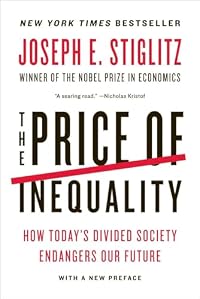
Joseph Stiglitz is professor of economics at Columbia University. Influential economist and Columbia University professor Joseph Eugene Stiglitz was born in Gary, Indiana on February 9, 1943. He received his undergraduate degree from Amherst College and his Ph.D. from MIT in 1967. He was awarded the John Bates Clark Medal in 1979 and the Nobel show more Memorial Prize in Economic Sciences in 2001. Stiglitz has taught at Yale University, Stanford University, Duke University, Oxford University, and Princeton University. In 2000, he founded the Initiative for Policy Dialogue. Stiglitz worked for the Clinton Administration beginning in 1993 and was the Chairman of the Council of Economic Advisers from 1995 to 1997. For the next three years he served as the World Bank's Senior Vice President and Chief Economist. Stiglitz chaired the Commission of Experts on Reforms of the International Monetary and Financial System in 2009. He has written several hundred articles and many books, including Making Globalization Work and Freefall: America, Free Markets, and the Sinking of the World Economy. His title The Price of Inequality made The New York Times Best Seller List for 2012. (Bowker Author Biography) show less
Common Knowledge
- Dedication
- To my many readers, who have responded with such enthusiasm to my writings on inequality and opportunity. To my children, Siobhan, Michael, Jed, and Julia, and my wife, Anya, all of whom, in their own way, are striving to cre... (show all)ate a fairer and better world. And to the scholars and activists everywhere who work with such dedication for social justice. Thank you for the inspiration and encouragement you have provided.
Classifications
- Genres
- Economics, Nonfiction, Politics and Government, General Nonfiction
- DDC/MDS
- 305.50973 — Society, government, & culture Social sciences, sociology & anthropology Social group - Age, Gender, Ethnicity People by social and economic levels History, geographic treatment, biography North America United States
- LCC
- HC110 .I5 .S8667 — Social sciences Economic history and conditions Economic history and conditions By region or country
- BISAC
Statistics
- Members
- 320
- Popularity
- 98,869
- Reviews
- 7
- Rating
- (4.03)
- Languages
- 6 — English, French, German, Italian, Portuguese, Spanish
- Media
- Paper, Audiobook, Ebook
- ISBNs
- 21
- ASINs
- 11