On This Page
Description
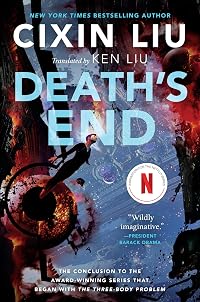
With The Three-Body Problem , English-speaking readers got their first chance to experience the multiple-award-winning and bestselling Three-Body Trilogy by China's most beloved science fiction author, Cixin Liu. Three-Body was released to great acclaim including coverage in The New York Times and The Wall Street Journal. It was also named a finalist for the Nebula Award, making it the first translated novel to be nominated for a major SF award since Italo Calvino's Invisible Cities in 1976. show more Now this epic trilogy concludes with Death's End . Half a century after the Doomsday Battle, the uneasy balance of Dark Forest Deterrence keeps the Trisolaran invaders at bay. Earth enjoys unprecedented prosperity due to the infusion of Trisolaran knowledge. With human science advancing daily and the Trisolarans adopting Earth culture, it seems that the two civilizations will soon be able to co-exist peacefully as equals without the terrible threat of mutually assured annihilation. But the peace has also made humanity complacent. Cheng Xin, an aerospace engineer from the early 21st century, awakens from hibernation in this new age. She brings with her knowledge of a long-forgotten program dating from the beginning of the Trisolar Crisis, and her very presence may upset the delicate balance between two worlds. Will humanity reach for the stars or die in its cradle? show lessTags
Recommendations






Member Reviews
A science fiction series that gets rave reviews from both Barack Obama and George R. R. Martin is certainly worth investigating. Since the books are heavily philosophical, so is my review. These are disconnected observations rather than a summary of the novels; so be it.
Observation 1: Almost all the science fiction I’ve read comes from American/European culture. This is from China. Is there anything different? After all, a science fiction writer is supposed to predict the future – or at least come up with a future that’s plausible; does the future look different to someone from a different culture with a different political ideology? It does, a little – and I found the differences surprising. The Western science future has often show more been the playground of the rugged individualist – especially during the “Golden Age” from the 1930s to 1950s. Stories from this era make space travel the province of the wealthy industrialist or the inspired inventor; what actually happened is that governments took over until very recently. In Cixin Liu’s trilogy, governments are in charge from the start – but do a pretty poor job of it; the United Nations is portrayed as particularly inept, for example blocking lines of scientific research because they are deemed too dangerous only to find that this forbidden research is just what’s needed to solve developing problems. Fortunately, “rugged individuals” come along and pursue the forbidden research – sometimes with extreme measures, like assassination – and save humanity. The difference from the Western versions is said individuals are not defying international law for their own interest, but for the interest of humanity as a whole.
Observation 2: Ideology doesn’t appear much, and when it does it’s again not what I expected. I assume this book had to get through Chinese censors to get published, but one of the heroes (sort of, he’s eventually punished for “crimes against humanity” because he violated UN laws on forbidden research) is a wealthy Western capitalist (to be fair, he’s portrayed as acquiring his wealth in an unusual fashion, and he’s also portrayed as having unpleasant personality characteristics). And one of the villains announces “The era for humanity’s degenerate freedom is over. If you want to survive here, you must relearn collectivism…”. And the results of that “collectivism” are pretty grim – just like the actual results of collectivism in the recent past. The era of the “Cultural Revolution” in China affects some of the protagonists, and they’re not very happy about it.
Observation 3: Cixin Liu is very hard on environmentalism and anti-intellectual/anti-science movements. These are consistently portrayed as anti-human, and are generally terminated with extreme prejudice by the powers that be. Since the PRC is technocratic society, I imaging that had no trouble getting past the censors.
Observation 4: The trilogy deals with the Fermi paradox from the very beginning, and in what I consider a more logical fashion than Western science fiction. In our popular science fiction – you can take Star Trek and Star Wars as examples – alien civilizations are portrayed as having roughly the same degree of technological development as the Earthlings that encounter them. In actuality – assuming there are alien civilizations at all – that’s vanishingly unlikely. If you consider the entire history of Earth, and the history of technology, alien life forms will most likely be either single celled organisms – that’s what the average living thing on Earth is, over time – or beings so advanced they are indistinguishable from God. Or Satan. All it would take in the four billion years or so of Earth history would be a minor difference – the development of intelligence occurring a little earlier or a little later, by a factor of 0.00001, say – and we’d be either at the Mesolithic level or have 40K years of further advance under our belts. It’s scarcely imaginable what technology will look like 40 years in the future, much less 40000. If you extend that across the entire galaxy, it’s likely there will be some civilization out there (again, assuming that there are any at all) that’s billions of years more advanced than ours. A corollary to that is Western science fiction usually assumes that advanced alien civilizations will be benevolent – or at worst neutral – toward humanity; the trilogy does not make that assumption and the results are viscerally horrifying. It’s one thing to imagine aliens invading Earth for resources or slaves or Lebensraum; it’s another to find them treating us as something like cobwebs in the corners – needing to be swept up to make things neat.
Very enlightening and thought-provoking, although sometimes the thoughts are nightmarish. I had a minor problem dealing with names; although international in scope many of the characters are, understandably, Chinese and it was hard to remember who’s who. show less
Observation 1: Almost all the science fiction I’ve read comes from American/European culture. This is from China. Is there anything different? After all, a science fiction writer is supposed to predict the future – or at least come up with a future that’s plausible; does the future look different to someone from a different culture with a different political ideology? It does, a little – and I found the differences surprising. The Western science future has often show more been the playground of the rugged individualist – especially during the “Golden Age” from the 1930s to 1950s. Stories from this era make space travel the province of the wealthy industrialist or the inspired inventor; what actually happened is that governments took over until very recently. In Cixin Liu’s trilogy, governments are in charge from the start – but do a pretty poor job of it; the United Nations is portrayed as particularly inept, for example blocking lines of scientific research because they are deemed too dangerous only to find that this forbidden research is just what’s needed to solve developing problems. Fortunately, “rugged individuals” come along and pursue the forbidden research – sometimes with extreme measures, like assassination – and save humanity. The difference from the Western versions is said individuals are not defying international law for their own interest, but for the interest of humanity as a whole.
Observation 2: Ideology doesn’t appear much, and when it does it’s again not what I expected. I assume this book had to get through Chinese censors to get published, but one of the heroes (sort of, he’s eventually punished for “crimes against humanity” because he violated UN laws on forbidden research) is a wealthy Western capitalist (to be fair, he’s portrayed as acquiring his wealth in an unusual fashion, and he’s also portrayed as having unpleasant personality characteristics). And one of the villains announces “The era for humanity’s degenerate freedom is over. If you want to survive here, you must relearn collectivism…”. And the results of that “collectivism” are pretty grim – just like the actual results of collectivism in the recent past. The era of the “Cultural Revolution” in China affects some of the protagonists, and they’re not very happy about it.
Observation 3: Cixin Liu is very hard on environmentalism and anti-intellectual/anti-science movements. These are consistently portrayed as anti-human, and are generally terminated with extreme prejudice by the powers that be. Since the PRC is technocratic society, I imaging that had no trouble getting past the censors.
Observation 4: The trilogy deals with the Fermi paradox from the very beginning, and in what I consider a more logical fashion than Western science fiction. In our popular science fiction – you can take Star Trek and Star Wars as examples – alien civilizations are portrayed as having roughly the same degree of technological development as the Earthlings that encounter them. In actuality – assuming there are alien civilizations at all – that’s vanishingly unlikely. If you consider the entire history of Earth, and the history of technology, alien life forms will most likely be either single celled organisms – that’s what the average living thing on Earth is, over time – or beings so advanced they are indistinguishable from God. Or Satan. All it would take in the four billion years or so of Earth history would be a minor difference – the development of intelligence occurring a little earlier or a little later, by a factor of 0.00001, say – and we’d be either at the Mesolithic level or have 40K years of further advance under our belts. It’s scarcely imaginable what technology will look like 40 years in the future, much less 40000. If you extend that across the entire galaxy, it’s likely there will be some civilization out there (again, assuming that there are any at all) that’s billions of years more advanced than ours. A corollary to that is Western science fiction usually assumes that advanced alien civilizations will be benevolent – or at worst neutral – toward humanity; the trilogy does not make that assumption and the results are viscerally horrifying. It’s one thing to imagine aliens invading Earth for resources or slaves or Lebensraum; it’s another to find them treating us as something like cobwebs in the corners – needing to be swept up to make things neat.
Very enlightening and thought-provoking, although sometimes the thoughts are nightmarish. I had a minor problem dealing with names; although international in scope many of the characters are, understandably, Chinese and it was hard to remember who’s who. show less
Like Book 1 of Cixin Liu’s towering The Three-Body Problem series, Book 3 begins with a siege.
But while the first book opened in 1967 (during China’s Cultural Revolution), the third book—Death’s End—flashes back to 1453 (during the Ottomans’ assault on Constantinople). It’s a bit disconcerting given that the second book left off in 2213.
The chronological zigzag makes sense given where the middle entry in the series concluded, however. Book 2 seemingly resolved the central conflict: Earth, threatened with invasion by aliens from Trisolaris, stumbled upon a form of deterrence relying on mutually assured destruction (not unlike the nuclear détente of the Cold War). The Trisolarans conceded defeat and changed course; show more humanity’s future looked secure.
So without a cliffhanger to contend with—as most Book 2s bequeath to Book 3s—why not rewind a few centuries?
Liu uses the opportunity to inject a bit of fantasy into his science fiction: an assassin who can remove her targets’ organs without touching them. Then he returns to the early days of the Trisolaris crisis and introduces a few more new characters. He also backfills some plot devices before finally advancing the narrative past the epilogue of Book 2.
In other words, the story takes a while to get going. But the preamble has a purpose, and it becomes clear as the “Deterrence Era” devolves into something far less stable.
The result is extraordinary.
I still never quite connected with the characters. Liu features a different protagonist in each book, and although Cheng Xin, the lead for Death’s End, is the most sympathetic, I always felt a little distant from her.
That may have been by design. “I am but an ordinary person,” she says at one point. “Unfortunately, I have not been able to walk the ordinary person’s path. My path is, in reality, the journey of a civilization.” Liu seems to have conceived of her as an avatar for humanity—or at least a facet of it, while other characters often represent our baser instincts.
This scale is what impressed me most by the close of Death’s End. The series spans eons; the date for one of the last chapters is “About Seventeen Billion Years After the Beginning of Time.” Along the way, we see human culture evolve, Trisolaran culture adapt to human culture, and new civilizations enter (and exit) the galactic playing field.
Liu also shows us more mind-bending science: Lightspeed travel. Black-hole shields. A “Great Wall at the scale of the universe.” Life in four dimensions. Death in two.
Some of this is cloaked in clever fantasy (like the assassin’s trick in 15th century Constantinople). Other aspects are laid out in interstitial passages from A Past Outside of Time, a fake history Liu uses to bridge the time jumps and provide necessary context for a story with such a massive scope. Just about all of it worked for me by the end.
In his translator’s note, Ken Liu (another fabulous author) writes, “I continue to be awed by the genius of [Cixin Liu] every time I read another passage from this novel. Of the three books in the trilogy, this third one is my favorite.”
I felt the same way. The Three-Body Problem series wasn’t a quick read for me, but I won’t forget it anytime soon. What an achievement.
Note: Since the translation uses the English versions of the author’s name and his characters’, I did the same in this review.
(For more reviews like this one, see www.nickwisseman.com) show less
But while the first book opened in 1967 (during China’s Cultural Revolution), the third book—Death’s End—flashes back to 1453 (during the Ottomans’ assault on Constantinople). It’s a bit disconcerting given that the second book left off in 2213.
The chronological zigzag makes sense given where the middle entry in the series concluded, however. Book 2 seemingly resolved the central conflict: Earth, threatened with invasion by aliens from Trisolaris, stumbled upon a form of deterrence relying on mutually assured destruction (not unlike the nuclear détente of the Cold War). The Trisolarans conceded defeat and changed course; show more humanity’s future looked secure.
So without a cliffhanger to contend with—as most Book 2s bequeath to Book 3s—why not rewind a few centuries?
Liu uses the opportunity to inject a bit of fantasy into his science fiction: an assassin who can remove her targets’ organs without touching them. Then he returns to the early days of the Trisolaris crisis and introduces a few more new characters. He also backfills some plot devices before finally advancing the narrative past the epilogue of Book 2.
In other words, the story takes a while to get going. But the preamble has a purpose, and it becomes clear as the “Deterrence Era” devolves into something far less stable.
The result is extraordinary.
I still never quite connected with the characters. Liu features a different protagonist in each book, and although Cheng Xin, the lead for Death’s End, is the most sympathetic, I always felt a little distant from her.
That may have been by design. “I am but an ordinary person,” she says at one point. “Unfortunately, I have not been able to walk the ordinary person’s path. My path is, in reality, the journey of a civilization.” Liu seems to have conceived of her as an avatar for humanity—or at least a facet of it, while other characters often represent our baser instincts.
This scale is what impressed me most by the close of Death’s End. The series spans eons; the date for one of the last chapters is “About Seventeen Billion Years After the Beginning of Time.” Along the way, we see human culture evolve, Trisolaran culture adapt to human culture, and new civilizations enter (and exit) the galactic playing field.
Liu also shows us more mind-bending science: Lightspeed travel. Black-hole shields. A “Great Wall at the scale of the universe.” Life in four dimensions. Death in two.
Some of this is cloaked in clever fantasy (like the assassin’s trick in 15th century Constantinople). Other aspects are laid out in interstitial passages from A Past Outside of Time, a fake history Liu uses to bridge the time jumps and provide necessary context for a story with such a massive scope. Just about all of it worked for me by the end.
In his translator’s note, Ken Liu (another fabulous author) writes, “I continue to be awed by the genius of [Cixin Liu] every time I read another passage from this novel. Of the three books in the trilogy, this third one is my favorite.”
I felt the same way. The Three-Body Problem series wasn’t a quick read for me, but I won’t forget it anytime soon. What an achievement.
Note: Since the translation uses the English versions of the author’s name and his characters’, I did the same in this review.
(For more reviews like this one, see www.nickwisseman.com) show less
This book has Problems. (Mild spoilers for characterisation and themes. No specific plot spoilers)
The main character barely exists in the story except to use her Feminine Emotions(TM) to stop Real Men(TM) from doing all the Real Work because her emotions tell her they're wrong. And every time she's wrong and punished and hates herself and goes into hibernation to escape the world. She's supposed to be a PhD in astrophysics but spends the entire novel doing nothing but stopping men from furthering actual scientific breakthroughs that she has no part in.
Which doesn't even touch on the horrific way gender is portrayed throughout the book. The number of "this was definitely written by a cisgender man" moments in this book are too numerous show more to count. Some examples: An autistic scientist is described multiple times as "not a real man" because he's "never touched a woman" (not ok on multiple levels). Multiple generations of humanity are derided for "not producing Real Men" because the world is peaceful so men all "look like women" (also not ok on multiple levels).
AND to top it all off, there are significant continuity errors in basic geometry when describing some objects. Like come on, this is a hard sci-fi book. If you can't get basic geometry right, how can I believe any of your ideas are based in actual science and reality as they're supposed to be?
The first two books in this series were so great. A beautiful sci-fi mystery and a fascinating sci-fi look at philosophy and ethics respectively. This one just felt disjointed and unfocused. Not to mention sexist. It also really emphasised just how little regard for the existence and relevance of Africa and South America the author has. Africa is mentioned once in the entire series (that often talks about global and species wide issues). South America isn't even mentioned once.
A very disappointing end to a previously promising series. show less
The main character barely exists in the story except to use her Feminine Emotions(TM) to stop Real Men(TM) from doing all the Real Work because her emotions tell her they're wrong. And every time she's wrong and punished and hates herself and goes into hibernation to escape the world. She's supposed to be a PhD in astrophysics but spends the entire novel doing nothing but stopping men from furthering actual scientific breakthroughs that she has no part in.
Which doesn't even touch on the horrific way gender is portrayed throughout the book. The number of "this was definitely written by a cisgender man" moments in this book are too numerous show more to count. Some examples: An autistic scientist is described multiple times as "not a real man" because he's "never touched a woman" (not ok on multiple levels). Multiple generations of humanity are derided for "not producing Real Men" because the world is peaceful so men all "look like women" (also not ok on multiple levels).
AND to top it all off, there are significant continuity errors in basic geometry when describing some objects. Like come on, this is a hard sci-fi book. If you can't get basic geometry right, how can I believe any of your ideas are based in actual science and reality as they're supposed to be?
The first two books in this series were so great. A beautiful sci-fi mystery and a fascinating sci-fi look at philosophy and ethics respectively. This one just felt disjointed and unfocused. Not to mention sexist. It also really emphasised just how little regard for the existence and relevance of Africa and South America the author has. Africa is mentioned once in the entire series (that often talks about global and species wide issues). South America isn't even mentioned once.
A very disappointing end to a previously promising series. show less
Interesting end of the series. It felt jam-packed with events, especially compared to the spans the previous books covered. It also felt more speculative than the previous two. Where those felt more grounded in science and following the consequences of events through, this book almost flits from event to event to event while gliding over how we got there. Still, I appreciated the imagination in what happens and the epic breadth of this book.
The author does occasionally get weird about gender and gender roles, such as the era where men become so feminized that people from past eras can't recognize the men as men, which does spoil the imagination uncoiling throughout the book.
The author does occasionally get weird about gender and gender roles, such as the era where men become so feminized that people from past eras can't recognize the men as men, which does spoil the imagination uncoiling throughout the book.
It isn't until this final book in the thesis that Liu's thesis comes out: life follows a trajectory resulting in dimensional war that eventually ends up collapsing the universe (and the birth of another universe).
Although this writing is considered science fiction, the plot takes direction from Cold War politics of Mutually Assured Destruction.
This is a kind of fiction that I find irresponsible. The more we are exposed to ideas, the more "normal" they feel (regardless of how far outside any natural thresholds or ethics they might fall). Liu's premise that life is inherently competitive to the point of galactic genocide says a lot about his psychology, but little about human nature, and even less about the alien society. It is a book show more that leaves the reader feeling as though the world is devoid of meaning, and that is not the energy we could use these days.
That said, the book is artfully written, especially the opening with the fall of Constantinople. show less
Although this writing is considered science fiction, the plot takes direction from Cold War politics of Mutually Assured Destruction.
This is a kind of fiction that I find irresponsible. The more we are exposed to ideas, the more "normal" they feel (regardless of how far outside any natural thresholds or ethics they might fall). Liu's premise that life is inherently competitive to the point of galactic genocide says a lot about his psychology, but little about human nature, and even less about the alien society. It is a book show more that leaves the reader feeling as though the world is devoid of meaning, and that is not the energy we could use these days.
That said, the book is artfully written, especially the opening with the fall of Constantinople. show less
Cixin Liu’s Death’s End, the third novel in his Remembrance of Earth’s Past trilogy, begins concurrently with some of the events of the second novel, The Dark Forest, before using the ability of people to go into hibernation to jump forward in time and move well beyond the second book. The Dark Forest left off with a stalemate, as Luo Ji holds the ability to instigate mutually-assured destruction against both Trisolaris and the solar system. In the uneasy peace, the Trisolarans have begun sharing their technology with Earth and even become fascinated by human culture. Humanity, however, has learned from Luo Ji’s “Dark Forest” theory of spacefaring civilizations that intelligent alien life is likely more dangerous than they show more thought and would strike first if faced with a threat, so human civilization has found ways to minimize its broadcasts of signals into space in order to avoid attracting attention from any other alien civilizations.
Cheng Xin, an astrophysicist, began working on a probe to reach the Trisolaran fleet as it approached before entering hibernation. In the future, she finds society much changed and her place in society elevated as she owns the rights to a star that is discovered to have Earth-like planets. She gifts the planets to humanity and, for her generosity, the people of Earth want her to take over control of the mutually-assured destruction technology that preserves the peace with Trisolaris. Unfortunately, the Trisolans realize that she is unlikely to use the weapon, and prepare to invade the Earth. Meanwhile, the ships Blue Space and Gravity, the latter of which contains a gravity wave transmitter, encounter a pocket of fourth-dimensional space beyond the solar system. Realizing that the Trisolarans have invaded, they broadcast the location of Trisolaris, thereby committing the world to destruction under the dark forest theory while also putting the Earth at risk for the same fate. Trisolaris abandons its plans to invade the Earth, while humanity wonders if there’s a way to save itself. It finds a way through a series of layered metaphors transmitted from the only human aboard a Trisolaran ship, which draw upon Edgar Allan Poe’s “A Descent into the Maelström” in order to hide clues for explaining lightspeed travel (pgs. 446, 449). Unfortunately, the destruction of the Solar System follows a plan that the Earth spacefleet could not foresee.
Demonstrating the role of the media in shaping public perceptions of places, Liu references the 2008 film Australia as Cheng Xin’s only knowledge of the continent prior to the Trisolarans attempting to exile humanity to the continent (pgs. 236-237). Liu’s title, Death’s End, refers to some of the changes that hibernation technology caused in human society. He writes, “Once the technology was successfully commercialized, those who could afford it would use it to skip to paradise, while the rest of humanity would have to stay behind in the comparatively depressing present to construct that paradise for them. But even more worrisome was the greatest lure provided by the future: the end of death… those who chose hibernation were taking the first steps on the staircase to life everlasting. For the first time in history, Death itself was no longer fair” (pg. 77). Here Liu uses science-fiction to pose larger questions about the nature of humanity, how changing something as universal as death would affect all levels of society, and explores the concept in tandem with his plot about human advancement following first contact with an alien intelligence. Similarly, another character remarks about the nature of death, “Death is the only lighthouse that is always lit. No matter where you sail, ultimately, you must turn toward it. Everything fades into the world, but Death endures” (pg. 449). Similarly, Liu examines how other technologies, like lightspeed travel, contribute to inequality as the future of the solar system is in doubt. He writes, “The inequality here was seen as the greatest in human history: inequality before death. Historically, inequality mainly manifested itself in areas like economics or social status, but death basically treated everyone the same… But never before had a situation like this presented itself: less than one-ten-thousandth of the population could go into safe hiding, leaving billions on Earth to die” (pg. 473).
Liu also broadens his cosmology. The Trisolarans were the only alien civilization glimpsed in the series’ previous two novels, but here he offers glimpses of fourth-dimensional civilizations (pgs. 287-303) as well as one of the alien species that engages in Dark Forest Deterrence, destroying advanced civilizations before they become a threat (pgs. 555-564). In both of those cases, Liu carefully avoid describing the aliens’ physiology, giving just enough of a hint about their technology to fit the themes of his novel without portraying so much that it could become easily dated. This foreshadows his conclusion, in which the fate of the universe hangs in the balance. The end effect is a work of tragic beauty, befitting the themes Liu examined throughout the series. For those who aren’t ready to walk away from the “Remembrance of Earth’s Past” trilogy, Liu authorized Li Jun’s fan fiction, The Redemption of Time, as an official interquel to the series and Ken Liu also translated that work. show less
Cheng Xin, an astrophysicist, began working on a probe to reach the Trisolaran fleet as it approached before entering hibernation. In the future, she finds society much changed and her place in society elevated as she owns the rights to a star that is discovered to have Earth-like planets. She gifts the planets to humanity and, for her generosity, the people of Earth want her to take over control of the mutually-assured destruction technology that preserves the peace with Trisolaris. Unfortunately, the Trisolans realize that she is unlikely to use the weapon, and prepare to invade the Earth. Meanwhile, the ships Blue Space and Gravity, the latter of which contains a gravity wave transmitter, encounter a pocket of fourth-dimensional space beyond the solar system. Realizing that the Trisolarans have invaded, they broadcast the location of Trisolaris, thereby committing the world to destruction under the dark forest theory while also putting the Earth at risk for the same fate. Trisolaris abandons its plans to invade the Earth, while humanity wonders if there’s a way to save itself. It finds a way through a series of layered metaphors transmitted from the only human aboard a Trisolaran ship, which draw upon Edgar Allan Poe’s “A Descent into the Maelström” in order to hide clues for explaining lightspeed travel (pgs. 446, 449). Unfortunately, the destruction of the Solar System follows a plan that the Earth spacefleet could not foresee.
Demonstrating the role of the media in shaping public perceptions of places, Liu references the 2008 film Australia as Cheng Xin’s only knowledge of the continent prior to the Trisolarans attempting to exile humanity to the continent (pgs. 236-237). Liu’s title, Death’s End, refers to some of the changes that hibernation technology caused in human society. He writes, “Once the technology was successfully commercialized, those who could afford it would use it to skip to paradise, while the rest of humanity would have to stay behind in the comparatively depressing present to construct that paradise for them. But even more worrisome was the greatest lure provided by the future: the end of death… those who chose hibernation were taking the first steps on the staircase to life everlasting. For the first time in history, Death itself was no longer fair” (pg. 77). Here Liu uses science-fiction to pose larger questions about the nature of humanity, how changing something as universal as death would affect all levels of society, and explores the concept in tandem with his plot about human advancement following first contact with an alien intelligence. Similarly, another character remarks about the nature of death, “Death is the only lighthouse that is always lit. No matter where you sail, ultimately, you must turn toward it. Everything fades into the world, but Death endures” (pg. 449). Similarly, Liu examines how other technologies, like lightspeed travel, contribute to inequality as the future of the solar system is in doubt. He writes, “The inequality here was seen as the greatest in human history: inequality before death. Historically, inequality mainly manifested itself in areas like economics or social status, but death basically treated everyone the same… But never before had a situation like this presented itself: less than one-ten-thousandth of the population could go into safe hiding, leaving billions on Earth to die” (pg. 473).
Liu also broadens his cosmology. The Trisolarans were the only alien civilization glimpsed in the series’ previous two novels, but here he offers glimpses of fourth-dimensional civilizations (pgs. 287-303) as well as one of the alien species that engages in Dark Forest Deterrence, destroying advanced civilizations before they become a threat (pgs. 555-564). In both of those cases, Liu carefully avoid describing the aliens’ physiology, giving just enough of a hint about their technology to fit the themes of his novel without portraying so much that it could become easily dated. This foreshadows his conclusion, in which the fate of the universe hangs in the balance. The end effect is a work of tragic beauty, befitting the themes Liu examined throughout the series. For those who aren’t ready to walk away from the “Remembrance of Earth’s Past” trilogy, Liu authorized Li Jun’s fan fiction, The Redemption of Time, as an official interquel to the series and Ken Liu also translated that work. show less
Death’s End is the concluding volume of Cixin Liu’s Remembrance of Earth’s Past trilogy. If you haven’t read the first two books, don’t begin here. But definitely begin, because this is the most magnificent science fiction work I have ever read, and I have read almost all of them.
The first book in the trilogy, The Three Body Problem, was a very nice work, but ultimately the least engaging of the three. The Dark Forest was the best book I’ve ever read, of any genre. It contained elements of anthropology, sociology, philosophy and outstanding hard science fiction concepts and scenarios. It was simply magnificent, and ended in such a manner that a third book was not necessarily required.
Well, Death’s End picks up where Dark show more Forest leaves off, in fact with a little overlap in order to introduce the main protagonist in the final work. For three hundred pages, Death’s End was every bit the equal of Dark Forest, but then there occurs a roughly 100 page segment that is so dumb, so contrived and so out of character with the other 1500 pages of the trilogy that it made me question who had written it and why it was there.
It is not really a spoiler to reveal that the referenced 100 pages involve a rather silly fairy tale (for some reason they refer to three tales, though there is really only one, split into three chapters). The fairy tale is part of an inter-stellar conversation between two of the book’s main characters in which one is trying to convey a message through the use of metaphor. The Trisolarans have allowed and even initiated the conversation, but under very strict guidelines that limit information that can be conveyed, under penalty of death. Then, they allow a 50 page fairy tale to be conveyed, and memorized word for word by one of the characters. Sure, that makes sense. I guess the incredibly advanced Trisolarans don’t understand the concept of metaphor and think telling a 50 page fairy tale would be normal conversation under the circumstances.
There follows another 50 pages in which the Earth Federation goes about deciphering the fairy tale in such a way that is even dumber and even more senseless than the fact that the fairy tale was conveyed in the first place.
SPOILER: In one of the most incredibly stupid moments of any book I’ve ever read, the experts are stumped by a particular place name in the fairy tale. Luckily for them, one of the analysts talks in his sleep. After muttering the mysterious place name in his sleep, he is informed by his live-in girlfriend that the name is actually a combination of two place names in Norway, and not just any place names; names that have not been used for centuries. Luckily for him, his Norwegian girlfriend is a scholar in ancient Norwegian place names. Lucky humans, what are the chances.
Then, like nothing ever happened, the novel returns to absolute excellence for the final 300 pages. It is the damndest thing; like listening to a two hour concert featuring the works of Mozart that is interrupted for ten minutes by a cacophonous din of meaningless music, and completely unnecessary as the author could have easily gotten where he needed to go without such a bizarre detour. For such a magnificent work to be marred in such a way is a shame, because one of the strengths of the trilogy is its believability and rock solid hard science fiction. Character actions and plot lines flow so smoothly because they are imminently believable and flawlessly crafted.
In any event, it is the best science fiction series I’ve experienced; far more complex and engaging than the Foundation works and so much more approachable and enjoyable than the Dune novels. If a 20 year old asked me where to start in reading science fiction, I would direct him to Foundation and other Asimov works. If a 40 year old, who had sampled much of the genre asked the same question, I would insist that he read this trilogy. Afterwards, he would thank me for the suggestion but ask, “What was up with that stupid fairy tale.” show less
The first book in the trilogy, The Three Body Problem, was a very nice work, but ultimately the least engaging of the three. The Dark Forest was the best book I’ve ever read, of any genre. It contained elements of anthropology, sociology, philosophy and outstanding hard science fiction concepts and scenarios. It was simply magnificent, and ended in such a manner that a third book was not necessarily required.
Well, Death’s End picks up where Dark show more Forest leaves off, in fact with a little overlap in order to introduce the main protagonist in the final work. For three hundred pages, Death’s End was every bit the equal of Dark Forest, but then there occurs a roughly 100 page segment that is so dumb, so contrived and so out of character with the other 1500 pages of the trilogy that it made me question who had written it and why it was there.
It is not really a spoiler to reveal that the referenced 100 pages involve a rather silly fairy tale (for some reason they refer to three tales, though there is really only one, split into three chapters). The fairy tale is part of an inter-stellar conversation between two of the book’s main characters in which one is trying to convey a message through the use of metaphor. The Trisolarans have allowed and even initiated the conversation, but under very strict guidelines that limit information that can be conveyed, under penalty of death. Then, they allow a 50 page fairy tale to be conveyed, and memorized word for word by one of the characters. Sure, that makes sense. I guess the incredibly advanced Trisolarans don’t understand the concept of metaphor and think telling a 50 page fairy tale would be normal conversation under the circumstances.
There follows another 50 pages in which the Earth Federation goes about deciphering the fairy tale in such a way that is even dumber and even more senseless than the fact that the fairy tale was conveyed in the first place.
SPOILER: In one of the most incredibly stupid moments of any book I’ve ever read, the experts are stumped by a particular place name in the fairy tale. Luckily for them, one of the analysts talks in his sleep. After muttering the mysterious place name in his sleep, he is informed by his live-in girlfriend that the name is actually a combination of two place names in Norway, and not just any place names; names that have not been used for centuries. Luckily for him, his Norwegian girlfriend is a scholar in ancient Norwegian place names. Lucky humans, what are the chances.
Then, like nothing ever happened, the novel returns to absolute excellence for the final 300 pages. It is the damndest thing; like listening to a two hour concert featuring the works of Mozart that is interrupted for ten minutes by a cacophonous din of meaningless music, and completely unnecessary as the author could have easily gotten where he needed to go without such a bizarre detour. For such a magnificent work to be marred in such a way is a shame, because one of the strengths of the trilogy is its believability and rock solid hard science fiction. Character actions and plot lines flow so smoothly because they are imminently believable and flawlessly crafted.
In any event, it is the best science fiction series I’ve experienced; far more complex and engaging than the Foundation works and so much more approachable and enjoyable than the Dune novels. If a 20 year old asked me where to start in reading science fiction, I would direct him to Foundation and other Asimov works. If a 40 year old, who had sampled much of the genre asked the same question, I would insist that he read this trilogy. Afterwards, he would thank me for the suggestion but ask, “What was up with that stupid fairy tale.” show less
Members
- Recently Added By
Lists

Best Science Fiction Novels
816 works; 426 members

2017 Hugo Eligible Novels
145 works; 14 members

Locus Award for Best Novel/SF Novel
53 works; 6 members

S.F. Masterworks (Complete)
229 works; 15 members

Top Five Books of 2021
604 works; 181 members

Unbound Worlds 100 Best SF Books
100 works; 8 members

2016 Science Fiction and Fantasy Books I'm Looking Forward To.
54 works; 6 members

Books Read in 2017
4,249 works; 130 members

Books Read in 2019
4,052 works; 110 members

Books Read in 2021
5,361 works; 114 members

Books Read in 2024
4,712 works; 128 members

Books We Love to Reread
688 works; 296 members
Book Worlds We'd Like To Visit
322 works; 158 members
Author Information

91+ Works 26,381 Members
Cixin Liu is the author of The Three Body Problem, which won Best Novel at the Hugo Awards 2015. (Bowker Author Biography)
Some Editions
Awards and Honors
Awards
Distinctions
Series

Work Relationships
Common Knowledge
- Canonical title
- Death's End
- Original title
- 死神永生
- Original publication date
- 2010 (Original Chinese) (Original Chinese); 2016 (English) (English)
- People/Characters
- Cheng Xin
- First words
- Pausing to collect himself, Constantine XI pushed away the pile of city-defense maps in front of him, pulled his purple robe tighter, and waited. -May 1453, C.E., The Death of the Magician
- Last words
- (Click to show. Warning: May contain spoilers.)On a blade of grass on one of the miniature continents, a drop of dew took off from the tip of the grass blade, rose spiraling into the air, and refracted a clear ray of sunlight into space.
- Blurbers
- Brin, David; Newitz, Annalee; Robinson, Kim Stanley; Martin, George R. R.; Obama, Barack
- Original language
- Chinese
- Canonical DDC/MDS
- 895.13
- Canonical LCC
- PL2947.C59 D4313
Classifications
- Genres
- Science Fiction, Fiction and Literature
- DDC/MDS
- 895.13 — Literature & rhetoric Literatures of other languages Literatures of East and Southeast Asia Chinese Chinese fiction
- LCC
- PL2947 .C59 .D4313 — Language and Literature Languages and literatures of Eastern Asia, Africa, Oceania Languages of Eastern Asia, Africa, Oceania Chinese language and literature Chinese literature Individual authors and works
- BISAC
Statistics
- Members
- 4,379
- Popularity
- 3,420
- Reviews
- 142
- Rating
- (4.15)
- Languages
- 14 — Chinese, Dutch, English, Finnish, French, German, Hungarian, Italian, Polish, Romanian, Spanish, Turkish, Ukrainian, Portuguese (Portugal)
- Media
- Paper, Audiobook, Ebook
- ISBNs
- 63
- ASINs
- 20