Seeds of Life
by John Taine
On This Page
Description
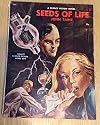
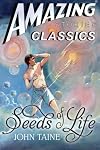
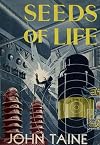
"A superb tale that every lover of science fiction will want to have around. Completely off-trail science fiction-and highly recommended therefore." -Galaxy Science Fiction This amazingly prophetic 1931 novel, which some say inspired Flowers for Algernon (on which the film Charlie was based), is easily the best novel Hugo Gernsback ever published in Amazing Stories. It features characters so mature their like would not be seen again until the post-war sf of the 1950s, and a theme that, in show more its rise and fall, prefigures that of "Flowers for Algernon" and carries it to a level of operatic tragedy not to be equaled until Bester's The Demolished Man. Seeds of Life, in short, is the story of Neils Bork, an alcoholic and failure raised to supernal heights of scientific genius and altruism by a scientific accident. And it is the story of what became of his golden dream of free, limitless energy for all, and of the marriage he thought would be crowned with glorious offspring. "In the unbelievably short period of six years, from 1924 to 1930, John Taine (Professor Eric Temple Bell of California Institute of Technology) drove himself to a unique .position in the science fiction world through the outrageously daring flights of the imagination which are the Taine trademark. Seeds of Life is top-notch Taine. The theme is biological-the sources of life, and of the forces which mold life. An accident remakes the blundering technician, Neils Bork, into the mutant superman, Miguel De Soto, and at the same time sets in motion other processes which attract the attention of Bork's employer, Andrew Crane, and the very competent Dr. Brown. The author keeps several mysteries at the boiling point-what has happened to Bork, to the black widow spider, to Bertha the hen; what is "De Soto's" plot against the mankind he considers degraded and degrading; what, above all, is the theory of evolution and devolution around which the whole book is built?" - Analog Science Fiction. Amazing Stories Classics is proud to bring this landmark work from the pages of the Amazing Stories Quarterly Oct 1931-with all of its original magazine illustrations-back before the reading public. show lessTags
Recommendations






Member Recommendations

Member Reviews
John Taine was a pseudonym for Eric Temple Bell who was a Scottish mathematician, author of a number of non-fiction books and sometime science-fiction writer. Seeds of Life published in 1951 in book form had been written some 20 years earlier and had been serialised in one of the pulp science-fiction magazines (Amazing Stories Quarterly). It is certainly an amazing story of scientists experimenting with X rays; electrically charged that could target certain aspects of mans evolution. An accident in a laboratory enhances the evolution of a lab assistant to the extent that he becomes a brilliant electrical scientist, who then goes to work on experiments that he believes will allow him to control the evolutionary process.
Neils Bork a show more taciturn man of Scandanavian origin is transformed into DR de Soto whose brilliant mind soon elevates him into becoming a leading scientist in his field with the ability to outsmart the money men who hope to profit from his inventions.
The story has several strands, science fiction of course, but there is also horror and social and political themes running through. It reads like a pulp fiction novel, but there are so many ideas bursting through that for once this reader wished that the author had taken more time over the writing. Still it is what it is and a good example of the genre 3.5 stars. show less
Neils Bork a show more taciturn man of Scandanavian origin is transformed into DR de Soto whose brilliant mind soon elevates him into becoming a leading scientist in his field with the ability to outsmart the money men who hope to profit from his inventions.
The story has several strands, science fiction of course, but there is also horror and social and political themes running through. It reads like a pulp fiction novel, but there are so many ideas bursting through that for once this reader wished that the author had taken more time over the writing. Still it is what it is and a good example of the genre 3.5 stars. show less
Originally published in Amazing Stories Quarterly in 1931, it was then released in novel form in 1951 through Fantasy Press in a run of 2,991 books. I read the 1955 edition published by Rich & Cowan.
John Taine is the pseudonym of mathematician Eric Temple Bell, he wrote both fiction & non fiction books, publishing the former under John Taine and the latter under his own name. Seeds of Life is one of the fifteen fiction books he wrote coming in around half way through his writing career.
The story whilst compact at 192 pages, is nonetheless quite a good read, it is set in the surrounds of the Erickson Foundation in a multi million volt electrical laboratory, a disgruntled assistant decides to destroy everything in the laboratory whilst show more simultaneously committing suicide by electrocution. However, rather than killing himself he destroys the laboratory whilst radiating himself with twenty million volts of x-rays leading to a mutation of his cells, and also creating the seeds of life, if you like.
Whilst it's not anything out of the ordinary in terms of early science fiction, I did enjoy it considerably more than some of the other early science fiction I've read and the writing was quite immersive and believably realistic science wise. show less
John Taine is the pseudonym of mathematician Eric Temple Bell, he wrote both fiction & non fiction books, publishing the former under John Taine and the latter under his own name. Seeds of Life is one of the fifteen fiction books he wrote coming in around half way through his writing career.
The story whilst compact at 192 pages, is nonetheless quite a good read, it is set in the surrounds of the Erickson Foundation in a multi million volt electrical laboratory, a disgruntled assistant decides to destroy everything in the laboratory whilst show more simultaneously committing suicide by electrocution. However, rather than killing himself he destroys the laboratory whilst radiating himself with twenty million volts of x-rays leading to a mutation of his cells, and also creating the seeds of life, if you like.
Whilst it's not anything out of the ordinary in terms of early science fiction, I did enjoy it considerably more than some of the other early science fiction I've read and the writing was quite immersive and believably realistic science wise. show less
Ratings
Members
- Recently Added By
Author Information

37+ Works 1,801 Members
Series
Belongs to Publisher Series
Galaxy SF Novel (13)
Work Relationships
Is contained in
Common Knowledge
- Canonical title
- Seeds of Life
- Original title
- Seeds of Life
- Original publication date
- 1931-10-01
- First words
- "Danger."
- Last words
- (Click to show. Warning: May contain spoilers.)Three short convulsive jerks, and the monstrous son expired in the shambles which had been his father.
Classifications
Statistics
- Members
- 49
- Popularity
- 614,207
- Reviews
- 2
- Rating
- (3.42)
- Languages
- English, French
- Media
- Paper, Ebook
- ISBNs
- 3
- ASINs
- 6