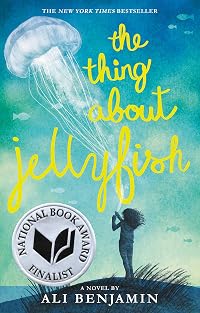
The Thing about Jellyfish
by Ali Benjamin
On This Page
Description
Twelve-year-old Suzy Swanson wades through her intense grief over the loss of her best friend by investigating the rare jellyfish she is convinced was responsible for her friend's death.Tags
Recommendations


Member Reviews
Wow, this is probably the first really good book I've picked up in a long, long while. The style and way of storytelling reminds me of Patrick Ness--and whoever knows me knows I absolutely adorePatrick Ness, so this is high praise indeed.
Book content warnings:
drowning
child death
After her (former) best friend drowns, twelve-year-old Suzanne "Zu" is determined to prove that she died due to the sting of a Irukandji jellyfish.
That's really the barest way to describe the novel, because this is really an exploration of child grief, isolation (and self-isolation) in youth, and a child's way of explaining the world, life, and death.
I wish we could have had confirmation that Zu was autistic, though, because as an autistic person reading this show more book, I was 100% sure she was like me. Growing up, Zu's problems were my problems, and her experiences were achingly similar to my own. But even without this confirmation, her character development and the way she's written is just so well done. I'd give anything for more books with characters like her.
I'm also touched that Zu's brother is LGBT with a boyfriend. Usually with side characters/brothers/best friends who are gay, it's just an add-in to grab some LGBT readers, and I just roll my eyes. But there's something different here, I don't know. There's something about how Zu's brother and his boyfriend are the most supportive characters; there's something about how damn healthy the relationship between her brother and his boyfriend is. It's written with such care and love that I don't mind it's a side relationship. I'm touched that it was included. That . . . never happens!
Anyway, this book taught me many things about life, grief, and jellyfish. I feel like I want to study jellyfish now! In any case, I'm definitely going to look up how I can somehow help jellyfish from taking over the seas. Or maybe get a poster of jellyfish to remind me that, yes, jellyfish are strong. They're forever. And that's pretty damn inspiring. show less
Book content warnings:
drowning
child death
After her (former) best friend drowns, twelve-year-old Suzanne "Zu" is determined to prove that she died due to the sting of a Irukandji jellyfish.
That's really the barest way to describe the novel, because this is really an exploration of child grief, isolation (and self-isolation) in youth, and a child's way of explaining the world, life, and death.
I wish we could have had confirmation that Zu was autistic, though, because as an autistic person reading this show more book, I was 100% sure she was like me. Growing up, Zu's problems were my problems, and her experiences were achingly similar to my own. But even without this confirmation, her character development and the way she's written is just so well done. I'd give anything for more books with characters like her.
I'm also touched that Zu's brother is LGBT with a boyfriend. Usually with side characters/brothers/best friends who are gay, it's just an add-in to grab some LGBT readers, and I just roll my eyes. But there's something different here, I don't know. There's something about how Zu's brother and his boyfriend are the most supportive characters; there's something about how damn healthy the relationship between her brother and his boyfriend is. It's written with such care and love that I don't mind it's a side relationship. I'm touched that it was included. That . . . never happens!
Anyway, this book taught me many things about life, grief, and jellyfish. I feel like I want to study jellyfish now! In any case, I'm definitely going to look up how I can somehow help jellyfish from taking over the seas. Or maybe get a poster of jellyfish to remind me that, yes, jellyfish are strong. They're forever. And that's pretty damn inspiring. show less
A complex meditation on friendship and grief, jellyfish and individuality, regrets and hope. A novel full of heart & science. 12-year old Suzy, reeling from and grappling with the accidental drowning of her ex-best friend, has given up talking while she obsesses over the secret life and facts of jellyfish.
As she works through her grief, we find out that she and her life-long friend had drifted apart in sixth grade--her friend had gone the way of popular girls focusing on looks and boys, while Suzy was still the nerdy, science geek who viewed the world with wonder and naiveté. Their relationship had deteriorated to terrible depths when her friend died, compounding Suzy's grief and guilt.
Suzy slowly emerges from her grief and reconnects show more with the world in a gripping, moving, funny, and courageous journey. show less
As she works through her grief, we find out that she and her life-long friend had drifted apart in sixth grade--her friend had gone the way of popular girls focusing on looks and boys, while Suzy was still the nerdy, science geek who viewed the world with wonder and naiveté. Their relationship had deteriorated to terrible depths when her friend died, compounding Suzy's grief and guilt.
Suzy slowly emerges from her grief and reconnects show more with the world in a gripping, moving, funny, and courageous journey. show less
This review written for the monthly newsletter of The Children's Book and Media Review"
“Jellyfish don't get bogged down by drama, by love or friendship, or sorrow. They don't get stuck in any of the stuff that gets people in trouble.”
When it comes to entertainment, I’m not a crier (real life is an entirely different story). There are only about four books that have made me cry. This is one of them.
After Suzy Swanson’s ex-best friend, Franny Jackson, drowns during the summer before 7th grade, Suzy stops talking. She decides that talking is pointless and stops. When her class goes to the aquarium and she sees a tiny, almost invisible but highly poisonous jellyfish, she is convinced that her friend died because of a jellyfish show more sting. Her whole life starts to focus on proving that it was a jellyfish that killed her friend, and she creates an elaborate plan to run away to Australia to get help from a jellyfish expert there.
The story is told through Suzy’s distinct style and personality. The story has Suzy’s observations about jellyfish as she does research to prove that it was jellyfish that killed her friend, quotes from her science teacher, and flashbacks that explain the history of her friendship with Franny. One of the most beautiful aspects of Suzy’s perspective is that she doesn’t truly understand what’s going on. As she focuses on jellyfish and not-talking, which for her means choosing not to fill the world with useless words, the perceptive reader understands that this is Suzy’s way of mourning the death of her friend and the earlier death of their friendship when Suzy has no power over the situation.
Her preoccupation with these things is what makes the book so heartbreaking. The reader understands why Suzy is doing these things, but Suzy herself does not. She is very much twelve-years-old and learning how confusing the world is. She doesn’t know how to help herself, or even know that she needs help, so she throws herself into not-talking and finding a way to get help from a jellyfish expert. Reading it made my heart ache for her, and when she finally starts to heal and let the people who love her into her life again, I couldn’t help but cry. Even days after I finished reading it, I couldn’t stop thinking about Suzy and her jellyfish.
The well-developed characters, complex emotions, focus on science, and the beautiful way it handles grief will capture the hearts of many of its readers. It is not surprise that The Thing about Jellyfish was nominated for the 2015 National Book Award for Young People's Literature. show less
“Jellyfish don't get bogged down by drama, by love or friendship, or sorrow. They don't get stuck in any of the stuff that gets people in trouble.”
When it comes to entertainment, I’m not a crier (real life is an entirely different story). There are only about four books that have made me cry. This is one of them.
After Suzy Swanson’s ex-best friend, Franny Jackson, drowns during the summer before 7th grade, Suzy stops talking. She decides that talking is pointless and stops. When her class goes to the aquarium and she sees a tiny, almost invisible but highly poisonous jellyfish, she is convinced that her friend died because of a jellyfish show more sting. Her whole life starts to focus on proving that it was a jellyfish that killed her friend, and she creates an elaborate plan to run away to Australia to get help from a jellyfish expert there.
The story is told through Suzy’s distinct style and personality. The story has Suzy’s observations about jellyfish as she does research to prove that it was jellyfish that killed her friend, quotes from her science teacher, and flashbacks that explain the history of her friendship with Franny. One of the most beautiful aspects of Suzy’s perspective is that she doesn’t truly understand what’s going on. As she focuses on jellyfish and not-talking, which for her means choosing not to fill the world with useless words, the perceptive reader understands that this is Suzy’s way of mourning the death of her friend and the earlier death of their friendship when Suzy has no power over the situation.
Her preoccupation with these things is what makes the book so heartbreaking. The reader understands why Suzy is doing these things, but Suzy herself does not. She is very much twelve-years-old and learning how confusing the world is. She doesn’t know how to help herself, or even know that she needs help, so she throws herself into not-talking and finding a way to get help from a jellyfish expert. Reading it made my heart ache for her, and when she finally starts to heal and let the people who love her into her life again, I couldn’t help but cry. Even days after I finished reading it, I couldn’t stop thinking about Suzy and her jellyfish.
The well-developed characters, complex emotions, focus on science, and the beautiful way it handles grief will capture the hearts of many of its readers. It is not surprise that The Thing about Jellyfish was nominated for the 2015 National Book Award for Young People's Literature. show less
This is a fantastic middle school book -- the kind that gets it. Suzanne (Zu, Suzy) Swanson has just started 7th grade with a big shadow -- her former best friend Franny drown at the end of the summer. As a result, she has consciously decided to stop talking: "...I'd started not-talking. Which isn't refusing to talk, like everyone thinks it is. It's just deciding not to fill the world with words if you don't have to. It is the opposite of constant-talking, which is what I used to do, and it's better than small talk, which is what people wished I did." (8) This book is her attempt to reconcile both the death and also how their friendship ended when the summer began. Suzy is the first-person narrator and she definitely has a different show more lens on the world -- a little childish, very literal (maybe on the spectrum?) and extremely intelligent. She alternates between the painful present of not fitting in with her typically cruel classmates and the past of the best moments of her 5 years of friendship with Franny -- until Franny started to change in 6th grade, liking boys and popular girls and knowing how to fit in and ultimately leaving Suzy in the dust. To add to Suzanne's mixed-up life, her parents got divorced around that time. She also has a gay brother who went off to college. Regarding the current state of her life she says: "Sometimes you want things to change so badly, you can't even stand to be in the same room with the way things actually are." Lots of issues to tackle here, none of them too new to this age and genre, but here they are handled so beautifully and poignantly without any of the predictability or treacle that other books rely on. The thing that helps Suzy move forward is jellyfish. "Jellyfish separate the world that was from the world that is....Jellyfish are survivors. They are survivors of everything that ever happened to everyone else." On a school trip to the aquarium (in which she describes her loneliness at being overlooked and forgotten touchingly) she wanders into the jellyfish room and is fascinated by what she sees and learns. True-to-Suzy-form, she gets a little obsessed ("there are 4 to 5 stings every second... twenty-three people are stung within 5 seconds") and begins to research them on her own and becomes convinced there is a link to Franny's death. This also doubles as her science research project and becomes a crazy (cray-cray) quest. Ultimately, she finds peace and understanding and acceptance of herself. One sweet boy, Justin and one true teacher, Mrs. Turton help her on this journey of self-awareness. If only all middle-schoolers could have such guides. I'm trying to decide if this is too young for 8th grade, but the depth would make it appealing -- there is lots of nuance here for a careful reader. Also probably best for 5th grade and up for the same reason. show less
It doesn’t make sense. How could it happen? She’s sick of hearing people say “some things just happen.” It isn’t really a reason. For a scientific thinker like seventh-grader Suzy Swanson, there has to be an explanation. Franny Jackson, her twelve year-old best friend, was an excellent swimmer, so how could she have just drowned? Bit by bit, through many flashbacks interspersed among this novel, we begin to see and understand Franny and Suzy’s relationship, from the idyllic beginning when it was just the two of them, to when it suddenly changes and Franny begins to make other friends. Franny makes many overtures to invite Suzy to join her new group of friends but she continually refuses. Instead, Suzy becomes increasingly show more more lonely, sad, angry and resentful. Vulnerable, grief-stricken, and guilt-ridden after Franny’s death, Suzy desperately searches for logical explanations where there appear to be none. She turns outward--to the jellyfish she discovers on a school field trip to the aquarium. The more she learns about the almost transparent Irukandji jellyfish, the more convinced she becomes that they are the villains, not her. Sometimes there are no answers, just more questions. This powerful book, written for tweens, is about life and all its messiness--family and friends, beginnings and endings, survival and acceptance, embracing love and hope, and letting go and moving on. It is a rewarding read.
show less
Sharyn H. / Marathon County Public Library
Find this book in our library catalog.
The Thing About Jellyfish is a novel about grief, the scientific method, and the wrenching, sudden changes that happen in friendships between elementary and middle school.
Suzy ("Zu" to her mom) has stopped talking after the death of her former best friend, Franny, over the summer between sixth and seventh grade. Franny was a good swimmer, and Suzy is convinced that she wouldn't have just drowned, there must be a reason ("Sometimes things things just happen" does not comfort her). She finds her reason - her hypothesis - during the school trip to the aquarium, where she learns about the Irukandji jellyfish.
For her science class research project, Suzy learns more about jellyfish, believing she can prove to her class that Franny's death show more was caused by a jellyfish sting. She considers reaching out to the experts she finds by e-mail or phone, but decides (improbably) that it will be easier to do face-to-face - even if her chosen expert is in Australia.
Suzy is doubly grieving: for the loss of her childhood friendship with Franny and for Franny's death. She reacts by not-talking - not to her parents, older brother, brother's boyfriend, teacher (who she likes), or therapist - and by searching for answers when really, unfortunately, sometimes things really do just happen. After her big plan fails, Suzy does start to come to terms with what's happened, and even, tentatively, begins a friendship with her science lab partner, a boy called Justin who takes medication for ADHD.
See also: A Mango-Shaped Space; Doll Bones
Quotes
Sometimes you want things to change so badly, you can't even stand to be in the same room with the way things actually are. (12)
There was such a gulf between my insides and outsides, between what was in my heart and what I was putting into the world. (270)
The trick to anything is just believing you can do it. When you believe in your own ability to do something, even something scary, it gives you an almost magic power. Confidence is magic. It can carry you through everything. (285)
Because of Winn-Dixie by Kate DiCamillo in Author's Note show less
Suzy ("Zu" to her mom) has stopped talking after the death of her former best friend, Franny, over the summer between sixth and seventh grade. Franny was a good swimmer, and Suzy is convinced that she wouldn't have just drowned, there must be a reason ("Sometimes things things just happen" does not comfort her). She finds her reason - her hypothesis - during the school trip to the aquarium, where she learns about the Irukandji jellyfish.
For her science class research project, Suzy learns more about jellyfish, believing she can prove to her class that Franny's death show more was caused by a jellyfish sting. She considers reaching out to the experts she finds by e-mail or phone, but decides (improbably) that it will be easier to do face-to-face - even if her chosen expert is in Australia.
Suzy is doubly grieving: for the loss of her childhood friendship with Franny and for Franny's death. She reacts by not-talking - not to her parents, older brother, brother's boyfriend, teacher (who she likes), or therapist - and by searching for answers when really, unfortunately, sometimes things really do just happen. After her big plan fails, Suzy does start to come to terms with what's happened, and even, tentatively, begins a friendship with her science lab partner, a boy called Justin who takes medication for ADHD.
See also: A Mango-Shaped Space; Doll Bones
Quotes
Sometimes you want things to change so badly, you can't even stand to be in the same room with the way things actually are. (12)
There was such a gulf between my insides and outsides, between what was in my heart and what I was putting into the world. (270)
The trick to anything is just believing you can do it. When you believe in your own ability to do something, even something scary, it gives you an almost magic power. Confidence is magic. It can carry you through everything. (285)
Because of Winn-Dixie by Kate DiCamillo in Author's Note show less
Reading, like other things, go in cycles. The Thing About Jellyfish by Ali Benjamin is the first of two books in a row I’ve read about a girl losing her best friend. (The second WhenKaceyLeftis When Kacey Left by Dawn Green.)
Twelve year old Suzy (aka Zu) lost her best friend Franny during the summer. Franny drowned while on vacation. However, Zu can’t come to grips with this because Franny was a great swimmer. She remembers when they met at their first swim class when Zu didn’t want to go into the pool and Franny just plopped in and swam to the other side. Zu then did the same and they became fast friends. Her mother’s explanation that ‘things just happen’ doesn’t quiet her mind.
Zu evaluates all the possible causes of show more Franny’s drowning and comes up with the idea that she was bitten by a poisonous Irukandji jellyfish and her goal now is to prove it. She decided not to talk (because there is nothing important to say) until she’s proven her hypothesis, which of course worried her parents who sent her to ‘the kind of doctor you can talk to.”
But there’s something else bothering Zu as well: she and Franny did not part on good terms. Would it have been different if she had known she’d never see Franny again? Of course, but you can’t change the past.
The Thing About Jellyfish is finely written middle grade book about losing a best friend, about being or becoming a loner, about overcoming loneliness and remembering good times. In the process, Benjamin contemplates the changes middle graders (especially girls) go through, how a loner in elementary school might be part of the ‘in-crowd’ in middle school and what she might do to a best friend to maintain her social status and the impact of her actions.
And finally, Ms. Benjamin imparts a tremendous amount of information about jellyfish that boggled this reader’s mind: their longevity as a species, their lethal venom, their growing population and its impact on other water borne species and their ability to regress in the face of danger.
The Thing About Jellyfish, deservedly, has been getting accolades in all the library journals and The New York Times. It is a tenderhearted story that kids and adults will enjoy. show less
Twelve year old Suzy (aka Zu) lost her best friend Franny during the summer. Franny drowned while on vacation. However, Zu can’t come to grips with this because Franny was a great swimmer. She remembers when they met at their first swim class when Zu didn’t want to go into the pool and Franny just plopped in and swam to the other side. Zu then did the same and they became fast friends. Her mother’s explanation that ‘things just happen’ doesn’t quiet her mind.
Zu evaluates all the possible causes of show more Franny’s drowning and comes up with the idea that she was bitten by a poisonous Irukandji jellyfish and her goal now is to prove it. She decided not to talk (because there is nothing important to say) until she’s proven her hypothesis, which of course worried her parents who sent her to ‘the kind of doctor you can talk to.”
But there’s something else bothering Zu as well: she and Franny did not part on good terms. Would it have been different if she had known she’d never see Franny again? Of course, but you can’t change the past.
The Thing About Jellyfish is finely written middle grade book about losing a best friend, about being or becoming a loner, about overcoming loneliness and remembering good times. In the process, Benjamin contemplates the changes middle graders (especially girls) go through, how a loner in elementary school might be part of the ‘in-crowd’ in middle school and what she might do to a best friend to maintain her social status and the impact of her actions.
And finally, Ms. Benjamin imparts a tremendous amount of information about jellyfish that boggled this reader’s mind: their longevity as a species, their lethal venom, their growing population and its impact on other water borne species and their ability to regress in the face of danger.
The Thing About Jellyfish, deservedly, has been getting accolades in all the library journals and The New York Times. It is a tenderhearted story that kids and adults will enjoy. show less
Members
- Recently Added By
Lists

Carole's List
445 works; 13 members

Research/Inquiry - mentor texts
43 works; 2 members

Books Read in 2016
4,666 works; 197 members

Books Read in 2019
4,052 works; 110 members
Author Information

18 Works 2,284 Members
Ali Benjamin is an award-winning American author. She is best known for her debut novel The Thing about Jellyfish, which was a 2015 National Book Award for Young People's Literature finalist. Benjamin has co-authored several books, including: The Keeper: A life of Saving Goals and Achieving Them, by Tim Howard, Positive: a Memoir by Paige Rawl, show more and The Cleaner Plate Club with Beth Bader. In addition to her published books, her work has appeared in numerous publications, namely Boston Globe Magazine and Martha Stewart's Whole living Online. She was also the sole story researcher and casting director for an hour-long primetime special, Sesame Street: Growing Hope Against Hunger, which won a 2012 Emmy Award. (Bowker Author Biography) show less
Some Editions
Awards and Honors
Awards
Distinctions
Notable Lists
Common Knowledge
- Canonical title
- The Thing about Jellyfish
- Original title
- The thing about jellyfish
- Original publication date
- 2015
- People/Characters
- Suzy Swanson; Franny Jackson; Mrs Turton; Justin
- Important places
- Eugene Field Memorial Middle School
- Dedication
- for curious kids everywhere
- First words
- A jellyfish, if you watch it long enough, begins to look like a heart beating.
- Last words
- (Click to show. Warning: May contain spoilers.)"Yeah," I said to Sarah. "Let's go."
- Original language*
- Engels
*Some information comes from Common Knowledge in other languages. Click "Edit" for more information.
Classifications
- Genres
- Tween, Kids, Fiction and Literature, Children's Books
- DDC/MDS
- 813.6 — Literature & rhetoric American literature in English American fiction in English 2000-
- LCC
- PZ7.1 .B453 .T — Language and Literature Fiction and juvenile belles lettres Fiction and juvenile belles lettres Juvenile belles lettres
- BISAC
Statistics
- Members
- 1,798
- Popularity
- 12,149
- Reviews
- 72
- Rating
- (4.15)
- Languages
- 8 — Chinese, Dutch, English, German, Hungarian, Italian, Spanish, Swedish
- Media
- Paper, Audiobook, Ebook
- ISBNs
- 37
- ASINs
- 4