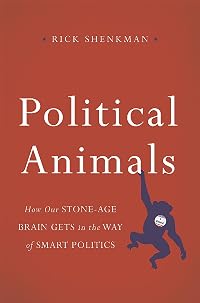
Political Animals: How Our Stone-Age Brain Gets in the Way of Smart Politics
by Richard Shenkman
On This Page
Description
This book "challenges us to go beyond the headlines, which often focus on what politicians do (or say they'll do), and to concentrate instead on what's really important: what shapes our response. Shenkman argues that, contrary to what we tell ourselves, it's our instincts rather than arguments appealing to reason that usually prevail. Pop culture tells us we can trust our instincts, but science is proving that when it comes to politics our Stone-Age brain often malfunctions, misfires, and show more leads us astray"--Dust jacket flap. show lessTags
Recommendations


















Member Reviews
Shenkman offers scientific research to help explain why we make political choices which are neither in our own best interests nor in the best interests of the society and nation as a whole. Many forces within our own psychology contribute to this bad decision making and we are also very much influences by our heredity and upbringing.
The analysis offered in this book rests upon research and surveys explaining many forces not previously factored into evaluating why elections turn out the way they do.
In spite of the quality of the evidence offered here, some is a bit superficial and incomplete with broad conclusions supported by very little evidence. But what is worse, is that many factors that influence elections are ignored. For show more example, what is the impact on the national consciousness of the constant distortion of facts and events be a certain "news" (re: propaganda) network?
The book's final section deals with 'lack of empathy" and probably understates the impact of this characteristic in determining our votes and our actions. For example, feeling sympathy for someone who is homeless or afflicted by a disease or addition is not the same as understanding their situation with empathy. Sympathy places the one who is sympathetic in a position of believed moral superiority over the other, the victim, while having empathy places the empathic person in a position of wanting to feel, think, and share the burden of the other person. Americans are sympathetic to the Syrian refugees, for example, but empathy would compel us to act.
Moreover, there is a strong mismatch between what people genuinely believe they believe and value and the behaviors those beliefs ought to influence. A person believes in honesty, for example, but brings home office supplies from work; or, more drastically, believes in honesty and justifies "calling in sick" as merely a "lie that everyone tells," rather than seeing it for what it really is: stealing a day's wages through dishonesty.
The book raises moral and ethical questions, but mainly focuses on the explanations of why our thinking is so shallow and decisions so poor. It is a good read and eye opening, but its explanations and analysis is incomplete. show less
The analysis offered in this book rests upon research and surveys explaining many forces not previously factored into evaluating why elections turn out the way they do.
In spite of the quality of the evidence offered here, some is a bit superficial and incomplete with broad conclusions supported by very little evidence. But what is worse, is that many factors that influence elections are ignored. For show more example, what is the impact on the national consciousness of the constant distortion of facts and events be a certain "news" (re: propaganda) network?
The book's final section deals with 'lack of empathy" and probably understates the impact of this characteristic in determining our votes and our actions. For example, feeling sympathy for someone who is homeless or afflicted by a disease or addition is not the same as understanding their situation with empathy. Sympathy places the one who is sympathetic in a position of believed moral superiority over the other, the victim, while having empathy places the empathic person in a position of wanting to feel, think, and share the burden of the other person. Americans are sympathetic to the Syrian refugees, for example, but empathy would compel us to act.
Moreover, there is a strong mismatch between what people genuinely believe they believe and value and the behaviors those beliefs ought to influence. A person believes in honesty, for example, but brings home office supplies from work; or, more drastically, believes in honesty and justifies "calling in sick" as merely a "lie that everyone tells," rather than seeing it for what it really is: stealing a day's wages through dishonesty.
The book raises moral and ethical questions, but mainly focuses on the explanations of why our thinking is so shallow and decisions so poor. It is a good read and eye opening, but its explanations and analysis is incomplete. show less
Shenkman offers scientific research to help explain why we make political choices which are neither in our own best interests nor in the best interests of the society and nation as a whole. Many forces within our own psychology contribute to this bad decision making and we are also very much influences by our heredity and upbringing.
The analysis offered in this book rests upon research and surveys explaining many forces not previously factored into evaluating why elections turn out the way they do.
In spite of the quality of the evidence offered here, some is a bit superficial and incomplete with broad conclusions supported by very little evidence. But what is worse, is that many factors that influence elections are ignored. For show more example, what is the impact on the national consciousness of the constant distortion of facts and events be a certain "news" (re: propaganda) network?
The book's final section deals with 'lack of empathy" and probably understates the impact of this characteristic in determining our votes and our actions. For example, feeling sympathy for someone who is homeless or afflicted by a disease or addition is not the same as understanding their situation with empathy. Sympathy places the one who is sympathetic in a position of believed moral superiority over the other, the victim, while having empathy places the empathic person in a position of wanting to feel, think, and share the burden of the other person. Americans are sympathetic to the Syrian refugees, for example, but empathy would compel us to act.
Moreover, there is a strong mismatch between what people genuinely believe they believe and value and the behaviors those beliefs ought to influence. A person believes in honesty, for example, but brings home office supplies from work; or, more drastically, believes in honesty and justifies "calling in sick" as merely a "lie that everyone tells," rather than seeing it for what it really is: stealing a day's wages through dishonesty.
The book raises moral and ethical questions, but mainly focuses on the explanations of why our thinking is so shallow and decisions so poor. It is a good read and eye opening, but its explanations and analysis is incomplete. show less
The analysis offered in this book rests upon research and surveys explaining many forces not previously factored into evaluating why elections turn out the way they do.
In spite of the quality of the evidence offered here, some is a bit superficial and incomplete with broad conclusions supported by very little evidence. But what is worse, is that many factors that influence elections are ignored. For show more example, what is the impact on the national consciousness of the constant distortion of facts and events be a certain "news" (re: propaganda) network?
The book's final section deals with 'lack of empathy" and probably understates the impact of this characteristic in determining our votes and our actions. For example, feeling sympathy for someone who is homeless or afflicted by a disease or addition is not the same as understanding their situation with empathy. Sympathy places the one who is sympathetic in a position of believed moral superiority over the other, the victim, while having empathy places the empathic person in a position of wanting to feel, think, and share the burden of the other person. Americans are sympathetic to the Syrian refugees, for example, but empathy would compel us to act.
Moreover, there is a strong mismatch between what people genuinely believe they believe and value and the behaviors those beliefs ought to influence. A person believes in honesty, for example, but brings home office supplies from work; or, more drastically, believes in honesty and justifies "calling in sick" as merely a "lie that everyone tells," rather than seeing it for what it really is: stealing a day's wages through dishonesty.
The book raises moral and ethical questions, but mainly focuses on the explanations of why our thinking is so shallow and decisions so poor. It is a good read and eye opening, but its explanations and analysis is incomplete. show less
People are overly reliant on their peers in guiding their political views. Most of us are less likely to read a story with a position that we oppose. We have less personal interaction with our politicians and rely on television ads and news snippets to guide our views. Then add in human biases. No wonder we can't figure out who to vote for.
Ratings
Members
- Recently Added By
Lists

Recommended Election Year Reads
9 works; 1 member
Author Information

11 Works 2,113 Members
Classifications
- Genres
- Nonfiction, Politics and Government, General Nonfiction, Sociology, Philosophy, Science & Nature
- DDC/MDS
- 320.01 — Society, government, & culture Political science Types of Government Political Science Philosophy and Theory
- LCC
- JK1726 .S54 — Political Science Political institutions and public administration (United States) Political institutions and public administration United States Political rights. Practical politics
- BISAC
Statistics
- Members
- 58
- Popularity
- 530,542
- Reviews
- 3
- Rating
- (3.31)
- Languages
- English
- Media
- Paper, Audiobook, Ebook
- ISBNs
- 6