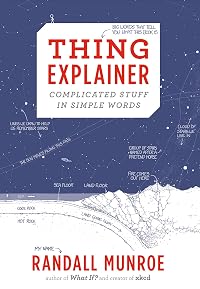
Thing Explainer: Complicated Stuff in Simple Words
by Randall Munroe
On This Page
Description
The creator of the popular webcomic "xkcd" uses line drawings and common words to provide simple explanations for how things work, including microwaves, bridges, tectonic plates, the solar system, the periodic table, helicopters, and other essential concepts.Tags
Recommendations









Member Reviews
We all have one, that person we'd prefer to get along with, but every time they open their mouth, so much stupid erupts that low-level irritation shifts into rage (there's a certain political figure that I react to every time).
That about sums up my experience with Thing Explainer.
Every time I picked it up intending to read a few cartoons explaining concepts like helicopters, the cell, elevators, or the auto engine, I'd end up either generally annoyed or quite specifically angry. Thing Explainer fails on so many levels for me, it was shocking. I went into it hoping for the grown-up version of [b:Charlie Brown's Super Book of Questions and Answers about All Kinds of Animals ... from Snails to People!: Based on the Charles M. Schulz show more Characters|625877|Charlie Brown's Super Book of Questions and Answers about All Kinds of Animals ... from Snails to People!|Charles M. Schulz|https://i.gr-assets.com/images/S/compressed.photo.goodreads.com/books/1217209308l/625877._SX50_.jpg|612230] and instead found cartoon explanations of things I still don't understand, such as how all the parts of a car work together. I understand that it was supposed to be funny, but I was hoping for informative as well.
It wasn't.
Language is meant to communicate ideas. Generally, more complex ideas require more specific words to convey meaning. Remember when you last talked to a two or three year-old and everything with four legs was a 'dog,' everything that flew was a 'bird' and every time someone cried they must be 'sad?' When we are just beginning to understand that words represent things and concepts, simple language suffices, but as we grow in age and sophistication, we learn words can be more specific in representing object and idea. The more we grow in experiences and want to convey information with accuracy, the more we need that vocabulary.
But specificity does not have to equal incomprehensible. For instance, in explaining what leukemia is to someone who was just diagnosed, I first had to teach about red blood cells, white blood cells and platelets. I taught these common terms, so that we all understood what it would mean when the nurse says, "your red blood cells are low and you need a transfusion." To explain, I didn't have to use vocabulary like 'erythrocytes,' 'leukeocytes' and 'thrombocytes;' simple descriptions such as "white blood cells fight off infection" and analogies like "soldiers fighting against an enemy" explain without being incomprehensible. But the terms 'cells,' 'transfusion,' 'infection,' 'red,' and 'white' are non-negotiable in learning the concepts related to blood. You have to understand them to understand communication about body processes.
I tested Thing Explainer on something I know: Cells. In the book, our body's cells are reduced to 'Bags of Water.' Inside the bags of water are other bags such as the 'bag filler,' the 'bags of death water,' 'bag shapers,' 'little builders,' and 'empty pockets.'
I found myself mentally trying to translate his terms into appropriate terminology: nuclei, mitochondria, lysosomes and Golgi apparatus, except I ended up irritated because endoplasmic reticulum and ribosomes sound alike with his description and I couldn't remember what Golgi bodies do. How is this even helpful? How does this help anyone understand the cell? DNA? Cancer? Genetics? It doesn't.
I tested it on something I didn't know: the automobile engine. "The Fire box computer watches how the fire box is working, and decides how much fire water to add to the air it sends in." Did this help? No. As he used the same words to explain its as to describe it, it's a useless explanation, like describing a circle as a 'round shape.'
There were occasional exceptions. The periodic table of elements was mildly amusing with descriptions like "green burning air that kills," "air in bright signs made from colored light," "the rock that makes up beaches, glass and computer brains," and at the end, "stuff that lasts for the time it takes you to close and open your eyes." However, for it to be funny, you have to know the table and elements off the top of your head. So, not so much for almost everyone.
It took me a lot of reflection to pinpoint the source of my rage: while Munroe disingenuously suggests that he is explaining "complicated concepts in simple words," he does so in such a way that the reader needs to understand the concept well to interpret his illustrations. This approach simultaneously insults the person who doesn't understand using the illusion of 'common words,' while creating an in-joke for people knowledgeable about those concepts.
The other reason it made me angry is my impression that like many people, Munroe is confusing 'complex' with 'incomprehensible' or 'pretentious.' He gives it away in the forward ("Page Before the Book Starts") when he says "I was really just worried that if I used the small words, someone might think I didn't know the big ones." A truly gifted person would be able to communicate with clarity instead of relying on circuitous explanations and false construction of word limits (he includes his personal emails in his source for the "1000 most common words"). Instead of actually communicating, what he did is replacement code sophisticated concepts into simple words, so to understand his comic, one mentally replaces 'fire box' with 'engine.' Really, the opposite of explaining things: he would have done just as well to use symbols (which is what he ends up doing for the evolutionary tree). Except it is supposed to be funny when the reader knows the replacement code.
I'm not laughing. This is one of those rare books that if I could give negative stars, I would. show less
That about sums up my experience with Thing Explainer.
Every time I picked it up intending to read a few cartoons explaining concepts like helicopters, the cell, elevators, or the auto engine, I'd end up either generally annoyed or quite specifically angry. Thing Explainer fails on so many levels for me, it was shocking. I went into it hoping for the grown-up version of [b:Charlie Brown's Super Book of Questions and Answers about All Kinds of Animals ... from Snails to People!: Based on the Charles M. Schulz show more Characters|625877|Charlie Brown's Super Book of Questions and Answers about All Kinds of Animals ... from Snails to People!|Charles M. Schulz|https://i.gr-assets.com/images/S/compressed.photo.goodreads.com/books/1217209308l/625877._SX50_.jpg|612230] and instead found cartoon explanations of things I still don't understand, such as how all the parts of a car work together. I understand that it was supposed to be funny, but I was hoping for informative as well.
It wasn't.
Language is meant to communicate ideas. Generally, more complex ideas require more specific words to convey meaning. Remember when you last talked to a two or three year-old and everything with four legs was a 'dog,' everything that flew was a 'bird' and every time someone cried they must be 'sad?' When we are just beginning to understand that words represent things and concepts, simple language suffices, but as we grow in age and sophistication, we learn words can be more specific in representing object and idea. The more we grow in experiences and want to convey information with accuracy, the more we need that vocabulary.
But specificity does not have to equal incomprehensible. For instance, in explaining what leukemia is to someone who was just diagnosed, I first had to teach about red blood cells, white blood cells and platelets. I taught these common terms, so that we all understood what it would mean when the nurse says, "your red blood cells are low and you need a transfusion." To explain, I didn't have to use vocabulary like 'erythrocytes,' 'leukeocytes' and 'thrombocytes;' simple descriptions such as "white blood cells fight off infection" and analogies like "soldiers fighting against an enemy" explain without being incomprehensible. But the terms 'cells,' 'transfusion,' 'infection,' 'red,' and 'white' are non-negotiable in learning the concepts related to blood. You have to understand them to understand communication about body processes.
I tested Thing Explainer on something I know: Cells. In the book, our body's cells are reduced to 'Bags of Water.' Inside the bags of water are other bags such as the 'bag filler,' the 'bags of death water,' 'bag shapers,' 'little builders,' and 'empty pockets.'
I found myself mentally trying to translate his terms into appropriate terminology: nuclei, mitochondria, lysosomes and Golgi apparatus, except I ended up irritated because endoplasmic reticulum and ribosomes sound alike with his description and I couldn't remember what Golgi bodies do. How is this even helpful? How does this help anyone understand the cell? DNA? Cancer? Genetics? It doesn't.
I tested it on something I didn't know: the automobile engine. "The Fire box computer watches how the fire box is working, and decides how much fire water to add to the air it sends in." Did this help? No. As he used the same words to explain its as to describe it, it's a useless explanation, like describing a circle as a 'round shape.'
There were occasional exceptions. The periodic table of elements was mildly amusing with descriptions like "green burning air that kills," "air in bright signs made from colored light," "the rock that makes up beaches, glass and computer brains," and at the end, "stuff that lasts for the time it takes you to close and open your eyes." However, for it to be funny, you have to know the table and elements off the top of your head. So, not so much for almost everyone.
It took me a lot of reflection to pinpoint the source of my rage: while Munroe disingenuously suggests that he is explaining "complicated concepts in simple words," he does so in such a way that the reader needs to understand the concept well to interpret his illustrations. This approach simultaneously insults the person who doesn't understand using the illusion of 'common words,' while creating an in-joke for people knowledgeable about those concepts.
The other reason it made me angry is my impression that like many people, Munroe is confusing 'complex' with 'incomprehensible' or 'pretentious.' He gives it away in the forward ("Page Before the Book Starts") when he says "I was really just worried that if I used the small words, someone might think I didn't know the big ones." A truly gifted person would be able to communicate with clarity instead of relying on circuitous explanations and false construction of word limits (he includes his personal emails in his source for the "1000 most common words"). Instead of actually communicating, what he did is replacement code sophisticated concepts into simple words, so to understand his comic, one mentally replaces 'fire box' with 'engine.' Really, the opposite of explaining things: he would have done just as well to use symbols (which is what he ends up doing for the evolutionary tree). Except it is supposed to be funny when the reader knows the replacement code.
I'm not laughing. This is one of those rare books that if I could give negative stars, I would. show less
Randall Munroe (best known for the brilliant webcomic xkcd) sets out to explain lots of complicated things using only the 1,000 most common words in the English language and some awesome line drawings. They're genuinely complicated things, too, from the periodic table of the elements, to what's inside your laptop computer or under your car's hood, to how a nuclear power plant works. Needless to say, the explanations are simple and kind of limited, but a lot less so than you'd think. You won't learn any of the technical names for things, but you may, in fact, learn a lot of other stuff. And the simplified language is bizarrely appealing. A lot of the names and descriptions he comes up with are clever, charming, and funny. (And he doesn't show more let being limited to a thousand word vocabulary keep him from making some good jokes, either.) More than that, I found it got me to actually stop and think about the things being described and their functions much more than just giving them their proper names would have. It made for a really fun, interesting change of perspective. show less
hilarious! delightful! i love it and i love you, randall monroe!! the reverse-engineering of things like "bags of death water" and "part after eight" the book makes you do is only part of the joy of seeing things you understand or don't understand explained in brilliantly imaginative new ways, accompanied by trademark xkcd-style comics (though i wish there were more!) and anecdotal jokes.
This must have been a bitch to edit.
I bought this sight unseen (or asked for it on my xmas list anyway) based on my adoration for his first book What If? Thing Explainer is much shorter - only 60 pages - and the concept is very cool; explain how some of the most common things work.
What I didn't realise is that Munroe went into this book determined to use only the "top 10 hundred" words used in the English language (he determined this based on a number of factors, which he explains at the end of the book, in the section where he lists all the words). He explains why he chose to do this at the beginning of the book.
I love the concept and it doesn't sound like that big a deal on the surface of it; until you actually try to read how, show more say, a dishwasher works and it's titled "Box that Cleans Food Holders" or the page that explains how the "Big Tiny Thing Hitter" works (that's a particle collider to you and I). It's sort of fun trying to figure out what some of the entries are but reading the whole thing becomes rather tedious and ultimately I skimmed through it, reading bits here and there and laughing at the little comic asides that make me such a fan of Munroe. Some of the entries though, would be a great start at explaining some of the easier concepts to small kids (there's an entry for a tree, for example). I especially love his explanation of the Constitution of the United States.
Ultimately, it's a fun book, but I would have loved this book had he written it in this same style, but didn't try to limit himself to just the 1000 most common words (which oddly enough do not include "nine"). show less
I bought this sight unseen (or asked for it on my xmas list anyway) based on my adoration for his first book What If? Thing Explainer is much shorter - only 60 pages - and the concept is very cool; explain how some of the most common things work.
What I didn't realise is that Munroe went into this book determined to use only the "top 10 hundred" words used in the English language (he determined this based on a number of factors, which he explains at the end of the book, in the section where he lists all the words). He explains why he chose to do this at the beginning of the book.
I love the concept and it doesn't sound like that big a deal on the surface of it; until you actually try to read how, show more say, a dishwasher works and it's titled "Box that Cleans Food Holders" or the page that explains how the "Big Tiny Thing Hitter" works (that's a particle collider to you and I). It's sort of fun trying to figure out what some of the entries are but reading the whole thing becomes rather tedious and ultimately I skimmed through it, reading bits here and there and laughing at the little comic asides that make me such a fan of Munroe. Some of the entries though, would be a great start at explaining some of the easier concepts to small kids (there's an entry for a tree, for example). I especially love his explanation of the Constitution of the United States.
Ultimately, it's a fun book, but I would have loved this book had he written it in this same style, but didn't try to limit himself to just the 1000 most common words (which oddly enough do not include "nine"). show less
I didn't devour this like I did What If? – in fact if the date started on Goodreads is anything to go by, it took me just over a year to read.
But I've enjoyed dipping in and out of this over the last 12 months; the simplification of language does get a bit much if you push on through too many pages in one go – and when it gets to something you might actually be familiar with, the gag can actually serve to obscure the meaning.
That said, the conceit is great, I learnt a lot (my favourite entry is the slightly left-field one on the US Constitution) and the gags are as cleverly stupid as you'd expect from Randall Munroe ("If it starts pointing toward space you are having a bad problem and you will not go to space today", indeed).
But I've enjoyed dipping in and out of this over the last 12 months; the simplification of language does get a bit much if you push on through too many pages in one go – and when it gets to something you might actually be familiar with, the gag can actually serve to obscure the meaning.
That said, the conceit is great, I learnt a lot (my favourite entry is the slightly left-field one on the US Constitution) and the gags are as cleverly stupid as you'd expect from Randall Munroe ("If it starts pointing toward space you are having a bad problem and you will not go to space today", indeed).
I respect Munroe’s premise here: explore complicated things (from science to machines) using only drawings and a thousand (“ten hundred”) common words. He doesn’t explain much, he mostly labels the parts (i.e. it’s more anatomy than physiology). And via that premise, the labels are never the actual names, so with topics I wasn’t familiar with I mostly 1) wondered what he was talking about and 2) wished I knew the thing’s actual name so I could google it and learn about it on my own. (For example: “{room of} water that keeps the {sky toucher} from falling over”; from his illustration, I conceived some appropriate nouns and when I googled “skyscraper ballast,” I got some relevant hits.) The periodic table of the show more elements is a hot mess.
I appreciated Munroe’s positivity and playfulness and tried to play along. A few times, I noticed my brain twisting to unlearn something and to grasp the simplicity of a thing, and I thought that might be good for it. I rated the book 3.5 stars but I liked it a lot less. show less
I appreciated Munroe’s positivity and playfulness and tried to play along. A few times, I noticed my brain twisting to unlearn something and to grasp the simplicity of a thing, and I thought that might be good for it. I rated the book 3.5 stars but I liked it a lot less. show less
This is both a great book, and a frustrating book. The highly detailed illustrations were wonderful, the stick figure comments were as always, lots of fun. But - its frustrating. For example, as someone who has a good idea of how a cell works, I couldn't figure out just what everything was! But, on things that I had absolutely no knowledge on, such as the Nuclear Plant, it was great, because it totally made sense, without all the big words.
It was fun to figure out what the different parts of things were actually called - but at times, it was described too simply. Of course, this isn't a book meant to meant to teach people about how things work with the correct terminology.
It was fun to figure out what the different parts of things were actually called - but at times, it was described too simply. Of course, this isn't a book meant to meant to teach people about how things work with the correct terminology.
Members
- Recently Added By
Lists

Top Five Books of 2021
604 works; 181 members

Houghton Mifflin Harcourt
45 works; 1 member
Author Information

12+ Works 15,934 Members
Randall Munroe was born in Easton, Pennsylvania on October 17, 1984. He received a degree in physics from Christopher Newport University. He got a job building robots at NASA Langley Research Center. In 2006, he left NASA to draw comics on the internet full-time. He is the author of the popular webcomic xkcd, the science question-and-answer blog show more What If, and the New York Times bestseller What If?: Serious Scientific Answers to Absurd Hypothetical Questions. (Bowker Author Biography) show less
Some Editions
Awards and Honors
Distinctions
Notable Lists
Work Relationships
Common Knowledge
- Canonical title
- Thing Explainer: Complicated Stuff in Simple Words
- Original title
- Thing Explainer: Complicated Stuff in Simple Words
- Original publication date
- 2015
- First words
- Hi! This is a book of pictures and simple words.
- Last words
- (Click to show. Warning: May contain spoilers.)Next to the world we're talking about, all our words are small.
- Original language
- English US
Classifications
Statistics
- Members
- 2,542
- Popularity
- 7,526
- Reviews
- 38
- Rating
- (3.97)
- Languages
- 9 — Czech, Dutch, English, German, Polish, Spanish, Swedish, Portuguese (Portugal), Chinese, traditional
- Media
- Paper, Ebook
- ISBNs
- 14
- ASINs
- 4