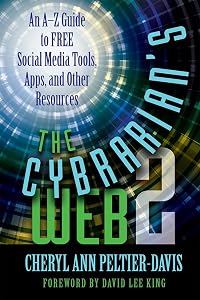
The Cybrarian's Web 2: An A-Z Guide to Free Social Media Tools, Apps, and Other Resources
by Cheryl Ann Peltier-Davis
On This Page
Description
In volume 2 of her popular guide, Cheryl Ann Peltier-Davis presents more that 60 free tech tools and demonstrates their successful use in libraries and information centers.Tags
Recommendations


Member Reviews
Although I remain generally skeptical of print books that are essentially webliographies (how long before their out of date? what features will change or disappear?) this book was more useful than I initially believed. The sites and apps are not all completely familiar... I feel like the first book in this series would've been entirely too basic or obvious...and I did discover a few sites I'd like to use professionally. The FREE on the cover should be asterisked... several sites have a free trial version or a very limited version, but for professional use one would likely need the paid version. I did feel that the section of each chapter about applicability to libraries was sometimes strained at best, or gave simplistic examplars of the show more tool being used in the field. show less
 This review was written for LibraryThing Early Reviewers.
My second book from Library Thing's Early Reviewers program is The Cybrarian's Web 2 ~ An A-Z Guide to Free Social Media Tools, Apps and Other Resources by Cheryl Ann Peltier-Davis. This is the second book on this topic by the author, who is also the Digital Initiatives, Cataloguing and Metadata Services Librarian at the Alma Jordan Library at the University of the West Indies, St. Augustine, Trinidad and Tobago, so this is obviously information she works with every day.
In the introduction she shares her goals in compiling this book, and I'll quote here:
". . . to offer an 'environmental scan' of available eresources and to methodically identify, select, and evaluate tools that information professionals can introduce and integrate into show more their workspaces, communities, and even their personal lives."
As the host of a blog devoted to finding free resources for writers I know how much time it takes to track down, investigate and even test drive free software, services and online tools; I've been doing it for ten years. It's definitely a lot of work. The payoff is sharing the information with other users who need these resources but can't afford to pay for them -- and this includes but is not limited to not-yet-published writers, students, the unemployed or underemployed, folks on fixed incomes etc. Since these folks are usually also regular patrons of public libraries, the information in Ms. Peltier-Davis's book can enable librarians and media specialists to do the same with this reference.
The book contains over sixty unique resources arranged alphabetically and also by website, type of service, and those available for mobile devices in the back of the book appendixes. The author covers each resource with website URLs, a detailed overview of the free services and each service's particular features. She then discusses in depth how information professionals can effectively use the resource in one or more ways. There are also scattered through the book little FYI boxes with more information, background notes and important tips.
How valuable are these resources? I'll give you not one but two examples: After the problems I've had with Google Docs I've been looking for a low-cost, no-hassle service to host my free e-book library and my weekly Just Write stories. In fact, I've been looking since December with no luck. Then I read this book and found a free hosting service to do that on page 111. I'd never heard of this service before, either, but when I went to check it out it appeared to be exactly what I need. Then my daughter came to me to ask if I knew of a web site for free online courses for a friend of hers who needs to brush up on her maths, and that was on page 33 of the book.
I rarely use the words must-have in relation to any book, but The Cybrarian's Web 2 is a reference that should be owned by every library and school out there, not only to help the professionals provide better services but to make available the kind of free eresources that are needed by so many of their patrons and students. show less
In the introduction she shares her goals in compiling this book, and I'll quote here:
". . . to offer an 'environmental scan' of available eresources and to methodically identify, select, and evaluate tools that information professionals can introduce and integrate into show more their workspaces, communities, and even their personal lives."
As the host of a blog devoted to finding free resources for writers I know how much time it takes to track down, investigate and even test drive free software, services and online tools; I've been doing it for ten years. It's definitely a lot of work. The payoff is sharing the information with other users who need these resources but can't afford to pay for them -- and this includes but is not limited to not-yet-published writers, students, the unemployed or underemployed, folks on fixed incomes etc. Since these folks are usually also regular patrons of public libraries, the information in Ms. Peltier-Davis's book can enable librarians and media specialists to do the same with this reference.
The book contains over sixty unique resources arranged alphabetically and also by website, type of service, and those available for mobile devices in the back of the book appendixes. The author covers each resource with website URLs, a detailed overview of the free services and each service's particular features. She then discusses in depth how information professionals can effectively use the resource in one or more ways. There are also scattered through the book little FYI boxes with more information, background notes and important tips.
How valuable are these resources? I'll give you not one but two examples: After the problems I've had with Google Docs I've been looking for a low-cost, no-hassle service to host my free e-book library and my weekly Just Write stories. In fact, I've been looking since December with no luck. Then I read this book and found a free hosting service to do that on page 111. I'd never heard of this service before, either, but when I went to check it out it appeared to be exactly what I need. Then my daughter came to me to ask if I knew of a web site for free online courses for a friend of hers who needs to brush up on her maths, and that was on page 33 of the book.
I rarely use the words must-have in relation to any book, but The Cybrarian's Web 2 is a reference that should be owned by every library and school out there, not only to help the professionals provide better services but to make available the kind of free eresources that are needed by so many of their patrons and students. show less
This review was written for LibraryThing Early Reviewers.Here was my review of volume 1: I love handy websites and was quite excited to receive this book. Unfortunately the list was not as handy as I had hoped. I was already aware of a lot of the websites mentioned and there were less "tools" than I would have liked. I'm afraid this book is not really ahead of its time and I can see it becoming quickly outdated. I would not recommend adding this to a librarian's arsenal of resources, but instead bookmark the web counterpart and check it every once in awhile.
So, why did I request volume 2? I'm a sucker for librarian reference books and I love e-resources. I can't help it. Was this one better? It felt on par with volume 1 to be honest. There were a lot of things here I had already heard of show more again - Pinterest, Code Academy, Instagram. I wish it would dig down deeper and have things that are cutting edge, but that is the problem with technology. By the time you go to print with a book the "newness" of it has worn off and everyone has moved on to the next thing. This would be useful for folks dipping their toes into e-resources, but experienced Web users won't find much here. show less
So, why did I request volume 2? I'm a sucker for librarian reference books and I love e-resources. I can't help it. Was this one better? It felt on par with volume 1 to be honest. There were a lot of things here I had already heard of show more again - Pinterest, Code Academy, Instagram. I wish it would dig down deeper and have things that are cutting edge, but that is the problem with technology. By the time you go to print with a book the "newness" of it has worn off and everyone has moved on to the next thing. This would be useful for folks dipping their toes into e-resources, but experienced Web users won't find much here. show less
This review was written for LibraryThing Early Reviewers.This is a useful resource for anyone who wants some new ideas about how to use online tools for education. As a Teacher Librarian, I find this book to be useful; each chapter is dedicated to a different online tool, almost all of them free. The chapters begin with an overview of the tool, which talks a little about how it works and how it was started. The overview also usually gives some comparisons to similar tools. After the overview, the chapters then give some tips about how to use the tool, and some specific ideas for "cybrarians" to use the tool. While the ideas are mainly focused on public libraries, I can still find good use for school applications as well. I would have liked to have seen a little more for education, rather than show more so much emphasis on social media-type tools. I was also a little disappointed in the fact that the chapter about TED.com had almost a sub point about TED-ed; that deserves a chapter all of its own! But overall, this is a good resource to get new ideas for new tools. It isn't in-depth, so if you are familiar with the tools mentioned, it may not give too much more as far as new ideas to use them. I will be using this book this coming school year to find new ways to help the teachers in my building incorporate technology in their classes. show less
This review was written for LibraryThing Early Reviewers.Extremely useful in its organization and reference to web tools of all kinds in use by librarians and libraries - specifically as these tools relate to services to patrons. Though an engaged librarian might already be aware of many of the applications and URLs mentioned in the book, this book, because of its simplicity, is a worthwhile reference and reminder for librarians in direct user and patron services because just because we might know of something, does not mean we actually use that thing. People, generally, are using many more web tools than any one librarian will know. For this, this book is handy. Thank you Cheryl Ann Peltier-Davis.
This review was written for LibraryThing Early Reviewers.The Cybrarian's Web includes overviews and usage tips, generally 2-3 pages each, for 101 websites and web tools. The scope of coverage includes A/V creation and sharing services, blogs, digital library and publishing software, ILS software, information aggregators, productivity tools, reference sites, search engines, social networking and bookmarking sites, web design tools, and wiki software. If you want to learn about the plethora of tools available, learn about new tools, or even just explore the difference between providers of similar services, this book will help you! (However, like any book about the Internet or computer science, it will quickly become dated.)
This review was written for LibraryThing Early Reviewers.I won this copy from Early Reviewers but I didn't choose it, so this review comes from someone who didn't want the book, has no use for the info, and isn't interested in the topic at all.
As the title indicates, this book is geared toward cybrarians and is a second edition. A few of the free resources it lists are Flipboard, Google Drive, Google Hangouts, Instagram, Kickstarter, Pinterest, Smashwords, Snapchat, and Tumblr. Each item is introduced with an overview explaining what it is, what it does, and how long it's been around. Then there is a description of features, and finally a short explanation of how a cybrarian could use the tool. Pretty concise and basic, each entry comprises roughly 4 pages and includes screenshots.
I would show more imagine this would be most useful to someone just entering the field as a cybrarian or someone who has very little experience with an online presence. However, the book apparently retails for $49.50, but with a little common sense and a quick Google search, you could get this info for free. show less
As the title indicates, this book is geared toward cybrarians and is a second edition. A few of the free resources it lists are Flipboard, Google Drive, Google Hangouts, Instagram, Kickstarter, Pinterest, Smashwords, Snapchat, and Tumblr. Each item is introduced with an overview explaining what it is, what it does, and how long it's been around. Then there is a description of features, and finally a short explanation of how a cybrarian could use the tool. Pretty concise and basic, each entry comprises roughly 4 pages and includes screenshots.
I would show more imagine this would be most useful to someone just entering the field as a cybrarian or someone who has very little experience with an online presence. However, the book apparently retails for $49.50, but with a little common sense and a quick Google search, you could get this info for free. show less
This review was written for LibraryThing Early Reviewers.Members
- Recently Added By
Author Information
4 Works 79 Members
Classifications
- Genres
- Nonfiction, Technology, Reference, Tween
- DDC/MDS
- 025.0422 — Computer science, information & general works Library & information sciences Administration; Departments Information storage and retrieval systems World Wide Web
- LCC
- ZA4225 .P44 — Bibliography, Library Science and Information Resources Information resources/materials Information resources (General) Information in specific formats or media Electronic information resources Computer network resources
Statistics
- Members
- 25
- Popularity
- 1,071,286
- Reviews
- 8
- Rating
- (3.25)
- Languages
- English
- Media
- Paper, Ebook
- ISBNs
- 2